Across the Upper Xingu, bullroarers link fish-shaped bodies, shared names and the pequi harvest. Mehinaku, Wauja, Kamayurá and Trumai accounts place them in exchanges among people, spirits and fruit trees, while older Nahukuá demonstrations and painted toys show the same instrument moving through public village life.
A painted fish turns above the village plaza, and its wooden body becomes a voice. In the Upper Xingu, that voice belongs to a world of visiting ceremonies, traded objects and obligations to the beings who keep people and food plants alive. The bullroarer connects several languages and several kinds of gathering: an orchard festival, a cure repaid with food, a joint rite between villages, a mask dance or a child’s game. 1, 2, 4, 3
The rivers joining the headwaters also join communities whose languages belong to different families. Kalervo Oberg, working there in 1948, described intermarriage, trade and visits for ceremonies among these neighbours. A Yawalapiti man could speak both Kuikuro and Kamayurá; other people knew enough of neighbouring languages to trade and take part in rites. The shared village form put large houses around a plaza with a flute house at its centre. Bullroarers, sacred flutes, fish and cultivated pequi trees belonged to this common setting. 1
The Trumai remembered the connection as a journey. Before going to the Kamayurá village, they danced in their own; at their hosts’ village they performed acts women could not see. By Buell Quain’s 1938 visit the rite had ceased, but adult men still remembered it. Their expression was that they had buried the kuth. A ceremony could disappear while its songs, names and journeys remained in memory. 2
Words crossed the same paths as people. Murphy and Quain recorded uríuri as the bullroarer word in both Trumai and Kamayurá. Karl von den Steinen had earlier set the Mehinaku matapu beside the Nahukuá matahu in his account, and matavu in his word list. These are two specific shared-name patterns: Kamayurá with Trumai, and Mehinaku with Nahukuá. Among the Wauja, matapu also names the painted fish instrument and its spirit. The regional likeness has a vocabulary as well as a sound. 2, 3, 6
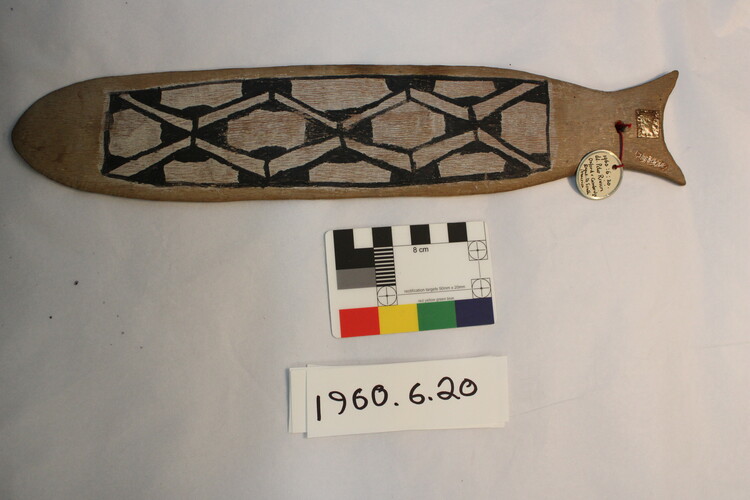
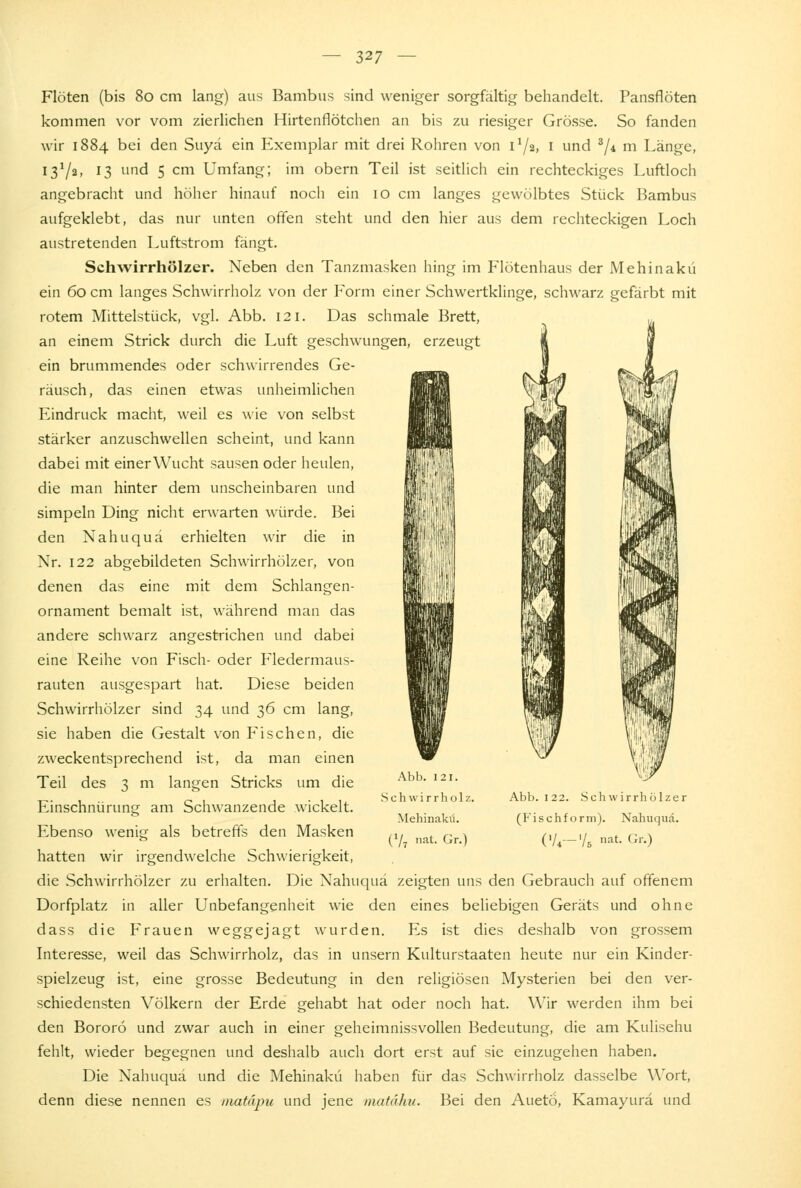
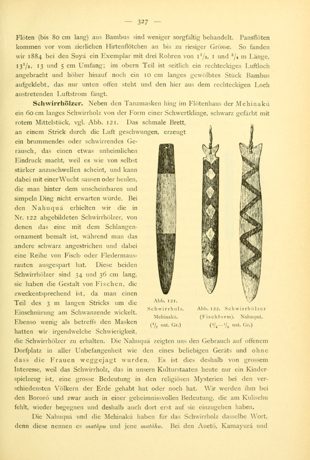
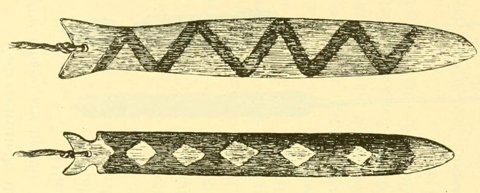
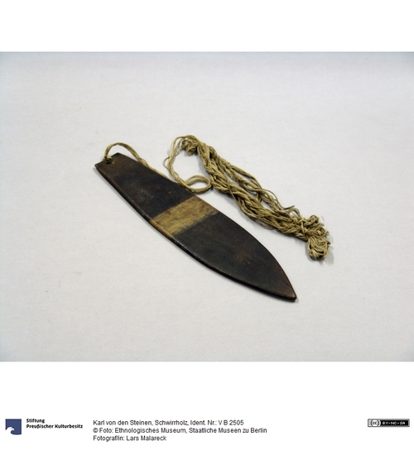
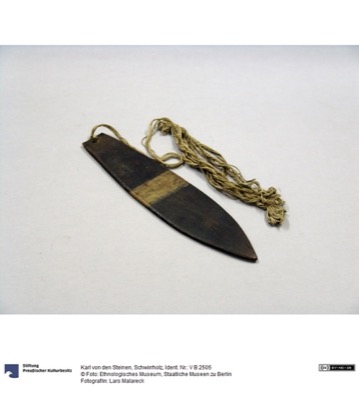
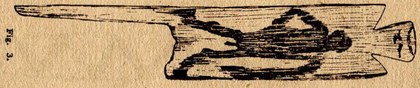
Fish shape can do practical work. The two Nahukuá boards von den Steinen described were thirty-four and thirty-six centimetres long; a constriction at the tail held part of the three-metre cord wound around it. One bore a snake ornament, the other a pattern of unpainted fish- or bat-shaped diamonds against black. His Mehinaku blade was different: sixty centimetres long, sword-shaped, black with a red middle, hanging beside dance masks in the flute house. Painted animal bodies and ceremonial storage connected the instruments without making every blade identical. 3
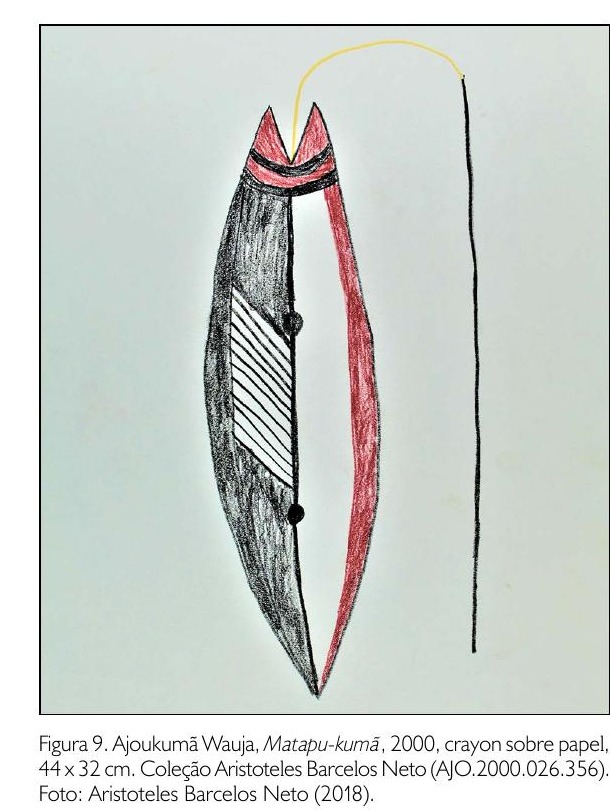
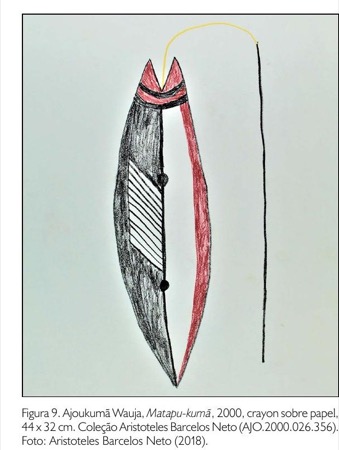
Wauja fish boards are commonly made as a male-and-female pair, their cords attached to long whirling poles. Ajoukumã Wauja drew the supernatural matapu-kumã in 2000 as both a fish and an instrument complete with cord and pole. Inside its body he showed the marks of the piau fish. Mehinaku performers likewise turn two boards together as a couple of spirit-fish. Their paint distinguishes named fish, using pequi oil, red urucum, charcoal and genipapo. 6, 4
In the Kamayurá account Oberg recorded, Yanamá acquired the bullroarer through two trades. He gave red toucan feathers to aikã, the mythical dogfish, and received the instrument. Then he gave it to the pequi tree, which taught him how to make pequi oil. Yanamá also made thunder and lightning. The fish-shaped urivurí became one of the tree’s guardian beings: old men smoked around a poorly bearing tree and asked those beings to restore its fruit. 1
The bargain concerns real work and a long wait. Oberg was told how the fruit was boiled and its oil skimmed into gourds. Trees took ten to fifteen years to bear. When a village moved, its inhabitants continued returning to the old orchard and ceremonial centre until the new trees produced fruit. The bullroarer’s tree could feed a community after its households had begun living elsewhere. 1
During the Mehinaku pequi festival, women bring roasted fish, porridge and manioc bread once the whirling boards stop. The food repays the spirit’s arrival. Roberta Braida also heard why one family kept sponsoring the rite: the shaman’s son had become ill after making too many bullroarers for sale. Repeated festivals renewed the repayment for his cure. In the Wauja celebration described by Christopher Ball, performers carry matapu to spirit masters’ houses, sound them there and return to receive lit tobacco from the sponsor. Music makes an obligation visible, and food or tobacco answers it. 4, 5
Rain is another request the sound can carry. Oberg’s Kamayurá account brings out urivurí when rain is late; the Bakairi name yelo joins the instrument to thunder and lightning. Yet the Nahukuá demonstration von den Steinen watched took place openly on the village plaza, without driving women away, and he described Kulisehu bullroarers used in festive mask dances and as playthings. The Upper Xingu family includes those public sounds alongside guarded spirit rites. Its continuity lies in the movement of painted voices through village life, harvest and exchange. 1, 3
In the Kamaiurá origin story, women were the first flute-players until the twins Sun and Moon drove them off with parapara and uriwuri bullroarers—fierce aquatic spirit-beings, mama'é, of fish and serpent essence. Whirled in gendered pairs, the larger blade is female and “conducting,” the smaller…
Ajoukuma Wauja, drawing of matapu-kuma (2000), in Aristoteles Barcelos Neto 2021, fig. 9 · CC BY 4.0
During the pequi festival, Wauja performers carry fish-shaped matapu from the village centre to the houses of the guardian-spirit masters and spin them before each house. The painted blades embody fish spirits, made in male-and-female pairs — a smaller one is aripe, 'grandfather,' and miniatures…
K. von den Steinen, Unter den Naturvölkern Zentral-Brasiliens (1894), p. 327, Abb. 121 · Public domain
When Karl von den Steinen reached the Mehinaku on the upper Xingu during his second Brazilian expedition of 1887-88, he stepped into their flute-house and found, hung along a ladder-like rack beside twenty masks and a few straw pendants, a single bullroarer: sixty centimeters long, painted black…
Karl von den Steinen, Unter den Naturvölkern Zentral-Brasiliens (1894), p. 327, Abb. 122 · Public domain
On the Kulisehu river in 1887–88, Karl von den Steinen collected bullroarers from the Carib-speaking Nahuquä carved in the form of fish, and set their name down in his comparative word-list: matavu — printed directly opposite the Arawak Mehinaku word matapu. One word, two language families: the…
By 1938 the Trumai told Buell Quain that they had “buried the kuth”: the rite was no longer performed, but most adults remembered travelling to the Kamayurá village for ceremonies where men “did things that the women cannot see.” The bullroarer’s name survives as uríuri or huri huri, along with the…
In the Upper Xingu the dangerous voice belongs to the flutes, not to this. Karl von den Steinen watched Nahuqua men whirl their roarers on the open village plaza in all unconcern, as they would any everyday tool, and nobody drove the women off; on the Kulisehu the same whirring board went to the…
1948 fieldwork; pp. 6–8, 23–24, 53–57. Kamayurá myth and rain use; regional interaction and orchard context. Food processing on p. 23 was reported to Oberg.
1887–88 expedition; pp. 104, 266, 307, 327–328, 497 and vocabulary pp. 525, 528. Mehinaku and Nahukuá objects, Bakairi name, public use and play. Haddon, Zerries and Loeb repeat this witness.
Doctoral ethnography, pp. 178–182: painted fish, paired whirling, food exchange, festival sponsorship after illness; the flute-ownership myth is cited from Gregor, kept separate from Oberg’s Kamayurá account.
Journal de la Société des américanistes 97(1):87–117, pp. 105–106: matapu performers and tobacco payment. This passage does not name Piyulaga or say that the particular performance was personally observed.