No. SA-Z1953-002
Sherente - Hieparo-wawe bullroarer
Eastern Brazil · South America
Restricted
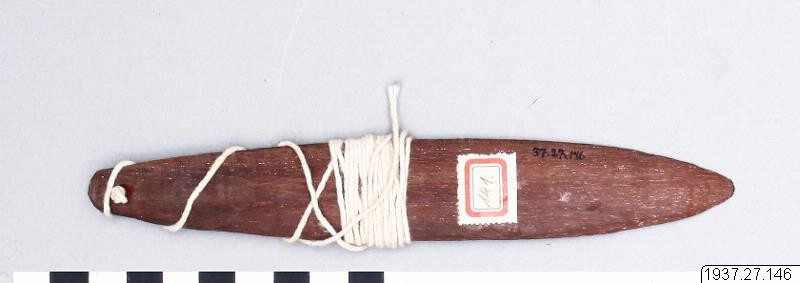
hieparo-wawe-wazdize'
howling of Hieparo-wawe
Etymology. The Sherente bullroarer is the hieparo-wawe-wazdize, the "howling of Hieparo-wawe": named for the shaggy night-demon Hieparo-wawe, the personified planet Mars, whose voice it produces when whirled to summon him.
Among the Sherente (Xerente) of eastern Brazil, the whirling of the bullroarer was the voice of Hieparo-wawe, a night demon who personified the planet Mars and ran as the chief companion of Wairie, the anthropomorphized moon. Through Mars and the Seven Stars the moon sent its revelations to the sdakra moiety. Hieparo-wawe appeared only after dark, usually to a lone hunter at his stand: long-haired and shaggy, the lord of the will-o'-the-wisps. His visionaries painted the entire body black save the face, hands and feet, which were red, in the paint of the demon himself. His pupils sought him out during roughly six days of instruction, carrying a bullroarer kept in an elongated lidded calabash; this instrument was the hieparo-wawe-wazdize, the "howling of Hieparo-wawe." At an appointed spot in the woods the pupil whirled it, and Mars appeared to him. Nimuendajú described Mars' pupils as doctors who sang at night, communicated with poisonous snakes and treated their bites. Small boys, meanwhile, kept buzzing boards (dawazdi) among their ordinary toys.
When his pupils, during their approximately six days' period of instruction, want to meet him in the woods, they carry with them a bull-roarer (hieparo-wawe-wazdize', "howling of Hieparo-wawe") in an elongated lidded calabash. At the appointed spot they whirl it, and forthwith the demon appears.
Nimuendaju 1942:89, quoted in Zerries 1953:280
Particulars
- Object
- A 17 cm pointed oval of wood with cord, guanaco sinew, and red-painted ends; Världskulturmuseerna 1937.27.0146.
- Function
- Pupils sound the sacred bullroarer to call Mars, Hieparo-wawe, during their instruction. Small boys play with separate buzzing-board toys.
Source
Curt Nimuendajú, The Šerente, trans. Robert H. Lowie (Los Angeles: The Southwest Museum, 1942), pp. 41, 85, 89–90; Otto Zerries, "The Bull-roarer among South American Indians," Revista do Museu Paulista n.s. 7 (1953), p. 280