No. SA-Z1953-005
Mashacali initiation bullroarers
Eastern Brazil · South America
Restricted
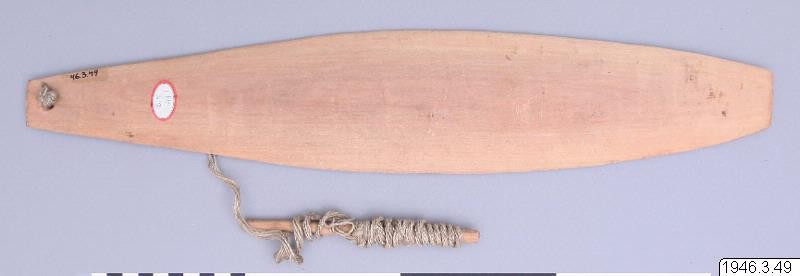
Source term: Schwirrgerät / Schwirrholz / bullroarer
Among the Mashacali of eastern Brazil, two kinds of sacred object belonged to the men's initiation: masquerade costumes and bullroarers. The disguise was a coarse bast fringe hung from a rope on the wearer's head, hiding him completely while he carried a six-foot switch; all the costumes were stored in the men's house and forbidden to the uninitiated, who were told that the dead appeared in this dress. The bullroarers were sorted by size and called "men," "women," and "boys," and only those entitled to do so were allowed to swing them. To outsiders the noise was explained as the voice of the spirits, and a newly initiated boy who gave away the secret faced corporal punishment. These details come from Curt Nimuendajú, who recorded them in 1938-39 among the last surviving members of the tribe; Otto Zerries, compiling them, judged the report from a neighboring people, the Botocudo, too vague to count.
The sound is interpreted to outsiders as emanating from the spirits, and newly initiated boys are forbidden on pain of corporal punishment to divulge the secret.
Métraux & Nimuendajú 1946:545, quoted in Zerries 1953:280-281
Particulars
- Function
- Sacred masks and bullroarers linked to initiation; men's house storage; outsiders told sound is spirits; initiates forbidden to reveal secret
Sources
- Alfred Métraux and Curt Nimuendajú, "The Mashacalí, Patashó, and Malalí linguistic families," in J. H. Steward (ed.), Handbook of South American Indians, vol. 1: The Marginal Tribes, BAE Bulletin 143 (1946): 541-545, p. 545 View · archived
- Otto Zerries, 'The Bull-roarer among South American Indians,' Revista do Museu Paulista n.s. 7 (1953), pp. 280-281, quoting Métraux and Nimuendajú (1946)