No. SA-Z1953-007
Karajá mask-dance bullroarer
Central Brazil · South America
Restricted
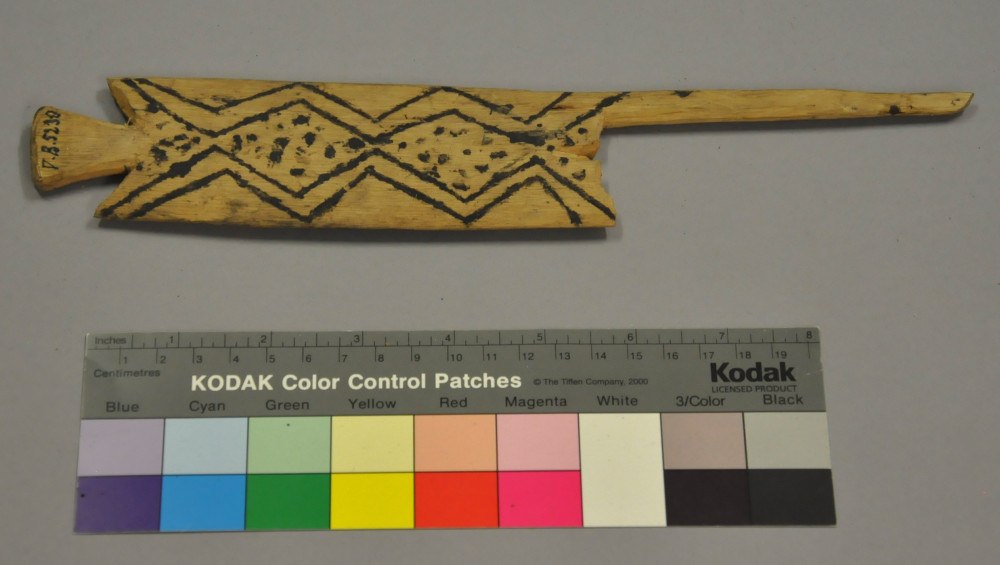
Source term: Schwirrgerät / Schwirrholz / bullroarer
noli-noli (also nolinóli): the Karajá name Krause gives for a bullroarer; Sachs glosses it as a Schwirrholz "mit Stange," i.e. a whirled blade mounted on a stick.
Among the Karajá of the Rio Araguaia the Aruanã dance masks represent fish and other animals and may not be seen by women except when worn by the dancers; a woman who slipped into the secret hut where the masks were kept met the death penalty. Whether a bullroarer belonged to this complex is genuinely uncertain. The only positive note is Krause's: he recorded an instrument called noli-noli — a bullroarer whirled on a stick — that, "if it can really be found there," might play a part in the mask dances.
Das Schwirrholz scheint bei den Karaya nicht im Gebrauch zu sein, wenigstens konnte nichts darüber ermittelt werden.
The bullroarer does not seem to be in use among the Karajá, at least nothing could be ascertained about it.
Ehrenreich 1891:38 (Beiträge zur Völkerkunde Brasiliens)
Particulars
- Function
- Possible bullroarer in mask dances; masks may not be seen by women outside performance; women entering storage hut put to death
Source
Fritz Krause, In den Wildnissen Brasiliens (Leipzig: Voigtländer, 1911), p. 312; Paul Ehrenreich, Beiträge zur Völkerkunde Brasiliens (Berlin: Spemann, 1891), pp. 37-38; Curt Sachs, Real-Lexikon der Musikinstrumente (Berlin: Bard, 1913), p. 273