No. MARCUZZI2010-001
Cuban orisha/Oro bullroarer cult
Cuba · Caribbean · Antilles
Sacred / spirit
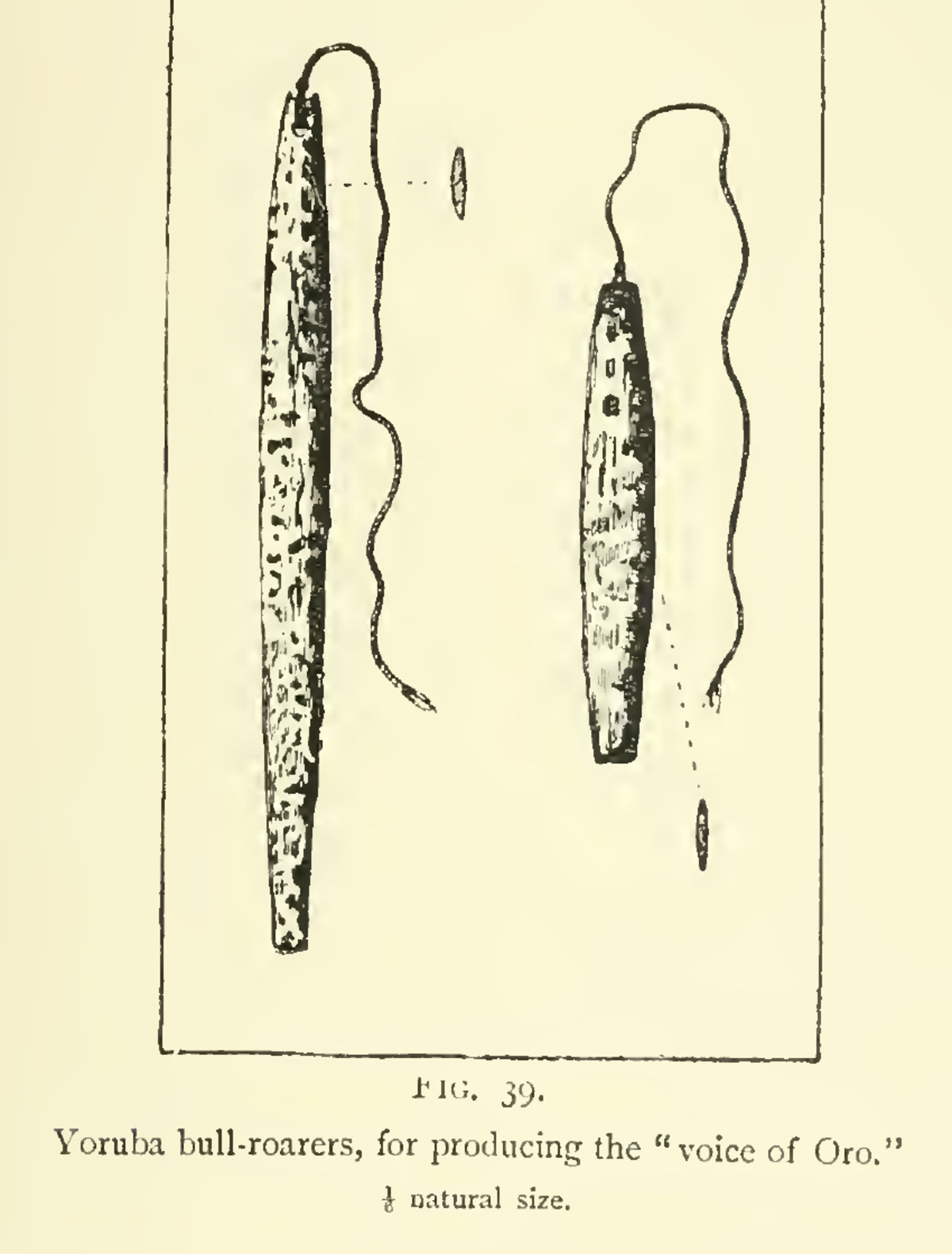
Oro / bullroarer cult
Source term: bullroarer
Oro: a feared Yoruba secret society whose voice is the bullroarer; carried to Cuba within orisha worship, where it is known as Oru or Orun.
In precolonial Yorubaland the Oro society was among the most feared collectives of all, carrying out on behalf of the state councils the executions of criminals and witches; the bullroarer was its voice. Michael Marcuzzi's 2010 study traces that cult across the Atlantic into Cuban orisha worship, where the transatlantic separation severed it from its judicial role and it survived in a more devotional but equally secretive form, known there as Oru or Orun. His central observation concerns the instrument itself: in Cuba, the sounding object at the heart of Oro's identity is frequently built not to sound.
this emblematic sounding instrument of the cult is often constructed in a manner that actually "mutes" the instrument.
Marcuzzi 2010, "The Bullroarer Cult in Cuba," Latin American Music Review 31(2):151-181
Particulars
- Function
- Voice of the Oro society; in Cuba, the emblem of a secret devotional cult within orisha worship.
Source
Michael Marcuzzi, 'The Bullroarer Cult in Cuba,' Latin American Music Rev. 31(2) (2010): 151-181