Atlas Essay —
The Name in the Blade
In Africa, New Guinea, Australia and Brazil the bullroarer bears the god’s own name, and swinging it brings the god
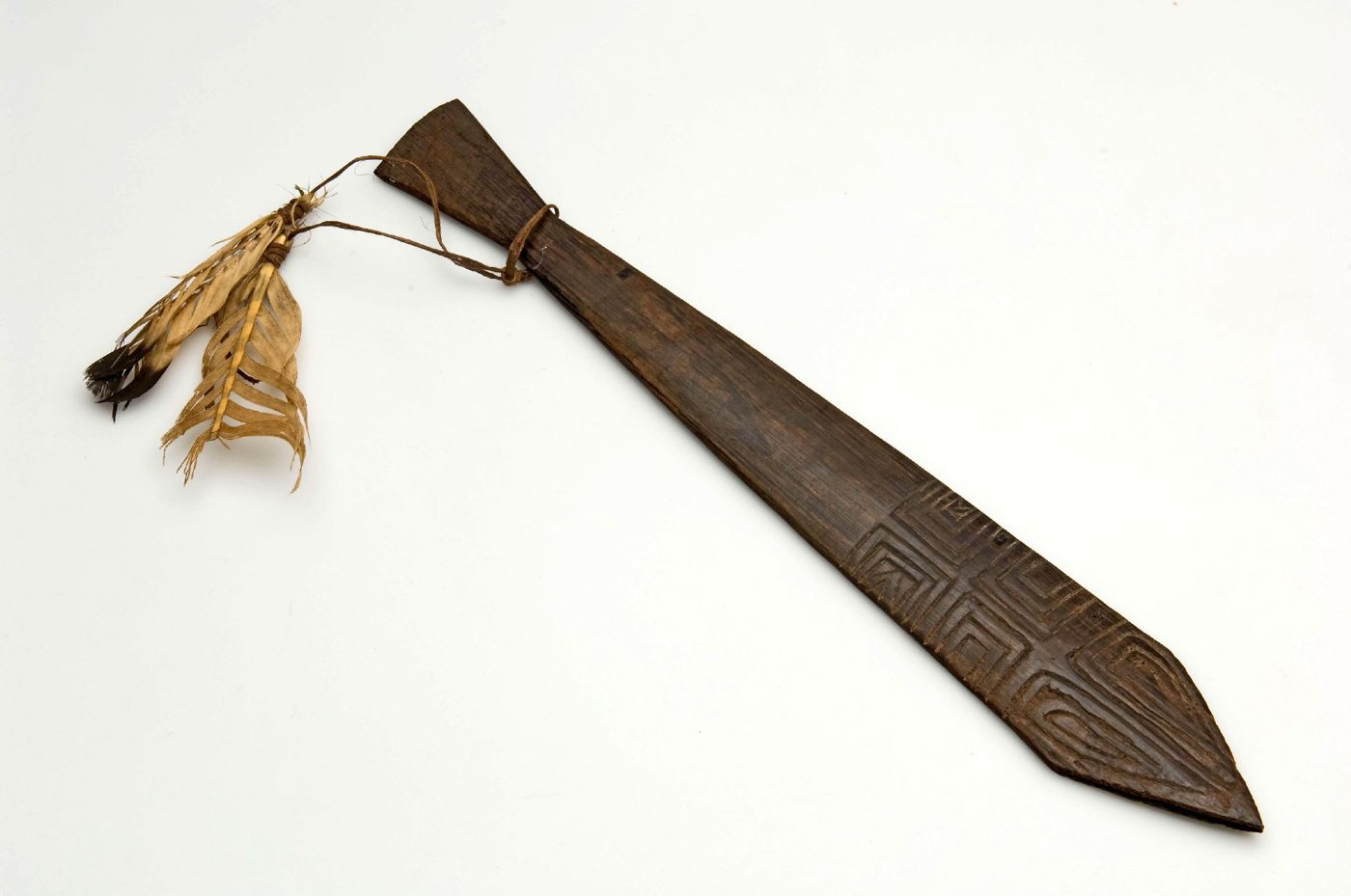
Around 1930, in the Ituri forest of north-eastern Congo, the missionary Paul Schebesta showed a Lendu man a bullroarer and asked him what it was. The man answered with the name of the forest god: “That is Tore.” In Mali the Bwa of San call their iron blade by the name of their god, Do, “the divinity itself”. On the south coast of New Guinea the Marind call theirs sosom, after the giant who walks the coast each year with the monsoon. At Port Keats in northern Australia, as the roar comes closer through the bush, the old men cry the secret name of the Mother: “Karwadi! Karwadi! The Old Woman is calling.” The board on the cord carries the being’s own name, and when it sounds, the being has come.
The bullroarer bears the exact name of the being whose voice it is. The instrument and the god share one word, so the blade in the hand is the god himself, present, and to swing it is to bring him. The pattern runs from the Congo forest and the cliffs of Mali to the Marind coast of New Guinea, the whole length of Australia and the swamps of central Brazil.
In brief
- Shown a bullroarer in the Ituri forest of the Democratic Republic of the Congo, a Lendu man said “That is Tore”; at Geti the Lendu call the blade fomvokai and God fomvo (Schebesta 1933, p. 135).
- The Bwa of San in Mali call their iron blade “the do”: “it is the divinity itself” (Capron 1957, p. 86). The Dogon give theirs the Great Mask’s name, imina na, and must always say which of the two they mean (Griaule 1938, p. 254).
- On the south coast of New Guinea “the name of the bullroarer is sosom”, the giant Sosom, and each village’s blades are rubbed against the last village’s to make them “alive” (van Baal 1966, pp. 473, 476). Inland, Yei-nan men swallow the blade to become “men who are orei” (van Baal 1982, p. 62).
- In northern Australia the Murinbata roar is “the sign of her real presence”, the Old Woman Karwadi (Stanner 1963, p. 4), and the Mungarai giant Kunapippi made sticks “called, like himself, Kunapippi” and twirled one “to let the boys know that he was close by” (Spencer 1914, pp. 214, 216).
- Among the Bororo of Brazil the funeral blades are aije, the water-monster’s own name, and the monster told the first men: “When one of you dies, then you call me and I will come” (Novaes 1994, p. 187).

“That is Tore”
The Ituri forest lies in the north-east of the Democratic Republic of the Congo, under the mountains along the Uganda border. Its hunters are the Efe and the Mbuti; its farmers, among them the Balese and the Lendu, live in villages along its edges, and the farmers say their initiation came to them from the forest people. Schebesta lived among them in 1929 and 1930. At the Balese village of Kalimoholo the men named him the sacred instruments: the bullroarer pahudjuhudju, a wooden flute, a great pot instrument and a smaller one blown like a shell. Then they gave him the name that covers all of them:
“All these instruments together are also called by the common name Tore. Tore handed all these instruments down to the forefathers. … Under the loud hooting of all these instruments the boys are made acquainted with Tore.”
Paul Schebesta, “Religiöse Ideen und Kulte der Ituri-Pygmäen”, Archiv für Religionswissenschaft 30 (1933), p. 134 (translated)
The leader of the initiation, dressed in skins and painted as the boys’ “grandfather”, swings the blade while the other old men work the rest. “The bullroarer is the voice of Tore,” Schebesta writes, and the god uses it to keep order in the houses. If a wife has been unruly to her husband, “if she has bitten him, as my informant told me!”, the bullroarer begins to whirr in the night. “The woman knows that it is meant for her and that she must make amends. She hurries to her clan and begs a gift, which she pays as a fine” (p. 134).
On the next page Schebesta sets down the initiation words of the peoples around the forest, and among them is the plainest answer anyone has given to the question of what a bullroarer is:
When I asked a Lendu about the bullroarer and showed him one, he said, that is Tore.Paul Schebesta, Archiv für Religionswissenschaft 30 (1933), p. 135 (translated): “Da ich einen Lendu nach dem Schwirrholz fragte und ihm eines zeigte, meinte er, das ist Tore.”
The Lendu of Geti put God’s name into the instrument’s ordinary word: “The Balendu of Geti call the bullroarer fomvokai or fomvokia; God they call fomvo” (p. 135). The Lendu blade at Geti carries God’s name, and the Balese set at Kalimoholo is Tore entire.
On the far side of the continent, in the San country of Mali, the Bwa keep their god in a sheepskin bag. Jean Capron, who studied the cult of Do among the Bwa villages of the San district in the 1950s, listed the sacred things of the cult, and came to the blade:
“— a rhombe or bull-roarer. For all the faithful it is the do: the principal piece of the cult, it is the divinity itself. It is also called aliwɛ, ‘it weeps’, or liñisā (‘it makes a noise’).
“The do is a small instrument made of an elliptical plate of iron about thirty centimetres long. … The sound it makes is vibrant and muffled: it is the voice of do (dotanu). At rest, the rhombe is shut in a sheepskin bag, hung from a beam of the ceiling.”
Jean Capron, “Quelques notes sur la société du do chez les populations Bwa du cercle de San”, Journal de la Société des Africanistes 27 (1957), p. 86 (translated)
The blade is the do, and its sound is the voice of Do. Name, object and god are one word.
Two hundred kilometres north of San, on the Bandiagara cliffs, the Dogon carve a great wooden serpent for the Sigui, the rite they hold once in sixty years, and call it imina na, the Great Mask. At Sanga, Marcel Griaule found, the bullroarer “bears the same name as the Great Mask” (Griaule 1938, p. 253 n. 1), and the sharing was so complete that it caused confusion in talk: “The same term imina na, Great Mask, is used indifferently for the wooden serpent and the rhombe. One must always specify which of the two one means when speaking of it with a native” (p. 254 n. 2). Before the new blade is used it is given “a share of the blood of the victims slaughtered on the Great Mask at its consecration”, and so “it acquires, in some measure, the power of that object, whose voice it is held to be and whose name it bears” (p. 254). Then a lizard is killed on it, and the men tell the power inside it what to do:
“Amma does not bring bad things.
Marcel Griaule, Masques dogons (Paris, 1938), p. 255 (translated)
Lébé does not bring bad things. …
Mount the heads of the women,
Do not mount the heads of the men.”
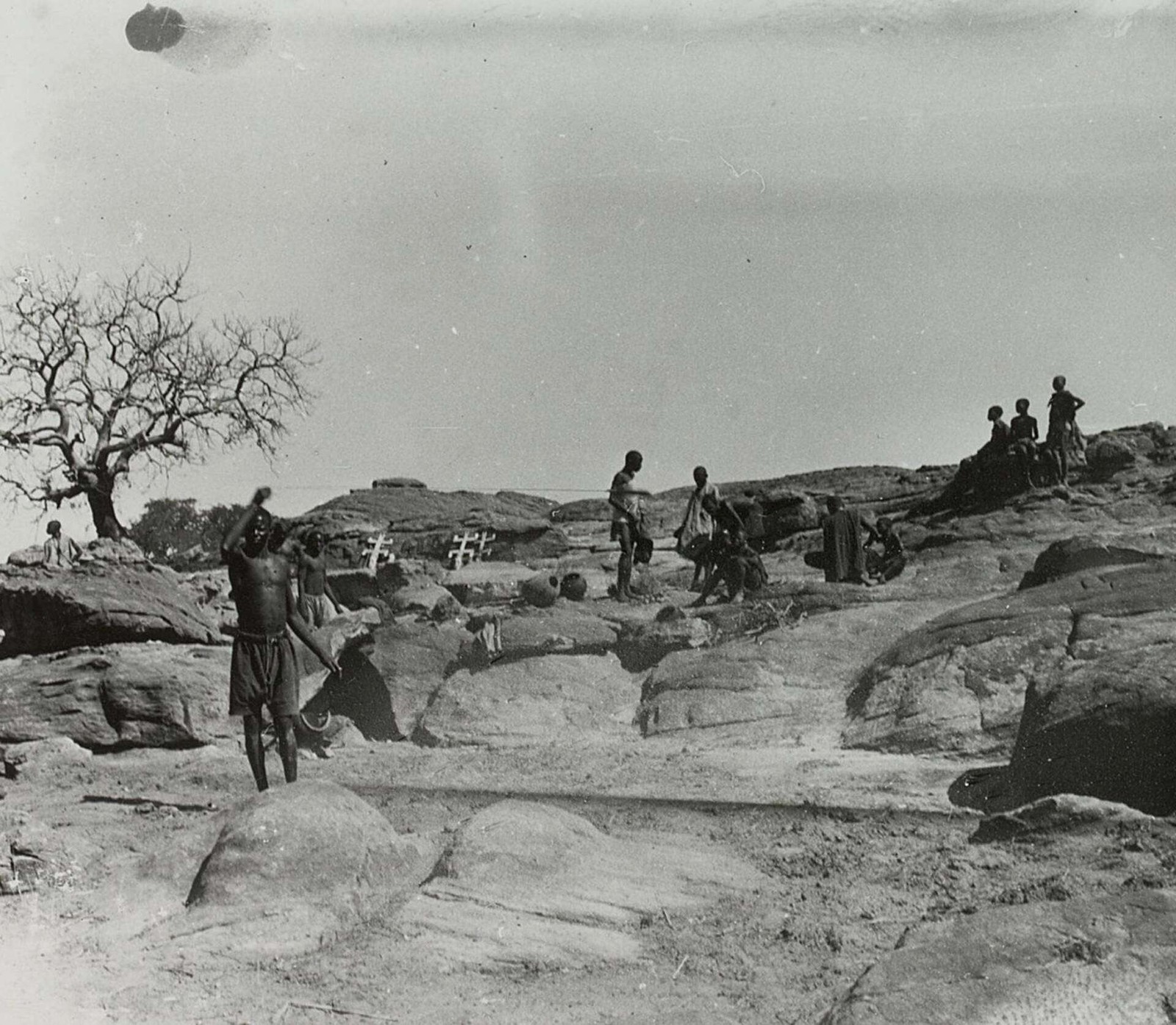
Among the Yoruba of south-western Nigeria the god of the night processions and the blade that voices him are both Oro. Leo Frobenius, who bought bullroarers in Yoruba country in 1910, wrote of the object as “the Oro” throughout. Women, he was told, “may gaze upon the Oro lying upon the ground when sacrificial blood is being poured upon it. But they must never see it in operation” (Frobenius 1913, p. 169). In the old days, he was “unanimously told”, the women who caught sight of an Oro procession “were straightway killed and hung up as a warning to others” (p. 170).
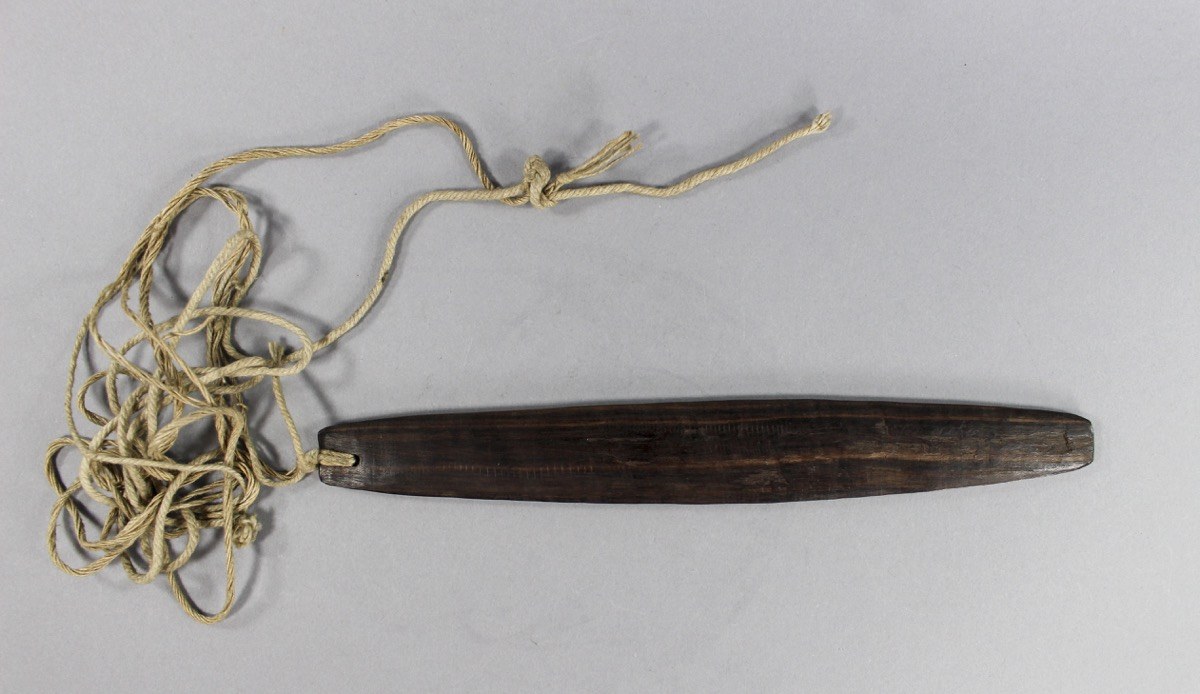
In the mountains of South Kivu, above Lake Tanganyika in the east of the Congo, the Bembe roarer is Tembwe, the leopard-god, who rules the circumcision called “the corpse”. “The snoring of the sacred rhombe, the spirit Tembwe … is none other than the voice of the leopard,” writes Pol Pierre Gossiaux, and the blade speaks in its own person at its appearances: “He who would surpass Tembwe will die crushed in the bush, proclaims the god-rhombe, the leopard-god.” At the cut the circumciser who “kills” and “swallows” the boy “is explicitly assimilated, at that moment, to Tembwe himself” (Gossiaux 2006). Blade, god and the man with the knife carry one name.
“The name of the bullroarer is sosom”
The Marind-anim live on the flat south coast of New Guinea, around Merauke, in the Indonesian province of South Papua. The giant of their eastern villages is Sosom. He is as tall as a coconut palm, his body is said to be of stone, and he can stand astride the Maro River with one foot on either bank. Each year with the east monsoon he walks the coast from village to village, and every village he visits holds his rite. Jan van Baal, the Dutch administrator who gathered everything written on the Marind into his great book Dema (1966), puts the identity in two plain sentences. “The bullroarer (sosom) is the voice of the déma Sosom” (p. 267), and “the name of the bullroarer is sosom”, so that “of course an imo man may say that he has seen sosom” (p. 473).
The blades are woken before the giant can use them. Van Baal follows Father Jan Verschueren, the missionary whose record of the rites he judged “by far the most authoritative” (p. 474), on how each village goes out to meet Sosom at the boundary of its land:
“At the outskirts of their territory the men meet a party from the neighbouring village, which has just finished the celebration. The receiving party must rub their bullroarers against those of the visitors. The bullroarers have been anointed with sperma … by making them touch the bullroarers of the village where the ceremony has just been finished, the bullroarers of the recipient party have been made ‘alive’. From now on they may be sounded. … The real sosom (bullroarer) is the bullroarer of the Kai-zé, because Sosom is their déma.”
J. van Baal, Dema (The Hague, 1966), pp. 475–476, after Verschueren
The giant’s blades pass the life to each other as he goes down the coast. The clan whose ancestor he is keeps “the sosom proper”, and on the night of the rite a man of that clan climbs a platform up to eight metres high inside the fenced ground and swings it over the boys sitting below (pp. 476, 478). Sosom is often announced as Tépo-anem, “sodomite (lit. tailbone-man)” (p. 477). His myth gave him the name: a girl’s mother cut off his penis while he was stuck fast in her daughter, and “with his mutilated genital Sosom could only sodomize” (p. 268). What became of the severed penis belongs to The Slain God’s Voice. The giant’s rite does what his name says. When the boys have met Sosom they are each given the bullroarer of their clan, and “for the rest of the night the boys are here subjected to promiscuous homosexual intercourse” (p. 479).
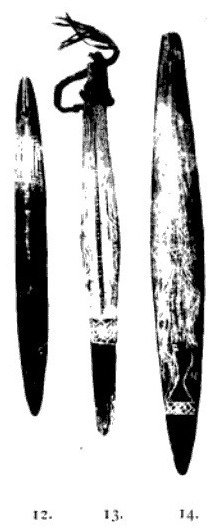
Up the Maro River, inland from the Marind, live the Yei-nan. Their bullroarer is the kupör, a small spatula of wood, and their word for that wood is also the name of their founder. Editing Verschueren’s notes on the Yei in 1982, van Baal set the identity down plainly:
“Orei refers not only to the bullroarer or bullroarer-like object used in ritual, and not only to the tree, either, but also to Orei, the leader of all the yevale taken by him to their respective territories in a canoe which again is called orei. It is reminiscent of the fact that the Marind-anim bullroarer, sasam, is in effect the same as Sosom, the dema.”
J. van Baal, Jan Verschueren’s Description of Yéi-nan Culture (The Hague, 1982), p. 49
The Yei make the identity bodily. Every male, van Baal goes on, “must become identical with orei by symbolically swallowing the implement” (p. 49). When a girl’s first blood flows, the men slip their blades under their tongues, dance, and then “suddenly re-produce their kupör from their bodies, but now the implements are covered with blood. Blood also gushes from their mouth and nose.” They sprinkle the blood over the hut where the girl sits with her mother. Asked what it meant, Verschueren’s informants said “that the men must become one with Orei. They must become orei kerau, men who are orei”, and that only when a virgin bleeds for the first time is “the kupör (that is Orei) able to glide smoothly into the body of an orei-man” (p. 62). The kupör is Orei, and the man who has swallowed it is Orei too. How the chips of the first orei palm became the blades is told in The Name of the Canoe.
East of the Marind, at the mouth of the Fly River in Papua New Guinea, the Kiwai let the blade speak its own name. Their word for it, according to the missionary Baxter Riley, is madubu, “I am a man” (van Baal 1966, p. 270). Gunnar Landtman, who lived among them in 1910–1912, took down how the first one came. An old woman named Méte, on Boigu Island, in the Australian Torres Strait, was chopping firewood when a splinter whirled up into the air, crying “Bigu-bigu-bigu,” and fell beside her. That night it came to her in a dream:
“Mother, that me, that my name bóigu (or bigu, for it called out its own name when whirling round). You go bush, cut him skin belong one wood … make him rope. You make hole along me close to nose, make fast rope.”
Gunnar Landtman, The Folk-Tales of the Kiwai Papuans (Helsingfors, 1917), no. 261, p. 316
The splinter told her to rub it with semen and the secretion of the vulva and swing it over the yam gardens: “I make noise too, bigu, bigu. That me make altogether garden move, make him grow” (p. 316). The Kiwai bullroarer introduces itself by name, and every time it is whirled it says the name again.
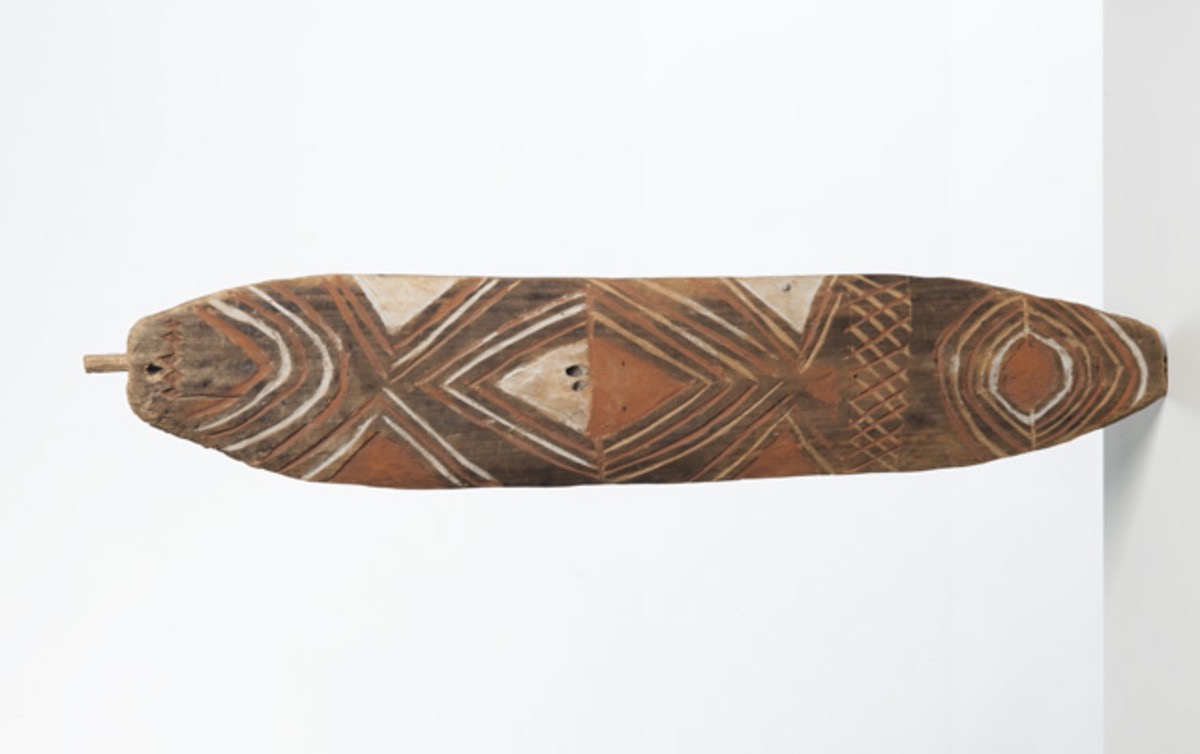
“Karwadi, yoi!”
The Murinbata of Port Keats, on the coast of the Northern Territory south-west of Darwin, held the ceremony called Punj for young men circumcised some years before. W. E. H. Stanner, the Australian anthropologist who worked with them from the 1930s, opened his account with the name:
“The bullroarers (ŋawuru) have the higher degree of sacredness which we may call sacrosanctity. The word Karwadi is the secret name of a provenant spirit also described as The Mother of All or as The Old Woman. … The bullroarer is her emblem; the sound it makes when swung is the sign of her real presence.”
W. E. H. Stanner, On Aboriginal Religion (1963; Sydney, 2014), p. 4
The name itself is the first secret the youths are given. On the first afternoon they sit inside a tight ring of men who sing a secret song until sundown, and the song ends with a cry, “Karwadi, yoi! It is the first occasion on which the youths have heard the secret name of The Mother of All” (p. 5). On the third day, as their bodies are anointed with blood, men hidden nearby begin to swing the boards, and “as the roar comes ever nearer, many of the older men, with shouts of well-simulated fear, cry ‘Karwadi! Karwadi! The Old Woman is calling’.” Then the swingers spring into view, each man brings a new-made bullroarer, rubs it on the youth’s breast and loins, “and then thrusts it between the youth’s thighs so that it stands up like an erect penis” (p. 8).
The blade carries her name on both sides of the secret. The men say the first one was made after the Old Woman’s death by Kudapun, the apostlebird, and lost in deep water; “two young women at fishing brought it ashore in a net”, and men “took them into the bush … and killed them by cutting their necks”. Yet, Stanner adds, “the ‘open’ or non-secret name of the bullroarer is Mutjingga”, the Old Woman’s own name, and “women tell their children that its noise is her voice” (p. 45 n. 21). The women know her by one name and the men by another, and the board in the hand answers to both.
East of Port Keats, on the Katherine and Roper Rivers, the name is the instrument’s ordinary word. Among the Djauan, after the cut, “the boy is now shown the bull-roarer, or Kunapippi, and told that he must say nothing about it to the women, who would be struck dead if they should chance to see it” (Spencer 1914, p. 162). The Mungarai told Baldwin Spencer whose name it was. In the far-off times there was “a very big man named Kunapippi”, who came out of the ground with spirit boys in his dilly bags:
“He possessed several of the sacred sticks, called, like himself, Kunapippi. He had made them, and was the first to have any. … Kunapippi went away and caught a lot of fish, crocodiles, turtles, etc. … He took one of his Kunapippi sticks with him, and, when he came back near to the camp, twirled it to let the boys know that he was close by.”
Baldwin Spencer, Native Tribes of the Northern Territory of Australia (London, 1914), pp. 214–216
The giant swung his own name to say that he was coming. Later he ate a party of strangers, “disgorged all their bones”, and was cut down with stone axes; his boys “secured the sacred sticks that belonged to Kunapippi and have kept and used them ever since” (pp. 216–217). Every Mungarai blade swung since is the giant’s name sounding near the camp.
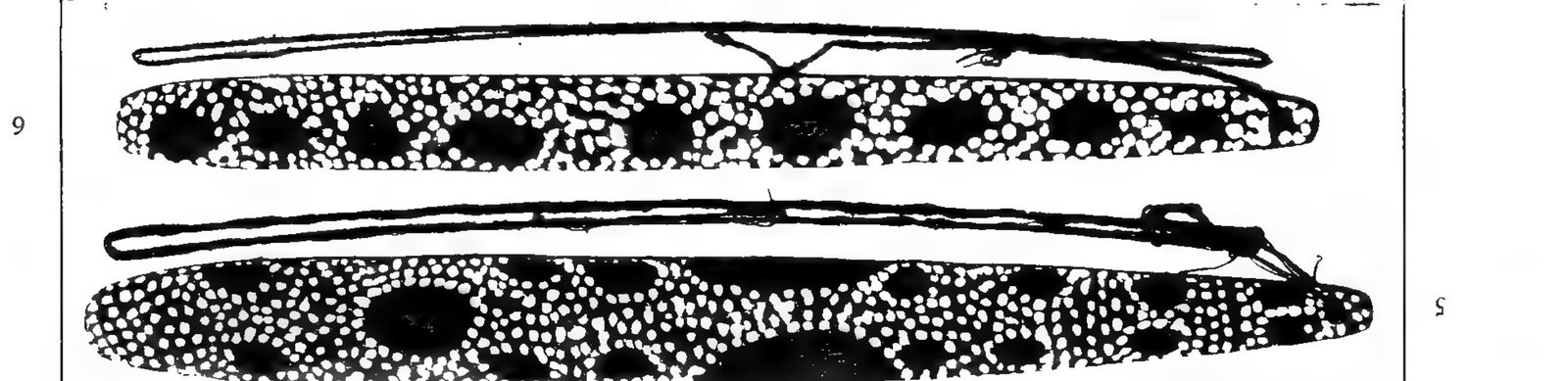
The linguist Arthur Capell’s 1956 vocabulary of forty north Australian languages has a column headed BULLROARER, and the Mother’s names stand in it. The Nunggubuyu say mamuna, and the Mara of the Limmen Bight coast mumuna; the Wandarang word, wugunabibi, carries Gunabibi, the name of the great cult and its Mother (Capell 1956, p. 18). Mumuna is the swallowing Mother whose dying cry Eaglehawk carved into the first board (The Mother of All, The Voice Was Hers). A man asking for the bullroarer in those languages asks for her by name.
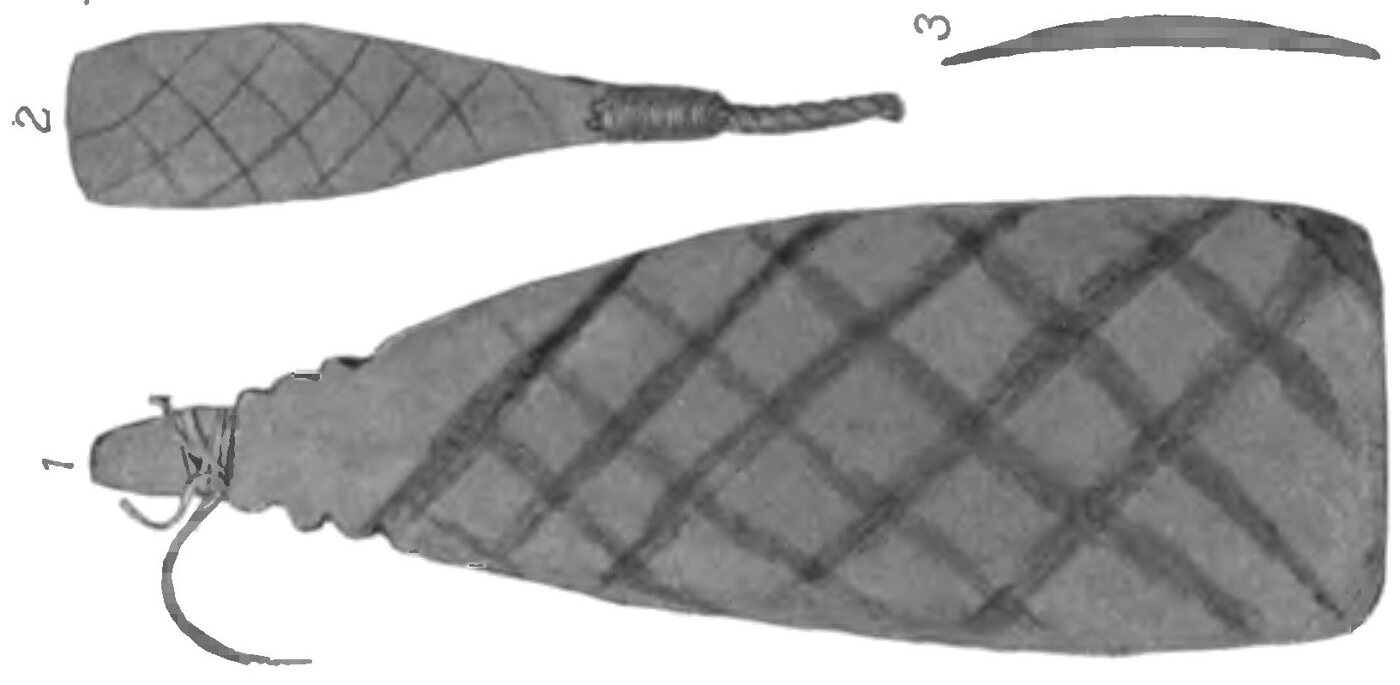
At the far south-eastern corner of the continent, in Gippsland in Victoria, the Kurnai named their two blades for the ancestor who made them. Mungan-ngaua, the All-Father, instituted the initiation, “which was conducted by Tundun, who made the instruments bearing the names of himself and his wife” (Howitt 1904, p. 493). The larger blade is Tundun, “the man”; the smaller, Rukut-Tundun, “the woman”, his wife (p. 628). On the nights after the secret was shown, the newly made men went out each carrying a Tundun to frighten the women, swinging them as they walked slowly round the camp in the dark, and “Tundun is thus supposed by the women and children to be walking round the camp before returning to the place whence he came.” When a blade flew off its string and a woman found it, she was told it was “a paddle belonging to Tundun” (pp. 631–632).
“Call me and I will come”
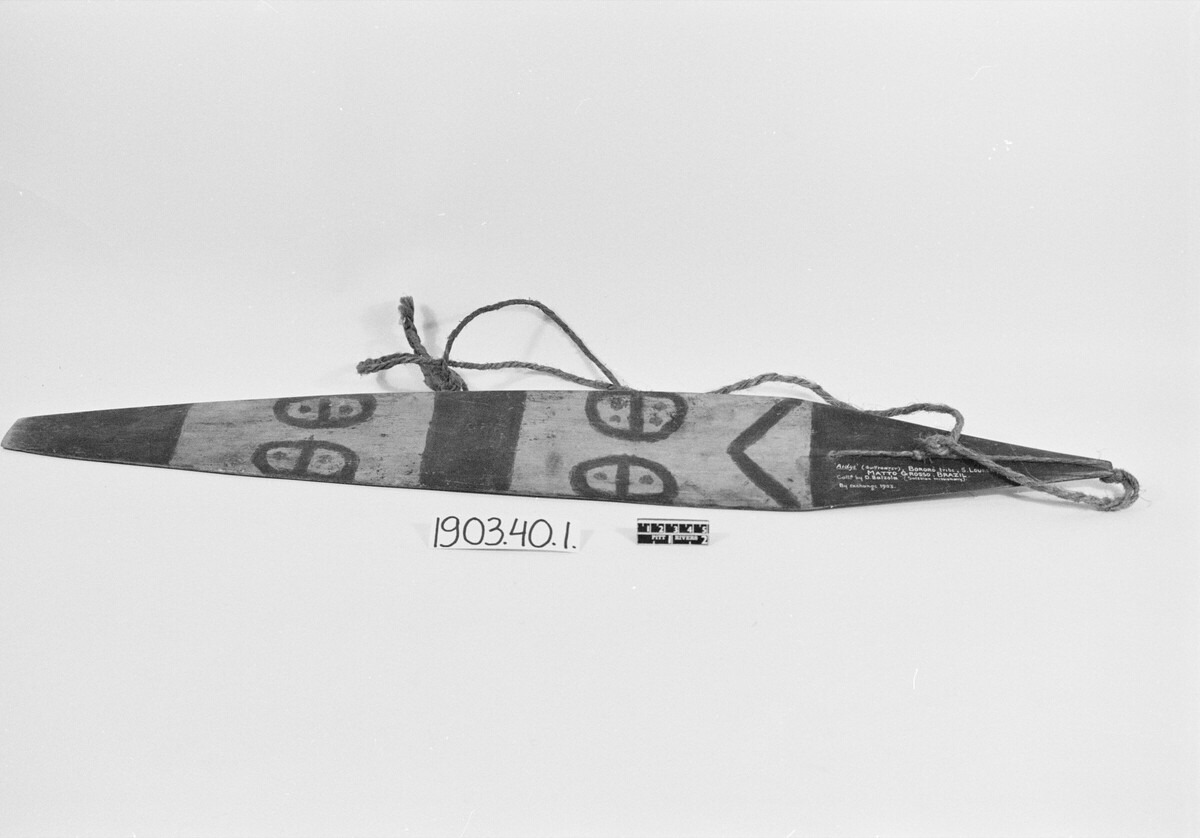
The Bororo of Mato Grosso, in central Brazil, swing their roarers at funerals, and the boards bear the name of the beast that lives in the deepest water. The anthropologist Sylvia Caiuby Novaes heard its story in 1972 from Kewai, a man of great standing at the village of Meruri. A man found a little spotted frog in the swamps and kept it in ever larger pots until it was round, black and a metre long; some said it was a water animal, others “an aroe, a spirit.” A great chief took it from him and drove it singing to the village centre. Then the beast spoke:
When one of you dies, then you call me and I will come.Kewai to Sylvia Caiuby Novaes, “Aije: a expressão metafórica da sexualidade entre os Bororo”, Revista de Antropologia 37 (1994), p. 187 (translated)
The call is the blade. “Aije is also the term the Bororo use for certain ornamented wooden blades, the bullroarers, used in particular phases of the funeral ritual,” Novaes writes; to the Bororo these blades are “the tangible material representations of this mythological being.” Each has its own size, pattern and name, and whirled on a cord from a long pole they make a buzz “like the cry of the aije itself”. Kewai told her how the blades came to be sounded: “It was the aije who asked that these little boards be played whenever they wanted to call him” (p. 187). The women are kept away by the beast’s own warning: a woman who saw it “would be left with a swollen belly and soft legs, dragging herself along the ground” (p. 187). At the funeral of every Bororo the men swing the aije, and the aije comes.
To swing the name
From Andrew Lang onward, the comparative books have called the roar the voice of a god, and so it is. The peoples who swing the blade say more. They give it the god’s own name: “that is Tore”; “it is the divinity itself”; “the kupör (that is Orei)”. In each place the instrument and the being are one word, and the word is a name, the proper name of one being with a story, a temper and a place it comes from. A voice can be heard from a distance. A name in the hand is the god near enough to touch.
The name is what makes the blade a summons. Kunapippi twirled his stick to tell the boys he was close by. The aije asked to be called with the boards whenever someone died. When Sosom’s blades sound in a village, Sosom is there, and when Tore’s blade whirrs at night outside the house of a wife who has bitten her husband, she knows it is meant for her. In every case the sound is the being arriving, and the name is how it is called.
The secret, when it is shown, does not take the name away. At Wendu in 1952 the Marind made the dancer who played Sosom kneel and took off his decorations in front of the boys, and “the déma is revealed to the boys as an ordinary man” (van Baal 1966, p. 481). Yet the Kai-zé still keep “the sosom proper”, and each boy goes home with his clan’s blade. At Port Keats the swingers leap into view, and in the same moment the youth receives a blade of his own between his thighs. The Yei-nan teach every boy to swallow the kupör and become Orei himself. What the initiate learns is that the god is in the hands of men, and that he now holds the god too. The women outside, running from the sound, are right about what is coming. They are wrong only about who is swinging it.
The pattern runs across the bullroarer’s widest range, from the forest farmers of the Congo and the cliff villages of Mali to the swamp coast of New Guinea, northern Australia, Gippsland and the funeral grounds of central Brazil, and its parallels are strikingly close: a giant who walks the coast, an ancestor who walks round the camp, a beast in deep water, a leopard in the mountains, an Old Woman in the bush, each with a board that bears its name. Wherever the roarer goes, it carries the name with it. To swing the blade is to say the god’s name aloud in the dark, and the god answers by coming.
Key sources
- Paul Schebesta, “Religiöse Ideen und Kulte der Ituri-Pygmäen (Belgisch-Kongo)”, Archiv für Religionswissenschaft 30 (1933), pp. 134–135 (Balese Tore and the instruments; the bitten husband; the Lendu “das ist Tore”; Geti fomvokai and fomvo).
- Jean Capron, “Quelques notes sur la société du do chez les populations Bwa du cercle de San”, Journal de la Société des Africanistes 27 (1957), pp. 81–129, at p. 86.
- Marcel Griaule, Masques dogons (Paris: Institut d’Ethnologie, 1938), pp. 253–255.
- Leo Frobenius, The Voice of Africa, vol. I (London: Hutchinson, 1913), pp. 169–170.
- Pol Pierre Gossiaux, Le Bwamè du Léopard des Babembe (Kivu-Congo): rituel initiatique et rituel funéraire (expanded digital edition, 2006), the chapters on Tembwe and the circumcision.
- J. van Baal, Dema: Description and Analysis of Marind-anim Culture (South New Guinea) (The Hague: Nijhoff, 1966), pp. 267–273 (Sosom’s myths; Kiwai madubu, p. 270), pp. 473–481 (the sosom rites, after Verschueren, Nevermann and Boelaars).
- J. van Baal (ed.), Jan Verschueren’s Description of Yéi-nan Culture (The Hague: Nijhoff, 1982), pp. 47–49, 61–62.
- Gunnar Landtman, The Folk-Tales of the Kiwai Papuans (Helsingfors, 1917), no. 261, p. 316.
- W. E. H. Stanner, On Aboriginal Religion (1963; Sydney: Sydney University Press, 2014), pp. 4–5, 8, 45 n. 21.
- Baldwin Spencer, Native Tribes of the Northern Territory of Australia (London: Macmillan, 1914), pp. 162, 213–217 and Plate II.
- Arthur Capell, A Vocabulary of 600 Words in Forty North Australian Languages (typescript, Sydney, 1956; State Library of New South Wales, A 6929), p. 18, the BULLROARER column.
- A. W. Howitt, The Native Tribes of South-East Australia (London: Macmillan, 1904), pp. 493, 628, 631–632.
- Sylvia Caiuby Novaes, “Aije: a expressão metafórica da sexualidade entre os Bororo”, Revista de Antropologia 37 (1994), pp. 184–187.
As far as we know, the general pattern, that the bullroarer bears the exact proper name of the being whose voice it is across these continents, is stated here for the first time.