Atlas Essay —
The Name of the Canoe
the Waria valley · the Huon Gulf · the Obat and Maro rivers · the Pahoturi River · Gippsland
A great canoe once came to the coast of what is now Morobe Province in Papua New Guinea. Some of its people stepped ashore and stayed; the rest sailed on. The ones who stayed are the Guhu-Samane, and the canoe was called Inaru. So was their bull-roarer. So was one of their clans, and so, before any other name, were they. The blade that roars in the men’s house carries the name of the vessel the people came out of, and when it sounds, the arrival happens again.
In brief
- The Guhu-Samane of the Waria valley give one name, Inaru, to the seafaring canoe their ancestors stepped out of, to that group’s bull-roarer, to a clan and to the whole people.
- The Yéi of the Obat and Maro rivers in Indonesian Papua came out of the orei palm, sailed home in orei canoes and carried a chip of the palm each: the kupör, the bullroarer. Its keeper becomes “one with Orei.”
- The Ende of the Pahoturi River cut their first bullroarers from the twin palms where their language began. The words came out “when the bullroarers were swung.”
- The Bukaua of the Huon Gulf shout their roarer’s name as the village war-cry, and the Bukawa-speakers of the Gulf trace their ritual roarers to a village at the mouth of the Waria, the river of the Inaru people. In Gippsland the Kurnai blade is Tundun, “the direct ancestor” of the Kurnai.
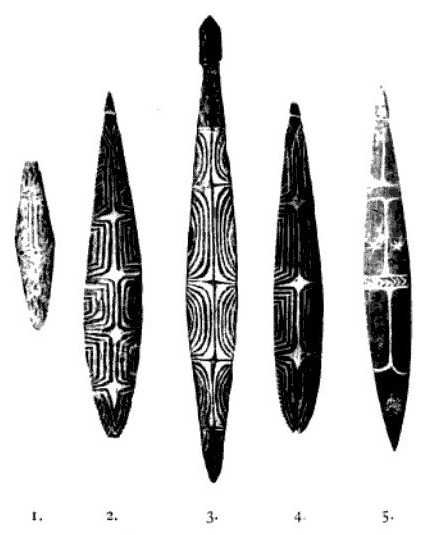
A people’s bullroarer is a chip of the thing the people came out of, and it carries that thing’s name: when it roars, the origin speaks in the present tense. That is why one blade can be a village’s war-cry, a lineage’s founder and the warrant for law, and why the charter travelled along the New Guinea coast with the founders who carried it.
Inaru steps out of the canoe
The Guhu-Samane live in the valley of the Waria River, which runs down from the mountains of Morobe Province to the sea on the north-east coast of Papua New Guinea. Their dictionary, compiled by the Summer Institute of Linguistics with the Guhu-Samane writer Ttopoqogo Hoopusu, has an entry for a single proper name:
Inaru … name of a certain lakatoi (seafaring canoe) (or ship) called “inaru” from which certain people emerged and pursued their tradition in the Morobe area while the others are said to have continued on with the vessel, name of the “bull-roarer” relating to the above group, name of a certain clan group, the original name of the Guhu-Samane people.
Guhu-Samane lexicon (SIL Papua New Guinea), entry Inaru
Four things carry one name. There is the canoe, a lakatoi, the big multi-hulled trading vessel of the Papuan coast. There is the bull-roarer of the group who stepped out of it. There is a clan, and there is the people as a whole, under the name they had before they were Guhu-Samane. The entry reads like a genealogy compressed into a word: the vessel gives birth to a group, the group keeps a voice, the voice belongs to a clan, and the clan’s first name is the people’s first name.
The dictionary’s Tok Pisin gloss renders the second sense as hausman, the men’s house, where the English says “bull-roarer.” Both are right, because among the Guhu-Samane the men’s cult, its house and its voice are one institution, called Poro. The same dictionary describes the poro ungapa, the cult’s bull-roarer, as a
fraternalized and highly-honored slat of palm wood to which a long whip is tied, at appropriate signal the executer of the instrument twirls it in a grand arc and produces a roaring, screaming noise which is regarded as the voice of the Poro spirit.
Guhu-Samane lexicon, entry Poro ungapa
To name Inaru’s men’s house and to name Inaru’s roarer is to name the same thing: the place where the canoe’s voice is kept.
The dictionary goes further than a single entry. Under poro ungapa it lists the proper names of the sacred bull-roarers, one hundred and nineteen of them. Under Poro it lists “the gods’ names which constituted the pantheon”: Ariqesa, Batebe, Beedzo ma Batabe, Dzaaro, Dzaubo, Dzupune and Inaru. Six of those seven gods appear by name in the list of roarers. The seventh is Inaru, whose own entry makes it a bull-roarer. Under poro nese, the “poro totem clan designs,” it lists sixty-seven clan emblems. Inaru is among them, and twelve more are, letter for letter, names on the roll of roarers. In this vocabulary a god, a clan and a voice in the dark are the same word. The roarer does not stand for a clan the way a flag stands for a country. It is the clan’s founder, sounding.
And the founder came by sea. The Guhu-Samane are a hill people now, but their first name is the name of a ship, and the roarer that bears it is a relic of a landing.
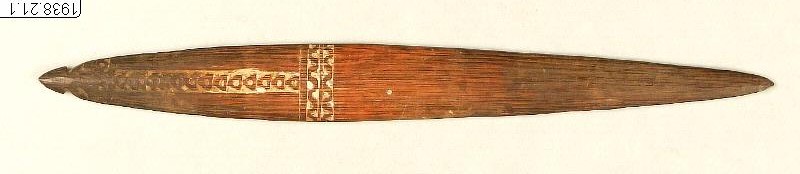
Chips of the first palm
Some eight hundred kilometres to the west, on the Obat and Maro rivers of Indonesian Papua, the Yéi tell the same story in wood. The missionary Jan Verschueren collected it, and Jan van Baal edited his papers. Their account of the orei palm is told in full in The Slain God, where the palm is the body of a being; here it matters for what the Yéi took away from it. Verschueren sums up the many tellings:
all yevale “originated from the orei-tree (magic palm) … (and) came to the country in an orei-canoe which was made from that tree. And they all took a chip of the orei-tree with them as a magical implement (the kupör or bullroarer).”
J. van Baal, ed., Jan Verschueren’s Description of Yéi-nan Culture (1982), p. 46
The yevale are the ancestor-spirits of the clans. In the southern telling the great palm stood on the plain where the Maro and Wanggo meet, and every night the neighbouring Kanum heard singing and dancing inside it. A Kanum man crept up with a stone axe and struck it. The palm burst open, the ancestors came tumbling out, and each took a chip of it to his own country. Then the pieces became boats:
The orei-tree had fallen to pieces, and each of these pieces constituted a canoe, in which the yevale went to their country. The Yéi-yevale had their own canoe, and so had the Boadzi and the Marind. They all went their own way.
Van Baal 1982, pp. 46–47
One palm, three peoples, three canoes. Orei, the leader, loaded his own canoe with the Yéi ancestors and everything that belongs to the Obat country, sago and bamboo and pandanus and mud, and poled upriver, setting a yevale ashore at the mouth of each tributary. “And each of the yevale was given his kupör to take with him.” Verschueren’s own summary of the whole cycle is a statement of the thesis in Yéi terms: “all yevale originated from the orei-tree, … they were brought to their home country in the orei-canoe, and … they all carried a kupör with them as the symbol of their authority” (p. 48).
Then the names collapse into one. Verschueren wrote that orei is the special wood “of which bullroarers are made everywhere in South New Guinea,” and that he used orei and kupör interchangeably. Van Baal draws it out:
Orei refers not only to the bullroarer or bullroarer-like object used in ritual, and not only to the tree, either, but also to Orei, the leader of all the yevale taken by him to their respective territories in a canoe which again is called orei.
Van Baal 1982, p. 49
Tree, canoe, leader and roarer: one word. The Guhu-Samane gave one name to canoe, roarer, clan and people; the Yéi give one name to palm, canoe, founder and roarer. Two peoples on opposite coasts of New Guinea, speaking unrelated languages, have built the same four-way identity, and in both the hinge is a vessel that carried the ancestors to their land.
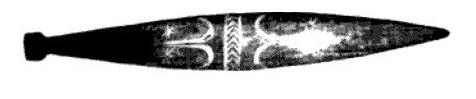
The Yéi did not leave the chip in a shrine. Each young man received a kupör at initiation and had to become identical with orei “by symbolically swallowing the implement” (p. 49); the ideal was to become an orei-kerau, an orei-man. Every clan had its own yevale, and an orei-man’s healing power reached only his own. Van Baal follows the chain to its end:
Would it really be too bold a speculation to suggest that the initiate/medicine-man is the reincarnation of his clan yevale, who left the orei-tree or -canoe with his kupör in his hand? If this is correct, then Yéi-nan totemism must have been ritually more important than we have hitherto supposed, which importance does not derive from its forming part of a ritual drama … but from the power of the magical act performed by an initiate who has become one with Orei by swallowing the kupör, which is the kupör of his clan and yevale.
Van Baal 1982, pp. 72–73
The founder steps out of the canoe holding his chip of the palm. Generations later his descendant swallows that chip and becomes him. Nothing in between has been lost, because the object never stopped being the origin. That is why Orei could hand Jögwul his kupör at the Sembe “in token of his authority there” (p. 47), the scene A Warrant on a Cord reads as a grant of office. The authority is real because it is the arrival itself, handed over.
The palms where speech began
East of the Yéi, across the border in Papua New Guinea’s Western Province, the Ende people of the Pahoturi River tell how their language was born. The story belongs to D. Kollowam and J. Ben Danipa, who gave the linguist Kate Lindsey permission to publish it:
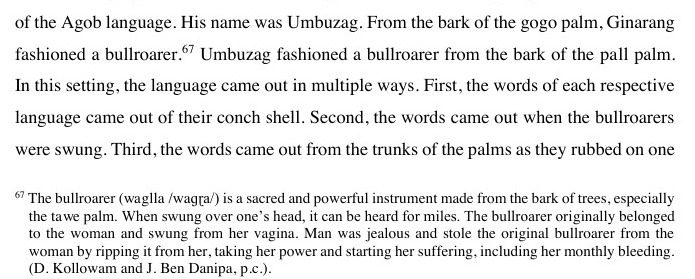
This is the origin of Ende language. The Ende language began in a place called Boze. In Boze, there were two tawe palm trees. One was gogo (green) and the other was pall (red). These two palms were twinned and their trunks intertwined. At the base of the two palms were two conch shells. These conch shells were word wombs and held the first words of the language. … Near the base of the gogo palm was the owner of the Ende language. His name was Ginarang. Near the base of the pall palm was the owner of the Agob language. His name was Umbuzag. From the bark of the gogo palm, Ginarang fashioned a bullroarer. Umbuzag fashioned a bullroarer from the bark of the pall palm. In this setting, the language came out in multiple ways. First, the words of each respective language came out of their conch shell. Second, the words came out when the bullroarers were swung. Third, the words came out from the trunks of the palms as they rubbed on one another. … From these words come the names of the two languages and in this way the language began to come out.
Kate L. Lindsey, Ghost Elements in Ende Phonology (Stanford, 2019), App. C.1.1, pp. 287–288
Here the roarer is not only cut from the origin; it is one of the mouths of the origin. The first Ende words came out of it as it spun. A people defined by its speech has its bullroarer made of the very palm its speech grew from, and the names “Ende” and “Agob” are words those palms said. Lindsey adds the gloss: “The bullroarer (waglla) is a sacred and powerful instrument made from the bark of trees, especially the tawe palm” (p. 288, n. 67). Every Ende waglla cut from a tawe palm repeats the first one.
The neighbours tell a version of the same birth. Across the Morehead country to the west, F. E. Williams recorded in 1936 how a being heard human voices inside the trunk of a felled sakr palm and let the peoples out one by one, each with its own language, until he reached the teller’s own people at the butt. Among the Keraki it is Kambel who cuts the palm and hears the first people inside, and the Keraki moiank, the bullroarer, is a polished blade of palm wood. The Nen dictionary at Bimadbn names Mñ as the man “who cuts the tree open” in the founding sakr myth, and the Nen roarers are cut from the qét palm and known by the groups that own them: one is “the Seregu clan’s bullroarer,” another “the Kiembturer people’s bullroarer.”
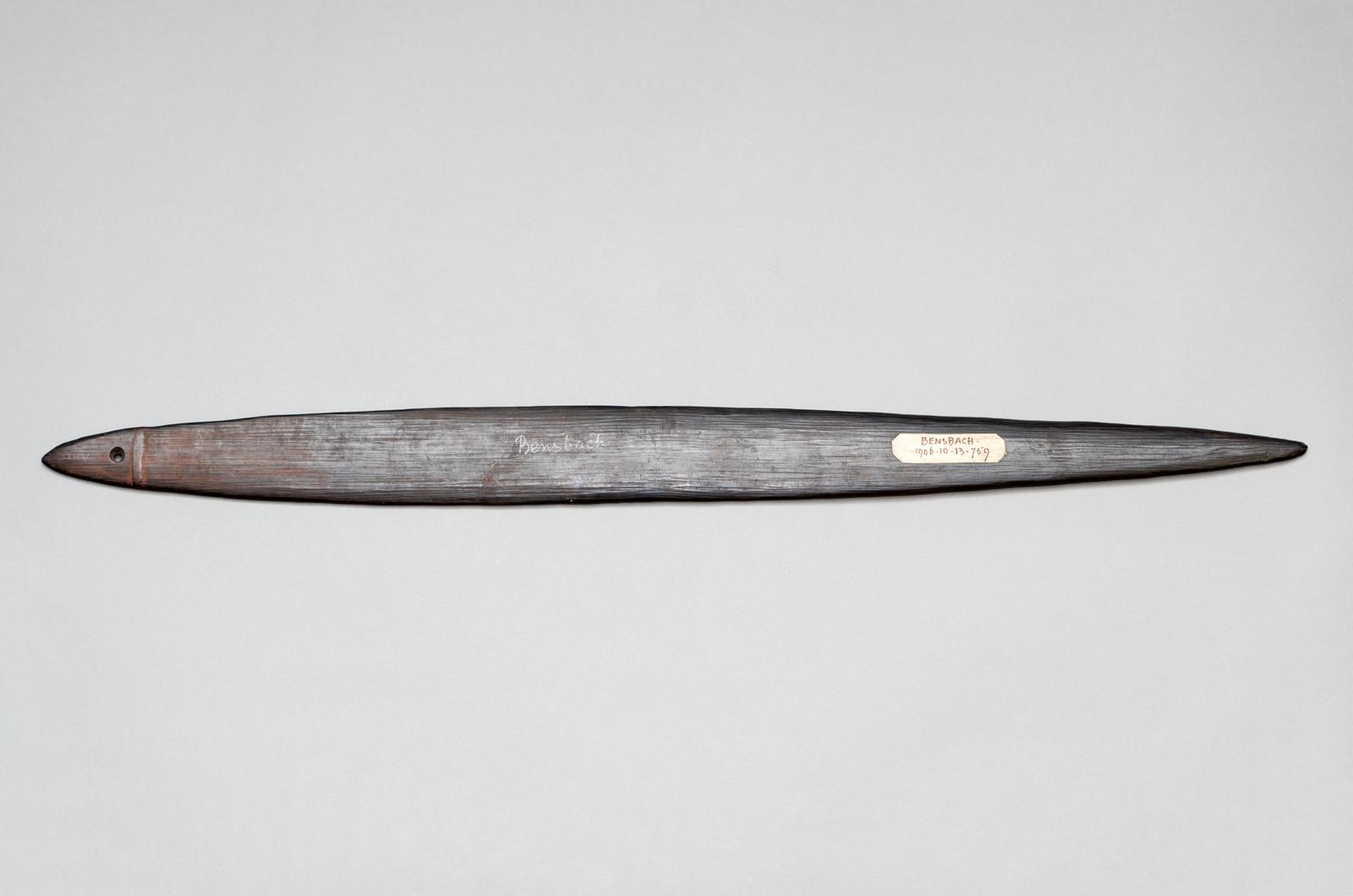
From the Obat to the Pahoturi, then, runs one province of palm-born peoples, and at its two ends the roarer is explicitly a piece of the palm. The Yéi carry chips of the orei; the Ende swing the bark of the tawe palms at Boze; the Keraki and the Nen swing palm wood from the country of the sakr. It is one story told across unrelated languages, and the instrument travels inside it.
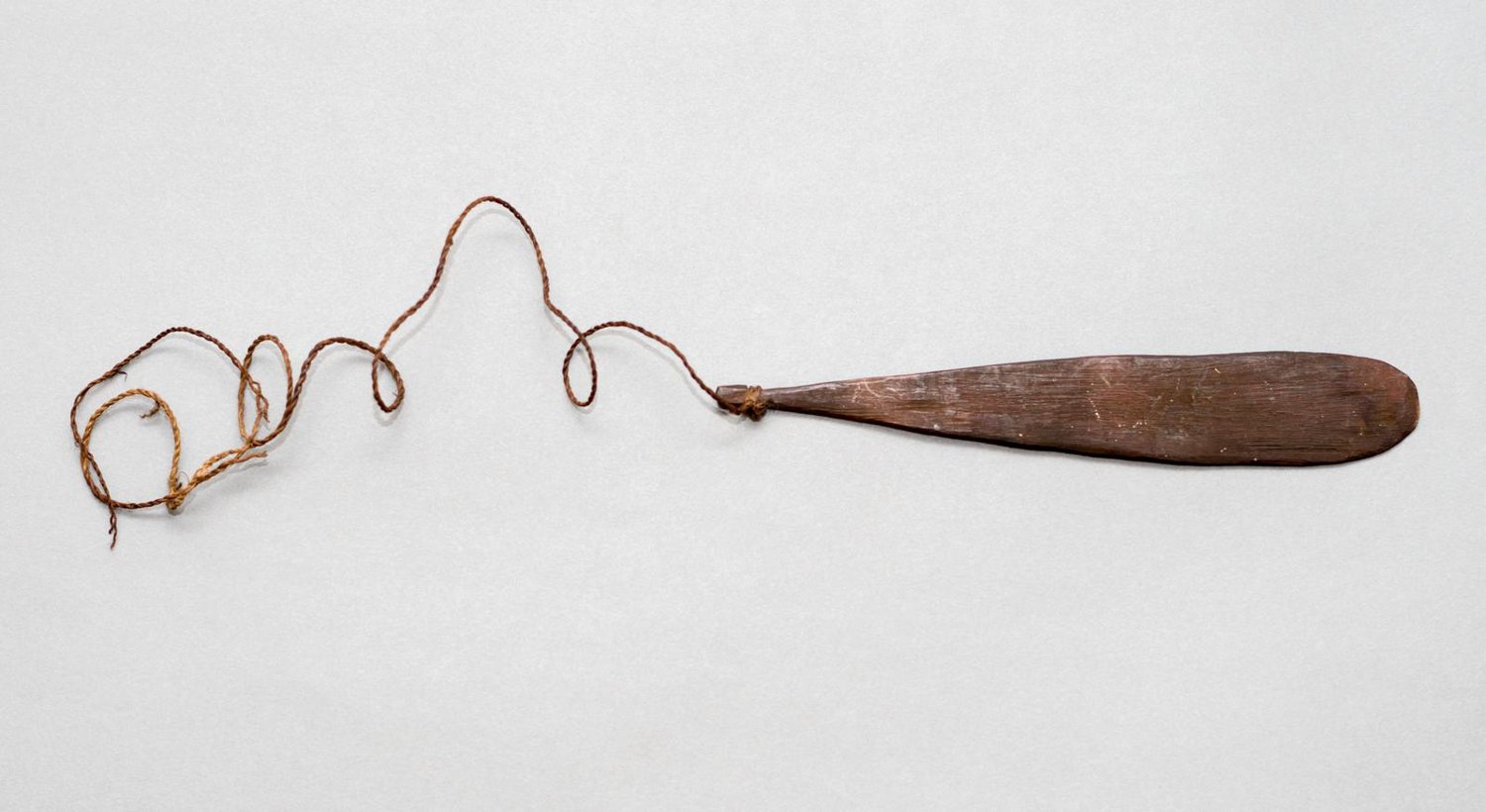
Tango yabo lanqua’s people
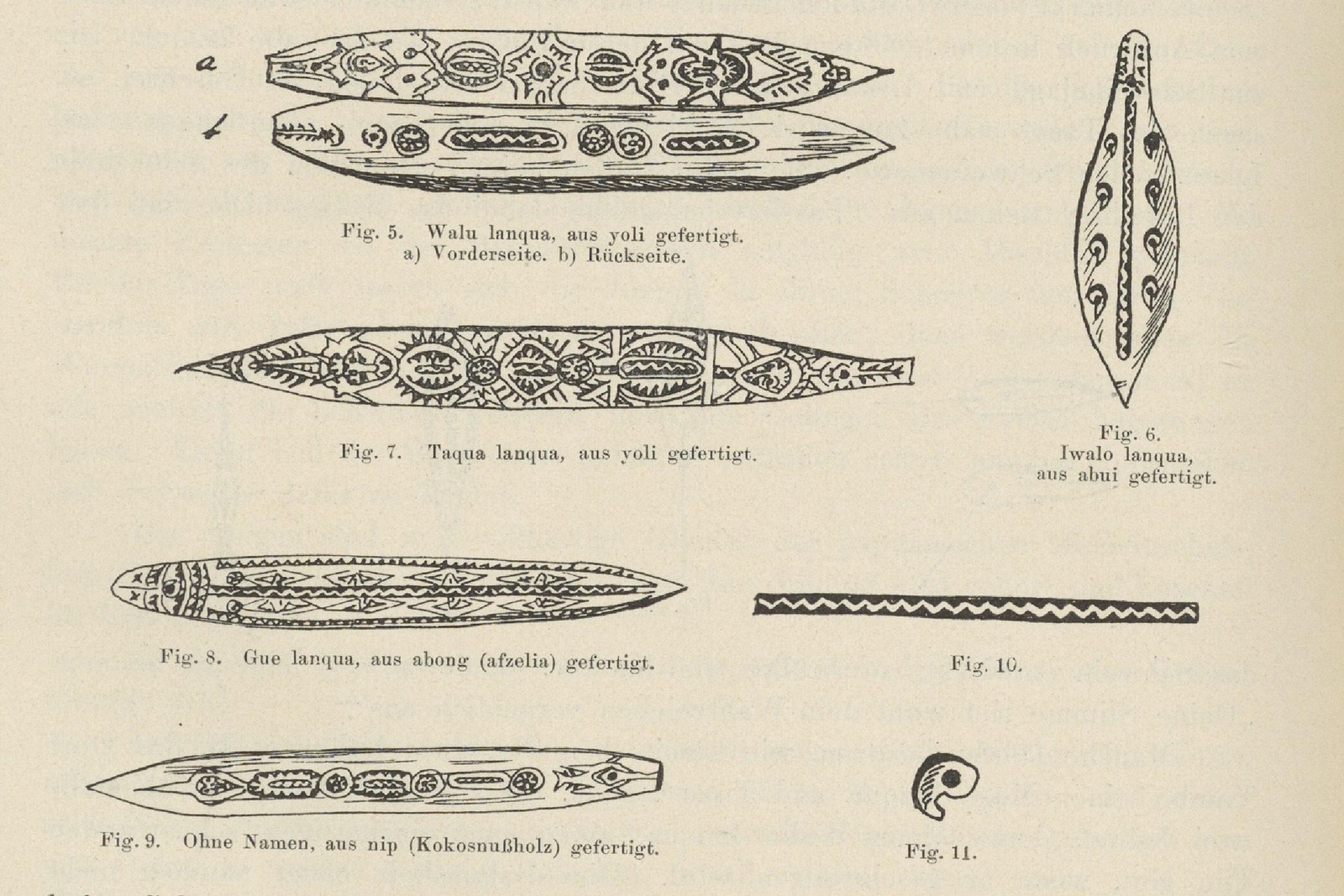
If the roarer is the origin, then the group is whoever came out with it, and the roarer’s name is the group’s own name. On the Huon Gulf, on the same Morobe coast as the Waria, the Bukaua show this from the other side. The missionary Stefan Lehner, writing in 1911, recorded that every village had its own balum, its ruling bullroarer, named for a man of old who had won respect by sorcery or courage, with lanqua, “the Old One,” after his name. The whole village, Lehner says, had professed its balum since time immemorial. Buingim swung Gebing lanqua; Auate, Iwalo lanqua; Bukaua itself, Quamtalo lanqua. And the name did not stay in the bush:
Often the name of the balum is also the war-cry of the village community, which rings out on raids, at pig hunts, at festivals such as the sam (pig market) and the aguwi (girls’ consecration), and of course at the Balum feast.
S. Lehner, “Bukaua,” in R. Neuhauss, Deutsch Neu-Guinea III (1911), p. 411; translated from “das Feldgeschrei der Dorfschaft”
A man whose balum was Tango yabo lanqua, Lehner wrote, would never side with the party whose balum was Nombu lanqua. When outsiders heard the cry across the forest they said “Tango yabo lanqua si lau ki hu,” Tango yabo lanqua’s people are setting their pig nets. A hunter who let the pig through the net was mocked: “Did your voice cry out your emblem for nothing?” The village was called by its roarer, fought under it and was taunted with it. That is exactly what a people does with the name of its founder. The New Guinea Origin follows these blades as evidence of where the cult was born; A Warrant on a Cord reads the Bukaua roarer as a badge of membership. Both follow from this: the Old One on the cord is the village’s own forebear, and the village is called after him.
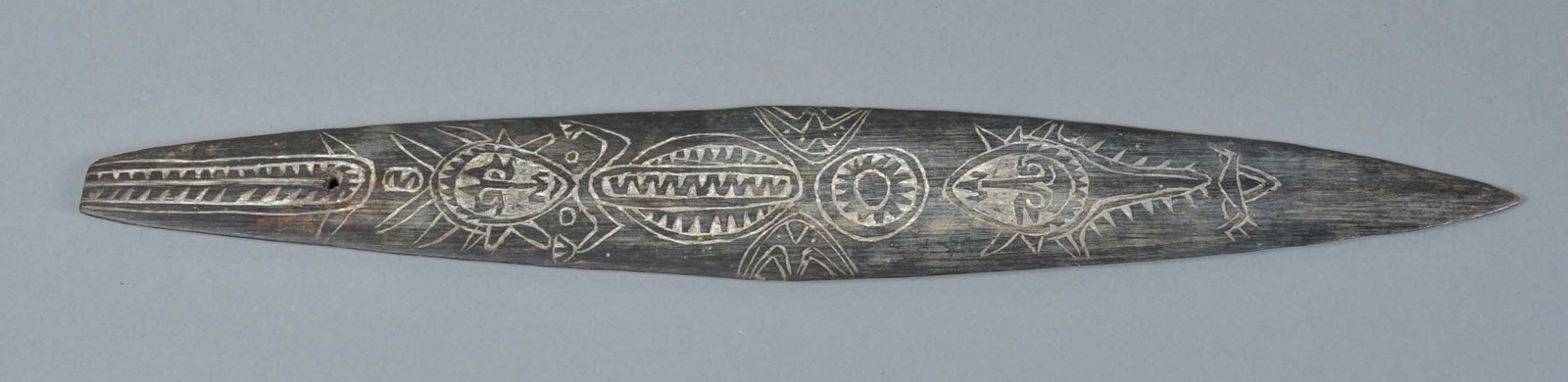
The roarers came from the Waria mouth
Where did the Old Ones come from? The Bukawa-speaking villages answer that themselves. The linguist Joel Bradshaw, tracing the myths and goods that circulated around the Huon Gulf, put it in a sentence:
The Bukawa-speakers north of Salamaua trace the origin of their ritual bullroarers to a village near the mouth of the Waria River far to the south.
Joel Bradshaw, “The Population Kaleidoscope,” Journal of the Polynesian Society 106 (1997), p. 232, citing Hogbin 1951, p. 214
The Waria is the river of the Inaru people, who “emerged and pursued their tradition in the Morobe area while the others are said to have continued on with the vessel.” The Guhu-Samane remember a canoe that put some of its people ashore on the Morobe coast and carried the rest farther. The Bukawa-speakers, up the coast, remember that their bullroarers came from a village at the mouth of the Waria. Set side by side, these read as the two ends of one voyage. The canoe dropped a founding group, and the founding group kept the canoe’s voice; the canoe sailed on, and the voice arrived on the Huon Gulf as a set of named Old Ones, each one a village’s own.
This is how a charter travels. It is not a doctrine taught in a classroom. It is an object with a name, cut from the origin and carried in the hand of the man who came out of it, and wherever he steps ashore it makes that place a beginning. The Yéi myth says so in so many words, with Orei setting each ancestor down at a river mouth with his kupör. The Guhu-Samane entry says so with a ship. The Bukawa-speakers, who never claimed the canoe, kept the other half of the memory: the roarers came up the coast from the south.
The same logic shows farther along the north coast. At the mouth of the Sepik, the Murik name their men’s society, urubaia damag, after its ironwood roarer, urubaia. The group takes the voice’s name, as it does on the Huon Gulf.
The oldest lineage in the government office
Inland from the Huon Gulf, in the Finisterre Range above Teptep, the Yopno kept one bullroarer above all the rest. The anthropologist Christin Kocher Schmid saw it on display at the site of the planned cultural centre:
a bullroarer, representing the ancestor of the oldest lineage of the Yopno eserong, and serving as a symbol of traditional law. This bullroarer used to be kept in the subdistrict office, investing the officer in charge with traditional legal authority.
Christin Kocher Schmid, Bijdragen tot de Taal-, Land- en Volkenkunde 149 (1993), p. 791
The blade is the founder of the senior line, and for that reason it is the law. When the government came, no new emblem of authority was needed: the ancestor sat in the subdistrict office, and the officer in charge drew his traditional legal authority from him. A Warrant on a Cord tells the rest of this object’s career. What this essay adds is the reason it worked. A Yopno bullroarer could make a stranger lawful because it was the oldest beginning the Yopno had, and whoever holds the beginning holds the right to say how things are.
“Show your grandfather to you”
The idea crossed to Australia, and at the far end of the continent it is spoken more plainly than anywhere. In Gippsland, in south-eastern Australia, the Kurnai men in charge of the boys told them, at the height of the Jeraeil initiation: “This afternoon we will take you, and show your grandfather to you.” What they showed was the bullroarer. Alfred Howitt explains:
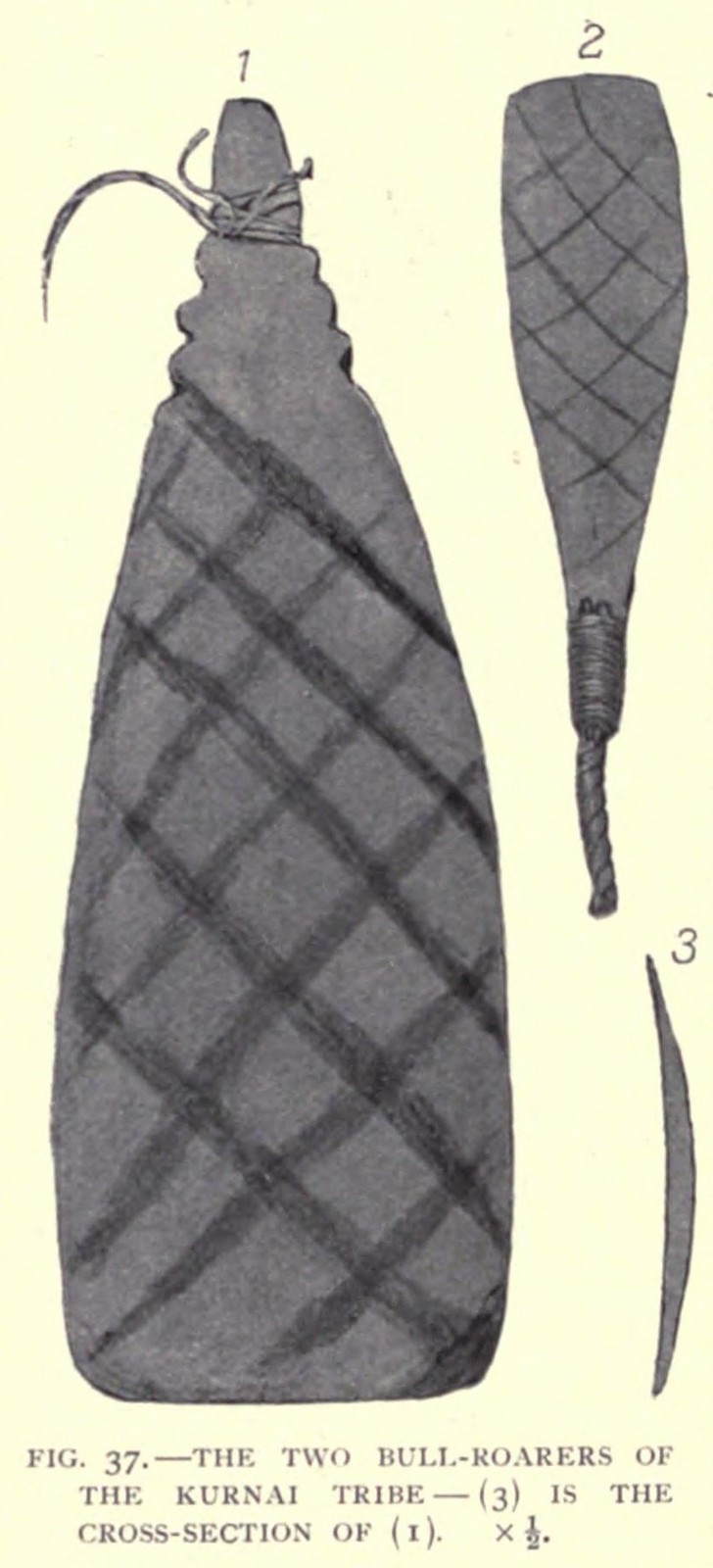
The Kurnai have two bull-roarers, a larger one called “Tundun” or “the man,” and a smaller one called “Rukut-Tundun” the woman, or wife of Tundun. The larger one is also called “Grandfather,” Wehntwin …
A. W. Howitt, The Native Tribes of South-East Australia (1904), p. 628
Then the old headman revealed the ancestral beliefs to the novices. Howitt condenses them:
Long ago there was a great Being, called Mungan-ngaua, who lived on the earth, and who taught the Kurnai of that time to make implements, nets, canoes, weapons — in fact, all the arts they know. He also gave them the personal names they bear, such as Tulaba. Mungan-ngaua had a son named Tundun, who was married, and who is the direct ancestor — (the Wehntwin, or father’s father) — of the Kurnai. Mungan-ngaua instituted the Jeraeil, which was conducted by Tundun, who made the instruments which bear the names of himself and of his wife.
Howitt 1904, p. 630
The Kurnai Tundun is the forefather of the Kurnai, made by his own hand and called by his own name. In the same telling, when the secret was betrayed, “the sea rushed over the land,” the survivors became the ancestors of the Kurnai, and Tundun and his wife became porpoises: the founder went back into the sea. Grandfather and Mother follows the kin terms the roarer carries across Australia; the point here is narrower and stronger. The boys are not told that the noise is a spirit. They are introduced to the man they come from.
Baldwin Spencer and Frank Gillen saw at once that this was a different thing from the spirit-voice told to women and children. Writing in 1899 they set the two side by side:
We are not referring to the fact that, as Mr. Howitt first showed, and as has since been abundantly verified by other workers, the women and children are taught to believe that the voice of the bull-roarer is that of some spirit such as Daramulun, but in Mr. Howitt’s paper dealing with the Jeraeil of the Kurnai tribe we meet with the still more suggestive fact that at a certain time during the initiation ceremonies the men who are in charge of the novices say to them, “This afternoon we will take you, and show your grandfather to you.” … In this account we see, first, that the bull-roarer is identified with a man who is regarded as a great ancestor or Weitwin, that is father’s father of the Kurnai. He it was who conducted the first ceremony of initiation, and he made the bull-roarer which bears his name and also made another smaller one which represents his wife.
Baldwin Spencer and F. J. Gillen, The Native Tribes of Central Australia (1899), pp. 137–138
“Still more suggestive” is right. The spirit’s voice is what the uninitiated hear. The forefather is what the initiated are shown.
Dropped at the place of origin
Spencer and Gillen knew the idea from their own field. Among the Arunta of Central Australia the deepest form of it belongs to the sacred boards and stones, the churinga, of which the whirled bullroarer is one branch. Every Arunta person is an ancestor of the Alcheringa, the creation time, come back, and every person has a churinga that marks the place the ancestor came out of. When a spirit-child enters a woman, they say, its churinga is dropped on the spot. If the men cannot find it they make one:
If it cannot be found then they proceed to make a wooden one from the Mulga or other hard wood tree nearest to the Nanja, and to carve on it some device or brand peculiar to the totem. Ever afterwards the Nanja tree or stone of the spirit is the Nanja of the child, and the Churinga is its Churinga nanja.
Spencer and Gillen 1899, p. 132
When the men must make one, the board is cut from the tree at the person’s point of origin, as the Yéi chip is cut from the orei and the Ende blade from the twin palms. It goes to the storehouse of the place the spirit came from, and it carries a name. Each churinga, they write, “is indeed the representative of, one of the Alcheringa ancestors,” and the living child “is the reincarnation of that particular spirit individual” (p. 138). The headman then gives the child its secret name, “either a new one or that of some celebrated man or woman of the Alcheringa” (p. 139), and their glossary defines it as the name “associated with his or her Churinga which belonged to an ancestor of whom the living individual is regarded as the reincarnation.”
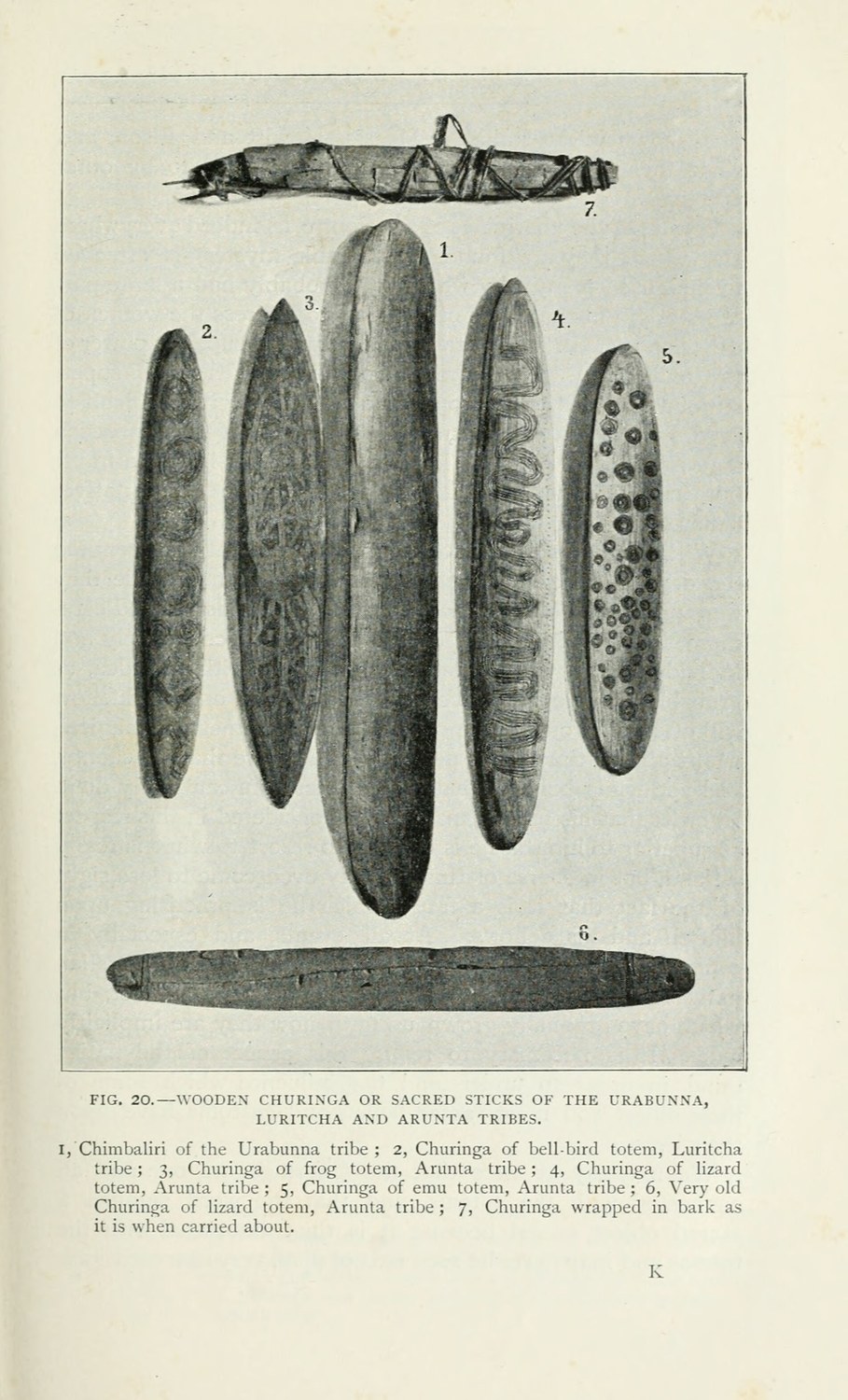
This is the Inaru identity at the scale of a single life. A people steps out of a canoe and keeps its voice; a person steps out of a tree or a stone and keeps its board. In Arunta country the object is usually a stone or board kept silent in the storehouse rather than a roarer swung in the dark, but the grammar is the same one the Yéi spoke with a palm and the Guhu-Samane with a ship.
The origin, still speaking
A people’s bullroarer is a chip of the thing the people came out of, and it carries that thing’s name: when it roars, the origin speaks in the present tense. That is why one blade can be a village’s war-cry, a lineage’s founder and the warrant for law, and why the charter travelled along the New Guinea coast with the founders who carried it.
Every case says it in its own materials. The Guhu-Samane named the canoe, the roarer, a clan and themselves Inaru, and gave their roarers the names of their gods. The Yéi came out of the orei palm in orei canoes led by Orei, each ancestor holding his chip of orei, and every initiate swallows that chip and becomes one with Orei. The Ende cut their roarers from the palms where their language began, and the first words came out of the roarers as they spun. The Bukaua shout the name of the Old One on the cord as their village’s war-cry, and the Bukawa-speakers trace their Old Ones to the mouth of the Waria, the river of the Inaru people. The Yopno set their oldest ancestor in the government office and made the officer lawful. The Kurnai showed their boys the grandfather of the Kurnai. The Arunta keep for every person a churinga from the place where that person’s ancestor came out, and give the person a secret name that goes with it.
Once the roarer is understood as the origin itself, its other powers stop needing separate explanations. It can be a war-cry because a village fights under its founder’s name. It can confer office because it is the arrival, handed on. It can stand for law because the first ancestor of the oldest line is where the way things are began. It must be hidden from those outside the group because it is the group, in the singular. And it moves the way founders move: in a canoe, down a coast, put ashore at a river mouth with a chip of the first palm in hand. The roar heard in a Huon Gulf village on the night of a balum feast is the sound of a landing on the Morobe coast, still going on.
Key sources
- Summer Institute of Linguistics, Papua New Guinea, Guhu-Samane lexicon (Noo Supu dictionary, with Ttopoqogo Hoopusu; Lexique Pro edition, 2007), entries Inaru, Poro (1), Poro ungapa, poro nese.
- J. van Baal, ed., Jan Verschueren’s Description of Yéi-nan Culture (Verhandelingen KITLV 99, 1982), pp. 46–49 (the orei palm, its canoes and the kupör), pp. 72–73 (the initiate as his clan yevale).
- Kate L. Lindsey, Ghost Elements in Ende Phonology (PhD thesis, Stanford University, 2019), App. C.1.1, pp. 287–288 and n. 67; story told by D. Kollowam and J. Ben Danipa.
- Kyoko Kashima, PhD thesis (Australian National University, 2020), pp. 51–52, for F. E. Williams, Papuans of the Trans-Fly (1936), pp. 54–55, on the sakr palm; Nicholas Evans, Nen dictionary, Dictionaria 8 (2019), s.v. Mñ, meyang.
- Stefan Lehner, “Bukaua,” in R. Neuhauss, Deutsch Neu-Guinea III (1911), pp. 411–412.
- Joel Bradshaw, “The Population Kaleidoscope: Another Factor in the Melanesian Diversity v. Polynesian Homogeneity Debate,” Journal of the Polynesian Society 106 (1997), pp. 222–249, at p. 232; citing H. Ian Hogbin, Transformation Scene (1951), p. 214.
- P. Schmidt (1926), p. 49, and Joseph Schmidt, Anthropos 28 (1933), p. 352, on the Murik urubaia.
- Christin Kocher Schmid, “Cultural Identity as a Coping Strategy towards Modern Political Structures,” Bijdragen tot de Taal-, Land- en Volkenkunde 149 (1993), p. 791.
- A. W. Howitt, The Native Tribes of South-East Australia (1904), pp. 628–630 and fig. 37.
- Baldwin Spencer and F. J. Gillen, The Native Tribes of Central Australia (1899), pp. 132–133, 137–139, and glossary s.v. Aritna churinga.
- As far as we know, the reading of the Guhu-Samane Inaru entry beside the Bukawa tradition of roarers from the Waria mouth is original to this page.