Atlas Essay —
The Yeenma Isogloss
Eucla · Southern Cross · the Goldfields · the Murchison
At Karratjibbin, in the goldfields scrub between Southern Cross and Mount Jackson in Western Australia, Daisy Bates wrote a two-word equation: “Bullroarer | Yinma.” Nine hundred kilometres east, on the Eucla coast of the Great Australian Bight, a man named Karnduing told her that the yinma was a long sacred board carved with the heart and belly of the eaglehawk, and that the dark spot in the Milky Way was its shadow. Far to the north-west, on the Sanford River in the Murchison, Kondebomur called the sounding blade mirroodee and called the board revealed to a new-made man yeenma. One word for the bullroarer, yeenma, was borrowed from language to language across some 1,350 kilometres of Western Australia, from the Bight to the Murchison, and it carried the object, the initiation and the sky-story with it.
In brief
- Speakers in eight places between Eucla and the Sanford River gave Bates yeenma, yinma, inma, or a close variant of it.
- The Karratjibbin folio glosses “Bullroarer” as Yinma and the long and short sacred totem boards as Goondain, Yeenma and Jilberee, yeenma. Bates’s papers also record a “Stone yeenma, bullroarer from Southern Cross district.”
- Further north the borrowed word settles on the large board while the roarer keeps a local name — Mirudi, Meerudi, Mirroodee — so what crossed the frontier was a two-part ritual kit, not a noisemaker.
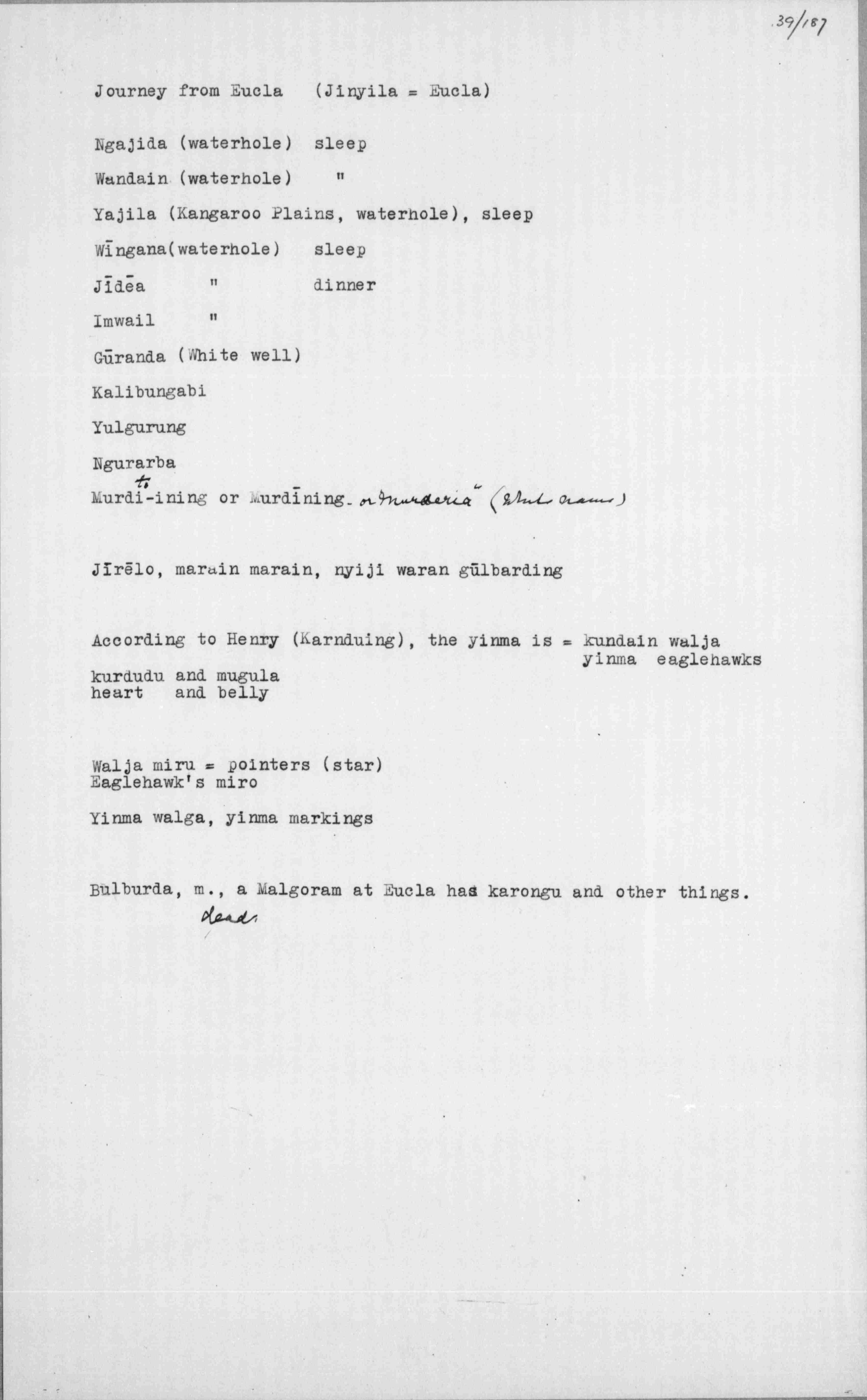
- At Eucla, and again at Weld Range some 1,100 kilometres away, the dark spot in the Milky Way is that sacred board.
One word for the bullroarer, yeenma, was borrowed from language to language across some 1,350 kilometres of Western Australia, from the Bight to the Murchison, and it carried the object, the initiation and the sky-story with it.
From the Bight to the Murchison
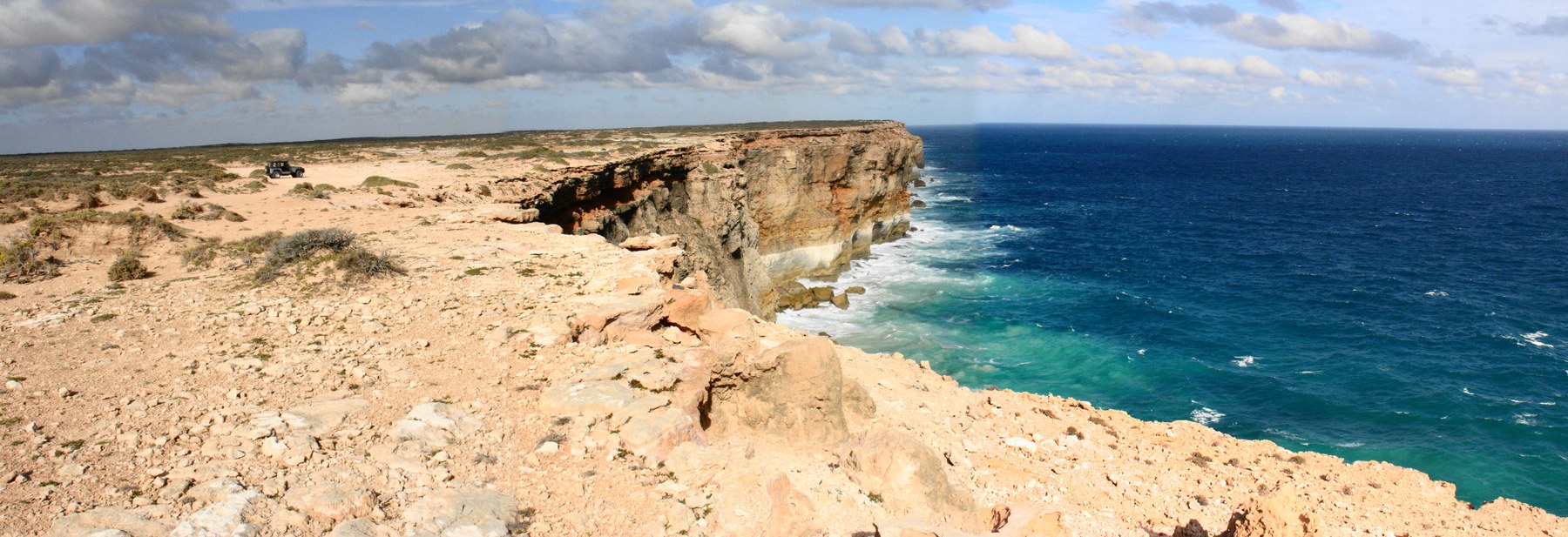
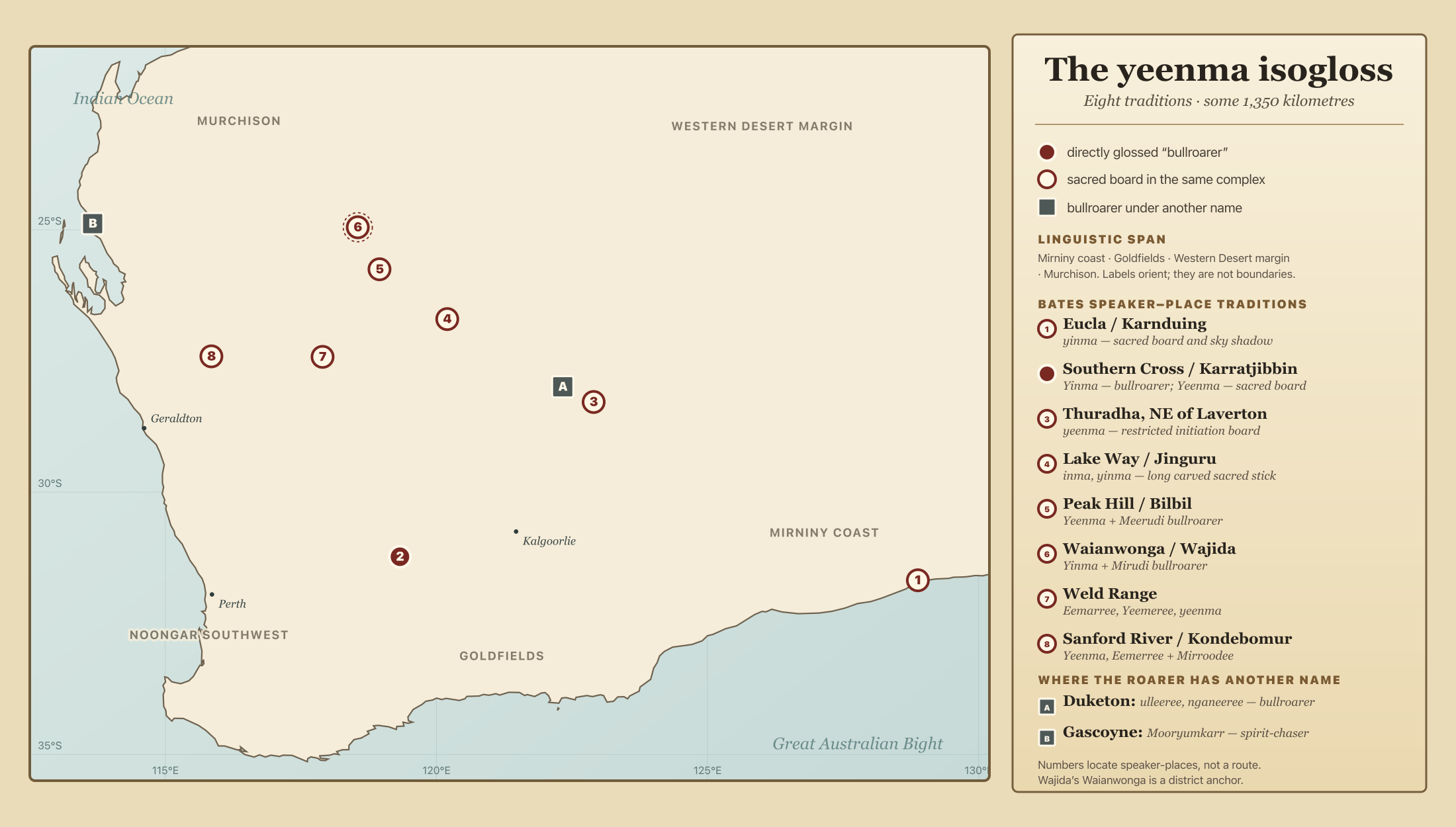
An isogloss is normally drawn as an edge: people on one side of the line say a word that people on the other side do not. The yeenma line is drawn instead through the middle of the country it crosses. It runs from Eucla on the Great Australian Bight, inland through the eastern Goldfields, up the western lip of the Western Desert, and out onto the Murchison at the Sanford River — 1,350 kilometres from end to end, measured between the two furthest speaker-places Bates recorded.
On the map below, the dark-red disc at Southern Cross is the one place where Bates equates yinma directly with “bullroarer.” The open rings are the places where the same word names the long sacred board that the roarer belongs beside. The two dark squares are the districts where the roarer answers to something else entirely.
Where yeenma is recorded
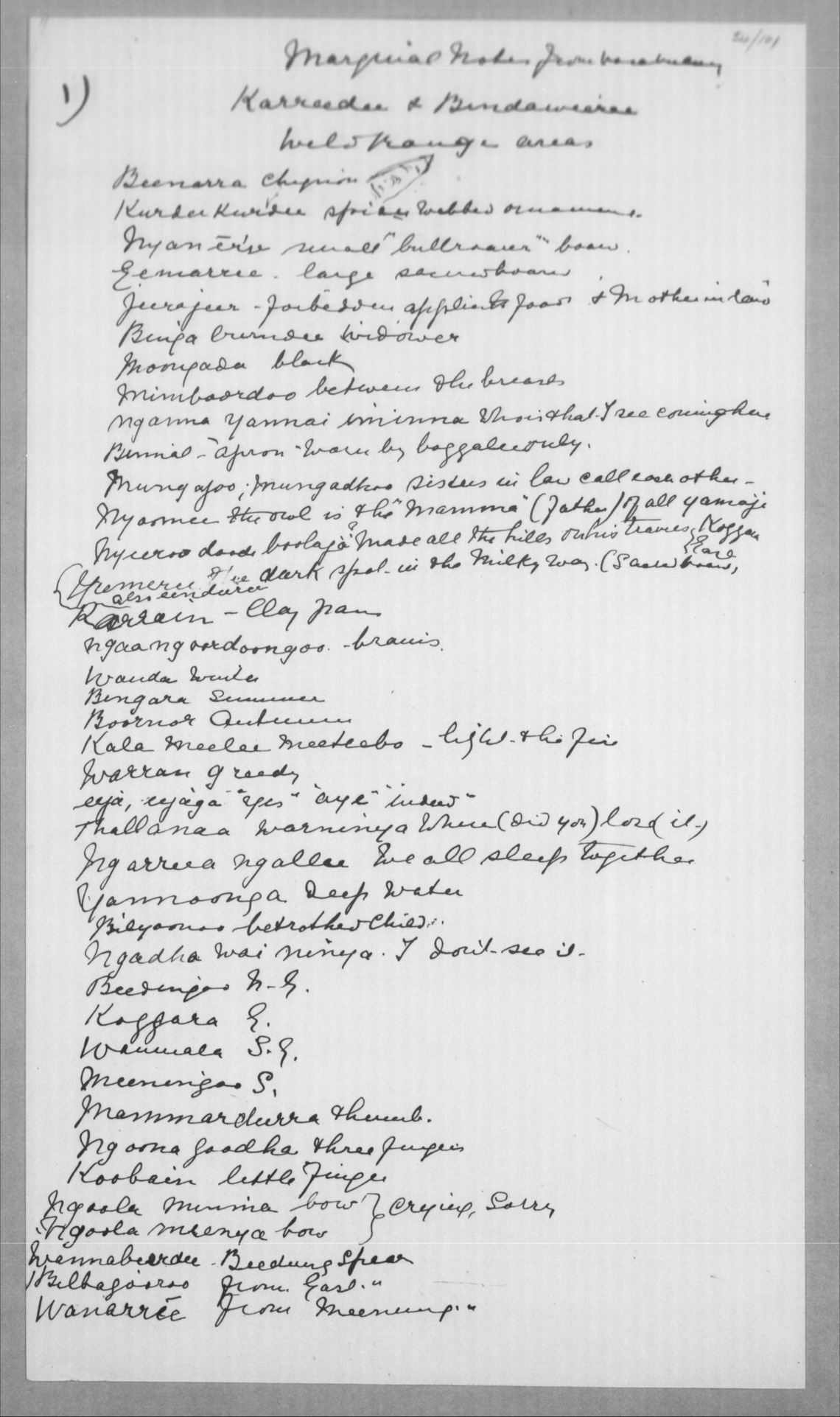
Speakers in eight places gave Bates the word: Karnduing at Eucla; Beedee, Bailberin and Gweea at Karratjibbin near Southern Cross; Thuradha north-east of Laverton; Jinguru at Lake Way; Bilbil in the Peak Hill district; Wajida of Waianwonga; Karreedee and Bindaweeree at Weld Range; and Kondebomur at the Sanford River.
| Speaker-place tradition | Recorded form | What the word names |
|---|---|---|
| Eucla / Karnduing | yinma | long sacred board; eaglehawk-marked board; its shadow in the Milky Way |
| Karratjibbin / Southern Cross | Yinma; Yeenma | bullroarer; long and short sacred totem boards |
| Thuradha / north-east of Laverton | yeenma; yinma; inma | secret sacred board handled in initiation |
| Jinguru / Lake Way | inma; yinma | long carved sacred stick |
| Bilbil / Peak Hill | Yeenma | long board with totem markings, beside Meerudi bullroarer |
| Wajida / Waianwonga | Yinma | long pointed carved board, beside Mirudi bullroarer |
| Karreedee and Bindaweeree / Weld Range | Eemarree; Yeemeree; yeenma | large sacred board; its dark place in the Milky Way |
| Kondebomur / Sanford River | Yeenma; Eemerree | board revealed and entrusted after initiation, beside Mirroodee |
Karratjibbin, between Southern Cross and Mount Jackson
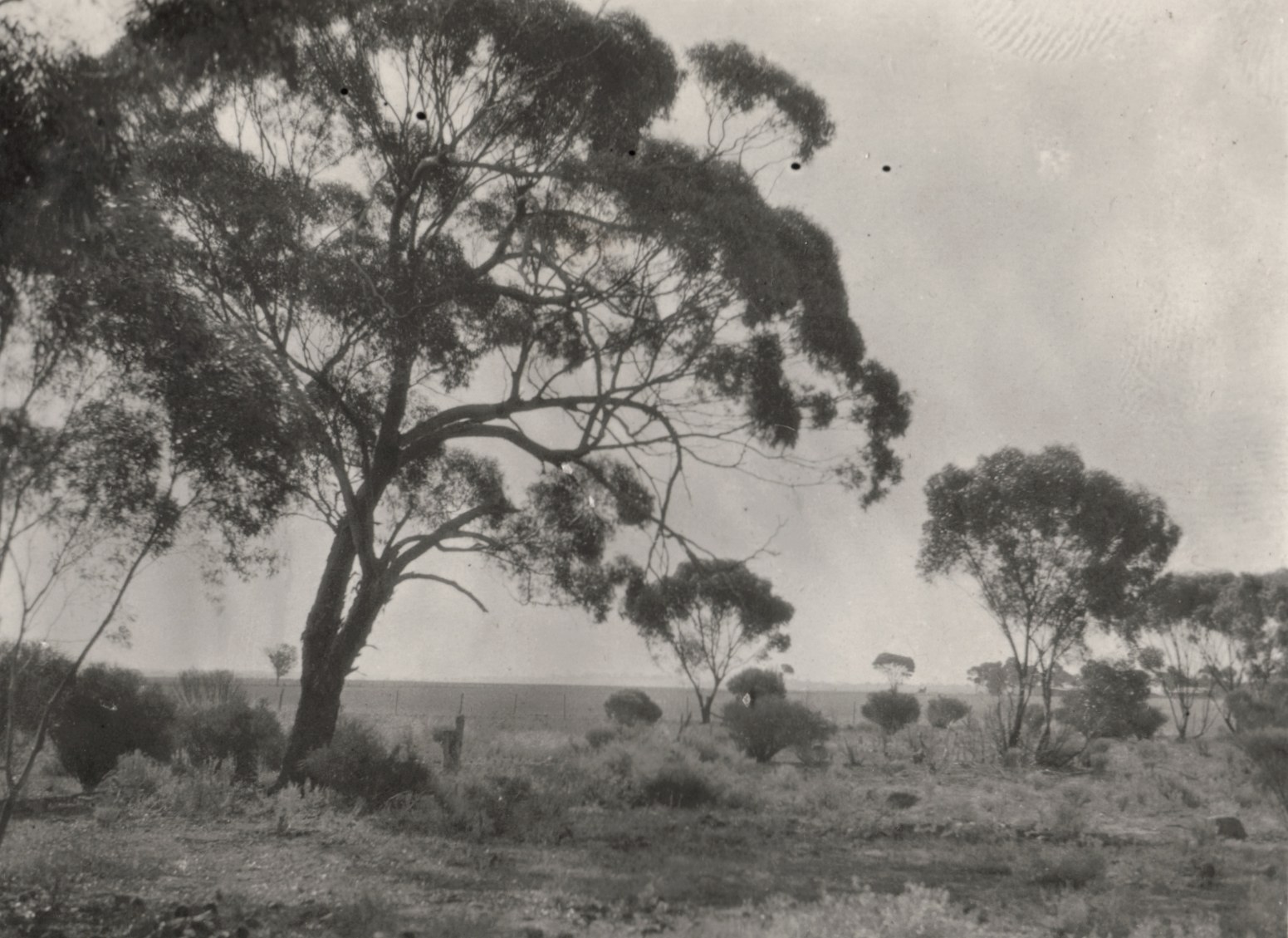
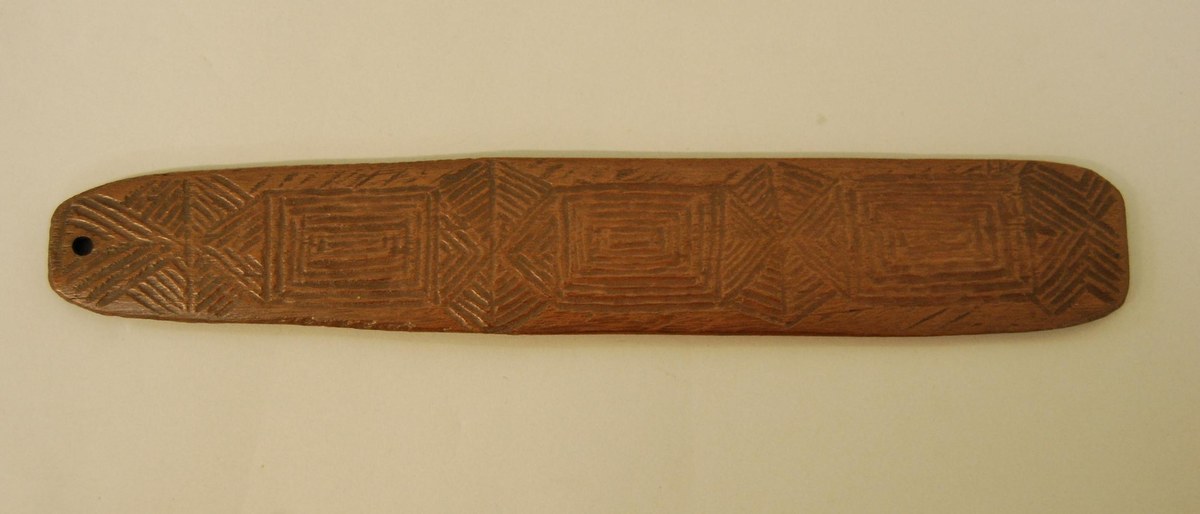
Beedee, Bailberin — Billy Wilson — and Gweea, also called Minalla, worked through Bates’s vocabulary at Karratjibbin, and their folio does the whole job in three entries. “Bullroarer | Yinma.” “Sacred Totem board long | Goondain, Yeenma.” “Sacred Totem board small short | Jilberee, yeenma.” A photograph caption in Bates’s papers at the State Library of Western Australia records the object itself: “Stone yeenma, bullroarer from Southern Cross district.”
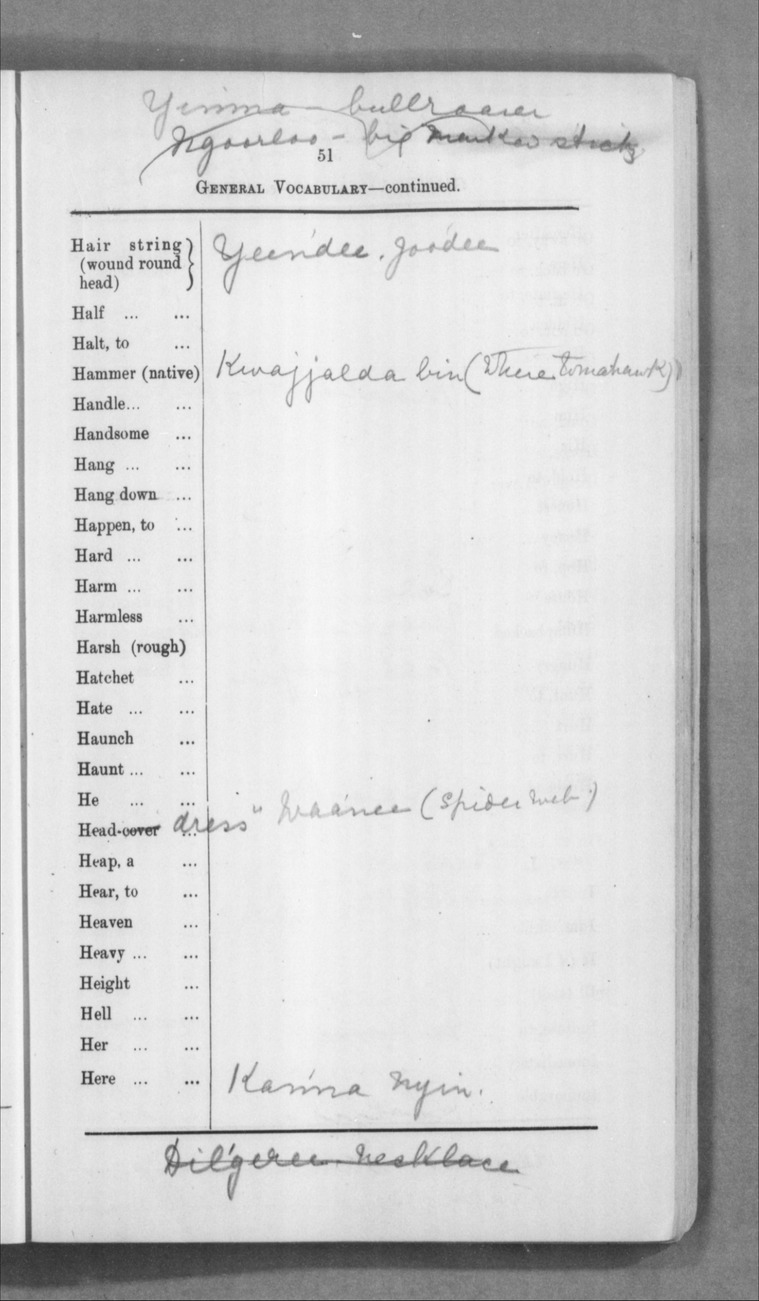
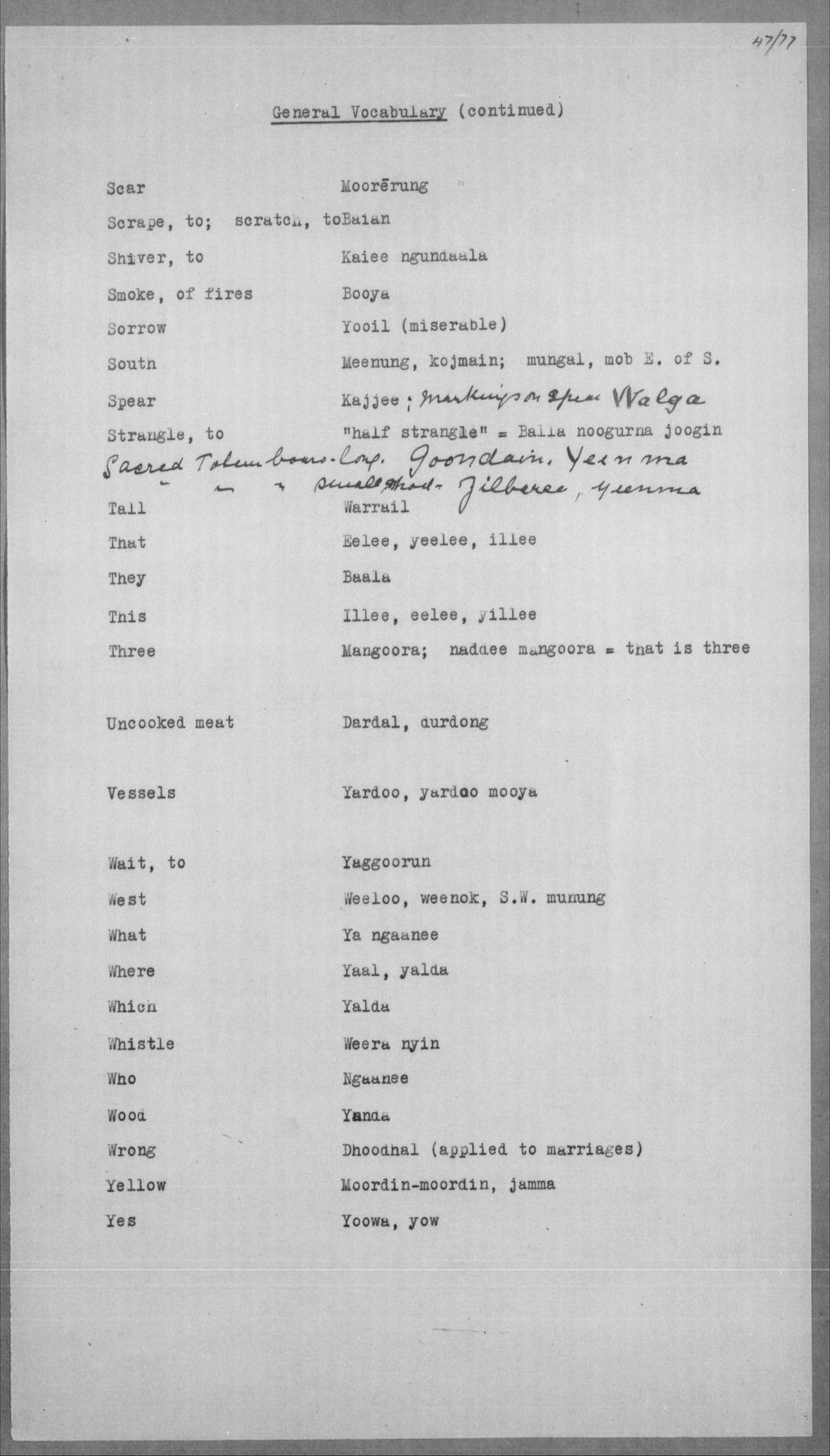
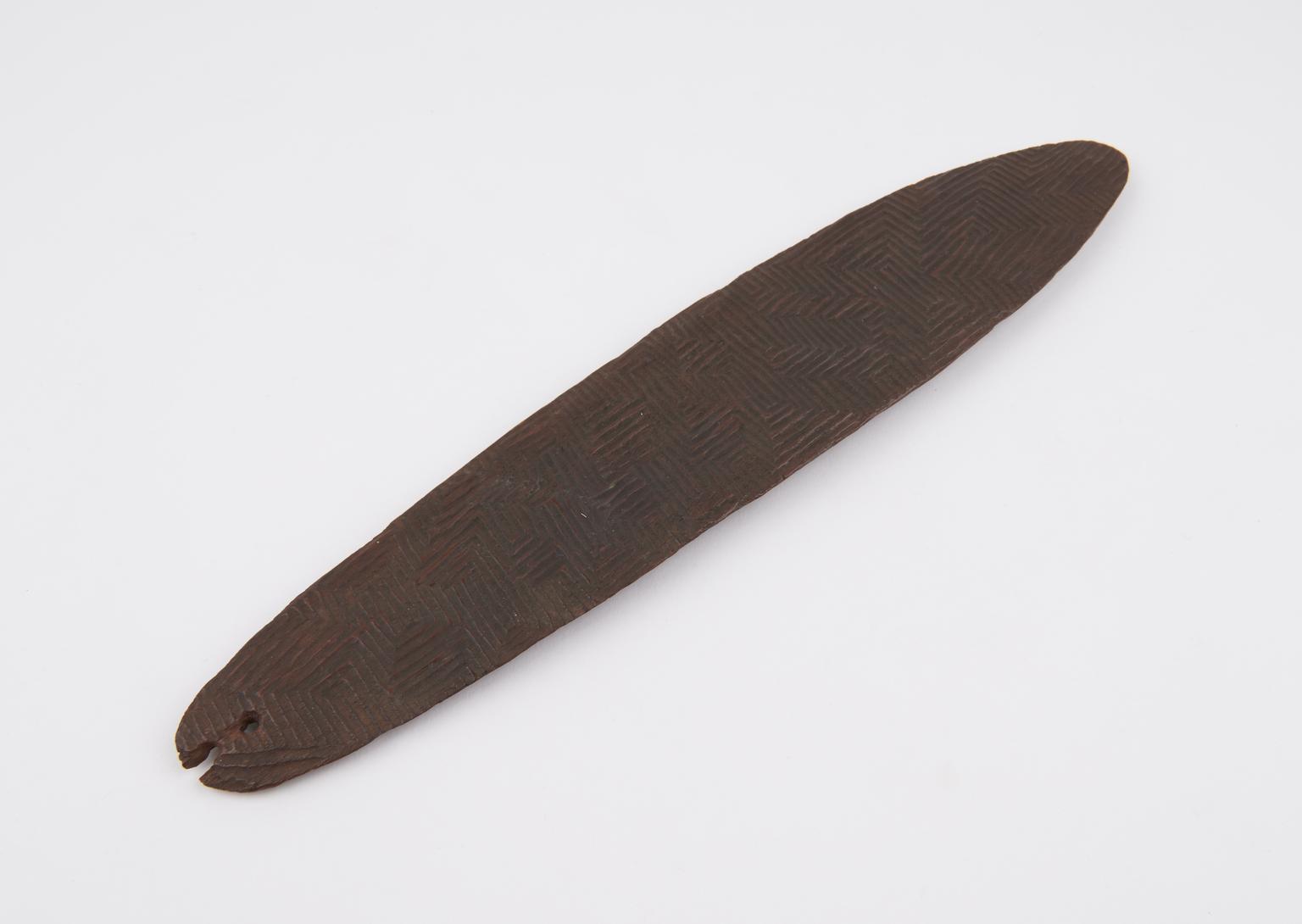
So in this country the word runs across the whole class: the whirled slat, the long board, the short board, wood and stone. Bates elsewhere equated these boards with Spencer’s churinga, and the physical grounds for the equation are visible in any of them — flat, pointed at the ends, incised on one face, pierced at one end for a cord. Yeenma can name the bullroarer at Southern Cross because at Southern Cross the bullroarer is one of the sacred boards.
The board, the blade and the novice
What the word carries with it, from one end of the corridor to the other, is a rite. At Eucla the yinma bears the eaglehawk’s heart and belly — kurdudu and mugula in Karnduing’s telling. At Thuradha, north-east of Laverton, the yeenma is a sacred board pushed through the novice’s mouth and down into his stomach, and Bates’s note on it is flat: it must not be seen or touched by women or uninitiated men. At the Sanford River the yeenma is shown to the boy after he is made a man, drawn across his breast, and afterwards given into his keeping; the women cover their faces while it passes, and only the old women may look.
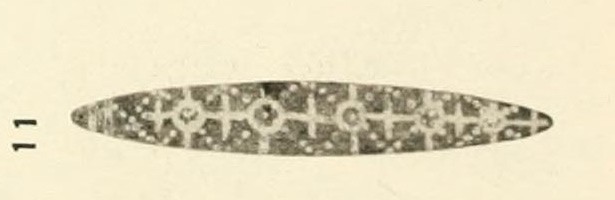
Beside that board, in the northern half of the corridor, stands a second object with a name of its own. Wajida of Waianwonga gives Mirudi for the bullroarer and Yinma for the long narrow board pointed at both ends. Bilbil in the Peak Hill district gives Meerudi, “magic board (bullroarer),” and Yeenma for the long board carved with totem markings, along with Jewurarra for the wood the yeenmee were made from. Kondebomur gives Mirroodee for the bullroarer and Yeenma, or Eemerree, for the board revealed after initiation. At Weld Range the small bullroarer is Nyanēr’se and the large board Eemarree.

That is the shape of the borrowing. A word taken up loosely for a noisemaker would attach to the thing that makes the noise. Here the borrowed word settles one level up, on the class of boards the roarer belongs to, while the roarer itself keeps whatever the local language already called it. The whole two-part kit moved: a long incised board hidden from women and novices, a smaller sounding blade beside it, a revelation at man-making, and a place in the sky.
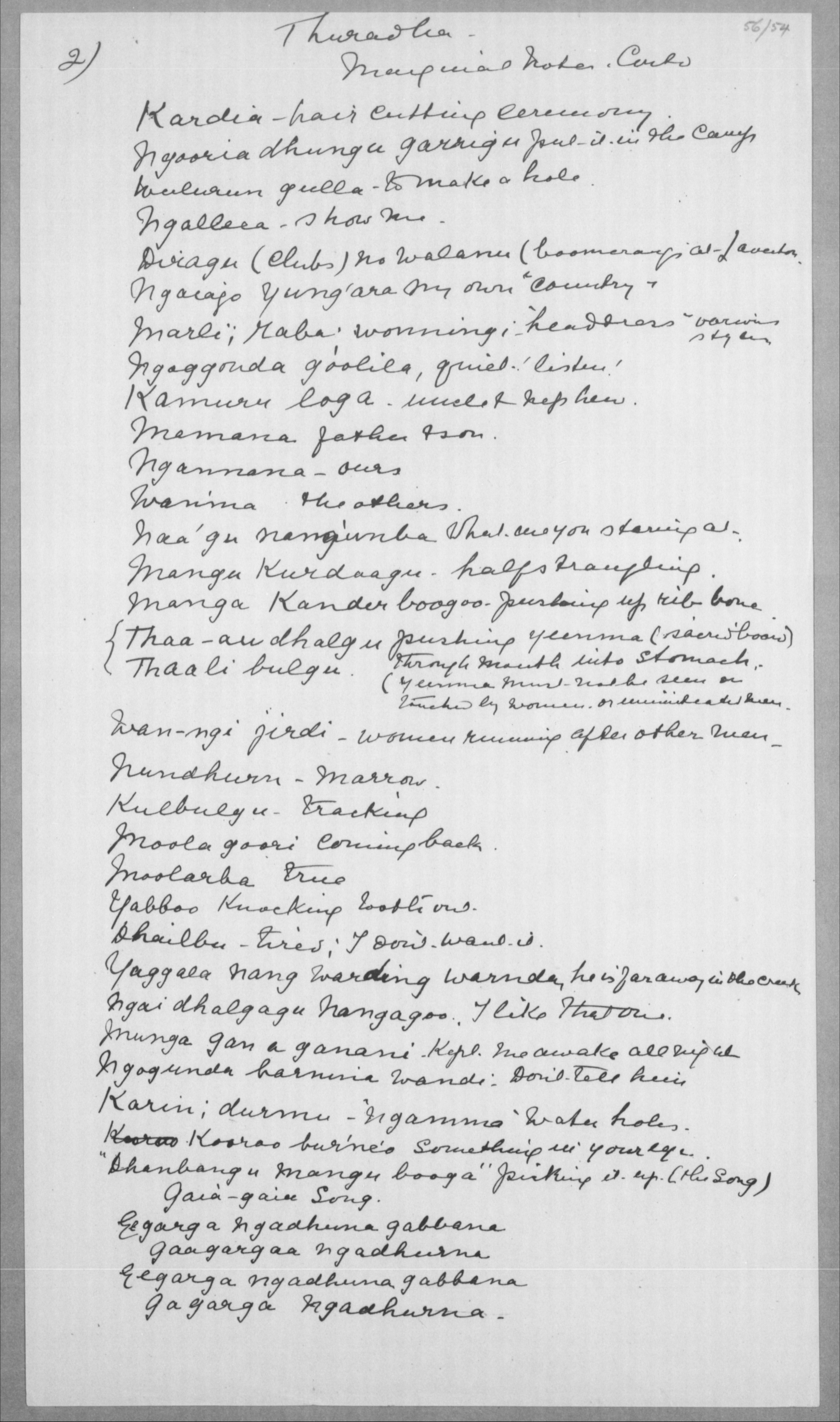
“yeenma must not be seen or touched by women or uninitiated men”— Daisy Bates, Thuradha’s vocabulary, north-east of Laverton, folio 56/25–54
Inma on the Western Desert margin
The word did not stop at the object. Bates’s “Central Districts” compilation folds three English glosses into inma — totem object, totem ceremony, totem songs — and lists inma among “all sacred boards — bullroarers, etc.” The same pages use it for a carved sacred board, for dances, and for the cleared ground a performance is held on. In Western Desert communities today inma is still song and ceremonial performance: an Australian Government account of an Aṉangu Pitjantjatjara Yankunytjatjara language project describes children’s inma as “stories sung and danced.”
That spread is what a borrowed word looks like at the receiving end. It arrives with the board, and in the language that takes it in it widens to cover the ceremony the board belongs to, the songs sung over it, and the ground it is shown on. Jinguru at Lake Way, well inside the Western Desert network, still gives the older, narrower sense first: “Inma, yinma | Long carved sacred stick.”
And it is the pairing, not the syllables, that settles the matter. A long incised board with a separately named roarer beside it, revealed to a novice at man-making and answered by a dark shape in the Milky Way, is not a thing reconstructible for a Pama-Nyungan ancestor; it is an institution with parts, and it rides with the object. Where the object went, so did its name — from Eucla to the Sanford River, through Mirniny, Ngadju, Wati and Kartu speech.
Eucla and Weld Range look into the same dark spot
Bates’s Eucla star list names the dark patch in the Milky Way — the Coalsack — as the shadow of the sacred long Yinma. Karnduing’s vocabulary from the same country explains the markings on that board: they are the heart and belly of the eaglehawk. In the star myth Bates took from the Willilambi people near Twilight Cove in 1924 the two accounts join: the old men, having killed the eaglehawk Walja who had been taking their boys, cut his heart, ribs, stomach, entrails and tail into the long yeenma boards, and made boorbing bullroarers from the same hardwood, which was moodiji — forbidden to the eaglehawk people and reserved to the hardwood totem.
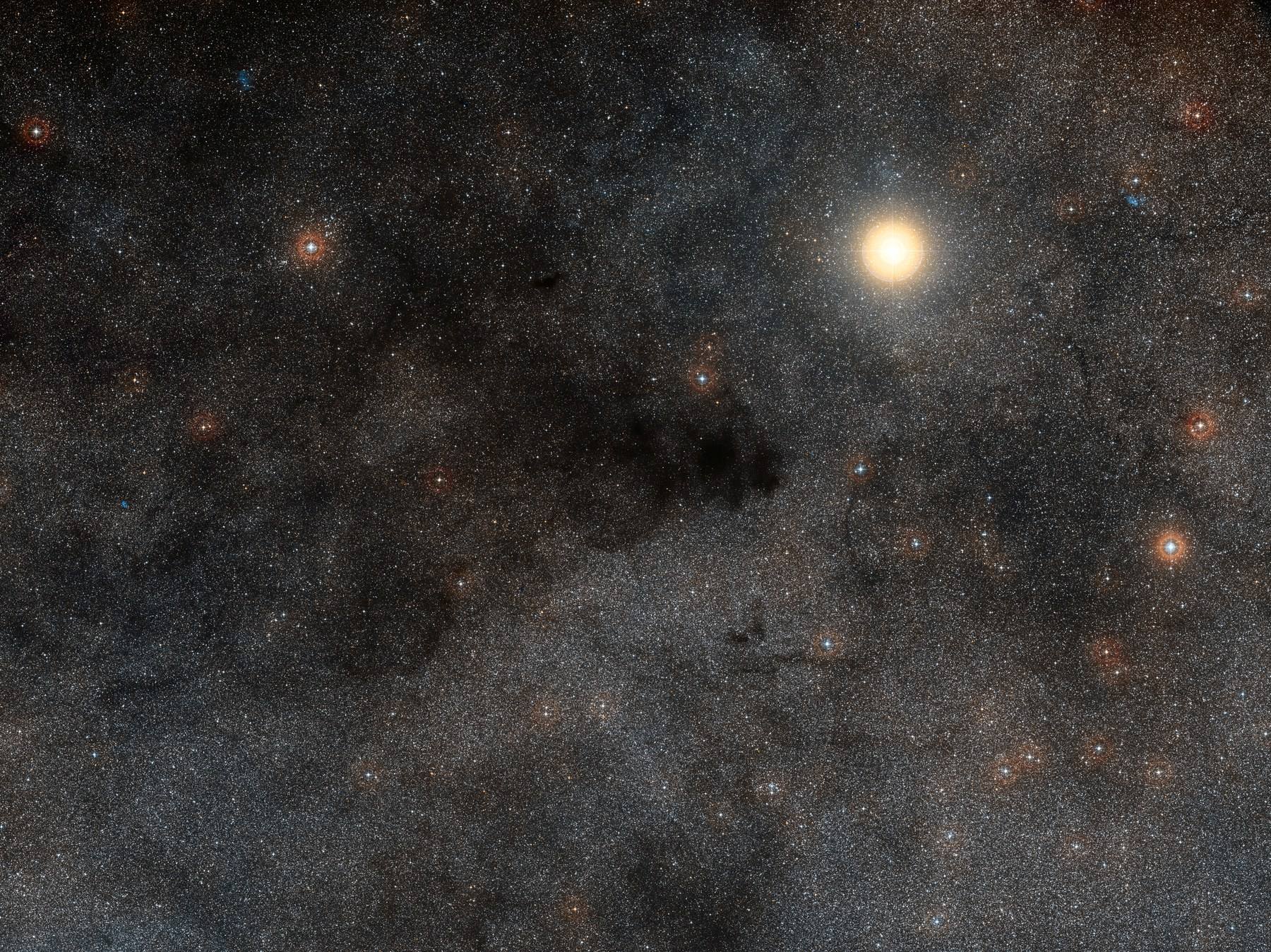
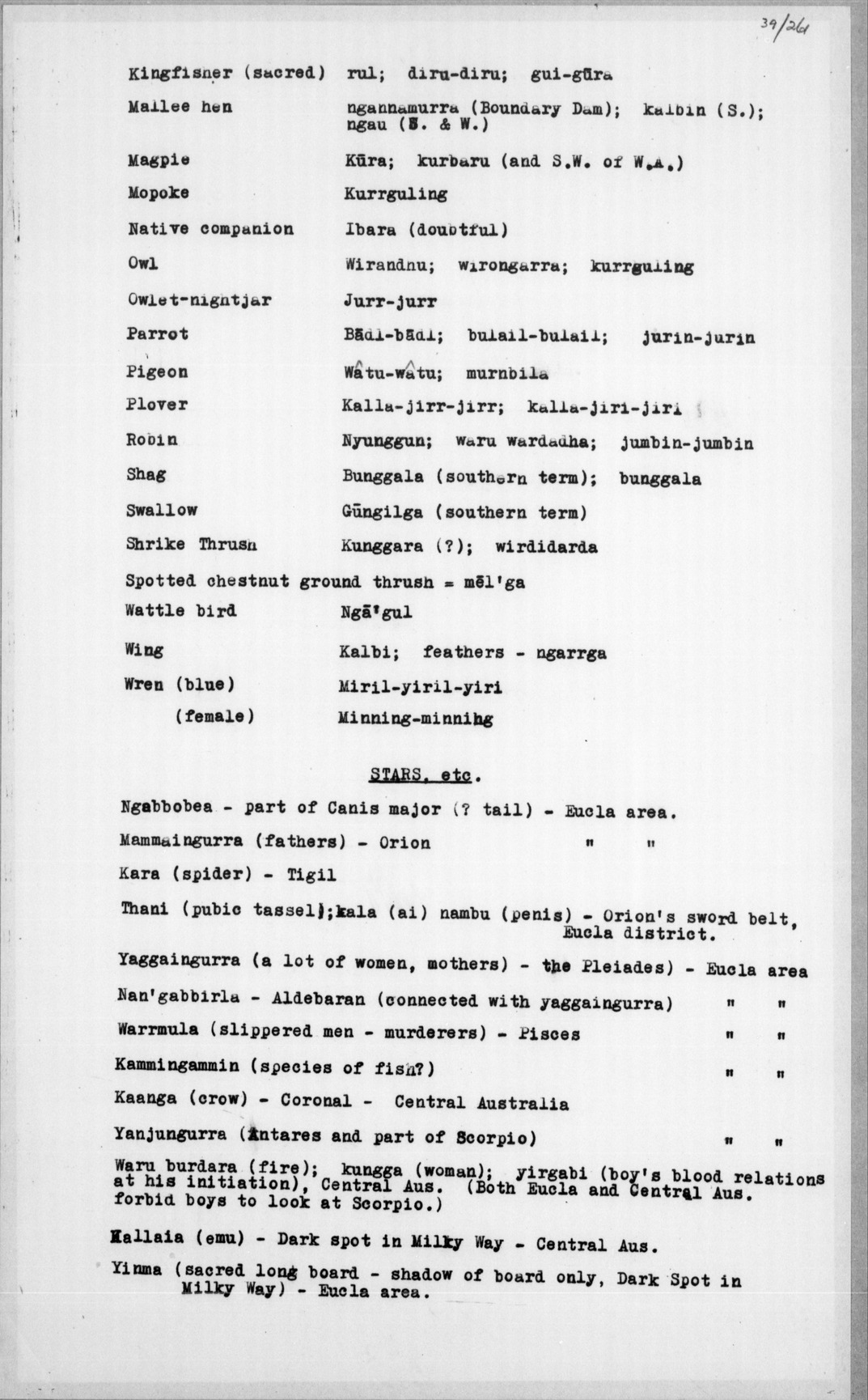
Some 1,100 kilometres away at Weld Range, Karreedee and Bindaweeree gave Bates the dark spot in the Milky Way as a sacred board too: Yeemeree, also eendeeree, with the main vocabulary adding yeemerree, yeenma. On the ground that district keeps the small bullroarer apart from the large Eemarree; in the sky it is the large board that appears. Two peoples at opposite ends of the corridor, in different languages, look into the same hole in the Milky Way and see the same class of board.
A traded object can carry its name and nothing else. A shared sky-placement is heavier freight: someone had to be told what the board is and what stands for it overhead. The Coalsack reading travels a third time north of the corridor, among Kaberry’s Lunga informants in the Kimberley, for whom the dark patch simply is the bullroarer, and Orion’s belt is the stick the bird Banaga threw after his roarer when it broke off the string.
Mirniny at Norseman, Wati at Thuradha, Kartu on the Murchison
The Karratjibbin folio is headed as a Mirniny vocabulary, and that heading is itself the corridor working. Mirniny is the language of the Bight coast, nine hundred kilometres east of Southern Cross — and Sue Hanson’s 2013 report on the South West Goldfields languages places West Mirniny, or Marlpa, inland around Norseman, between the Bight and Karratjibbin. Hanson describes pre-contact speech here as language webs rather than the hard-edged territories of later administrative maps, with the Goldfields tongues facing both toward the Wati chain of the Western Desert and toward Wadjuk in the south-west. The Oxford Guide to Australian Languages recovers a Ngadju–Mirniny–Nyungar grouping in the same country.
Across that web the word crosses real linguistic ground. It begins in Mirniny on the Bight; it is taken down in the Goldfields at Karratjibbin; it reaches Thuradha and Lake Way, which the Oxford Guide places in the Wati network of the Western Desert; and it ends among the Kartu languages of the Murchison, Wajarri country, at Weld Range and the Sanford River. Tim McCabe, reporting on the Noongar dialect bloc for the Single Noongar Claim, used Bates’s Southern Cross vocabulary as his illustration of a wordlist that is not Noongar, and his map puts Ngadju and its neighbours outside the Noongar enclosure. The corridor stops short of the Noongar southwest; its western end is Kartu country on the Murchison.
At Duketon the roarer has another name
Duketon sits between Laverton and Lake Way, in the middle of the run, and Bates’s vocabulary from there gives “Bullroarer | ulleeree, nganeeree.” No yeenma. What Duketon does give is the two-part kit a third time: Kenneth Young’s Duketon note keeps the large sacred board, Milyabil, apart from the small bullroarer board. The same division that pairs Yeenma with Meerudi at Peak Hill and Yeenma with Mirroodee on the Sanford River is in force at Duketon under wholly local names — which is the institution arriving intact and the vocabulary staying home.

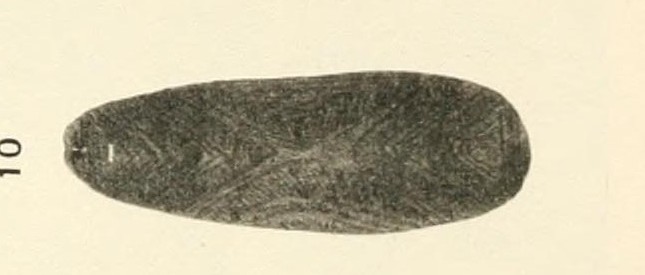
Five hundred kilometres north-west of Weld Range, at the mouth of the Gascoyne, the same kind of blade was catalogued in 1886 under a third name again, Mooryumkarr, glossed “spirit-chaser.” Between Southern Cross, where yinma is the roarer, and the Murchison, where the roarer is mirudi and yeenma is the board beside it, the lexical arrangement is reorganised locally at every stop. The ceremonial technology is not.
Wanderwörter
Historical linguists have a name for words that travel this far: Wanderwörter. Comparing Australia with the Americas, Hannah Haynie, Claire Bowern, Patience Epps, Jane Hill and Patrick McConvell found that the terms most prone to long-distance borrowing are exactly these — material culture, technologies, ritual objects, the vocabulary of things that change hands. The mechanism is plain: a new or prestigious object arrives inside a transaction, and the people receiving it learn what it is called in the same hour they learn how it is made, who may see it, and what is sung over it.
Yeenma behaves that way in every particular. The phonetic shell moves within the range an early English ear and typewriter could hold — yinma, yeenma, inma, eemarree, yeemeree. The referent shifts between the whirled blade, the long board, the carved stick, the ceremony and the song. What does not shift is the company the word keeps: initiation, restricted sight, revelation to a novice, patterned carving, paired boards, a place in the Coalsack.
The word and the board occupy the same corridor across four speech worlds. Which end sent it is a smaller question than that it moved.
The Murchison end of the line
Follow the word back through the eight vocabularies. At Karratjibbin the roarer is Yinma and the boards, long and short, are Yeenma. At Eucla the yinma is cut with the eaglehawk’s heart and belly and answered by the Coalsack. At Thuradha it goes into the novice’s mouth and is kept from women and uninitiated men. At Lake Way it is the long carved stick; at Peak Hill, the long board carved with totem markings, with Meerudi beside it. At Weld Range it is the large board and again the dark spot in the Milky Way. At the Sanford River it is drawn across a new-made man’s breast and then handed to him “to look out for a time.”
Where the word does not reach, the object does. Duketon calls the roarer ulleeree and nganeeree and still keeps Milyabil, the large board, apart from the small one; the Gascoyne calls it Mooryumkarr, the spirit-chaser. Between them and Southern Cross lie eight speaker-places in which the borrowed name and the borrowed institution arrive together — Mirniny on the Bight, Ngadju and its Goldfields neighbours, Wati on the desert margin, Kartu on the Murchison — over 1,350 kilometres of country.
One word for the bullroarer, yeenma, was borrowed from language to language across some 1,350 kilometres of Western Australia, from the Bight to the Murchison, and it carried the object, the initiation and the sky-story with it.
Key sources
- Daisy Bates, vocabularies of natives from Norseman, Southern Cross and the Eastern Goldfields districts, folio 47/58–113, compiled with Beedee, Bailberin (Billy Wilson) and Gweea/Minalla of Karratjibbin, for “Bullroarer | Yinma,” “Sacred Totem board long | Goondain, Yeenma,” and “Sacred Totem board small short | Jilberee, yeenma”; and the State Library of Western Australia Bates papers, Acc. 6193A, item 95/12, for the caption “Stone yeenma, bullroarer from Southern Cross district”.
- Daisy Bates, Eucla / Karnduing, folio 39/162–189, and the Eucla sky notes, for the eaglehawk-marked yinma (kurdudu, mugula) and the dark spot in the Milky Way as its shadow.
- Daisy Bates, “Aboriginal Stellar Myths,” The Australasian, 26 July 1924, p. 56, for the Willilambi eaglehawk myth, the moodiji hardwood, and boorbing beside yeenma.
- Daisy Bates, Thuradha, north-east of Laverton, folio 56/25–54, and the related Barduwonga vocabulary, for the initiation board, the prohibition on women and uninitiated men, and the yinma / inma variants.
- Daisy Bates, Jinguru’s Lake Way vocabulary, Bilbil’s Peak Hill vocabulary, and Wajida’s Waianwonga vocabulary, for the paired board and bullroarer terms.
- Daisy Bates, Karreedee and Bindaweeree at Weld Range and Kondebomur of Meega at the Sanford River, for Nyanēr’se against Eemarree, the second Milky Way placement, and the revelation of the board after man-making.
- Daisy Bates, Duketon vocabulary, for “Bullroarer | ulleeree, nganeeree”; Kenneth Young’s Duketon note for the large sacred board Milyabil against the small bullroarer board; and Giglioli’s 1886 caption (object 3), Pettazzoni 1911:257 n. 1, and Hambly 1936, fig. 10 (Field Museum 173152), for the Gascoyne Mooryumkarr.
- Daisy Bates, “Central Districts,” folio 60/52–119, lines 293–299, for inma as totem object, ceremony, song and dance and among “all sacred boards — bullroarers, etc.”; Australian Government, “Languages: Keeping culture alive”, for contemporary Aṉangu Pitjantjatjara Yankunytjatjara usage.
- Nick Thieberger, Digital Daisy Bates: technical details, the transcriptions and National Library Section XII images behind every Bates folio cited here.
- Sue Hanson, 2013 South West Goldfields language report, for language webs and West Mirniny/Marlpa around Norseman; Tim McCabe, Single Noongar Claim: Linguist’s Report, pp. 15, 50–51, 64, for the contrastive use of the Southern Cross vocabulary and the placement of Ngadju outside Noongar; Claire Bowern, The Oxford Guide to Australian Languages (2023), map notes 65–69, for the Ngadju–Mirniny–Nyungar grouping and the Wati and Kartu placements.
- Hannah Haynie, Claire Bowern, Patience Epps, Jane Hill and Patrick McConvell, “Wanderwörter in languages of the Americas and Australia”, Ampersand 1 (2014): 1–18.
- Phyllis Kaberry, Aboriginal Woman, Sacred and Profane (1939), pp. 12–13, for the Lunga Coalsack and the bird Banaga.
- W. D. Hambly, Primitive Hunters of Australia (Field Museum Anthropology Leaflet 32, 1936), p. 4 and p. 25, plate I figs. 10–11, for the bullroarers from Mount Margaret and the Gascoyne; British Museum Oc1953,15.1, for the Kalgoorlie-acquired bullroarer.
- As far as we know, reading the eight Bates yeenma vocabularies as one borrowed word crossing Mirniny, Wati and Kartu speech is original to this page.