Atlas Essay —
The Mouth Is Opened Twice
Peoples who say the first humans were cut open also shut the novice’s mouth and open it again with a sacred thing, while the bullroarer sounds
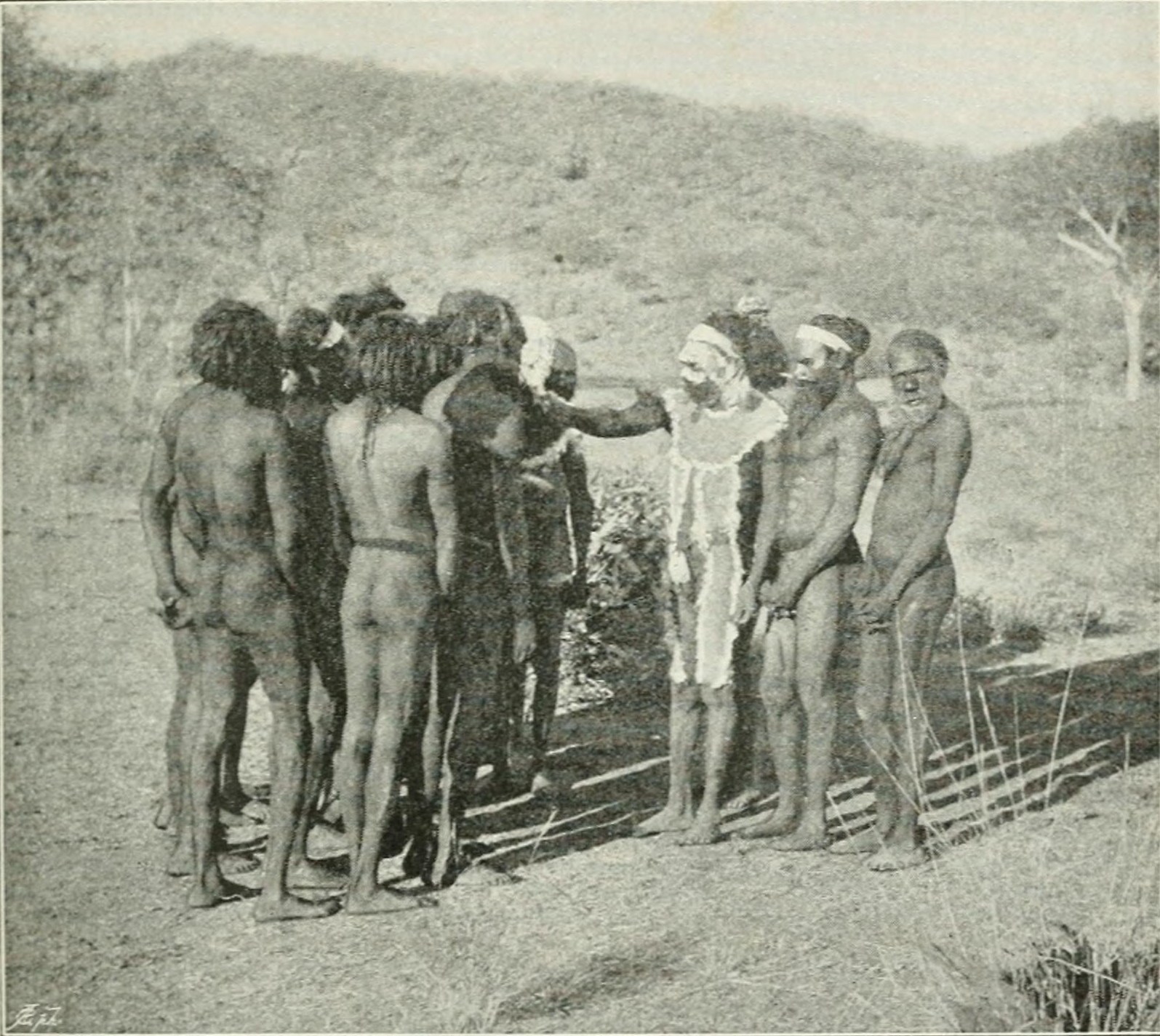
In the beginning, the Arrernte of Central Australia say, there were no men and women. There were lumps lying along the shore of a salt sea, “doubled up into a rounded mass”, with no distinct limbs, their eyes hidden behind unopened lids, and no mouths. Two beings came down from the western sky with great stone knives and made them into people: “A cut with the knife made the mouth, which was pulled open several times to make it flexible.” Then they circumcised the men. Every Arrernte boy goes through it again. The old men shut his mouth when they take him, the bullroarers roar over the cut, and at the end a sacred thing from the ceremony, a pole or a plume, is touched to his lips to open it.
Peoples who say the first humans were sealed and had to be cut open also close the novice’s mouth in the initiation and open it again by the touch of a sacred thing, while the bullroarer roars over the rite. Among the Arrernte the opener is the pole or the plume of the ceremony, and the grown men’s mouths are stroked with the churinga itself, the class of object the bullroarer belongs to. On the Huon Gulf of New Guinea the roarer goes to the boy’s face. The creation cut is made again on every boy.
In brief
- The Arrernte makers cut and pulled open each first person’s mouth, then circumcised them; in Carl Strehlow’s version the maker also gave each one a tjurunga, a churinga.
- The Arrernte novice “must not speak unless spoken to” until a sacred object from the ceremony, such as the Nurtunja pole, is touched to his mouth. Spencer and Gillen’s glossary names the same act among the men “stroking the mouth with Churinga”.
- The Anmatyerre tell their boys that the spirit whose voice is the bullroarer has put his penis into their eyes, nose and mouth and between their fingers and toes: the openings the makers cut.
- The Arrernte, Anmatyerre and Kaytetye tell the myth and keep the rite. North up the telegraph line the rite runs on alone: the Warumungu boy’s mouth was stopped with his father’s tassel, he carried the roarer for a moon in the bush, and he was opened with feathers and a finger to bite.
- On the Huon Gulf of Papua New Guinea an old man knocks the Bukaua boy’s chin shut with a bullroarer before the cut, and the Jabêm headman touches each returning boy’s chin and forehead with one.
- Off the roarer’s ground the same pair turns up again. The Marind-anim of New Guinea say their first people were lumps of clay whose mouths opened before they could speak, and at their initiation clay is thrust into the novices’ mouths.

The lumps by the salt water
Baldwin Spencer and Frank Gillen heard the story at Alice Springs in the Northern Territory in the 1890s, from the Arrernte (they wrote Arunta) of the MacDonnell Ranges. Two beings called Ungambikula, “out of nothing” or “self-existing”, saw from the western sky the Inapertwa, “rudimentary human beings or incomplete men”.
“Coming down from their home in the western sky, armed with their Lalira or great stone knives, the Ungambikula took hold of the Inapertwa, one after the other. First of all the arms were released, then the fingers were added by making four clefts at the end of each arm; then legs and toes were added in the same way. The figure could now stand, and after this the nose was added and the nostrils bored with the fingers. A cut with the knife made the mouth, which was pulled open several times to make it flexible. A slit on each side separated the upper and lower eye-lids, hidden behind which the eyes were already present, another stroke or two completed the body, and thus, out of the Inapertwa, men and women were formed.”
Spencer and Gillen, The Native Tribes of Central Australia (1899), pp. 388–389.
Then the makers circumcised them, “by means of a fire-stick”, and turned themselves into little lizards called Amunga-quiniaquinia, from “amunga a fly and quiniaquinia to snap up quickly” (p. 389). The creation of man was a cutting, and it ended at the foreskin.
The Lutheran missionary Carl Strehlow took the story down a decade later among the western Arrernte at Hermannsburg. His first people are the rella manerinja, the “grown-together people”: “Their eyes and ears were closed; in place of the mouth there was a small round opening” (an Stelle des Mundes befand sich eine kleine runde Öffnung; Strehlow 1907, p. 3). Their maker is a lizard of the same kind, Mangarkunjerkunja, “the fly-catcher”:
“With a stone knife he first separated the individual beings from one another, slit their eyes, opened their ears, the mouth and the nose, separated the fingers and the toes from one another, and circumcised them with a stone knife; he carried out the subincision on them too. Then he showed them how to make fire by rubbing … gave them spear, spear-thrower, shield and boomerang, and to each one a tjurunga.”
Carl Strehlow, Die Aranda- und Loritja-Stämme in Zentral-Australien I (1907), p. 6 (translated).
Mouth, penis, sacred board: one sequence. Tjurunga is Strehlow’s spelling of churinga, the class of sacred objects that includes the bullroarer. The atlas holds a pair of western Arrernte roarers from Strehlow’s mission country.
Their Arandic neighbours to the north tell it too. The Anmatyerre (Unmatjera) say a grub ancestor lay unable to “undouble himself” until a crow said, “I think I will make him into a man”, and with its bill “cut the eyelids open, slashed across the face with its bill, making the mouth”. The case he came out of “was his Churinga” (Spencer and Gillen 1904, pp. 156–157). The Kaytetye (Kaitish) began with “indefinitely shaped creatures”, “commonly supposed to have had two anal openings, one on each wrist” (p. 153). Two hawk boys came at last to “some individuals who were remarkable for the possession of extremely small mouths”, and “transformed them into complete men and women and also initiated them” (pp. 345–346).
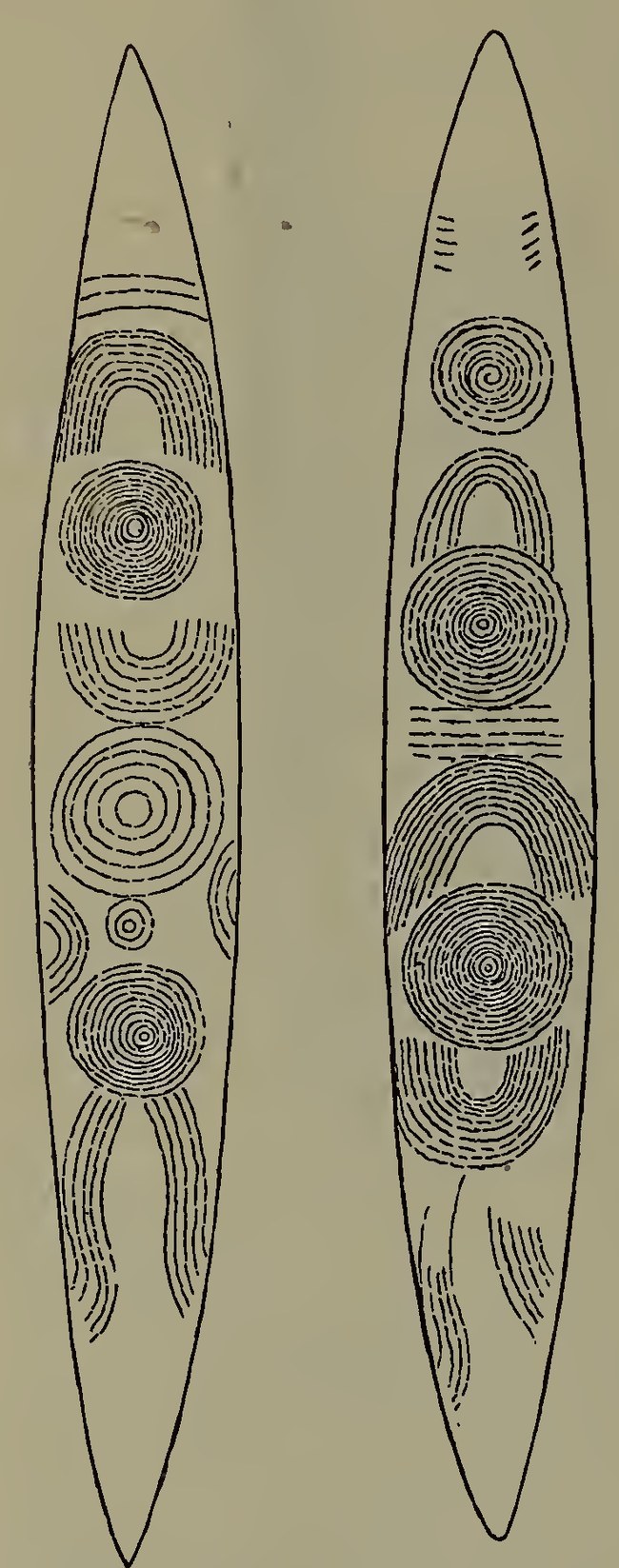
The Kaytetye sky-being who swings the first churinga over his own sons was left unopened himself. Atnatu “derives his name from the fact that he has no anus”, and he “first of all made the Churinga, and swung them up in the sky when he initiated his offspring” (pp. 498–499).
Shut
The Arrernte boy’s mouth is closed on the first day of his circumcision rite:
“He must not speak unless spoken to, and even then his words must be as few as possible, and spoken in a low tone. … Should he try to see what was going on … some great calamity would happen to him — Twanyirika, the great spirit whose voice was heard when the bull-roarers spoke, would carry him away.”
Spencer and Gillen 1899, pp. 221–222.
On the night of the cut the bullroarers sound all round, and the women are told that Twanyirika “enters the body of the boy after the operation” (p. 246 n.). “You have done well, you have not cried out”, the men tell him, and an elder brother presses the roarers on the wound and tells him “that it was these and not Twanyirika which made the sound, that they were sacred Churinga.” “To this the boy listened in silence” (p. 248). The Anmatyerre say what the spirit does inside him:
The old men tell the boys that Twanyirika has put his penis into the eyes, nose, mouth, and between the toes and fingers of the youth.Spencer and Gillen, The Northern Tribes of Central Australia (1904), p. 498
Eyes, nose, mouth, fingers, toes: the being whose voice is the roarer goes into each place the Ungambikula opened with their knives. In the beginning the lizards cut the lump open; now the roar’s owner forces the openings again, and the knife takes the foreskin as it did then.
Through the cut itself the mouth is stopped. For the Anmatyerre and Kaytetye subincision the father’s Nurtunja pole is laid on a shield, a man lies down on it, and the boy is placed on his back above him: “fur-string is thrust into his mouth”. Afterwards his father gives him his churinga: “This is your churinga alcheri which had your kurnah in the Alcheringa”, the board his spirit lived in at the beginning of things (1904, p. 342). The Urabunna of Lake Eyre in South Australia begin the whole making when a grandfather “seizes hold of him and puts his hand over the boy’s mouth, telling him to remain silent” (p. 332).
More than two thousand kilometres north, on the Huon Gulf of Papua New Guinea, the roarer’s own wood shuts the jaw. The initiation of the Bukaua and their Jabêm neighbours was the balum, a word for the dead, for the monster that swallowed the boys, and for the bullroarer that was its voice. The Lutheran missionary Stefan Lehner wrote of the Bukaua:
“Before the circumcision one of the old men strokes the boy upwards over the body with a bullroarer and knocks his chin against his upper jaw: he shall keep silent about the balum before women and the uninitiated.”
Stefan Lehner, “Bukaua”, in R. Neuhauss, Deutsch Neu-Guinea III (1911), p. 407 (translated). “Vor der Beschneidung streicht einer der Alten den sagu mit einem balumli über den Leib aufwärts und schlägt ihm das Kinn gegen den Oberkiefer: ‘schweigen vom balum Weibern und Uneingeweihten gegenüber soll er.’”
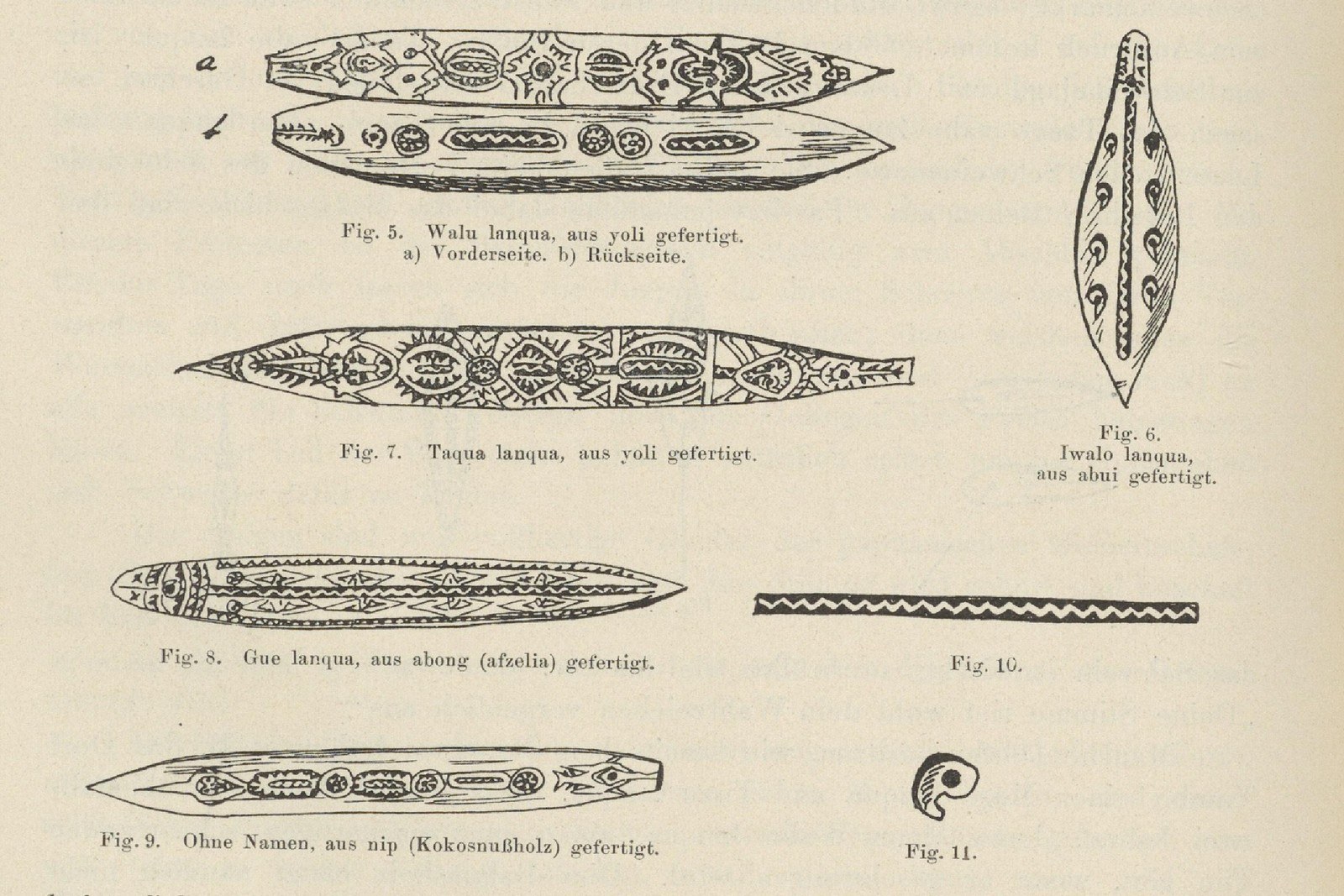
After the cut, boar’s tusks were bound over the boys’ mouths “so that their cries of pain sound only muffled” (p. 408). The Urabunna grandfather’s hand and the Bukaua elder’s roarer do the same work at the same moment, before the knife. The roarer that is a tongue elsewhere in New Guinea here shuts the jaw. Circumcision, the roarer and the stopped mouth crossed Torres Strait together, as one rite, and they kept their order on the far side.
Opened with the sacred things
The opening is done at the mouth and with the things of the ceremony. After subincision the Arrernte youth speaks to no one for three days, and then hunts game for each of the men who took part in his making:
“At the presentation of Chaurilia the man to whom it is given always performs some sacred ceremony, after which the mouth of the Ertwa-kurka and those of all present are touched with some sacred object which has been used during the ceremony, such as a Nurtunja, and in this way the ban of silence is removed.”
Spencer and Gillen 1899, p. 260.
Spencer photographed the same release at the end of the Engwura, the last Arrernte initiation (Plate I). The old man “took a bunch of feathers which had been used as part of the decoration and touched with it the mouths of all those present. By means of this action, which is called Aralkalilima, the ban of silence was broken.” Then he took the young man’s gift of food and “placed it against the mouth of the young man” (pp. 382–383).
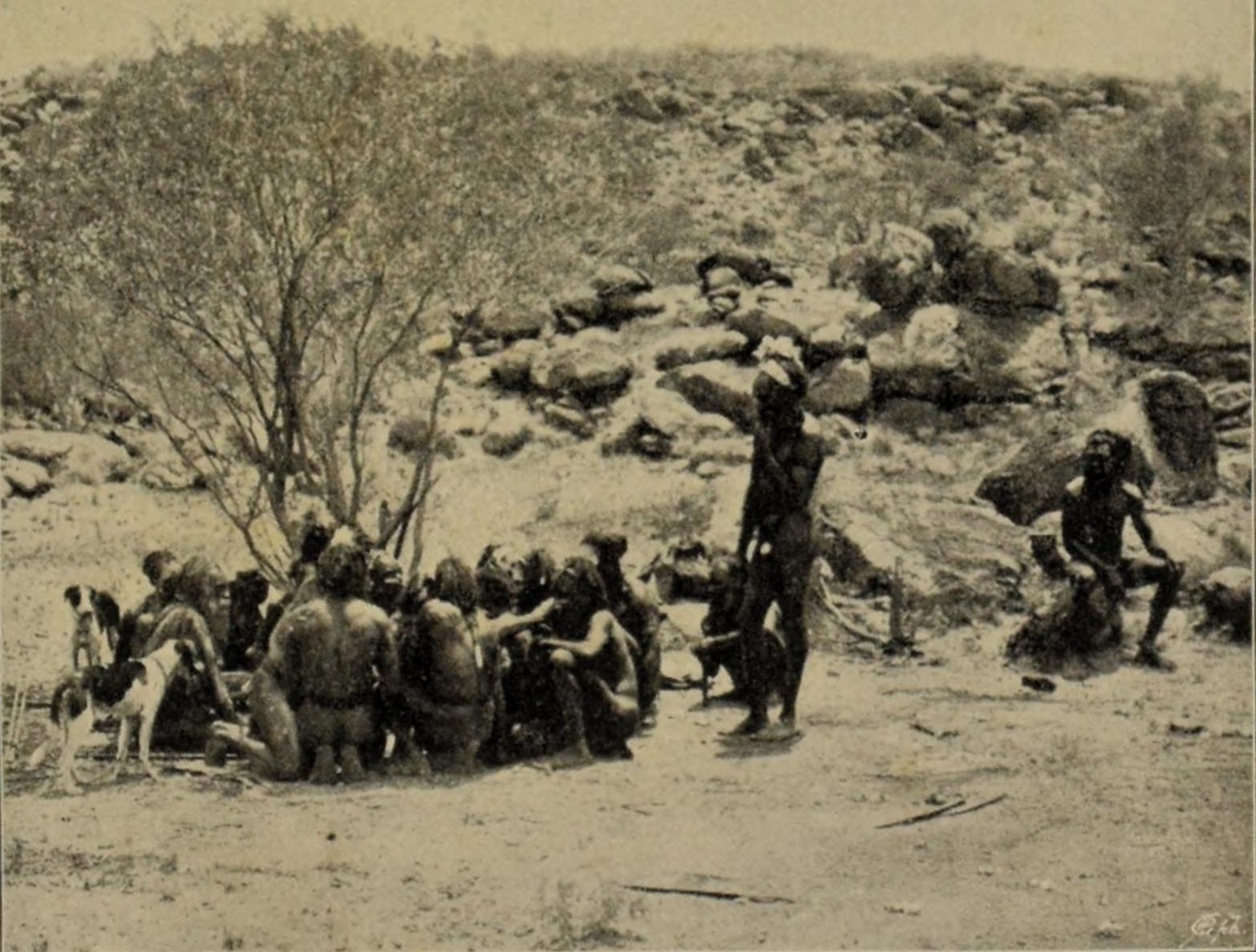
In one release the performer had played a man carrying “the body of a dead man which he intended to eat”, shown by a half-ring of grass stalks bound with fur-string, the Atnuta, “emblematic of the limp body.” Then “Aralkalilima was performed, the Atnuta being used to stroke the mouth of the ab-moara men” (p. 385). The dead man the ancestor meant to eat gives the young man back his speech.
Among grown men the same gesture is made with the churinga itself. When Spencer and Gillen returned in 1901 they watched a set of churinga carried back to the Emily Gap storehouse. A heavy stone churinga was struck on each man’s stomach, which gives the bowels “sight”; then two visiting men from distant northern groups knelt by the local headman, who “stroked their mouths and beards with the Churinga — a ceremony called aralkalirrima” (1904, p. 266). Their glossary defines the word:
Ardlka-Ulima — Stroking the mouth with Churinga. Arunta tribe.Spencer and Gillen 1904, glossary, p. 746
Aralkalilima for the novice, aralkalirrima for the men: one word, one touch at the mouth, made with the pole or the plume on the boy and with the board on the man. On the Huon Gulf the roarer does it. When the circumcised Jabêm boys came home to Ssimbang in 1887, the old headman touched each boy’s chin and forehead with the bullroarer, and they spoke with their women only after the next morning (Schellong 1889, p. 161).
A finger to bite
Spencer and Gillen’s second journey ran north up the telegraph line to the Gulf of Carpentaria. The myth of the sealed first people is recorded for the Arandic peoples; beyond them the rite runs on alone, and the roarer runs with it. One boy among the Warumungu of Tennant Creek, in the Northern Territory, can stand for the rest.
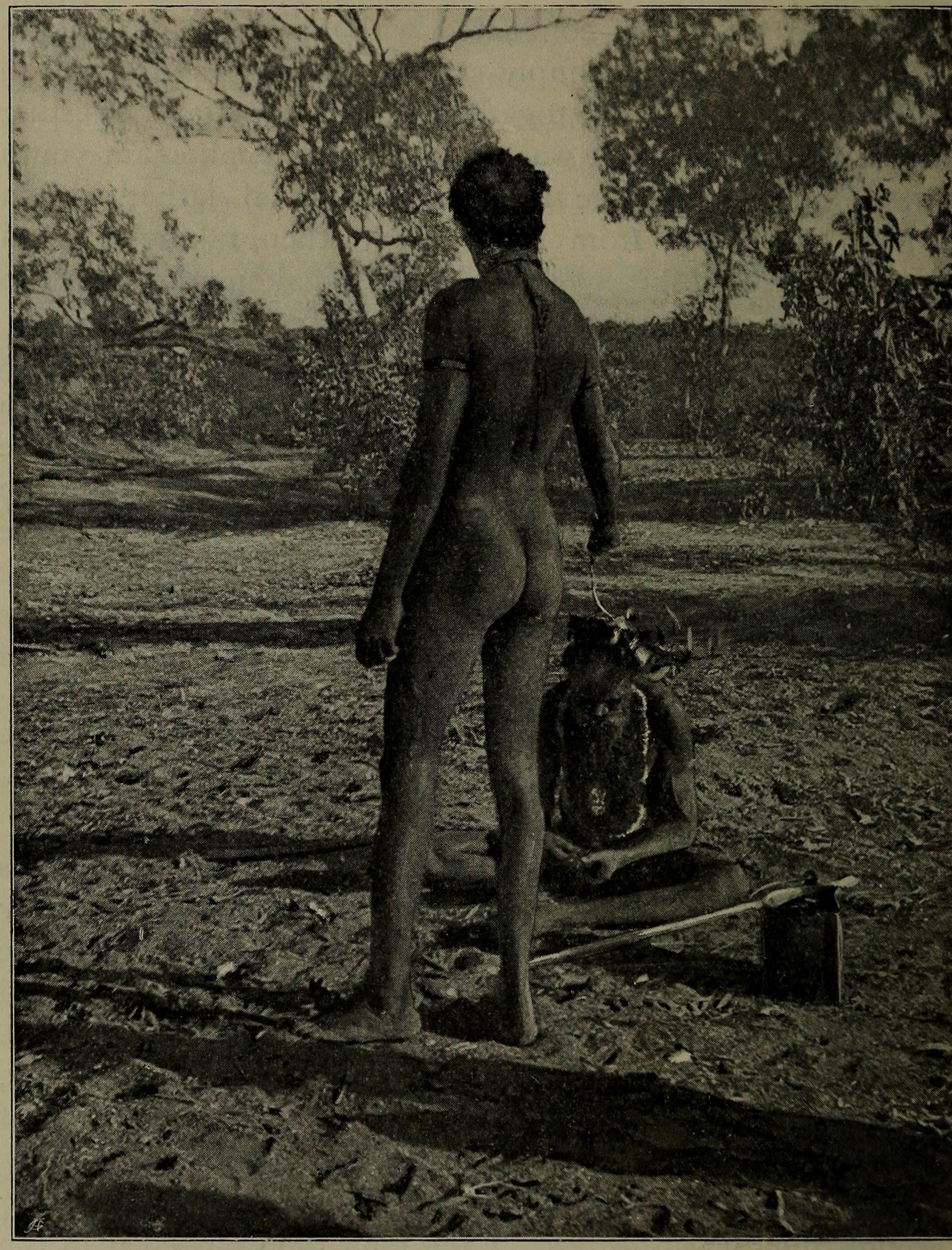
He was kept up all night with dancing until “suddenly he heard the murtu-murtu roaring, and was, as he told us, ‘too frightened to do anything’” (p. 351). A tassel was pressed into his mouth at the cut, and at his subincision “a pubic tassel belonging to his father was pressed down into his mouth” (pp. 351, 355). As soon as he was circumcised he was given a bunch of eagle-hawk feathers, “with which he touched the heads of” men of three classes, “so as to make them speak to him and break the ban of silence”, and his mother had to drink the blood of his wound (pp. 351–352). That night his father put the roarer in his hands; he carried it for a moon in the bush and gave it back when he healed (p. 352). He came home behind a man swinging it, and each man he fed held out a finger to bite, “and thus releases him from the ban of silence” (p. 353). Spencer and Gillen added:
“After initiation he is supposed to be so much impressed with the performance that he is too overcome to talk. The older men also tell him that he has seen strange things and must not talk until he is told that he may by his kulla-kulla. The newly initiated youth is indeed supposed to spend his time pondering over what he has seen.”
Spencer and Gillen 1904, p. 353 n.
Hands shut until the name
On the Queensland coast around Maryborough, opposite K’gari (Fraser Island), the initiation was the Dora. Howitt had the account from Harry Aldridge:
“The boys are told to close their hands and not to open them till they get their new names, under all kinds of fearful penalties. … the boys have to crouch down and are fed by the Quonmies with bits of cooked meat and drinks of water, for the boys have their hands closed and may not help themselves in any way. … Nor may they speak, being only permitted to nod or shake their heads”.
A. W. Howitt, The Native Tribes of South-East Australia (1904), pp. 603–604.
At last the Headman asks each boy several times, “What will your name be?”, speaks the name himself and cries “Shout!”, and the crowd roars it back. A spear, shield and boomerang are slipped into the boy’s hands, “and he now, for the first time since the ceremonies commenced, opens his hands and looks up from the ground” (p. 605). The hands open at the name; the voice is given by the crowd. After the fights that follow, the bullroarer Pundunda sounds from the scrub, and the women are told that if they listen “they will lose their hearing, and if they look back they will become blind” (p. 606).
Clay in the mouth
The two halves, the sealed first people and the stopped mouth, are bound tightly enough to turn up together where the roarer is not in the rite. Some two thousand kilometres north of the Arandic country, across the Arafura Sea, the Marind-anim of the south coast of New Guinea, in the Indonesian province of Papua, tell both. Their first people were fish thrown on the beach by a stork, “where the clay covered and killed them. So the fish were no longer anything but shapeless lumps of clay.” They warmed themselves at a fire of bamboos:
“Thus the apertures of their ears, eyes, mouth, and nostrils were opened, but as yet they could not speak, they could only utter a murmuring sound. … At last … a big bamboo burst with a louder crack than usual, which frightened the people so that they gave a loud shriek, and that was the beginning of human speech.”
J. G. Frazer, Folk-Lore in the Old Testament I (1918), pp. 37–38, after Viegen.
Frazer gives the link himself: “The legend … is said to be represented dramatically by them at the mysteries or rites of initiation”. At the Mayo, their great initiation, a man on two sticks plays the bird and throws the novices into the sacred enclosure, where they are “coated from head to foot with a thick layer of clay; more than that, lumps of clay are thrust into their mouths by initiated men, and these they have afterwards to spit out into holes dug in the ground.” (p. 39). The mouth is stopped with the stuff the first men were made of, and spat clear. Frazer puts no roarer in the Mayo. The Marind bullroarer, shaped like a fish, belongs to their other great cult, the Sosom, where it swallowed boys and gave them back.
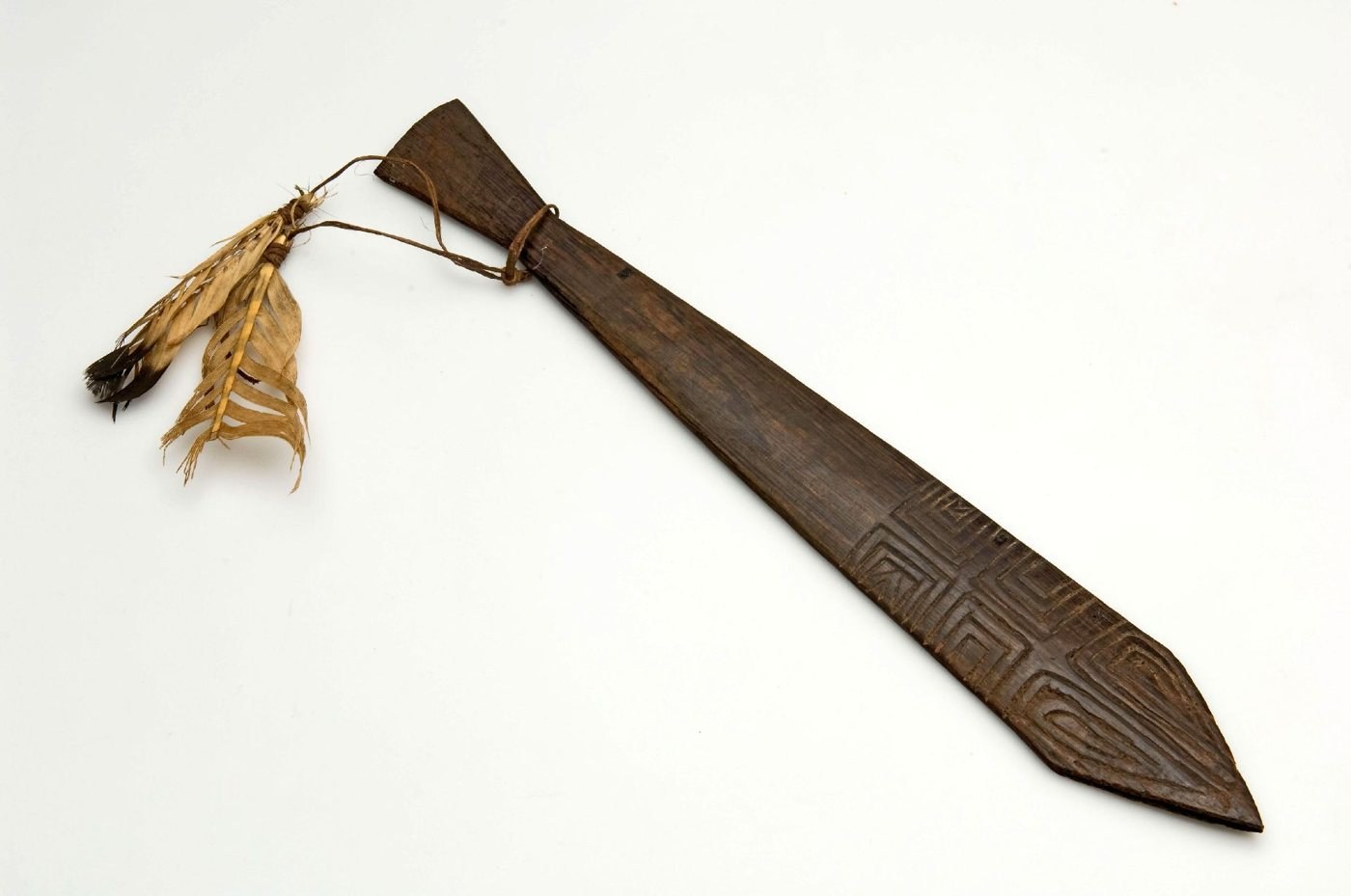
West of the Fly River, near Daru in Papua New Guinea, the Masingara tell the sealed man as a tale. Íregíde had “no mouth” and no anus until the girl Mürke cut both open in the night, and “a great quantity of white matter looking like the discharge of a boil poured out”. He woke able to speak: “My god, I got mouth now! … I man now, my word, I man now!” (Landtman 1917, pp. 427–428).
Their neighbours at the mouth of the Fly opened the women on the night of their great secret rite. When Marunogere of Iasa first held the Kiwai moguru over a dead pig, “At that time the women’s vulva had no opening.” He had the pig and his dead wife cut up and their blood caught in a bamboo tube. That night he lit a torch and went into the women’s house with a bone dagger: “He bored a hole in each woman with the dagger and poured a little blood into the hole. The women’s menstruation ever since then comes from that blood.” In the morning “one after another of them said, ‘I got blood! You got blood? you got hole?’” (Landtman 1917, p. 343).
Across Torres Strait on Mabuiag, in Queensland, Australia, there was no cutting and no roarer, only the lesson. The boy’s mother’s brother showed him the dirt under a fingernail, “This dirt is outside, you put him inside”, and told him that if he heard his parents called, “you no speak out, you keep him inside” (Haddon, Reports V, 1904, pp. 213–214). Haddon states that “No mask nor bull-roarer were employed at this ceremony” (p. 215); the island kept its bullroarer for others.
Opened twice
The Arrernte set the two cuts side by side themselves. The makers cut the mouth and then the foreskin. The rite takes the boy in the same order. He is shut: told not to speak, a hand or fur-string at his mouth while the knife works. The roarers sound, and their owner enters him, into his eyes, nose and mouth and between his fingers and toes, the openings of the first creation. Then he is opened, and what touches his lips is a sacred thing of the rite: feathers from the decoration, the pole, the dead man’s effigy; and when the men themselves are touched at the storehouse, the churinga. The maker handed each first person a tjurunga; the sacred things of the rite unseal the novice.
The myths say why it is done. A lump that cannot speak, eat or see is not yet a person, and neither is a boy. Every boy is put back into that state, sealed and mute, his mouth stopped with string, tusk, tassel or a hand, while the roar goes over him. Then the old men open him as the lizards opened the first people, and he comes out with a voice of his own, the symbolic self that Ritual Made Mind sees the bullroarer’s rites calling up. The mouth is opened twice: once at the beginning of the world, and again on every boy, with the sacred things at his lips and the churinga roaring over him.
Key sources
- Baldwin Spencer and F. J. Gillen, The Native Tribes of Central Australia (London: Macmillan, 1899): pp. 221–222, 246 n., 248 (the novice silenced; Twanyirika; the roarers on the wound), p. 260 (sacred object touched to the mouth), pp. 382–385 and figs. 89–90 (Aralkalilima), pp. 388–389 (the Ungambikula and the Inapertwa).
- Baldwin Spencer and F. J. Gillen, The Northern Tribes of Central Australia (London: Macmillan, 1904): p. 153 and pp. 345–346 (Kaytetye first people), pp. 156–157 (Anmatyerre crow), p. 266 (aralkalirrima), p. 332 (Urabunna), p. 342 (Anmatyerre and Kaytetye), pp. 351–355 and fig. 113 (Warumungu), pp. 498–499 (Twanyirika, Atnatu), p. 746 (glossary).
- Carl Strehlow, Die Aranda- und Loritja-Stämme in Zentral-Australien I (Frankfurt: Städtisches Völker-Museum, 1907), pp. 3, 6.
- Stefan Lehner, “Bukaua”, in R. Neuhauss, Deutsch Neu-Guinea III (Berlin: Reimer, 1911), pp. 407–408, 412.
- O. Schellong, “Das Barlum-Fest der Gegend Finschhafens (Kaiserwilhelmsland)”, Internationales Archiv für Ethnographie 2 (1889), p. 161.
- J. G. Frazer, Folk-Lore in the Old Testament I (London: Macmillan, 1918), pp. 37–39, after J. Viegen and others.
- Gunnar Landtman, The Folk-Tales of the Kiwai Papuans (Helsingfors, 1917), p. 343 (Marunogere) and pp. 427–428 (Íregíde).
- A. C. Haddon (ed.), Reports of the Cambridge Anthropological Expedition to Torres Straits V (Cambridge, 1904), pp. 213–215.
- A. W. Howitt, The Native Tribes of South-East Australia (London: Macmillan, 1904), pp. 603–606.