Atlas Essay —
The Roarer Is a Tongue
From New Britain to Mali, the bullroarer is called the tongue of a spirit, a dog or a dead man
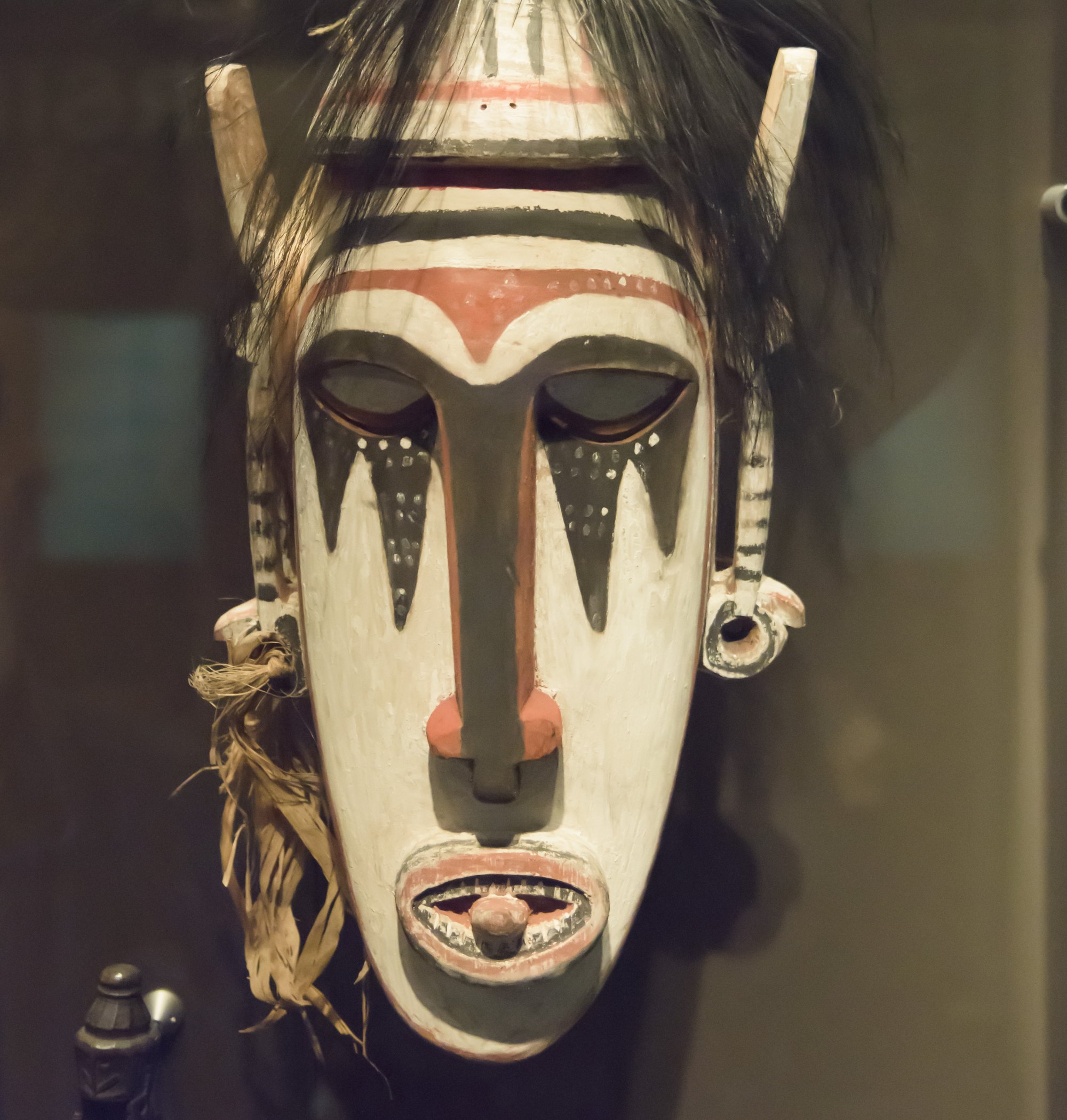
On the western tip of New Britain a wooden face comes out of the bush under a crest of dark feathers, and somewhere behind it, out of sight, its tongue is roaring. Across the strait on the New Guinea coast the same roar is the tongue of the being that eats boys. In the Highlands it is a tongue pulled out of the first dog’s mouth. In Mali, half a world away, it is the tongue that hung from the mouths of the old men who were turning into snakes, and it is one of three tongues, one of them cut out with the larynx. A flat slip of wood on a string is about the size and shape of a tongue, and people a long way apart have said that is what it is.
The bullroarer is called a tongue: the tongue of the mask around the Vitiaz Strait of Papua New Guinea, the tongue of the primal dog in the New Guinea Highlands, the tongue of the first dead among the Dogon of Mali. The peoples who named it heard the roar as speech and gave the blade the name of the organ that speaks.
In brief
- The Kilenge of western New Britain, in Papua New Guinea, sound the bullroarer with their great masks: “In fact the bull-roarer is known as the tongue of nausung” (Dark 1979).
- The same phrase runs round the neighbouring coasts. On Umboi it was “the ‘tongue’ of the spirit” (Bamler 1911, p. 512); at Sio on the New Guinea mainland “the tongue of the mariam” (ter Keurs 2007, p. 291); in the Aria language of the New Britain interior the word for bullroarer is barku ene blene, “the tongue of the spirit” (Thurston 1996, p. 331).
- In the Vitu Islands, north of New Britain, a kinsman swings lavena Kaka Paraɣa, the tongue of the Elder Person, as a bride leaves her village.
- Among the Yagwoia of Papua New Guinea, “the origin of the bull-roarer is the tongue extracted from the primal dog’s mouth” (Mimica 2025, p. 59).
- The Dogon of Mali cut the first bullroarer “in the image of the hanging tongue of tired old men” as they turned into serpents (Griaule 1938, p. 67). In their secret language one name, awa non, means both the bullroarer and the language itself.
- The Ende of southern Papua New Guinea say the first words of their language “came out when the bullroarers were swung” (Lindsey 2019, p. 288).

The tongue of nausang
The Kilenge live around Cape Gloucester, where New Britain ends and the Dampier Strait begins. Their greatest masks are the nausang: long wooden faces painted white, black and red, each a named being with its own mark. Pregnant women were led to nausang to have its mark put on their bellies so that the child would be born healthy. The art historian Philip Dark, who worked at Kilenge from the 1960s, set the masks beside those of the neighbouring coasts and wrote of the instrument that goes with them:
“These masks are probably equivalent to the nausung masks of the Kilenge, who also use the bull-roarer with the masks. In fact the bull-roarer is known as the tongue of nausung.”
Philip J. C. Dark, “The Art of the Peoples of Western New Britain and Their Neighbors,” in S. M. Mead (ed.), Exploring the Visual Art of Oceania (1979).
The mask is a carved face, and a carved face cannot speak. The voice comes from elsewhere, from a blade whirled where the women cannot see it, and the Kilenge join the two by naming the blade for the part of the mouth that makes speech. The carvers gave the face a tongue as well: the nausang Kwambu, at the head of this page, holds one between its teeth.
The Kilenge say the roarer was first a woman’s. Women from the Siassi Islands, the traders of the strait, went out for firewood and made the first bullroarer. They were later killed by the men, who took the bullroarer for themselves. So the missionary Carl Laufer heard it from a Kilenge man named Lavatu.
Cross the Dampier Strait to Umboi, which the old charts call Rook, and the phrase is waiting. Georg Bamler, a Lutheran missionary on the Tami Islands at the mouth of the Huon Gulf, wrote down in 1911 what the Tami told him of their northern neighbours. The men of Rook wound themselves in barkcloth, stuffing every limb to make the figure as huge and fat as they could, set a mask of light wood on top, and walked into the village to collect the pigs.
“On Rook they also still have the bullroarer in use, which is there given out to be the ‘tongue’ of the spirit. … It is indeed held high as a ‘lord,’ but no longer so guarded from the women. There the nearest female relatives of the circumcision recruits are said to be present in person at the operation, on which occasion they must see the bullroarer.”
„Auf Rook hat man daneben auch das Schwirrbrett noch in Gebrauch, das dort als die ‚Zunge‘ des Geistes ausgegeben wird.“
Georg Bamler, “Tami,” in R. Neuhauss (ed.), Deutsch Neu-Guinea, vol. III (1911), p. 512.
On Umboi the tongue had come out into the open. A boy’s closest female relatives, it was said, stood by while he was circumcised, and the tongue of the spirit was put in front of their eyes. The masked spirits of this coast, on the same page, “run through all of New Britain; their last outliers are Siassi and Tami.”
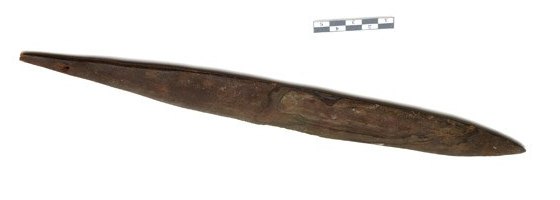
Cross the Vitiaz Strait to the mainland, to Sio on the north coast of the Huon Peninsula. The masked beings there are the mariam, and nausang, writes Peter ter Keurs, is simply “the Kilenge name for mariam.” A great mariam came rarely, for the initiation of the firstborn son of an important leader, and only to a village strong enough to feed it.
“As the tongue of the mariam, the bullroarer frightened the boys who were to be initiated by its sound. In local terms, initiation meant being eaten by the mariam and after some time brought back to the village as an initiated man.”
Peter ter Keurs, in Arts of Africa and Oceania: Highlights from the Musée Barbier-Mueller (2007), p. 291.
The boys hear the tongue of the thing that is about to eat them. Kilenge, Umboi and Sio stand on three shores of one stretch of water, and the Siassi Islanders in the middle of it were the traders who sailed between them. The masks went with the canoes, and so did the name of the blade.
Barku ene blene
Inland from the north coast of New Britain, some eighty kilometres east of Kilenge, the Aria language is spoken along the west bank of the Aria River. William Thurston collected its vocabulary in 1981–82, and the entry for one spirit reads, entire:
“barku N 1. spirit sp [evoked to admonish someone for misbehaviour …]; 2. casque. barku ene blene bullroarer [the tongue of the spirit]. alau ila barku casque of a cassowary.”
William R. Thurston, “The Bibling Languages of Northwestern New Britain,” in M. D. Ross (ed.), Studies in Languages of New Britain and New Ireland 1 (1996), Aria lexicon, p. 331.
Here the tongue is the instrument’s ordinary name. An Aria speaker who wants to say “bullroarer” says barku’s tongue. Barku is a spirit called up to rebuke people, and the same word names the horny crest on a cassowary’s head. Five entries above it on the same page stands bao, “club for ritually executing widows.”
The neighbours on the same rivers are the bush Kaliai, and their Varku is strikingly close to barku in name and in office. Andrew Lattas, who lived with them in the 1980s, describes him: “Varku is composed of a bullroarer and a painted wooden mask. His role is to avenge breaches of custom.” The cassowary is called Varku’s father, and initiated boys come out painted in the cassowary’s colours. He “often cries menacingly in the bush at the edge of a village, warning women to fetch wood, water and food for the men’s house they might have neglected.” The first Varku was a woman’s: Kewak, one of the first mothers, made it from a chip that flew whirring off her firewood, until her brother Kowdok took it and chased her into the sea. In one telling he killed her with a fighting stick as she climbed out of the water, and this, the Kaliai said, was the origin of the widow-killing ceremony, in which “a widow would be shown the trickery underlying Varku and then killed by her brothers.” For any woman who discovered the secret the punishment was death: “The cassowary-shaped footprint of Varku was cut into her hair and the head severed and thrown through a hole in the top of the men’s house to the women gathered in the village plaza.”
At the end of the boys’ initiation the women dance in anger outside a fence, spears in their hands:
Varku’s ‘tongues’ stop crying and the maternal mask, Varku’s mother, brings the initiates to the fence.Andrew Lattas, “Trickery and Sacrifice,” Man 24 (1989), pp. 463–464
The tongues are plural because the blades are, and they cry. Lattas also records what a tongue is to the Kaliai. “The mouth is often jokingly regarded as a vagina with the tongue being the male penis: so much so that the act of speaking is said to mime the act of sexual intercourse.” Men make suggestive allusions to women “by moving the tongue sexually back and forth inside the mouth.” Speech begets; the tongue is the male member of the mouth; and the men’s most secret possession, the thing whose sight killed a widow, is a tongue.
Five peoples on three shores and a river call the blade a tongue. The mask is a face, the bullroarer is its tongue, and the being that owns both eats boys or rebukes women.
The voice of the Ancestor
The Vitu Islands lie in the Bismarck Sea some sixty kilometres north of the New Britain coast. The trader and ethnographer Richard Parkinson, in 1907, wrote of them and of the mainland opposite:
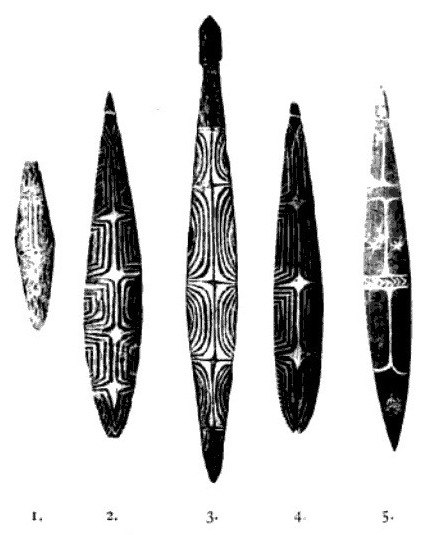
“It is further characteristic of this whole region of western New Britain that at the circumcision festivities the bullroarer plays an important part and, as in Kaiser-Wilhelmsland [mainland New Guinea] and on Bougainville, is regarded as the voice of a spirit, the sight of whom is in every case forbidden to the women.”
Richard Parkinson, Dreissig Jahre in der Südsee (1907), pp. 640–641.
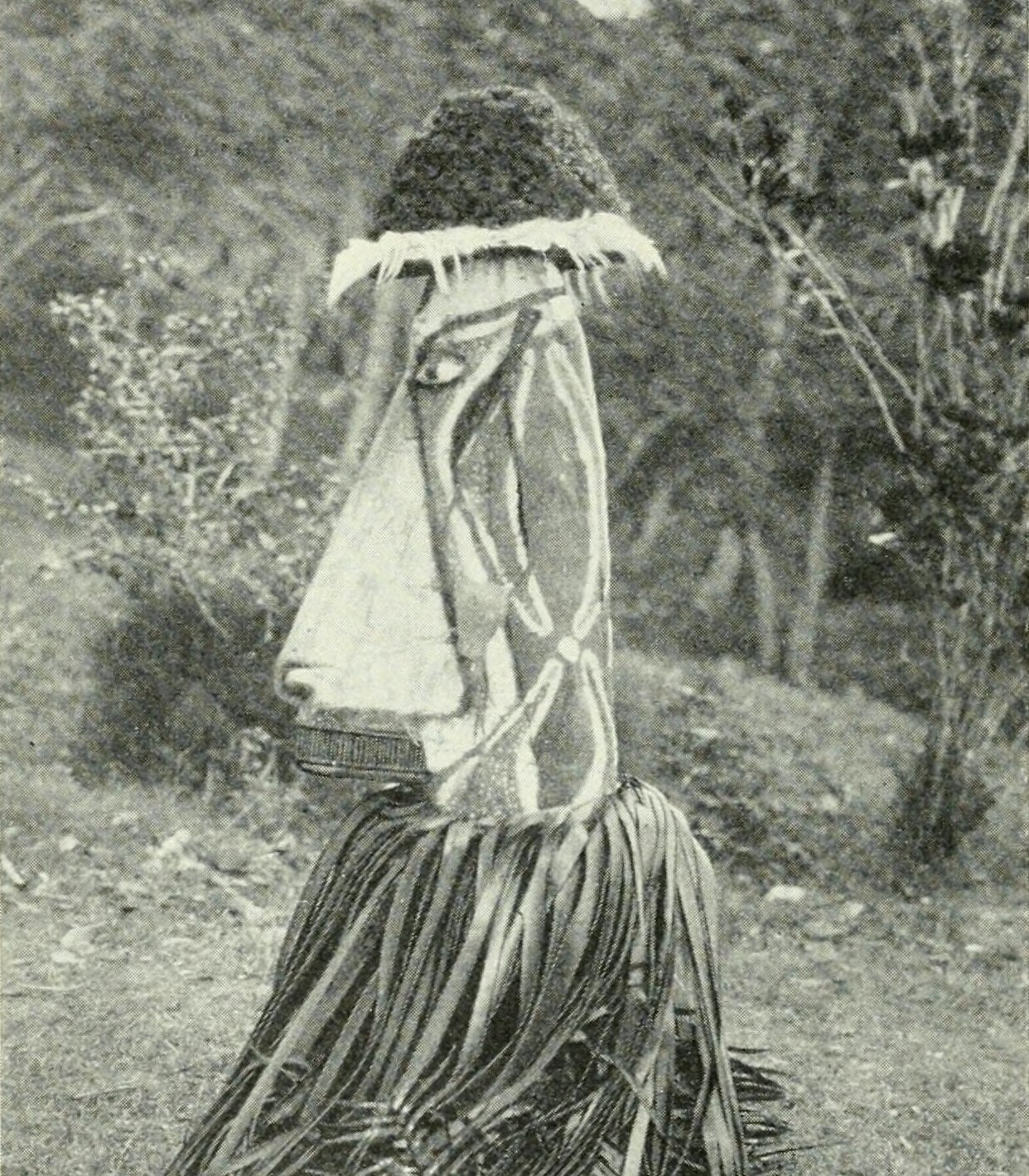
In the 1970s Jennifer Blythe lived on Vitu and found the instrument at weddings. The bride is painted and ornamented and carried to her husband’s village. “As the bride leaves her village a kinsman swings a bull-roarer (lavena Kaka Paraɣa) to symbolize the consent of the ancestors to her departure.” Her footnote gives the name in English: “Lavena Kaka Paraɣa may be translated ‘The voice of the Ancestor’.”
Kaka is “person” in Vitu and paraɣa is “elder, lord”; on Ghulu Island in the same group the rite whose last performance opens with the bullroarer sounded twice is Kakaparagha, the Elder Person. Lavena is a body part with a possessive ending. When the Gospel of Mark was put into Vitu, the deaf man with the impediment in his speech was healed in these words: ia vakulia na lavena kaka kua, “he touched the man’s tongue,” and then na lavena ia pakoko, “his tongue was loosed.” The voice crying in the wilderness, in the same translation, is a different word, halinga. The name of the Vitu bullroarer is the Tongue of the Elder Person.
In these languages the name sits where tongue and voice meet.
The primal dog
The Yagwoia are Angan-speaking mountain people on the south-eastern edge of the Papua New Guinea Highlands, nearly three hundred kilometres inland from the Vitiaz Strait. At their initiations the bullroarer is the voice of an invisible dog, and the boys in the dark are its prey. Jadran Mimica, who has worked among them since the 1970s, gives the instrument’s origin in a single line: “the origin of the bull-roarer is the tongue extracted from the primal dog’s mouth” (Mimica 2025, p. 59 n. 25).
Here the tongue has an owner with teeth, and it has been taken out of him. Around the Vitiaz Strait the tongue belongs to a carved face. In the Yagwoia mountains it was torn from a living mouth, and the mouth was a hunting animal’s.
The hanging tongue
The Dogon farm the Bandiagara escarpment in Mali, in West Africa. Marcel Griaule’s Masques dogons (1938) gives their account of how death and the bullroarer began. Among the Andoumboulou, the small people who came before men, nobody died. The very old turned into great serpents, or into spirits, and passed into a world with its own speech, the language of the Sigui. Death came through a breach of that language: one of them not yet transformed heard it and had it taught to him, though he was warned that “to learn the language was to bring death into the world.” The oldest of them died of it. To make amends the Andoumboulou danced the first Sigui and carved a great wooden serpent to hold the dead man’s force. Men took the rite from them, and when they consecrated a Great Mask of their own they set a new instrument beside it.
“In addition, there had been placed on the altar the first bullroarer cut by men in the image of the hanging tongue of tired old men. These used to groan at the time of their transformation into a great serpent, and this groaning was reproduced by men by means of the little tongue of wood turning on itself at the end of a cord.”
« … le premier rhombe taillé par les hommes à l’image de la langue pendante des vieillards fatigués. Ceux-ci gémissaient lors de leur transformation en grand serpent … »
Marcel Griaule, Masques dogons (1938), p. 67.
Griaule returns to it when he describes the sound, which he compares to a lion’s roar: “the bullroarer, in fact, has the form of a tongue, since it is said to have been cut in the image of the hanging tongue of tired old men. The sound it gives out is said to be an imitation of the groans of an old man labouring to move, or to transform himself, when the moment came, into a serpent” (p. 256). The mask carved in the dead elder’s likeness is “an old man with a hanging tongue” (p. 56), and Griaule notes that the mask called albarga “has a tongue coming out of the mouth of the figure represented.”
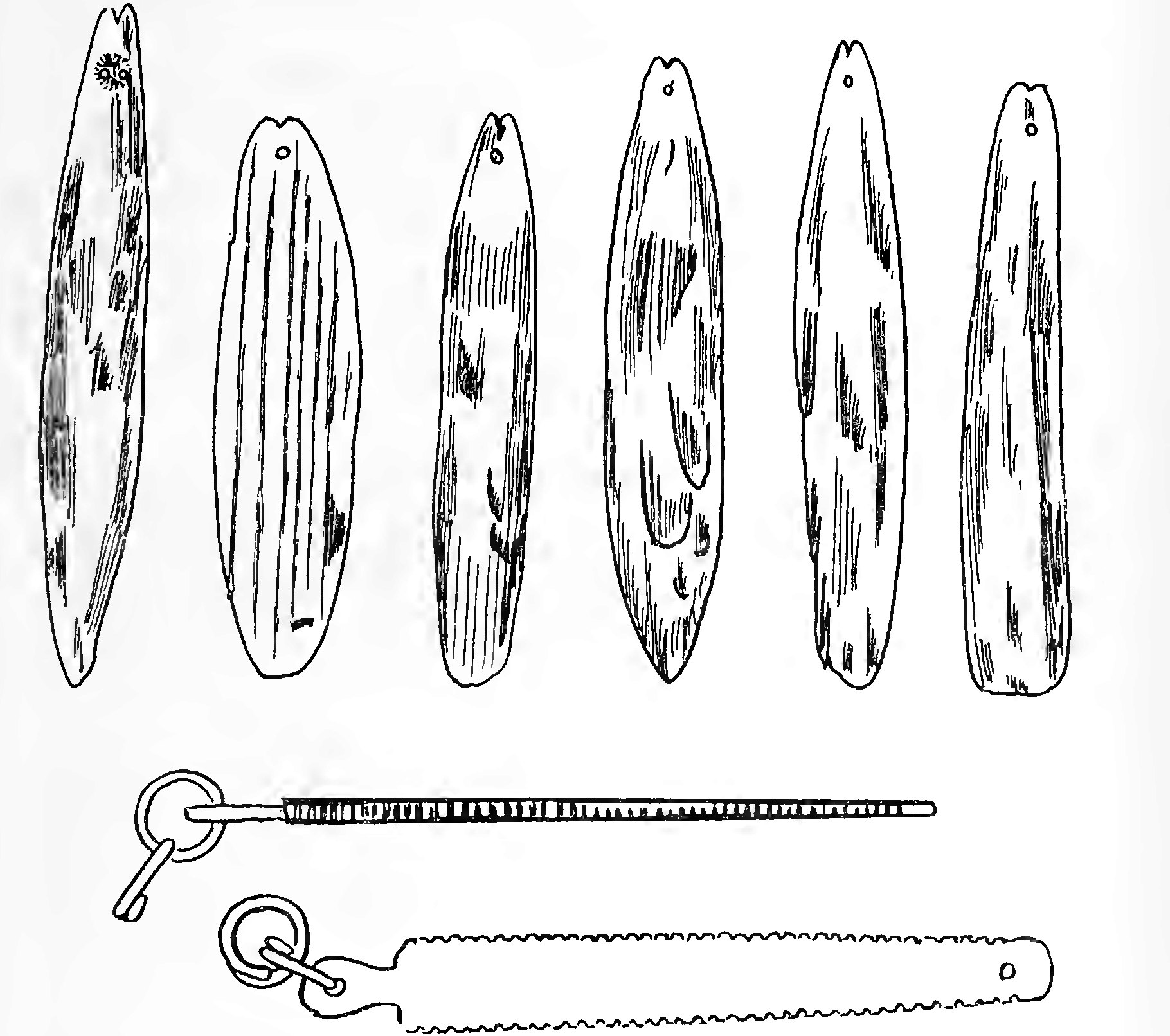
A Dogon mask, like a Kilenge one, is a face without a voice, and the Dogon give it one in the same way. The bullroarer takes the blood of the victims killed over the Great Mask and so gains “the power of this object, of which it is considered the voice and whose name it bears” (p. 254). In one Dogon account the first man to whirl one, Moyna of Yougo, tells the women: “It is the Great Mask speaking. The women and children who come out when this voice rises will be eaten.” In the secret language taught at the Sigui the bullroarer is awa non, and Griaule’s glossary spells out the phrase: “literally, the mouth (or throat, or speech) of the mask.” The same two words are the name of the secret language itself, “the language of the masks, the language of the Sigui” (p. 838). The instrument and the tongue men speak share one name, in a country where death entered the world because someone learned a language.
Fifty years on Germaine Dieterlen recorded the teaching in its fullest form, three blades and three owners: “On the level of myth, each of the three bullroarers is a tongue.” One is the Fox’s, “cut at the same time as his larynx.” One is the catfish’s, the sign of the human fetus. One is the tongue of Dyongou Sérou, the first ancestor to die. The Fox loses his tongue and his voice-box to the same knife, and what was cut out of him is whirled on a string at every Sigui, once in sixty years, and still talks.
Under the tongue
Two more peoples of New Guinea put the tongue at the bullroarer’s entrance and at its origin: one blade goes in under a boy’s tongue, and one rite was sung by a tongue cut from a dead man.
The Yéi-nan live on the upper Maro River in the far south of Indonesian New Guinea, near the border with Papua New Guinea. Their bullroarer is the kupör. At a boy’s first initiation, after weeks of fasting, the novices are lined up in the bush facing the senior men, whose blades have been rubbed with grass and lime to make them squeal. The missionary Jan Verschueren describes what follows:
“Now the boys have to open their mouths, with the tongue lifted upwards. They are told that the kupör will enter their bodies under the tongue. … Suddenly the older men step forward and pull the kupör out of the boys’ bodies. … If it appears from the vicinity of the genitals, this is a hint that the boy is a potential sorcerer …”
J. van Baal (ed.), Jan Verschueren’s Description of Yéi-nan Culture (1982), pp. 60–61.
The grown men do it to themselves in the full rite, when they “swallow their kupör (under the tongue, as usual)” and bring them out again at a menstruating girl’s hut covered with blood.
North of them, on the upper Fly River along Papua New Guinea’s border with Indonesia, the Yonggom swing bullroarers in the men’s initiation called yawat, and yawat was taught by a severed tongue. Kamberap had sex with his married sister Yumgon, took to stealing her sago by night like a wild pig, and was caught in the trap her husband Kaim set. Mortally wounded, he gave orders for his own butchering. “My torso and legs: take them for an arat pig feast … My head and chest and arms: they are for the men to eat, they are for yawat.” Then, as Stuart Kirsch was told it:
“Kaim placed Kamberap’s lower jaw and tongue in the fork of a nearby tree so that he could address the men assembled in the small clearing. Kamberap sang the verses that explain how to conduct yawat ritual. The men followed his instructions. They wrapped the upper half of his body in tree bark after covering him with sago and ferns, and cooked it over a banked fire. At daybreak, they opened the bark and consumed its contents.”
Janet Richards and Stuart Kirsch, “The Myths of Osiris and Kamberap in Cross-Cultural Comparison” (2013), p. 278.
A jaw and a tongue, cut from a man about to be eaten and set up in a tree, sing the whole rite into being. When Stuart Kirsch went through it in 1989, flutes alternated and a bullroarer sounded while the novices walked a gauntlet of leaf-covered figures that ended at a severed pig’s head with a man’s shell headband tied across its forehead: “Look, this is Kamberap’s mouth!” The pig was cut up, cooked over the fire and fed to the initiates, who were told: “You taste Kamberap’s skin.” A tongue cut from the founder’s body goes on speaking after he has been eaten, and the Yonggom swing the bullroarer in the rite it dictated.
The words came out
A tongue is for talking, and on the south coast of New Guinea the bullroarer talks. The Ende live on the Pahoturi River in the South Fly district of Papua New Guinea. Their story of how the Ende language began, told to the linguist Kate Lindsey by its owners, is set at two palms, the gogo and the pall, with two conch shells at their roots. “These conch shells were word wombs and held the first words of the language.” Ginarang, owner of the Ende language, sat at the base of one palm, and Umbuzag, owner of the neighbouring Agob language, at the other.
“From the bark of the gogo palm, Ginarang fashioned a bullroarer. Umbuzag fashioned a bullroarer from the bark of the pall palm. In this setting, the language came out in multiple ways. First, the words of each respective language came out of their conch shell. Second, the words came out when the bullroarers were swung.”
Kate L. Lindsey, Ghost Elements in Ende Phonology (2019), p. 288.
Each language has its own bullroarer, cut from its own tree, and speech comes off the blade as it turns. Lindsey’s note on the instrument gives its earlier history: “The bullroarer originally belonged to the woman and swung from her vagina. Man was jealous and stole the original bullroarer from the woman by ripping it from her, taking her power and starting her suffering, including her monthly bleeding.” The Ende roarer too was once a piece of a woman’s body, swung from her vagina, and was ripped out of her.
The organ that speaks
Most of the world’s bullroarers are a voice: of a spirit, an ancestor, a monster, thunder. A voice needs no anatomy. The peoples in this essay went one step further into the mouth and named the part. They did not choose the lungs, though the roar is deep, or the teeth, though the being often eats. They chose the tongue, the flat thing that moves and turns breath into words.
That choice says what the roar was taken to be. A Kilenge or a Dogon mask has a carved mouth and cannot use it, and the blade is the missing part, working at a distance. The Ende say outright that words came off it. The Dogon call it by the name of a language. The Vitu blade gives the ancestors’ consent to a marriage, which is a thing said. Even where the being is a dog, what the Yagwoia hear is an announcement with a meaning the boys are expected to understand. The Athabaskan peoples of North America reached the same place by another road and named the bullroarer “that which speaks”; and the ancient root behind Nggwal, the Sepik spirit of Papua New Guinea, and the Djanggawul of Arnhem Land in northern Australia is glossed “tongue; to speak.”
And the tongue is detachable. A voice cannot be cut out, kept in the men’s house, rubbed with lime, fed blood, shown to a widow before her brothers kill her, or put before a boy’s kinswomen at his circumcision. A tongue can. The Yagwoia tongue was extracted from the primal dog, an image Jadran Mimica calls “the oral-ocular castration.” The Fox’s was cut with his larynx. Kamberap’s was set in the fork of a tree. The Ende blade was ripped from a woman’s vagina. Each time the organ of speech is taken from its first owner and goes on speaking in the hands of the men who hold it, and that is what a boy learns when the blade is put in front of him: the roar that terrified him has an organ, and men hold it.
Around the Vitiaz Strait the tongue travelled with the masks, by canoe, between peoples who traded and married, and the name went with the blade from shore to shore. The Highlands and the Bandiagara cliffs are a longer reach, and the bullroarer made longer ones: it passed from people to people across the world, and what it was called went with it. In Leiden the Kwambu mask still holds its red knob of tongue between its teeth. The tongue that spoke for it was out in the bush, on a string, in a man’s hand.
Key sources
- Philip J. C. Dark, “The Art of the Peoples of Western New Britain and Their Neighbors,” in Sidney M. Mead (ed.), Exploring the Visual Art of Oceania (Honolulu: University Press of Hawaii, 1979), ch. 6 (the bullroarer as “the tongue of nausung”).
- Carl Laufer, “Rigenmucha, das höchste Wesen der Baining (Neubritannien),” Anthropos 41–44 (1946–49): 497–560, n. 39 (the Kilenge origin story, from Lavatu).
- Georg Bamler, “Tami,” in R. Neuhauss (ed.), Deutsch Neu-Guinea, vol. III (Berlin: Reimer, 1911), p. 512, sammlungen.ub.uni-frankfurt.de · archived.
- Peter ter Keurs, in Arts of Africa and Oceania: Highlights from the Musée Barbier-Mueller (Geneva, 2007), p. 291 (Sio; English and French texts).
- William R. Thurston, “The Bibling Languages of Northwestern New Britain,” in M. D. Ross (ed.), Studies in Languages of New Britain and New Ireland 1, Pacific Linguistics C-135 (Canberra, 1996): 249–401, Aria lexicon, p. 331.
- Andrew Lattas, “Trickery and Sacrifice: Tambarans and the Appropriation of Female Reproductive Powers in Male Initiation Ceremonies in West New Britain,” Man n.s. 24 (1989): 451–469, pp. 463–464 (Varku, the widow-killing, the tongues at the fence).
- Richard Parkinson, Dreissig Jahre in der Südsee (Stuttgart: Strecker & Schröder, 1907), pp. 640–641 and fig. 116, archive.org.
- Jennifer M. Blythe, Following Both Sides: Processes of Group Formation in Vitu (PhD thesis, McMaster University, 1978), p. 154 and n. 3; p. 73 (paraga).
- Luke Balane, “Music from Ghulu Island, West New Britain Province,” in Robert Reigle (ed.), New Guinea Ethnomusicology Conference Proceedings (1995), pp. 129–130; René van den Berg and Peter Bachet, Vitu Grammar Sketch (SIL, 2006), pp. 30, 33. The Vitu New Testament (Wycliffe, 2019): Mark 1:3, 7:33, 7:35.
- Jadran Mimica, Imacoqwa’s Arrow: On the Biunity of the Sun and Moon in a Papuan Lifeworld (Chicago: HAU Books, 2025), p. 59, n. 25, haubooks.org · archived.
- Marcel Griaule, Masques dogons (Paris: Institut d’Ethnologie, 1938), pp. 55–56 (the language that brought death; the mask with the hanging tongue), 66–67 and notes (the first bullroarer; Moyna), 253–256 and fig. 43, 838 (awa non).
- Germaine Dieterlen, “Mythologie, histoire et masques,” Journal des Africanistes 59 (1989): 7–38, pp. 33–34; English as “Masks and Mythology among the Dogon,” African Arts 22(3) (1989), p. 43.
- J. van Baal (ed.), Jan Verschueren’s Description of Yéi-nan Culture, Verhandelingen KITLV 99 (The Hague: Nijhoff, 1982), pp. 60–62.
- Janet Richards and Stuart Kirsch, “The Myths of Osiris and Kamberap in Cross-Cultural Comparison,” in E. Frood and A. McDonald (eds), Decorum and Experience: Essays in Ancient Culture for John Baines (Oxford: Griffith Institute, 2013), pp. 277–284.
- Kate L. Lindsey, Ghost Elements in Ende Phonology (PhD dissertation, Stanford University, 2019), Appendix C.1.1, pp. 287–288 and n. 67.