No. MUS2026-113
Kuikuro roarer swung in the open
Brazil · Upper Xingu, Mato Grosso · South America · Amazonia
Play / practical
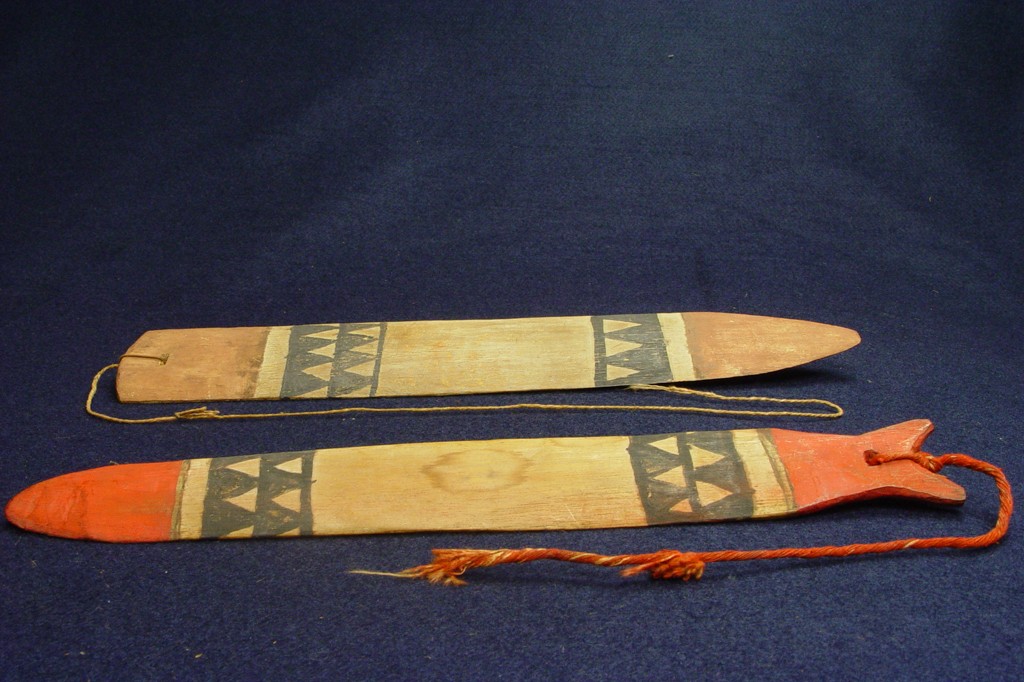
Source term: bull-roarer
matapu / matahu (Mehinaku-Nahuqua), zunidor (Portuguese): the Upper Xingu bull-roarer, a flat oblong or fish-shaped board whirled on a cord; among the Bakairi called yelo/iyelo, the word for thunder and lightning.
Among the Carib-speaking Kuikuro and their Upper Xingu neighbours the bull-roarer keeps strikingly modest company. The secrecy and the dread of being seen by women belong to the great hardwood kagutu flutes; the roarer, by contrast, von den Steinen watched the Nahuqua sound on the open village plaza "in all unconcern, as they would any everyday tool, and without the women being driven off." On the Kulisehu river it served the merry mask dances, and it doubled, he noted, as a plaything. The two Museu do Índio boards, oblong and painted in black, red and white, are such roarers; their voice in Xingu life is the cheerful, public one, not the funeral secret von den Steinen would meet only further off among the Bororo, whose women would die merely from seeing it. Even the roarer's ornament answered to its sound: Kulisehu painters gave roarers the image of the hissing snake, as they gave flutes the fluting monkey.
Das schmale Brett, an einem Strick durch die Luft geschwungen, erzeugt ein brummendes oder schwirrendes Geräusch, das einen etwas unheimlichen Eindruck macht, weil es wie von selbst stärker anzuschwellen scheint, und kann dabei mit einer Wucht sausen oder heulen, die man hinter dem unscheinbaren und simpeln Ding nicht erwarten würde.
The narrow board, swung through the air on a cord, makes a humming or whirring noise with a somewhat uncanny effect, because it seems to swell louder as if of its own accord, and it can rush or howl with a force no one would expect of so plain and simple a thing.
von den Steinen 1894, p. 327, on the Upper Xingu bull-roarer (Schwirrholz)
Particulars
- Object
- Two Kuikuro bull-roarers, 31.2 and 29.2 cm: oblong wooden blades painted black, red and white; the shorter with a notched butt and red-dyed cotton cord.
- Function
- Whirled openly at Upper Xingu mask dances, and otherwise a toy.
Sources
- Karl von den Steinen, Unter den Naturvölkern Zentral-Brasiliens (Berlin: Dietrich Reimer, 1894), pp. 294, 307, 327-328, 497
- Museu do Índio / FUNAI, Gerhard Baer Collection (1959), inv. 7697, Tainacan item 52448
- Museu do Índio / FUNAI, Gerhard Baer Collection (1959), inv. 7698, Tainacan item 52433 View · archived
- Otto Zerries, 'The Bull-roarer among South American Indians,' Revista do Museu Paulista n.s. 7 (1953), pp. 281-283