No. COHEN2021-001
Lagoa das Onças ceramic zumbidor
Brazil · Upper Xingu · Mato Grosso · South America · Amazonia
Function not recorded
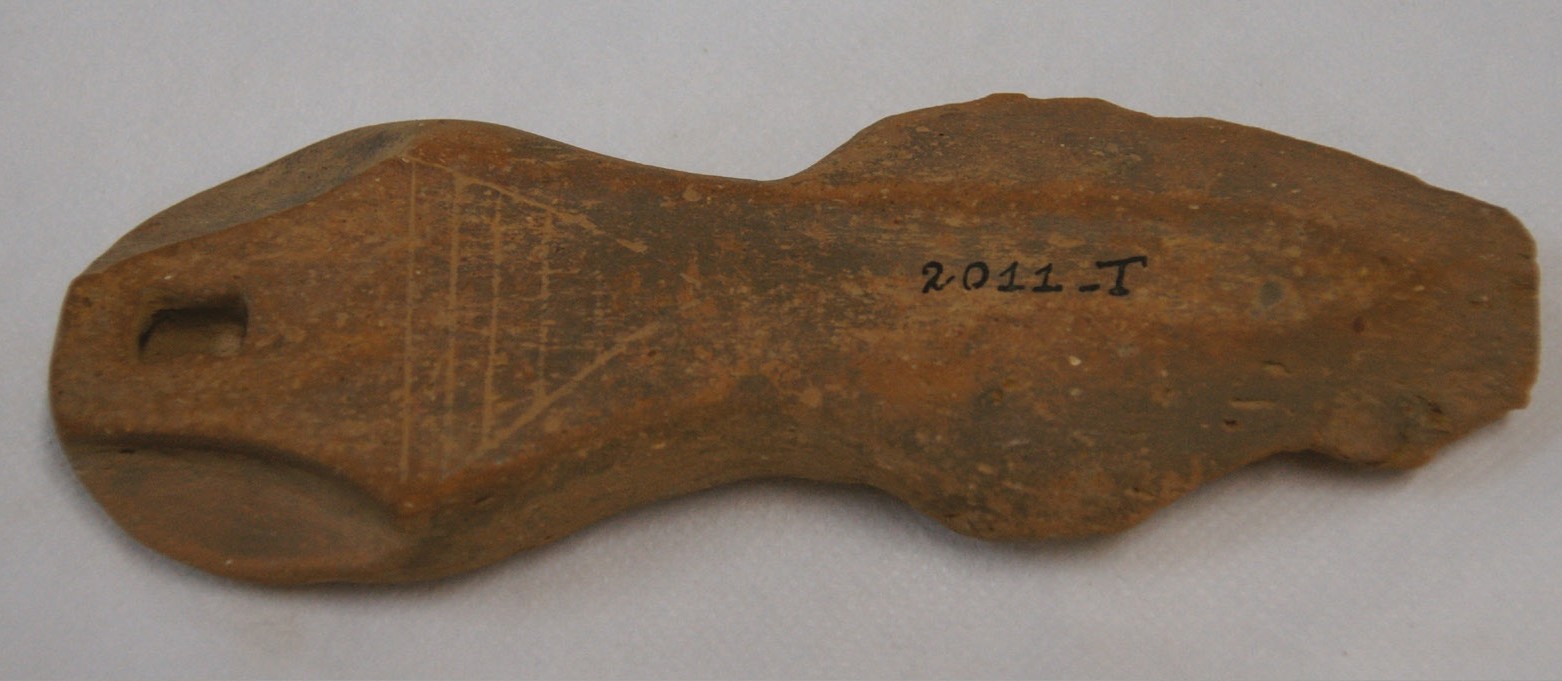
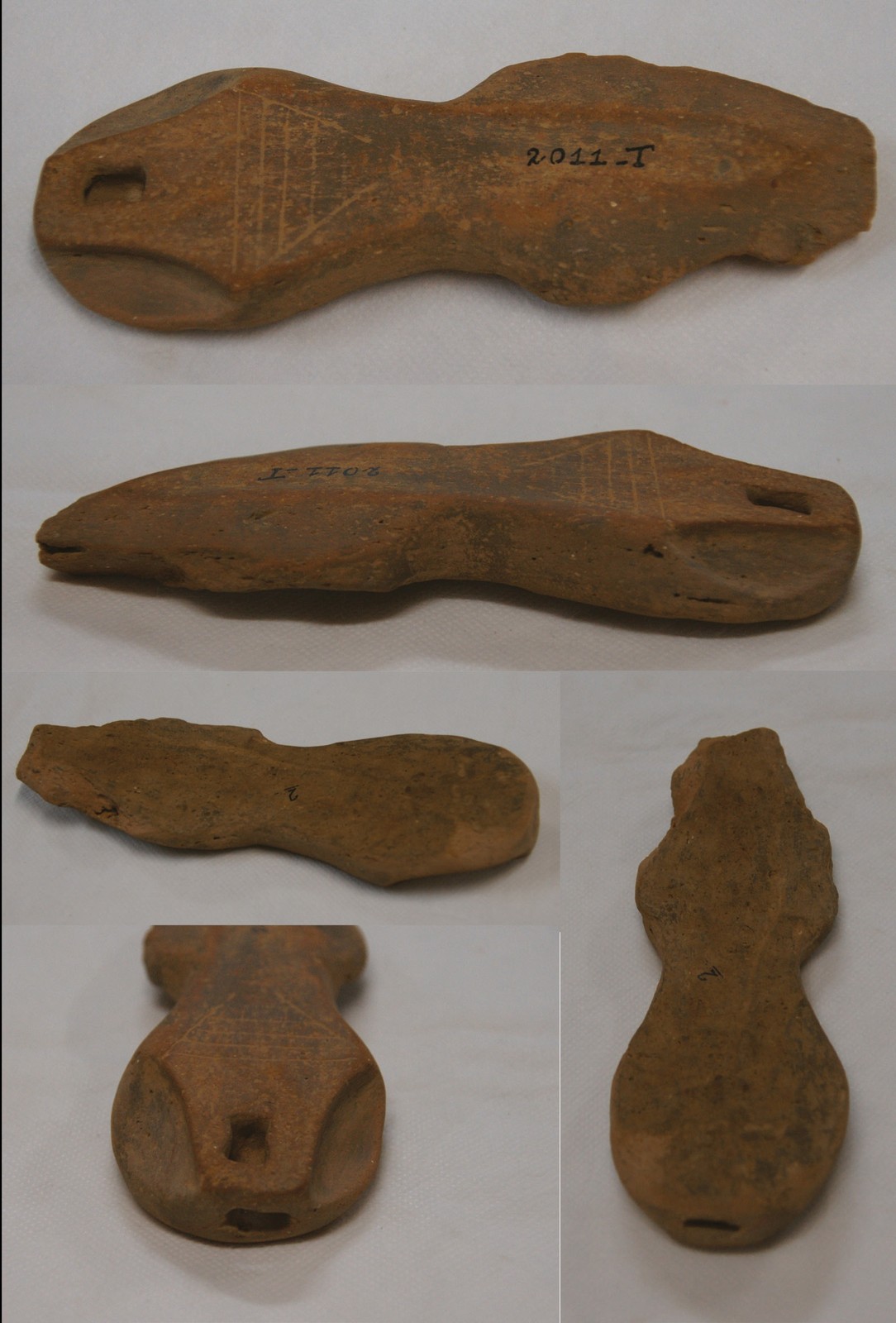
zumbidor
Source term: zumbidor (Portuguese catalog term)
zumbidor — Portuguese, 'buzzer/whirrer'; the Brazilian catalog term for the bullroarer class.
Nearly every bullroarer in the world's collections is wood or bone; the one from Lagoa das Onças is fired clay. Eighteen and a half centimetres of dark incised ceramic, bored at one end for its cord and worn smooth around the openings, it was brought out of the Upper Xingu by the archaeologist Pierre Becquelin and sits in the Goeldi Museum among the ancient instruments of the Amazon. It is classed by its mechanics — a rotary free aerophone — and nothing else came down with it: no maker's people, no date, no memory of what its clay voice was for.
Aerofone livre de interrupção não autófono giratório.
Free interruptive aerophone, non-autophonic, rotary.
Cohen & Venturieri, Arqueologia musical amazônica (2021), p. 70
Particulars
- Object
- Elongated incised ceramic zumbidor, 18.5 cm long, 6.4 cm at its widest, 2.0 cm thick, with a terminal bore of 0.5 x 1.2 cm and wear at its openings; distinctive incisions.
- Function
- Not recorded: the Goeldi catalog classifies it organologically as a rotary free aerophone — the bullroarer class — but no cultural use survives with the object.
Source
Liliam Cristina Barros Cohen & Leonardo Vieira Venturieri, Arqueologia musical amazônica: catálogo de instrumentos tapajônicos e marajoaras pré-cabralinos do Museu Paraense Emílio Goeldi (UFPA, 2021), pp. 69-70; Museu Paraense Emílio Goeldi, inv. 2011