No. MUS2026-122
Nahukúá Little Lightning
Brazil · Upper Xingu (Steinen expeditions of 1884 and 1887-88) · South America
Play / practical
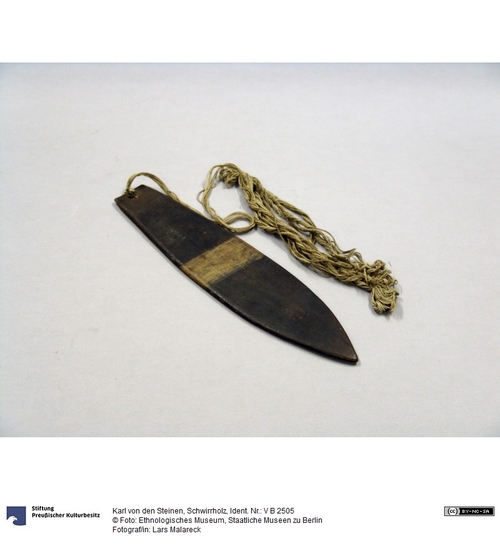
Kleiner Blitz ("little lightning")
Source term: Schwirrholz
Etymology. The Berlin main catalog's gloss for the Nahukúá bullroarer, "Kleiner Blitz" (little lightning), ties the instrument to the storm — the recurring lightning/thunder association of the bullroarer in lowland South America.
“Little Lightning” is the name attached to this Nahukúá bullroarer from the upper Xingu. Its broad 38.5-centimetre blade flashes with black and red paint—a storm-name for an instrument built to split the air with sound. Karl von den Steinen, who carried it home, watched such blades whirled openly on the village square, women looking on — mask-dance gear and plaything at once, with none of the secrecy the instrument keeps elsewhere.
Die Bakaïrí geben ihm den Namen yélo, iyelo, das heisst ihr für Blitz und Donner gemeinsames Wort, etwa »Gewitter«. Wollen wir in ihrem Sinn sprechen, müssen wir es nicht, wie ich früher gethan habe, »Blitz«, sondern nach seinem Geräusch »Donner« nennen.
The Bakairí give it the name yélo, iyelo — their one word for lightning and thunder together, something like 'thunderstorm'. If we are to speak in their sense, we must call it not 'lightning', as I did before, but, after its sound, 'thunder'.
Karl von den Steinen, Unter den Naturvölkern Zentral-Brasiliens (1894), p. 328
Particulars
- Object
- Broad wooden bullroarer, 38.5 × 9 cm, painted black and red and catalogued as “Kleiner Blitz” (“Little Lightning”).
- Function
- Whirled openly — von den Steinen, this object's own collector, watched upper-Xingu bullroarers swung on the village square with the women looking on, serving the mask dances and doubling as a toy; nothing about them was hidden.