Atlas Essay —
Live Snakes
The bullroarer and the serpent in the hands: New Britain, Arizona, the Greek mysteries
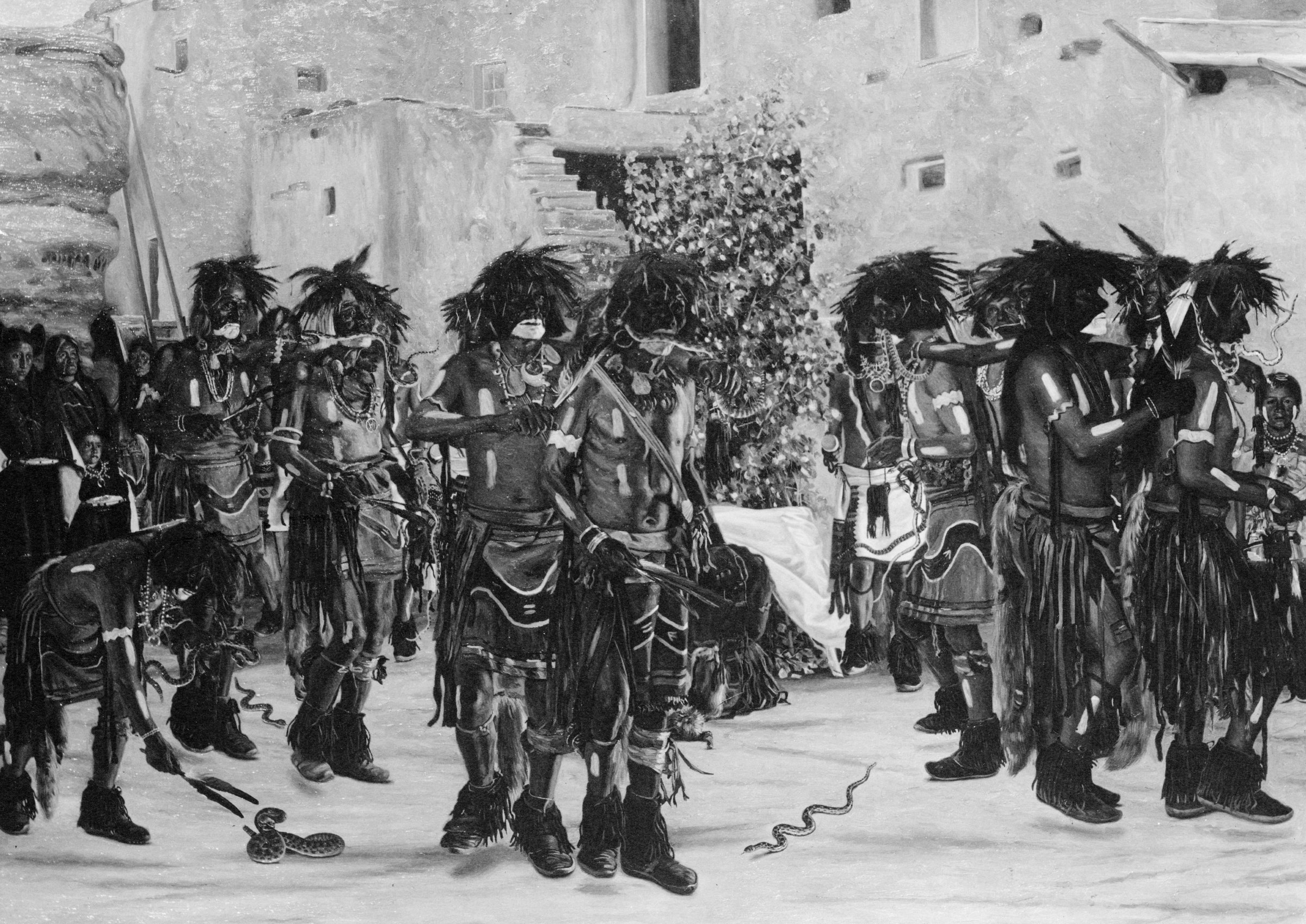
A fire burns in a clearing in the mountains of New Britain. From the dark bush comes the roar of bullroarers, and the boys who have fasted for a month leap into the light with snakes three metres long wound round their chests. On a mesa in Arizona, men who have heard the roarer swung over their kiva since before dawn dance across the plaza with rattlesnakes held between their teeth. In the streets of Athens, in the age of Demosthenes, a young man leads a procession of initiates with fat-cheeked snakes squeezed above his head, in a mystery cult whose sacred instrument was a whirled wood that roared.
In three places far apart, the bullroarer belongs to a rite in which living snakes are handled. Among the Baining of New Britain, the Hopi of Arizona and the initiates of Dionysus and Sabazios in the Greek world, the roar sounds and the dancers take the serpent into their hands, round their bodies and into their mouths.
In brief
- Among the Uramot Baining of New Britain, in Papua New Guinea, the bullroarer is the voice of the creator Rigenmucha. At the night fire dance that ends the boys’ initiation, the roarers sound from the bush, the great masks leap out, and the new initiates follow with snakes 2–4 metres long, swinging them, winding them round chest and arms and lunging at the crowd. Carl Laufer watched it in 1934.
- The Baining themselves say what the snakes are for: with the blood and the sexual emblems, they carry fertility to the new men.
- At the Hopi Snake Dance in Arizona the roarer lies on the Snake altar beside the snake bags. Before the dance, a messenger twirls it at the spring to announce himself to the horned water serpent, and warriors in snake kilts circle the kivas swinging it almost without pause. That afternoon the Snake men dance with rattlesnakes between their teeth (Voth 1903, pp. 288, 320, 327–328, 346).
- In Athens Aeschines led the initiates of his mother’s mysteries through the streets squeezing live snakes and brandishing them overhead (Demosthenes, On the Crown 260). Their god Sabazios was Dionysus under another name, the elder Dionysus “who is called by some Sabazius” (Diodorus 4.4.1), and in the mysteries of Dionysus the roaring wood was whirled.
- Andrew Lang, writing unsigned in the London Saturday Review, set the Hopi and the Greek rites side by side in October 1884: the roarer, he wrote, sounded over the Hopi snakes “as it roars in Australian mysteries, and roared at the rites of Dionysus.”

The fire dance of the Baining
The Baining live in the mountains of the Gazelle Peninsula, at the north-eastern tip of New Britain, the long island east of mainland Papua New Guinea. The Uramot, the central Baining, told the missionary Carl Laufer that their god Rigenmucha, “the one who was always there,” has no body and is never shown in a mask. He is heard. His voice, warning and admonishing, sounds in the whirring of the bullroarers, a salecha, and the masks of the initiation are called the bullroarer’s children, called into being by that voice.
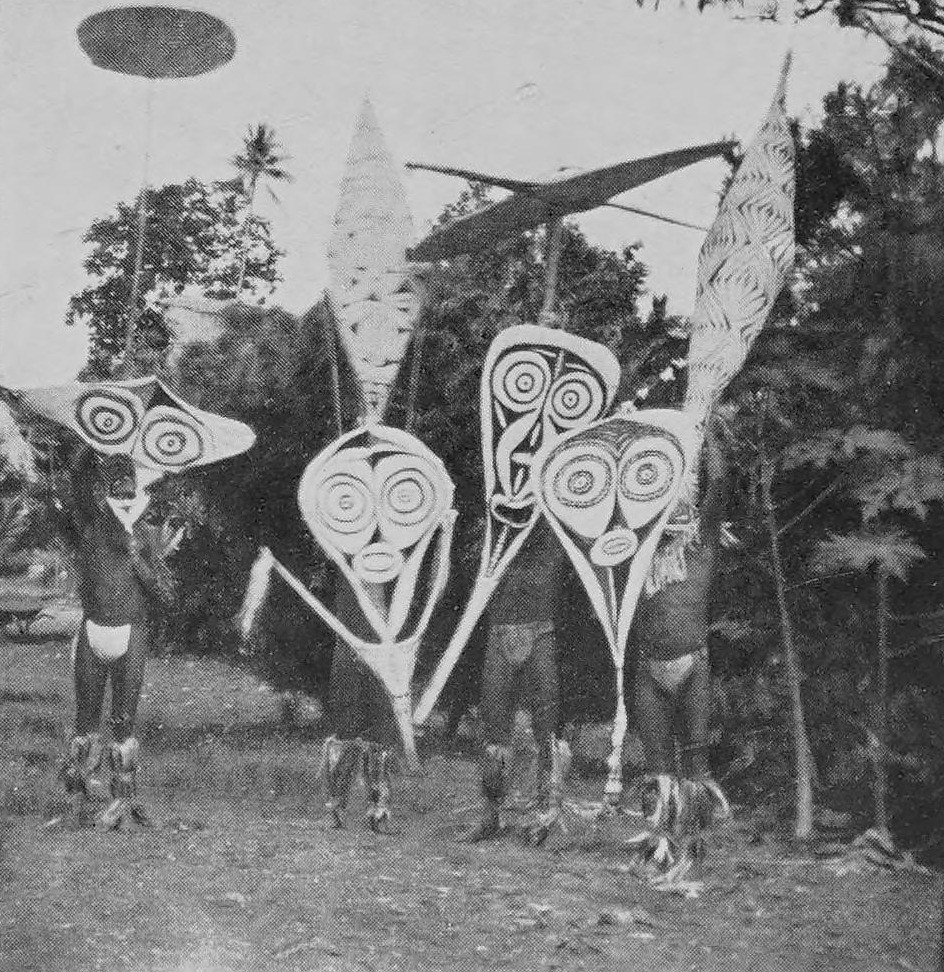
The boys meet the voice first with their eyes covered. Their fathers lead them blind between two hidden rows of painted men, each holding a roarer, sit them on the ground, and the instruments burst out howling. Then the hands come away and the boys see their own fathers and uncles, and learn how the sound is made. A month of seclusion and fasting follows. A few days before it ends, the old men take the boys into the bush to catch snakes, and keep them alive in net bags for the last night.
Laufer was at that last night in 1934. The women had spent days carrying firewood for a great pyre; the dancers dressed in the bush beyond the clearing; the old men of the orchestra beat bamboo tubes on the ground and sang. Then:
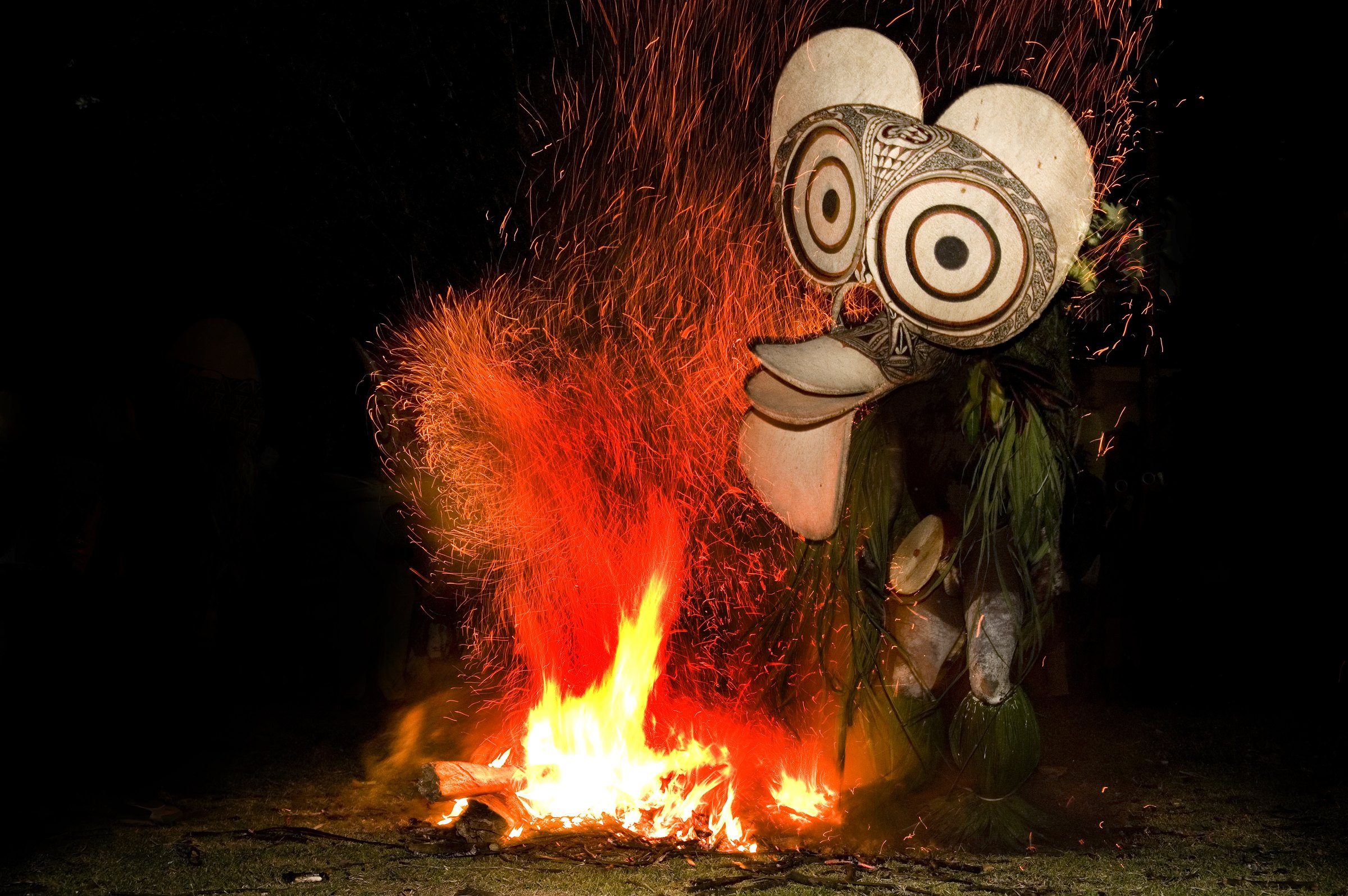
Suddenly from the bush close by comes the roar of the bullroarers, the dull howl of the bamboo trumpets, the cutting shrill note of the grass flutes. The orchestra stops as if frozen; women and children shrink back in fright. And with a piercing cry the first vunbun mask leaps out of the dark of the forest into the blinding light of the yellow-red tongues of flame.
… Now the children of the vunbun pair rush in, usually two, with the kuanrem hats and the same male and female sexual emblems. In their hands they swing ulanqi snakes two to four metres long, wind them round chest and arms, beat them against their bodies and leap with the writhing animals at the spectators: an uncanny sight.
Carl Laufer, “Rigenmucha, das Höchste Wesen der Baining,” Anthropos 41–44 (1946–49), pp. 526–527, translated
The “children” are the new initiates, appearing in public for the first time. Mask after mask comes in, and the ground round the fire becomes, in Laufer’s word, an inferno of circling, stamping, trumpeting spirit-figures; dancers snatch small children from their mothers’ arms and leap with them through the flames. The dance ran without a break from nine at night until four in the morning, when the last of the fire went out. Laufer’s two catechists from the coast, he wrote, “were half dead with fear and crept behind my back.” Afterwards the snakes went to the women, who carried them home in their string bags to roast and eat.
Two young Baining men, Kames and Barap, explained the meaning to him. The new men come out as children of the initiation ancestors, ready now to found families. So that they will have many children, the ancestors are called on, and the whole people is shown the means plainly, in symbols “known to all as bearers of fertility”:
“The organs of generation, blood, and snakes.” — Laufer, Anthropos 41–44, p. 528 (Zeugungsglieder, Blut und Schlangen)
The roar brings the masks out of the forest, and the masks bring the snakes. The god speaks in the bullroarer, the bullroarer begets the masks, and the boys come out of the dark as the masks’ children, carrying living serpents as the power that will make them fathers.
The Snake Dance of the Hopi
The Hopi live on three mesas in north-eastern Arizona, and every second summer each village holds the Snake Dance, the best-known rite in native North America. For days the Snake men gather snakes from the four directions and keep them in the kiva, the underground chamber of the society. The bullroarer is part of the furniture of that room. At Oraibi the Mennonite missionary Henry Voth, who spoke Hopi, saw the roarers lying on the floor of the Snake altar “to the right of Pöokong,” the war god’s image, together with the lightning frames, the snake whips and the snake bags (p. 288).
On the eve of the dance the Snake chief gives a messenger a bullroarer, meal and honey, and sends him out to a distant spring for water. At each shrine on the road he twirls the roarer, and when he nears the spring he does it for a named listener:
Arriving within a short distance of the spring, he stopped and twirled the bullroarer and blew his eagle-bone whistle to announce, he said, to the water deities (the Balölökongwuu and Clouds—the latter in this connection being considered personifications) his presence.
H. R. Voth, The Oraibi Summer Snake Ceremony (1903), p. 320
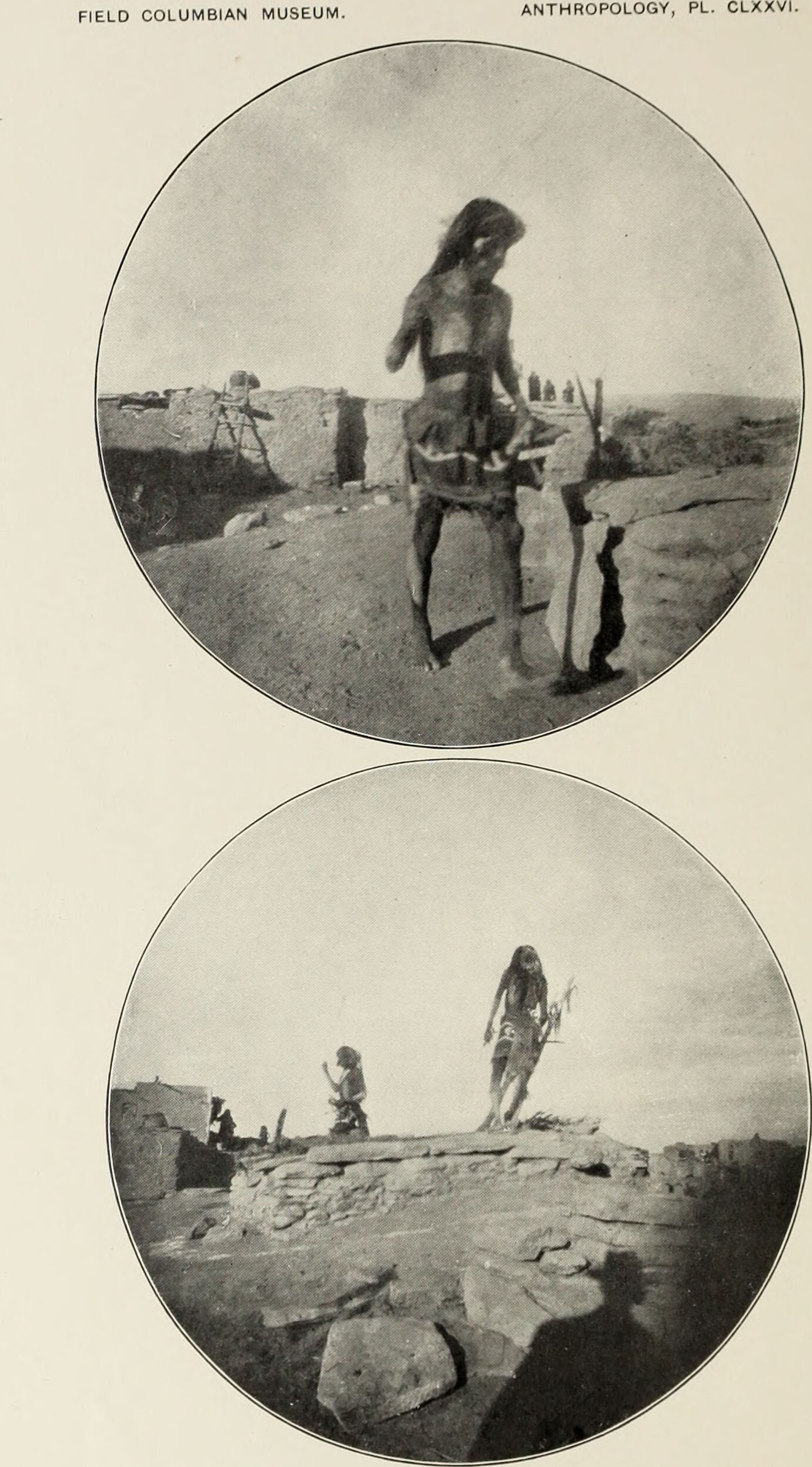
The Balölökongwuu are the horned water serpents, the great snakes who live in springs and send the water up. The roarer is how a man speaks to them. He comes home twirling it all the way to the edge of the mesa. Through the last night and the morning of the dance, the two warriors of the ceremony, in snake kilts, circle the Snake and Antelope kivas “twirling the bullroarers almost constantly”; inside the Antelope kiva they shoot the lightning frame four times and swing the roarer four times. Voth’s footnote gives the meaning: “These acts symbolize lightning and thunder” (p. 328). At Walpi, J. Walter Fewkes saw the two roarers on the Antelope altar cut into the stepped shape of a rain cloud.
That afternoon the snakes come out. The Snake men dance in pairs before the bower where the snakes are kept, and Voth describes what each man does as he kneels:
This snake he places between his teeth, grasping its body with both hands; both move slowly around in a sinistral circuit, the holder of the snake moving it and also stepping to the time of the singing.
Voth, The Oraibi Summer Snake Ceremony, p. 346
His partner lays a hand on his shoulder and strokes his back with the feather whip. Oraibi was the careful village, where the dancers took the snake close behind its head. In the others, Voth saw men hold “two, three, and on one occasion even four, snakes at one time between the teeth, the reptiles intertwining into a ball as it were in front of the dancer’s mouth,” and men with a small snake stuffed whole into the mouth, “the head of the reptile only protruding from between his lips.” At Walpi in 1881, John G. Bourke watched an old man come out whirling the roarer in the procession, and heard it roar again while the dancers ran down the mesa trails with the snakes in their fists to set them free. The roarer that announced the messenger to the water serpents at the spring is the thunder that brings their rain.
Snakes in the streets of Athens
In 330 BC Demosthenes, defending his career before an Athenian jury, turned on his rival Aeschines and recalled his youth. Aeschines’ mother Glaukothea ran initiations in the mysteries of Sabazios, the Phrygian Dionysus, and her son had been her acolyte. By night, Demosthenes said, he mixed the libations, dressed the novices in fawn-skins and scoured them with clay and bran. By day:
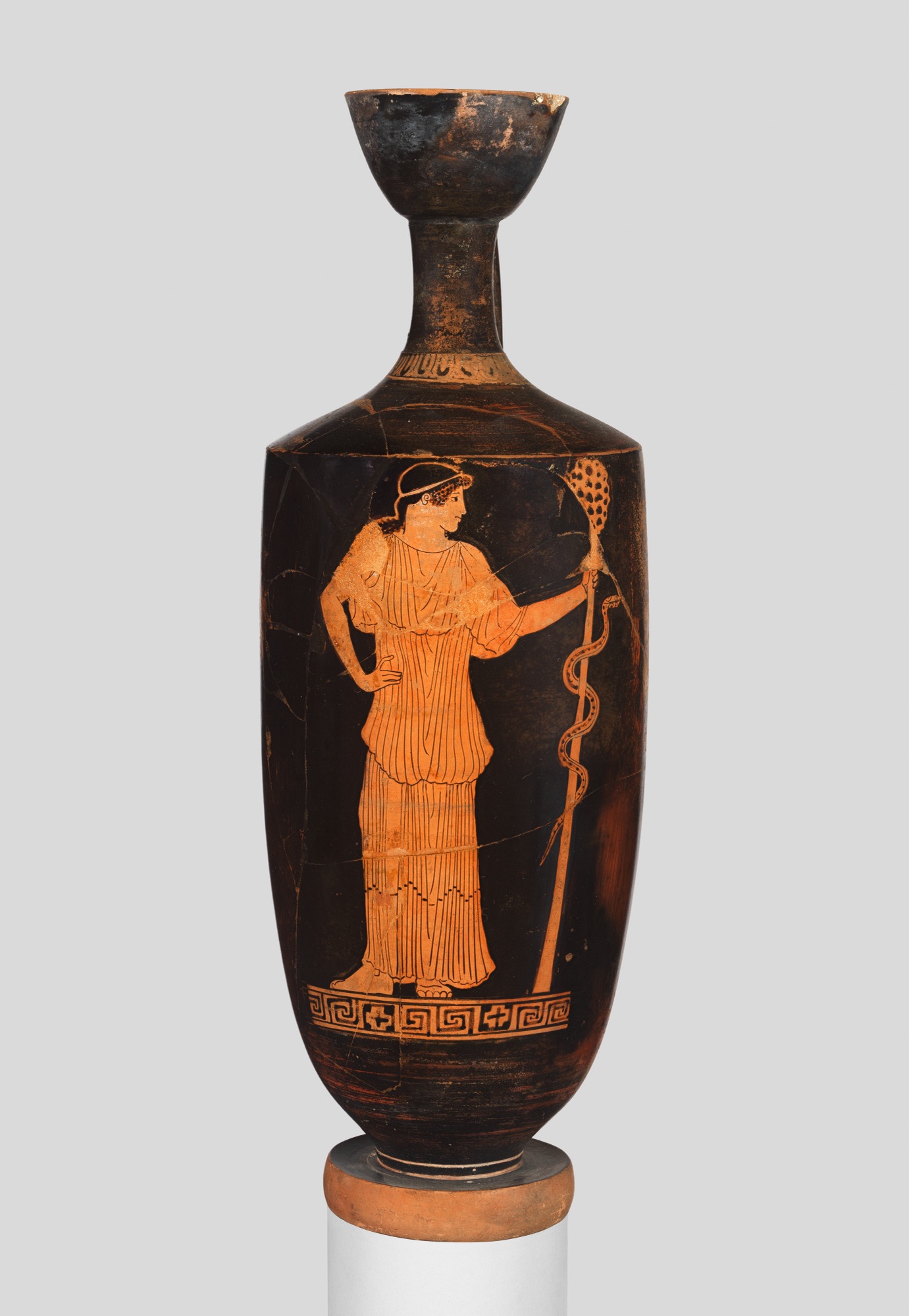
In day-time you marshalled your gallant throng of bacchanals through the public streets, their heads garlanded with fennel and white poplar; and, as you went, you squeezed the fat-cheeked snakes, or brandished them above your head, now shouting your Euoi Saboi! now footing it to the measure of Hyes Attes! Attes Hyes!
Demosthenes, On the Crown 260, trans. C. A. Vince and J. H. Vince (1926)
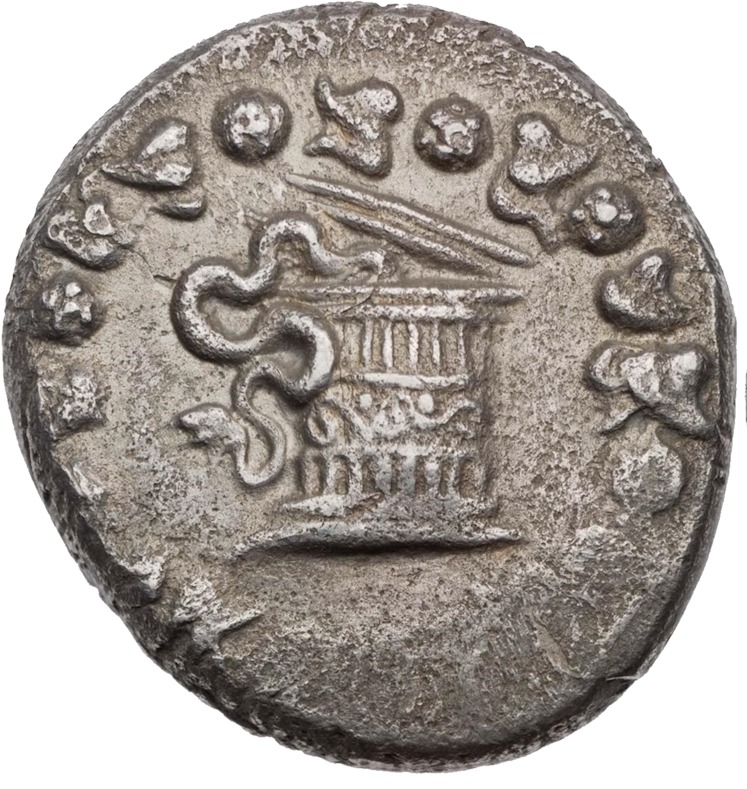
The fat-cheeked snakes are the pareiai, the big harmless brown snakes kept in the cult. Sabazios was Dionysus by another name. Diodorus of Sicily tells of an elder Dionysus, born of Zeus and Persephone, “who is called by some Sabazius,” whose birth and sacrifices are “celebrated at night and in secret” (4.4.1). Clement of Alexandria gives the token of the Sabazian mysteries, “the god through the bosom,” and explains it: a snake drawn through the bosom of the initiated. The roarer belonged to these mysteries. An old scholiast on Clement’s text, glossing the toys with which the Titans lured the child Dionysus to his death, explains the konos as “a small piece of wood tied to a string, and whirled round in the mysteries to produce a roaring noise.” Clement names the rhombos among those toys, and a ritual papyrus from Egypt, the Gurob papyrus, lists the cone and the rhombos among the things to be thrown into the sacred basket of a Dionysiac rite. The Greek mystery tradition has the roaring wood and the live snake in the same mysteries. Athens is only where the scene was written down. Sabazios came to the Greeks from Phrygia and Thrace; his snake rises from the basket on the silver cistophori struck at Pergamon in Asia Minor; and in Egypt the Gurob sheet set the snake and the roar on a single page. The mysteries ran the length of the eastern Mediterranean, and the serpent and the roarer travelled in them together.
The match was made long ago. On 18 October 1884 the London Saturday Review printed an unsigned notice, by Andrew Lang, under the title “Snake Dances, Moqui and Greek.” Lang laid out the Hopi rite from John G. Bourke’s new book and then reached for Athens:
There the serpents were released; and while this part of the ceremony went on the noise of the turndun roared, as it roars in Australian mysteries, and roared at the rites of Dionysus.
… Nothing can possibly be more explicit than this. Athens, like a Moqui village, was accustomed to the spectacle of dancers waving snakes in the midday streets.
“Snake Dances, Moqui and Greek,” The Saturday Review 58 (18 October 1884), p. 502
The roar and the living snake
Put the three scenes side by side. In each, the rite belongs to a closed society that a man enters by initiation: the Baining men’s cult, the Hopi Snake fraternity, the mysteries of Sabazios and Dionysus. In each the bullroarer is a sacred instrument of that society, sounded at the rite. And in each the climax is the same astonishing act: the initiates take up living serpents and dance with them in public, round the chest, in the teeth, above the head. Lang set two of the three side by side in 1884. Laufer, a Catholic missionary, watched the third by firelight in 1934.
The serpents are not the same animal, and oceans lie between the three peoples. What they share is the pairing. The roar comes first, as a voice: Rigenmucha’s in the bush, the thunder that calls the water serpents at the spring, the noise whirled in the mysteries of the god the Titans killed. Then the snake comes into the hands, as the power the voice has summoned: fertility for the new Baining fathers, rain for the Hopi corn, and for the Greek initiate the god himself, “the god through the bosom” of the Gurob papyrus. A whirled slat and a living serpent are an odd pair to invent once. Found together three times, at the heart of three initiations, they are one rite, remembered in three places.
The same pairing runs through hundreds of atlas records: the serpent painted on the blade, the roarer named for a snake, the cults of the Rainbow Serpent in Australia; The Serpent’s Voice lays out that wider trail, and Snake Venom Is an Entheogen follows the venom. Here the serpent is no picture and no name. It is alive, it is in the dancer’s hands, and the bullroarer has just stopped roaring.
Key sources
Laufer, C. 1946–49. “Rigenmucha, das Höchste Wesen der Baining (Neubritannien).” Anthropos 41–44: 497–560 — Rigenmucha’s voice in the salecha and the masks as its children, p. 510 and n. 28; the boys between the rows of roarers, pp. 520–521; the snake hunt and the fire dance, pp. 526–527, with n. 44 on the night of 1934; Kames and Barap on the meaning, p. 528. Laufer points to the fuller accounts of the Baining snake dance by K. E. Read (Oceania 1930/31), G. Bateson (Oceania 1931/32) and J. Poole (Oceania 1942/43).
Voth, H. R. 1903. The Oraibi Summer Snake Ceremony. Field Columbian Museum Anthropological Series 3, no. 4. Chicago — the roarers on the Snake altar, p. 288; the messenger and the Balölökongwuu, pp. 318–321; the warriors at the kivas, pp. 321–322, 327–328 and pl. CLXXVI; the snakes in the teeth, p. 346 and n. 2. Fewkes, J. W. 1900. “Tusayan Flute and Snake Ceremonies.” 19th Annual Report of the Bureau of American Ethnology, pt. 2 — the rain-cloud roarers on the Walpi Antelope altar, p. 983. Bourke, J. G. 1884. The Snake-Dance of the Moquis of Arizona. New York.
Demosthenes, On the Crown 259–260, in Demosthenes II, trans. C. A. Vince and J. H. Vince, Loeb Classical Library (1926). Diodorus of Sicily, Library of History 4.4.1, trans. C. H. Oldfather, Loeb Classical Library (1935). Clement of Alexandria, Protrepticus 2.16 (the Sabazian snake) and 2.17–18 (the toys of Dionysus), with the scholiast in C. A. Lobeck, Aglaophamus (1829), i.700. P. Gurob 1, ed. J. Hordern, Zeitschrift für Papyrologie und Epigraphik 129 (2000): 131–140.
“Snake Dances, Moqui and Greek.” Unsigned review. The Saturday Review 58, no. 1512 (18 October 1884): 501–502. Lang, A. 1884. Custom and Myth, ch. “The Bull-Roarer.” London.