No. DUBOIS1981-001
Maré’s spinning-board game
New Caledonia (France) · Loyalty Islands · Mare · Oceania · Melanesia
Play / practical
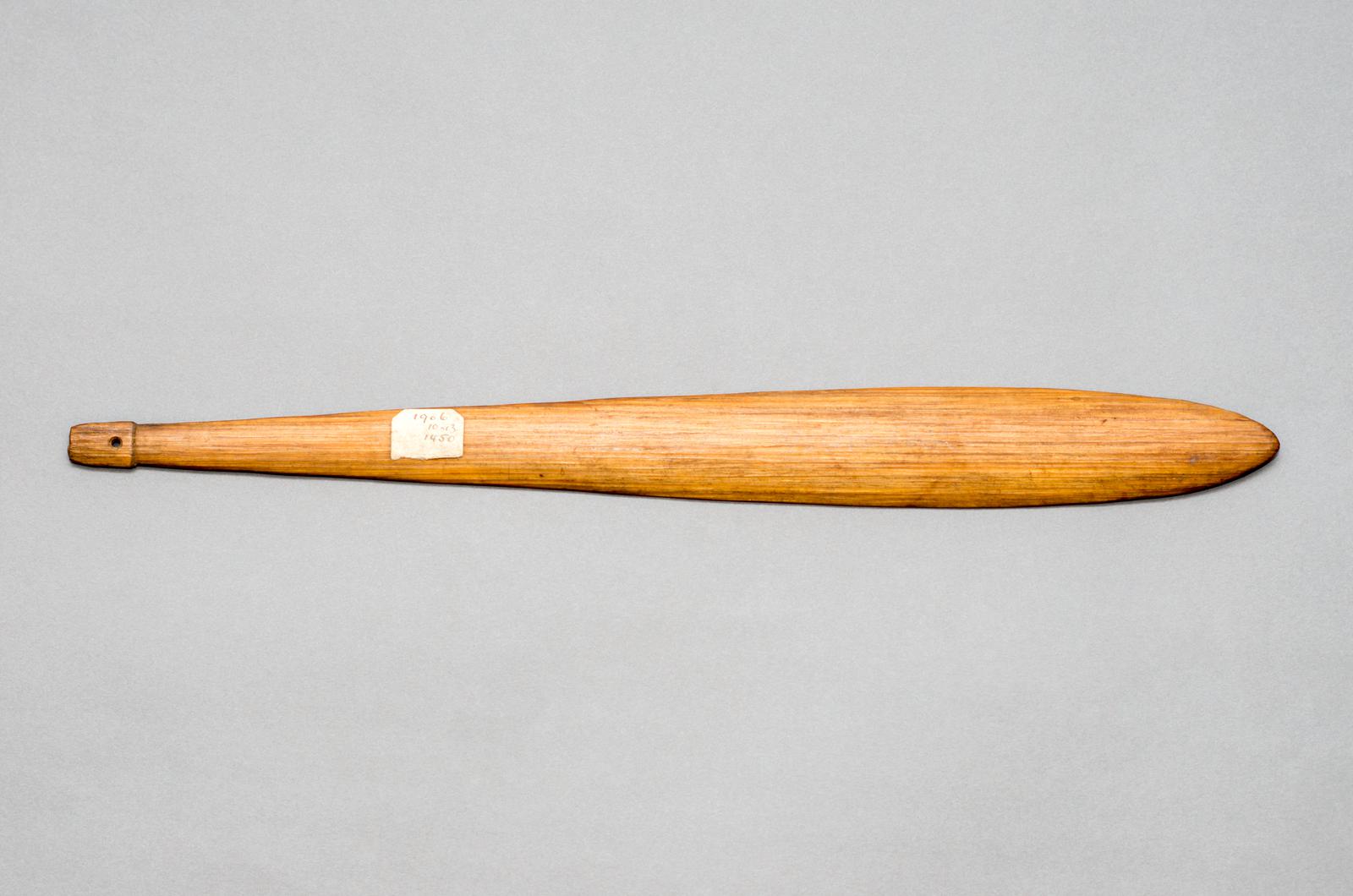
Small people were remembered at Rawa and Peorawa before later arrivals reached Maré. Dubois’s history associates these first inhabitants with knowledge of boomerangs and bullroarers. Games once went with the growing of the yams: young men bounced straight sticks and bent boomerangs along the ground and tallied points on fern fronds. Among the island's other games was a little board, twenty centimetres long, spun at the end of a string, though Dubois did not see it played much.
faire tourner un rhombe, planchette de 20 cm, au bout d'une ficelle
spin a bullroarer, a board 20 cm long, at the end of a string
M.-J. Dubois 1971, Ethnobotanique de Maré, p. 359
Particulars
- Object
- A wooden board about 20 cm long, spun at the end of a cord.
- Function
- Spun as a game, though rarely played.
Source
Marie-Joseph Dubois, 'Ethnobotanique de Maré, Iles Loyauté (Nouvelle Calédonie) (Fin)', Journal d’agriculture tropicale et de botanique appliquée 18(9–10) (1971), pp. 310–371, at p. 359; Dubois, Mythes et traditions de Maré (1975), ch. IV; Dubois, Histoire résumée de Maré (1981), p. 5