No. NAMER-002
Seri hacaaij, songs from the sea
Mexico · Sonora · Isla Tiburon · North America
Restricted
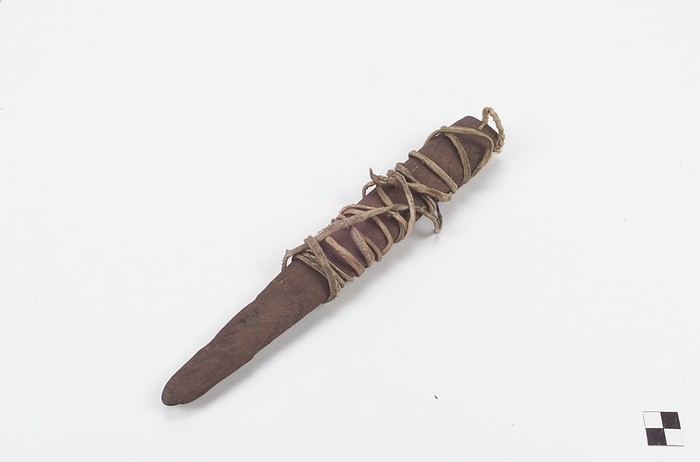
hacaaij
Source term: Bullroarer
hacaaij: Seri bullroarer used by a shaman; plural hacaailc (Moser and Marlett 2005, p. 164).
A four-day fast could end with the sea answering back. In a Seri quest for songs, the seeker painted sea animals on a beach shelter, then went out on the fourth night with a bullroarer. If he succeeded, the animals sang and spoke like little people, teaching songs, the winds’ timing and the fish runs. A would-be shaman made a second summons. After a four-day fast he whirled an ironwood bullroarer on a deer-tendon cord to call the santos, then lay waiting in a cave known to be good for the purpose. If they came, the cave became a beautiful house. The Comcaac call the instrument hacaaij; this carved wooden one came from Isla Tiburón in 1924.
Collected in 1924 by Edward H. Davis (1862-1951, a rancher and field collector for MAI) during fieldwork sponsored by MAI.
National Museum of the American Indian, Collection History note
Particulars
- Object
- Wood-and-hide bullroarer collected on Isla Tiburón in 1924 by Edward H. Davis; NMAI catalog 12/9728.
- Function
- A shaman’s instrument, whirled at a cave by a novice doctor at the end of a four-day fast to call the santos; seekers of sea songs also sounded it.
Sources
- National Museum of the American Indian, 12/9728, Comcaac (Seri), Isla Tiburón; collected by Edward H. Davis, 1924. View
- William B. Griffen, Notes on Seri Indian Culture, Sonora, Mexico (1959), pp. 16, 50. View
- Mary B. Moser and Stephen A. Marlett, Comcaac quih yaza quih hant ihiip hac (2005), p. 164. View · archived
- Thomas Vennum, “Locating the Seri on the Musical Map of Indian North America,” Journal of the Southwest 42(3) (2000), p. 703. View · archived