The Bullroarer Atlas

MUS2026-179 - museum specimen

English folk / Hemsby

United Kingdom - Norfolk - Hemsby - Europe

Function not recorded

The Hemsby buzzer itself, engraved by Haddon in 1898: a rounded-end Norfolk board with rows of small teeth, its cord knotted through the...
The Hemsby buzzer itself, engraved by Haddon in 1898: a rounded-end Norfolk board with rows of small teeth, its cord knotted through the terminal hole. A. C. Haddon, The Study of Man (1898), fig. 38 no. 8 Public domain Image source
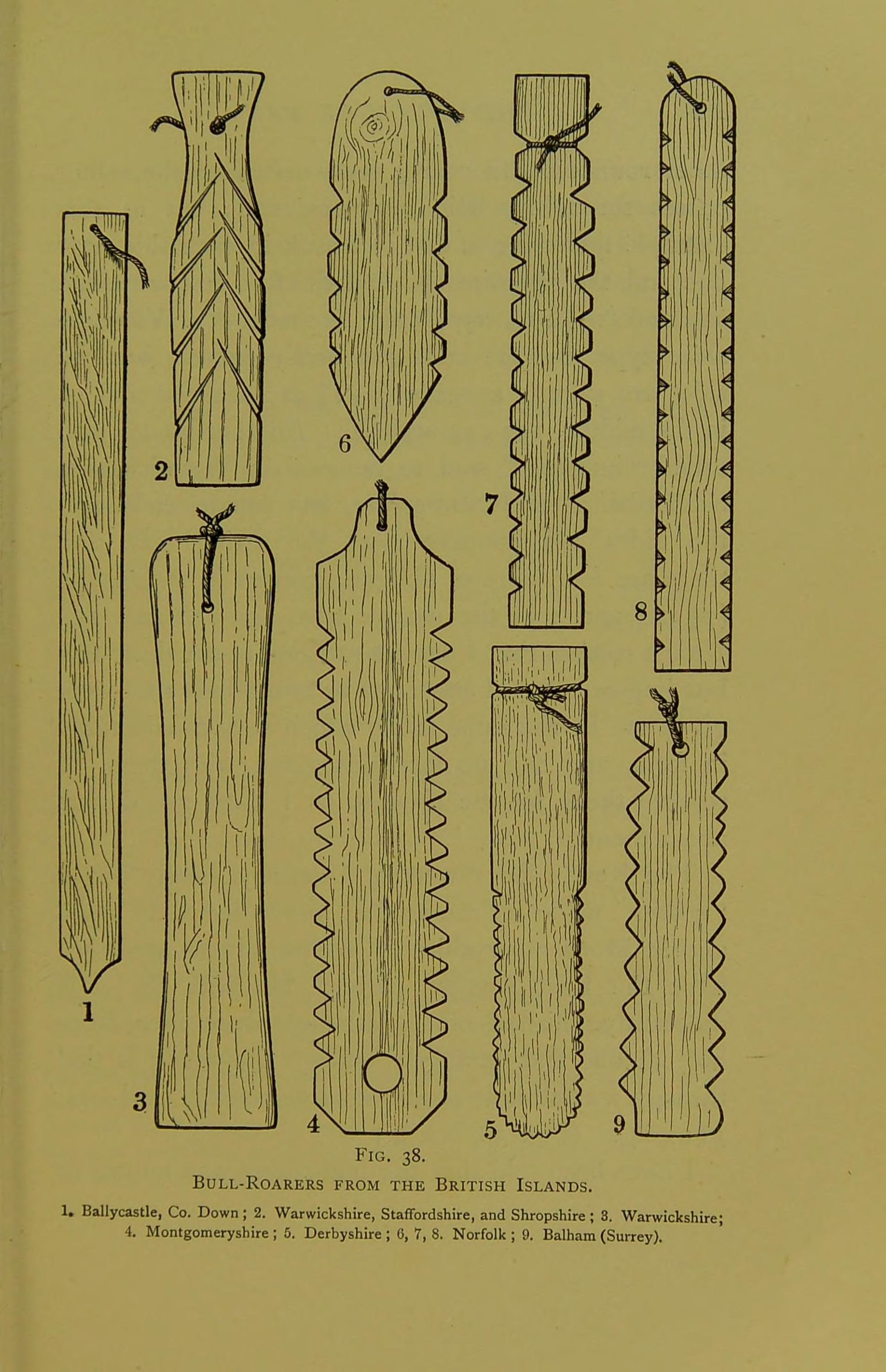
Haddon's full plate of bull-roarers from the British Islands; the Hemsby buzzer is no. 8, among companions from Ballycastle to Balham.
Representative image. Haddon's full plate of bull-roarers from the British Islands; the Hemsby buzzer is no. 8, among companions from Ballycastle to Balham. A. C. Haddon, The Study of Man (1898), fig. 38 Public domain Image source

Buzzer English

Source term: Bullroarer

Buzzer / humming buzzer: Haddon's own Norfolk term (1898:278); this Hemsby specimen is independently matched to no. 8 in his Fig. 38 plate of British bullroarers

Norfolk children called it the humming buzzer, or simply buzzer: a wooden board whirled on a length of string until it growled. This slim, rounded-top example from Hemsby is one of the county specimens Alfred Haddon engraved as No. 8 in his 1898 survey of British bullroarers — the same blade, cord and all, that sits in the Cambridge drawer today.

I have several specimens from different parts of Norfolk, where it is called "humming buzzer," or simply "buzzer"

A. C. Haddon, The Study of Man (London: John Murray, 1898), p.278
Object
Rectangular wooden board, 291 x 35 mm, with triangular notches along both long edges; a bundled, looped cord passes through a hole at the rounded end, the opposite end flat; the specimen itself is figured in Haddon 1898, Fig. 38 no. 8 (p.279).
Function
Function not recorded.
Map confidence
high - Hemsby village-center anchor matching MAA provenance; not a documented use site.
Source location
MAA 1922.386; Haddon 1898, The Study of Man, Fig. 38 no. 8, p.279 (in-text figure; MAA record cites it as 'Plate 38, Fig. 8' and misdates the book 1908)

View source Open this point on the interactive map