Atlas Essay —
Lightning Wood
Arnhem Land and the Kimberley, northern Australia · the Navajo, Yavapai, Apache, Zuni and Hopi Southwest
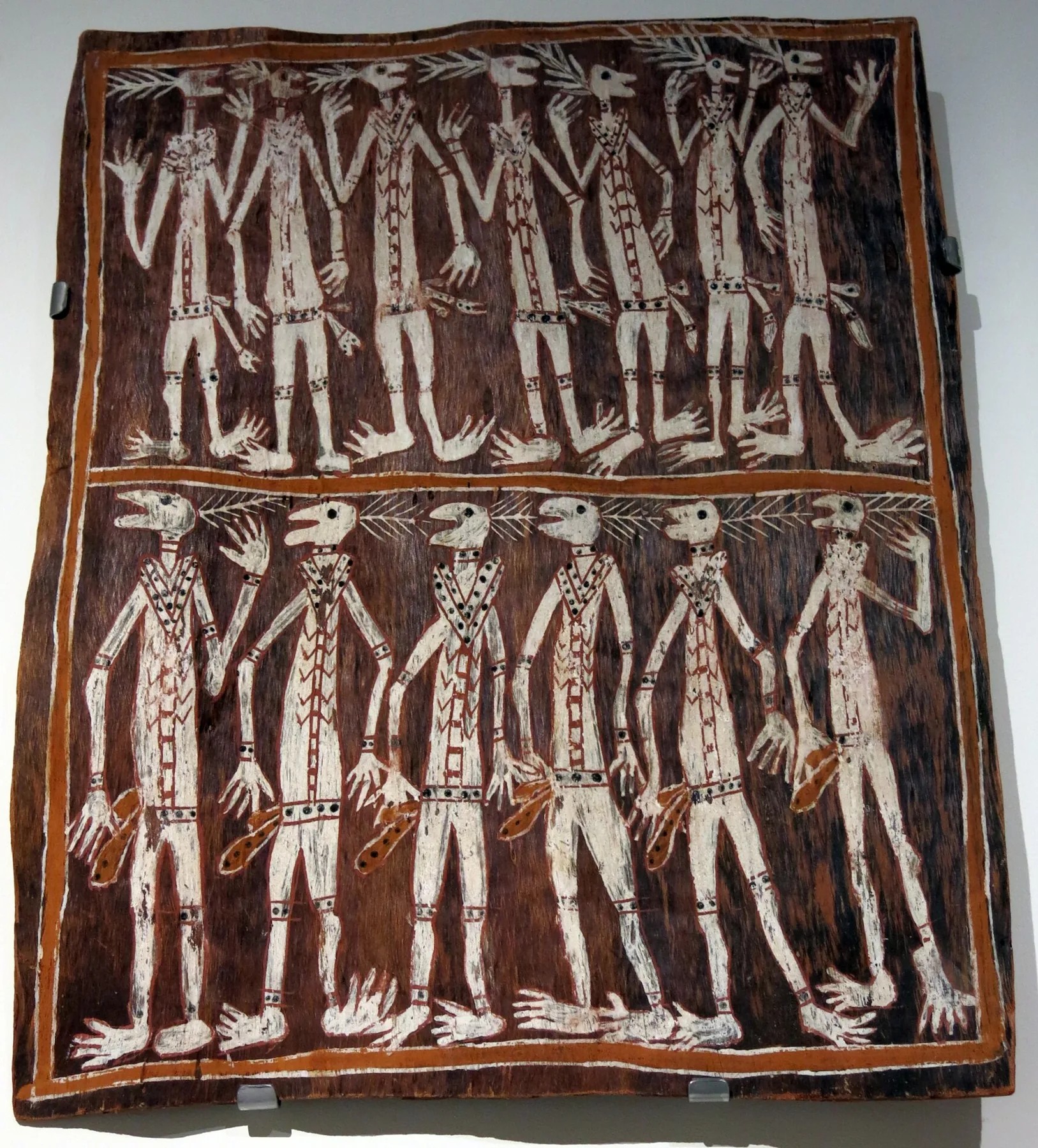
The first men to make a bullroarer in Arnhem Land, in northern Australia, did not take any wood they found. They went to a tree the great serpent Yurlunggur had split with his lightning, cut a clean piece from it, painted his design on it, and swung it, and they heard his voice again. On the far side of the Pacific, Navajo chanters in Arizona said the groaning stick could be made of nothing but pine the lightning had struck, and Hopi priests painted the lightning down the blade with a snake’s head at its tip.
On two continents the bullroarer’s wood comes from the lightning, and on both the lightning belongs to a serpent.
In brief
- In the Wawilak story of north-east Arnhem Land, the first bullroarer is cut from a tree Yurlunggur split by lightning, marked with his design and strung on human hair. Swung, it gives back his voice.
- Yurlunggur is the storm: his eyes shoot lightning and his voice is the thunder. Arnhem Land singers call the storm serpent the Lightning Snake, “making the lightning.”
- In the Kimberley of north-western Australia, the Ngarinyin hero Ngunyari painted the first boards with lightning, “for the mai-angari and the lightning are one and the same.” Their Unambal neighbours say “the lightning is also a yellow snake.”
- Navajo chanters held that the groaning stick “may only be made of the wood of a pine tree which has been struck by lightning,” and coated it with lightning-struck pitch and charcoal.
- Yavapai doctors, the Northern Tonto Apache and the Hopi of Walpi also cut their roarers from lightning-struck wood, and Zuni workmen expected it of any roarer.
- Hopi priests drew the lightning on blade and altar as snakes with heads, and Apache medicine-men carried wands painted with “snake-lightning.”

The tree Yurlunggur split
The Wawilak story belongs to the Yolngu of north-east Arnhem Land, in Australia’s Northern Territory, and stands behind their great initiation rites. Two sisters walk north toward the sea. At the waterhole of Mirrirmina the elder sister’s blood falls into the water, and the python Yurlunggur, who lives at the bottom of the well, smells it and rises. In the telling Lloyd Warner took down in the late 1920s, he spits well water into the sky and hisses to call the rain, and a black cloud gathers over the sisters’ hut. He swallows them and their babies. Then he rears into the sky and lays his head on a cloud: “His eyes shot lightning.” Far off, two Wawilak men “had heard the terrible noise of the snake’s voice (thunder) and they had seen the skies fill with lightning.”
The men of the story then set about making the Snake. They cut their arms and let the blood run, as the sisters had bled. They raised a tall padded pole to stand for him, and it made no sound. Ronald Berndt, who recorded the Kunapipi version of the story in the 1940s, gives what they did next (he spells the serpent Julunggul):
So they took a clean piece of wood from the tree which the Julunggul had split by lightning...., and marked it with the Snake design. They obtained human hair cord, and threaded it through the hole they had bored at one end of the wooden slab. When they swung this object (the bullroarer), they could hear the sound of the Julunggul....
Ronald M. Berndt, Kunapipi (1951), p. 36, quoted in Chris Knight, Menstruation and the Origins of Culture (1987), p. 306
The wood is clean. It comes from a tree the Snake himself has split. It carries his design, and it hangs on human hair. Swung, it gives back the voice the silent pole could not. The lightning is not weather around the instrument. It is the serpent’s own mark on the tree, and the blade is cut from the place where he struck.
The songs make one being of the storm and the Snake. In the Arnhem Land song cycles Berndt translated, the monsoon arrives with “the Lightning Snake, drawn by the smell of the blood,” and the singers follow him through the new rains: “Great Snake, flashing along and making the lightning.” The blade carries him too. A Yolngu bullroarer in the Peabody Museum at Harvard is catalogued as a “bull roarer, python design.”
Ngunyari’s boards are the lightning
West of Arnhem Land, beyond the Northern Territory border, in the Kimberley of north-western Australia, the Ngarinyin tell how the hero Ngunyari made the first bullroarers, the mai-angari, “with his blood and his elbows” and put his voice into them. Helmut Petri, who worked among the Ngarinyin with the Frobenius expedition in 1938, wrote the story down:
In Waringari Ngunyari had painted not only his chest but the mai-angari too with the signs of the lightning, for the mai-angari and the lightning (Malngeri) are one and the same. He bored four of the boards at one end and fastened them to a cord of human hair. He swung them in a circle and let them “sing out.” Then Ngunyari found that the humming of the swung mai-angari was his own voice, and he gave each board its own name.
Helmut Petri, Sterbende Welt in Nordwest-Australien (1954), as reproduced in Horst Südkamp, Wondjina, pp. 231–232; translated from the German
Here the board does not merely come from the lightning. It is the lightning. The cord of human hair, the bored end and the voice are the same as in Arnhem Land. And the lightning has an owner. The Ngarinyin told Petri that the storm being Kaluru throws the lightnings, the malngeri, and that he “carries them in his body.” Their northern neighbours, the Unambal of the far Kimberley coast, told Andreas Lommel of the same expedition where Kaluru came from and what his lightning is:
The Wondjina Kaluru was the one who threw the first lightning; he had painted himself yellow for it. Yellow snake-lines crossed on his chest. … The yellow lines on the Wondjina’s chest are snakes. The lightning is also a yellow snake, and every spear and every throwing-stick is to be painted with a yellow snake. … In the first time the Wondjina Kaluru came out of Ungud. … Ungud answered: I will believe it only when you shatter that tree there with the lightning. Kaluru drew a great arc, then let lightning and fire out … and shattered the tree. Then Ungud rose up as a snake on a tree and climbed across the sky as a rainbow.
Andreas Lommel, Die Unambal (1952), as reproduced in Horst Südkamp, Wondjina, pp. 247–248; translated from the German
Ungud is the Rainbow Serpent of the Kimberley. Out of the serpent comes the being who throws the lightning, and the lightning is a snake. Ngunyari’s boards are that lightning, painted on and sounding with a voice.
Pine the lightning struck
In the American Southwest the rule is spoken as law. Washington Matthews, the army surgeon who watched the Navajo Mountain Chant in Arizona in the 1880s, describes the blade whirled at the head of the night dances, a thin black board sparkling with iron ore, with turquoise eyes and mouth. Then he gives the chanters’ rule:
“The Navajo chanters say that the sacred groaning stick may only be made of the wood of a pine tree which has been struck by lightning.”
Washington Matthews, “The Mountain Chant” (1887), para. 135, p. 436The Franciscan Fathers at Saint Michaels, writing down the Navajo curing chants in 1910, give the recipe, and the lightning goes into it three times:
The prescriptions governing the construction of the bull-roarer … are very minute in detail. It is elliptical in shape and made of pine wood riven by lightning …. The whole is then covered with yucca pitch …, lightning-struck pitch …, and charcoal gathered from a tree struck by lightning.
Franciscan Fathers, An Ethnologic Dictionary of the Navaho Language (1910), p. 414
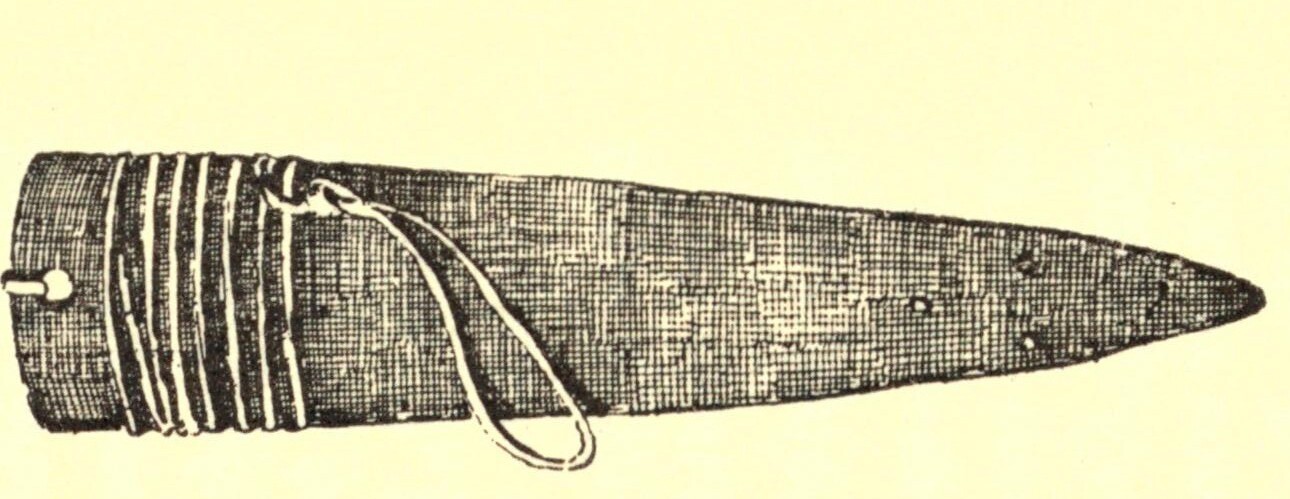
When Edward Gifford surveyed the Apache and Pueblo peoples for the University of California in the 1930s, his checklist asked whether the bullroarer was “of lightning-struck wood.” The answer was yes among the Western Navajo and the Eastern Navajo, among the Northern Tonto Apache in the pine country at the head of the Verde River, and at Walpi on the Hopi First Mesa.
The Yavapai doctors of central Arizona, Yuman-speaking neighbours of the Apache, made theirs the same way. In 1932 Gifford met Amuukyat, an old blind Northeastern Yavapai shaman:
Shaman amuukyat had 9-in. bullroarer, 1¼ in. in greatest width. One end square, other rounded; 40-in. buckskin cord passed through hole in square end. Wood from lightning-struck pine. Surface painted with white earth (matahē). Zigzag red line down middle of one surface represented lightning.
… When summoned, he whirled bullroarer to send his power ahead to sick person. Then went himself, taking bullroarer. Swung it outside sick person’s house, and clouds, lightning, and thunder came from e. This was sign sick person would get well.
E. W. Gifford, “Northeastern and Western Yavapai” (1936), pp. 289, 309
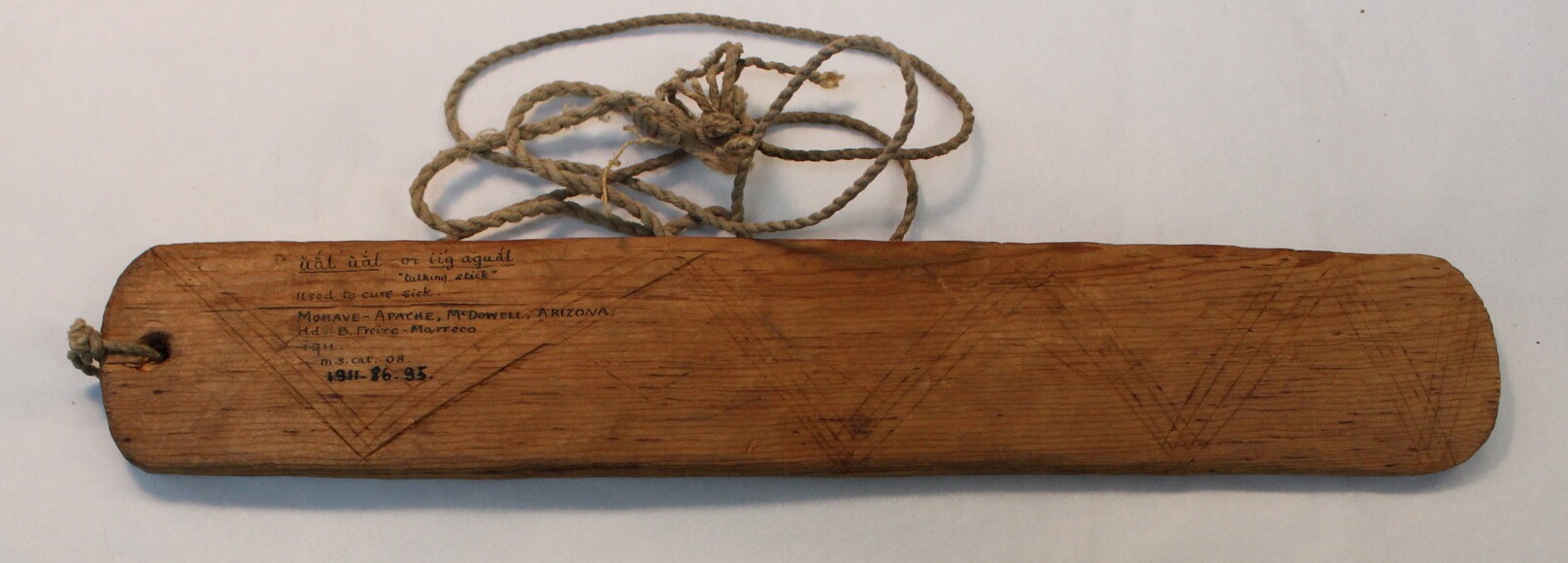
At Fort McDowell, east of Phoenix, the Yavapai medicine blade that Barbara Freire-Marreco sent to Oxford in 1911 is lightning-struck cottonwood incised with lightning zigzags. The wood and the mark say the same thing twice.
Captain John Bourke heard the same of the Apache at San Carlos, in the 1880s: their “sounding wood” was pine or fir “struck by lightning on the mountain tops,” and the same lightning-riven wood made the amulets they hung on their children’s cradles, “the duplicates, on a small scale, of the rhombus.” At Zuni, in New Mexico, the rule was the very idea of the instrument. When Neil Judd excavated Pueblo del Arroyo, in Chaco Canyon, in the 1920s, he turned up a blade of elk bone, and his Zuni workmen knew it at once for a bullroarer, “although made from the cannon bone of an elk instead of lightning-riven wood, and although it bears two transverse incisings rather than lightning symbols.”
Lightning with a snake’s head
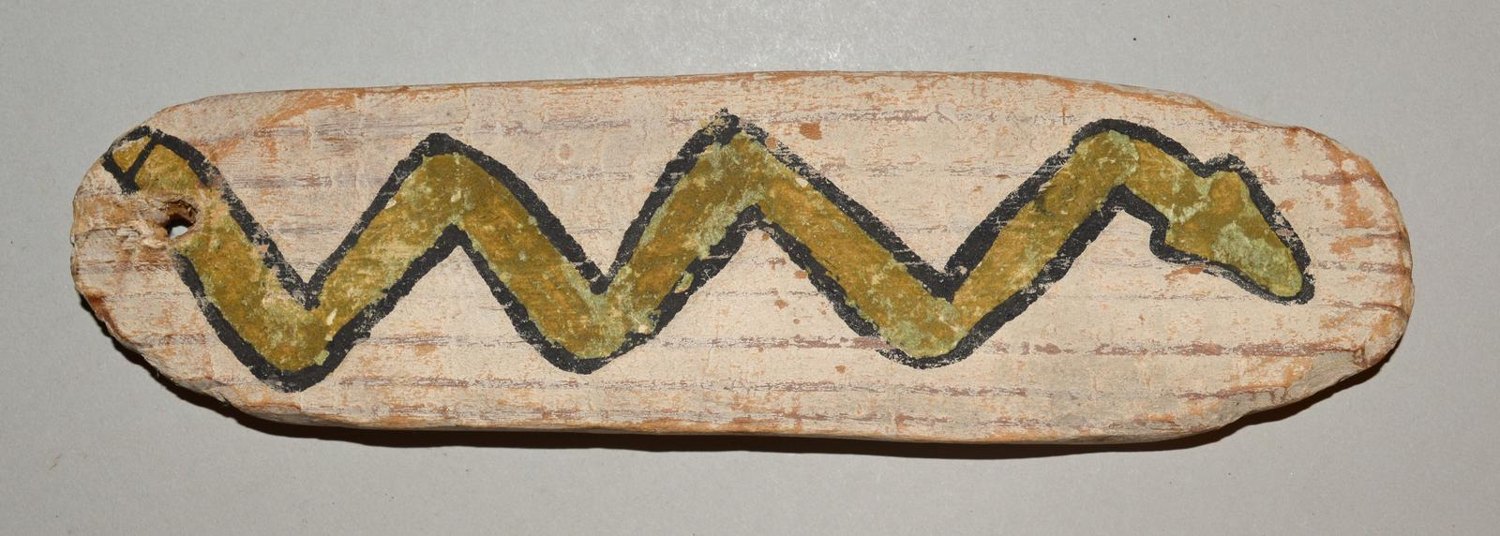
The Hopi painted the serpent onto the blade itself. Bourke first saw a bullroarer at the Snake Dance in the Hopi village of Walpi, in August 1881, where the medicine-men whirled it about their heads “faithfully imitating the sound of a gust of rain-laden wind.” The Walpi blade was a long, narrow board capped with a small triangle, and he described its painting:
Where the former shape was used, as at the Tusayan snake dance, the tracing of a snake or lightning in blue or yellow followed down the length of the rhombus and terminated in the small triangle, which did duty as the snake’s head.
John G. Bourke, “The Medicine-Men of the Apache” (1892), p. 477
A snake or lightning: Bourke could not choose, because on the blade they are one line. The zigzag is the lightning, and it has a head. Gifford’s Walpi informant gave him both halves of the rule at once: the roarer was cut from lightning-struck wood, and it bore a lightning design on both sides.
The same drawing lies on the altar. At Mishongnovi, on Second Mesa, Walter Fewkes recorded the sand picture of the Antelope priests’ altar for the Snake ceremony:
… in the remainder there are four zigzag designs representing lightning, as snakes, colored yellow, green, red, and white, with black rims. Each lightning symbol has a triangular head, with two dots for eyes and parallel marks for a necklace.
J. Walter Fewkes, “Tusayan Flute and Snake Ceremonies” (1900), p. 968
The Apache said it in a word. At Fort Marion in Florida in 1887, where the Chiricahua Apache were held prisoner, Bourke watched three medicine-men painted for the spirit dance, with yellow snakes on their arms and lightning zigzags on their backs, each holding two wands “ornamented with snake-lightning in blue.”
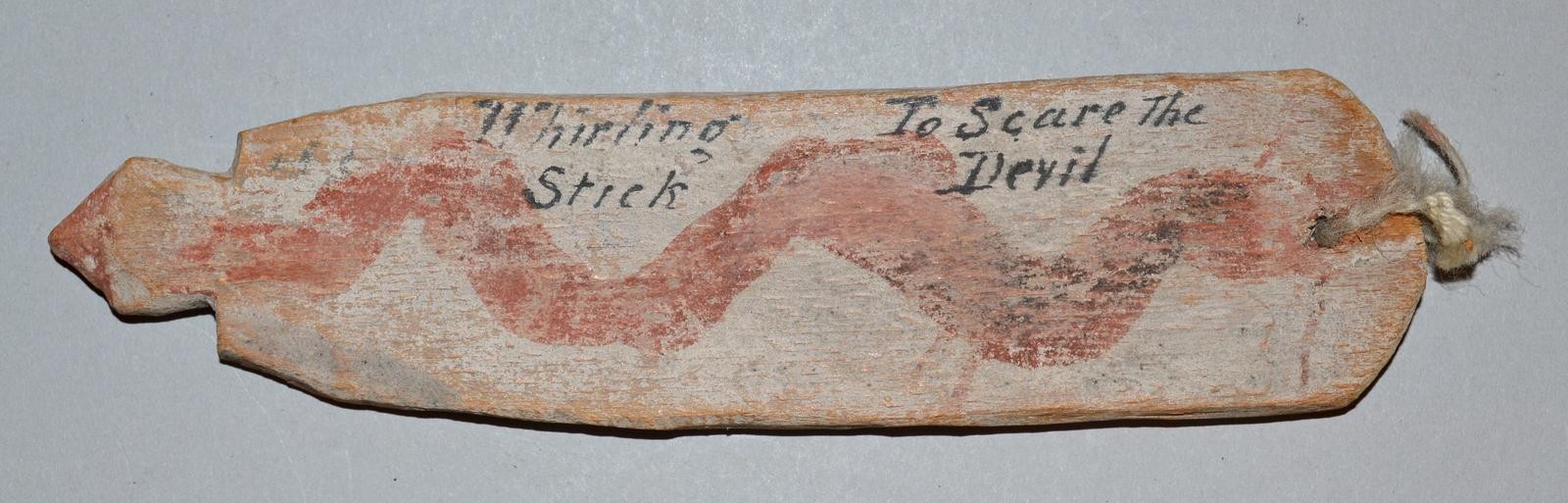
The Snake Dance is the Hopi prayer for the summer rain. The dancers carry live snakes in their mouths and then free them, to take the prayer down to the powers below, and through the dance the roarer sounds the thunder of the storm the snakes are sent to bring. At Mishongnovi a Hopi boy painted a black zigzag on his own blade, and its 1928 label reads “thunder & lightning.” The lightning the Navajo and Yavapai looked for in the tree, the Hopi drew onto the board, and they drew it as a snake.
The serpent’s wood
Set the two continents side by side and the wood comes from the same place. A bullroarer is not made from just any wood. It is made from wood the sky has already spoken through. In Arnhem Land the men of the story took it from the tree Yurlunggur split, and the Lightning Snake’s voice came back out of it. In the Kimberley the board and the lightning are the same thing, and the lightning is a yellow snake. Among the Navajo the pine must be riven by lightning and its pitch and charcoal struck by lightning too. Among the Yavapai the shaman swung lightning-struck pine outside a sick person’s house, and clouds, lightning and thunder answered from the east. At Walpi the lightning runs down the blade and lifts its head.
The match is close in its small particulars: wood from a struck tree, a design that names its owner, a voice that returns when the blade is swung. And the being behind the lightning is the same kind of being. In Arnhem Land he is the Lightning Snake who splits the tree; in the Kimberley Kaluru comes out of Ungud and throws a lightning that is a snake. On the Hopi altar the lightning is drawn as snakes with eyes, and an Apache medicine-man’s wand carries “snake-lightning.”
The rule tells the maker where the voice lives. It lives in the storm, and the storm is a snake. Cut the blade from the tree he struck, and when it turns on its cord, the one who struck it is speaking.
Related essays: The Wood That Speaks · The Living Double · The Rainbow Serpent
Key sources
- Berndt, Ronald M. 1951. Kunapipi: A Study of an Australian Aboriginal Religious Cult. Melbourne: Cheshire — the first bullroarer from the lightning-split tree, p. 36, as quoted in Knight 1987, p. 306.
- Berndt, Ronald M. 1976. Love Songs of Arnhem Land. Melbourne: Nelson — the Lightning Snake, p. 68, and the song of the Great Snake “making the lightning,” as quoted in Knight 1987, pp. 335–337.
- Knight, Chris. 1987. Menstruation and the Origins of Culture: A Reconsideration of Lévi-Strauss’s Work on Symbolism and Myth. PhD thesis, University College London — Warner’s Wawilak text, pp. 236–242; Berndt’s bullroarer origin, p. 306.
- Warner, W. Lloyd. 1937; rev. ed. 1958. A Black Civilization: A Social Study of an Australian Tribe. New York: Harper — the Wawilak myth, as reprinted in Knight 1987, pp. 236–242.
- Petri, Helmut. 1954. Sterbende Welt in Nordwest-Australien. Braunschweig: Limbach — Ngunyari’s mai-angari, as reproduced in Horst Südkamp, Wondjina: Der göttliche Tiermensch, pp. 231–232 (and n. 290 for the source); Kaluru and his malngeri lightnings, quoted by Südkamp, p. 96.
- Lommel, Andreas. 1952. Die Unambal: Ein Stamm in Nordwest-Australien. Hamburg: Museum für Völkerkunde — Kaluru’s yellow snake-lightning and his birth from Ungud (myth II,3), as reproduced in Südkamp, Wondjina, pp. 247–248.
- Peabody Museum of Archaeology and Ethnology, Harvard University, 30-54-70/D3412.1: Yolngu “bull roarer, python design.”
- Matthews, Washington. 1887. “The Mountain Chant: A Navajo Ceremony.” Fifth Annual Report of the Bureau of Ethnology, pp. 379–467 — the whizzer in the third dance, para. 133, p. 435; the groaning stick and its lightning-struck pine, para. 135, p. 436.
- Franciscan Fathers. 1910. An Ethnologic Dictionary of the Navaho Language. Saint Michaels, Arizona — the bull-roarer, p. 414.
- Gifford, E. W. 1936. “Northeastern and Western Yavapai.” University of California Publications in American Archaeology and Ethnology 34(4) — Amuukyat’s bullroarer, p. 289; its use in curing, p. 309.
- Gifford, E. W. 1940. “Culture Element Distributions: XII, Apache-Pueblo.” Anthropological Records 4(1) — elements 2208–2212, bullroarer, “of lightning-struck wood” and design, p. 58; notes on wood and the Walpi lightning design, p. 152.
- Pitt Rivers Museum, Oxford, 1911.86.95: Yavapai medicine bullroarer, Fort McDowell, collected by Barbara Freire-Marreco, 1911.
- Bourke, John G. 1892. “The Medicine-Men of the Apache.” Ninth Annual Report of the Bureau of Ethnology, pp. 443–603 — the rhombus at Walpi and San Carlos, its three forms and its lightning wood, pp. 476–477; the Chiricahua spirit dancers’ wands “ornamented with snake-lightning,” p. 583; the lightning-riven tzi-daltai amulets, p. 587.
- Fewkes, J. Walter. 1900. “Tusayan Flute and Snake Ceremonies.” Nineteenth Annual Report of the Bureau of American Ethnology, part 2 — the Mishongnovi Antelope altar and its lightning snakes, pp. 967–968.
- Judd, Neil M. 1959. Pueblo del Arroyo, Chaco Canyon, New Mexico. Smithsonian Miscellaneous Collections 138(1) — the elk-bone bullroarer and the Zuni workmen, p. 133.
- British Museum, Am1891,0612.21 and Am1891,0612.22: Hopi bullroarers painted with a zigzag snake and a red serpent. Pitt Rivers Museum, Oxford, 1928.9.99: Mishongnovi blade labelled “thunder & lightning.”