Atlas Essay —
The Living Double
Rouku · Idoma country · the Urubamba · the Xingu–Tapajós · Xerente country · Torres Strait
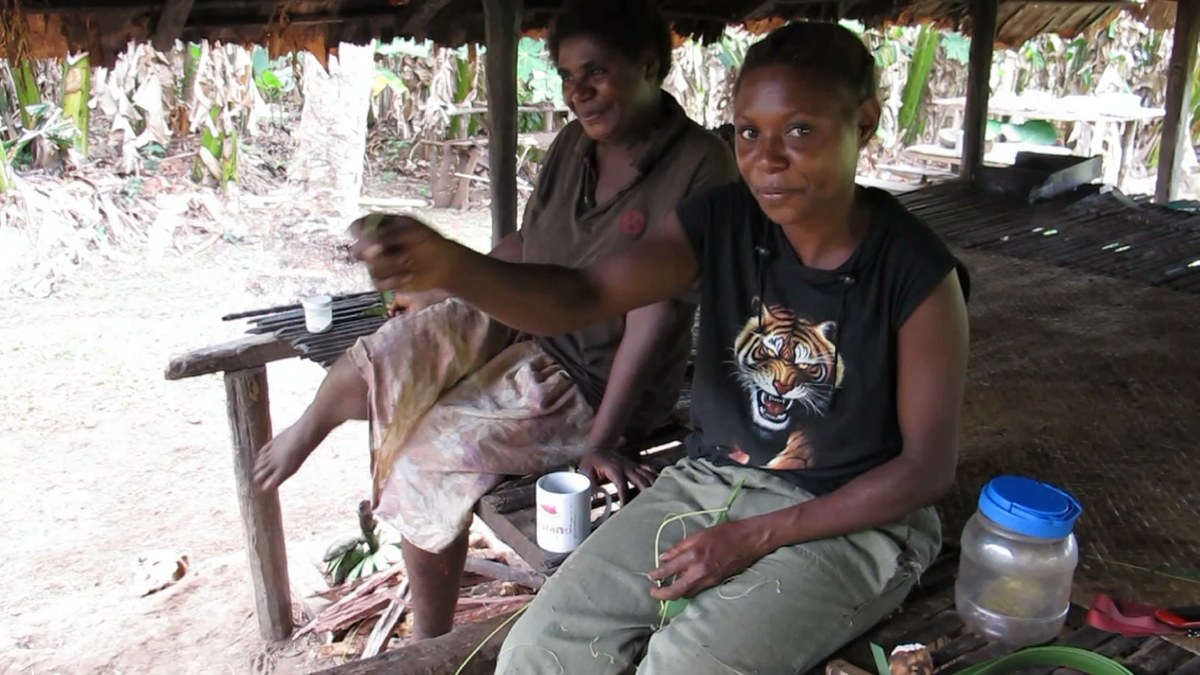
At Rouku, Nakre Abia folds coconut leaf into a bow, ties on a fibre cord, and sends it around his body. It buzzes only while it clears his shirt, the ground, and the trees. The film calls the thing by name: frfr, a children's toy. But Komnzo has another word for another bullroarer. That one is wooden, secret, and born in a myth of blood. It belongs to initiated men. The two instruments have not replaced one another. They are alive together.
In brief
- The Komnzo leaf frfr is a children's toy; the wooden ŋofoŋofo belongs to initiated men. Idoma boys improvise an ofukùfukù from a ruler while an ancestor society sounds a separately named fish-shaped plaque.
- Matsigenka evidence states the division as sacred and nocturnal versus children's and diurnal. Xipaya evidence suggests a shape boundary; paired Xerente passages show a stronger ritual object distinguished by custody, training, and the being expected to answer.
- Mabuiag grades permission in steps, while among the Mbaya-Caduveo and Upper Tanana one object crosses between ritual and play. There is no universal evolutionary sequence.
Living bullroarer systems often keep a child-safe double beside the restricted instrument: a second form separated by material, name, shape, scale, time of day, or permission.
The toy is not always the last stop
The standard history runs downhill. A sacred instrument loses its god, taboo, and ceremony; what remains is a toy. European buzzers and buttons-on-a-string make that descent easy to imagine. The atlas contains genuine examples of ritual forms passing into play. But the downward line becomes a trap when applied to every toy. It turns coexistence into chronology. If an ethnographer records a children's bullroarer, we begin to invent a sacred past for it; if a cult instrument appears nearby, we assume the toy is its worn-out descendant.
The more interesting records resist that sequence because the senior and junior forms are documented at the same time. They may occupy the same village or the same museum accession. Their names, materials, hours, or operators differ. The child's instrument does not announce that the cult has died. It shows how a living cult distributes access to a dangerous acoustic technology.
“Child-safe” here describes a social fact, not a modern safety rating. Coconut leaf can cut. A swinging board can strike someone. The safety lies in what the object is allowed to mean. Its sound does not summon the forbidden being, confer the office, expose the myth, or place the child inside the penalty structure of the senior instrument. The physical mechanism is shared; the ritual consequence is sandboxed.
Rouku: translate the voice into leaf
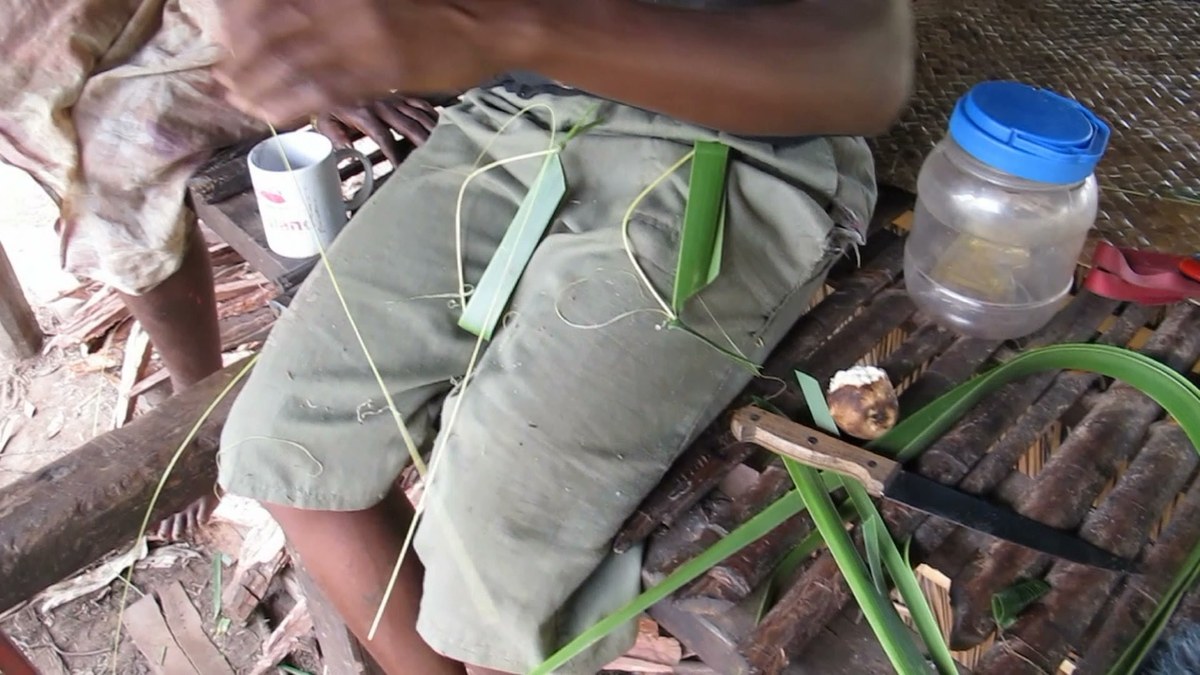
Christian Döhler's Komnzo lexicon makes an unusually clean separation. Frfr is a “children's toy bullroarer,” made entirely from coconut leaf, bent into a bow and tied to a cord. Ŋofoŋofo is the bullroarer proper, cut from the wood of the süfr tree. A filmed demonstration supplies what dictionary entries cannot: construction, handling, and sound in a continuous public act. Abia builds two leaf instruments and explains that contact with body, clothing, or tree arrests the buzz. The instrument works by staying free.
The wooden roarer occupies a different world. Döhler's grammar preserves the story of a man who heard roaring inside his wife's belly. Birds entered her body to retrieve the object, emerged blood-red, and one finally stole it for the man. The story ends by establishing the wooden bullroarer as sacred and restricted to initiated men. In Döhler's 2021 account it is a thin wooden slat on a long twisted cord, formerly secret across the Morehead district.
Nothing here resembles one undifferentiated object sliding between seriousness and play. The system makes four cuts at once: leaf against tree wood, frfr against ŋofoŋofo, child against initiate, public demonstration against bodily origin myth. The junior form reproduces the aerodynamic trick but not the sacred biography. It is almost a translation: durable wood becomes disposable leaf, esoteric name becomes everyday name, dangerous interior becomes open air.
Idoma: an ancestral fish beside a school ruler
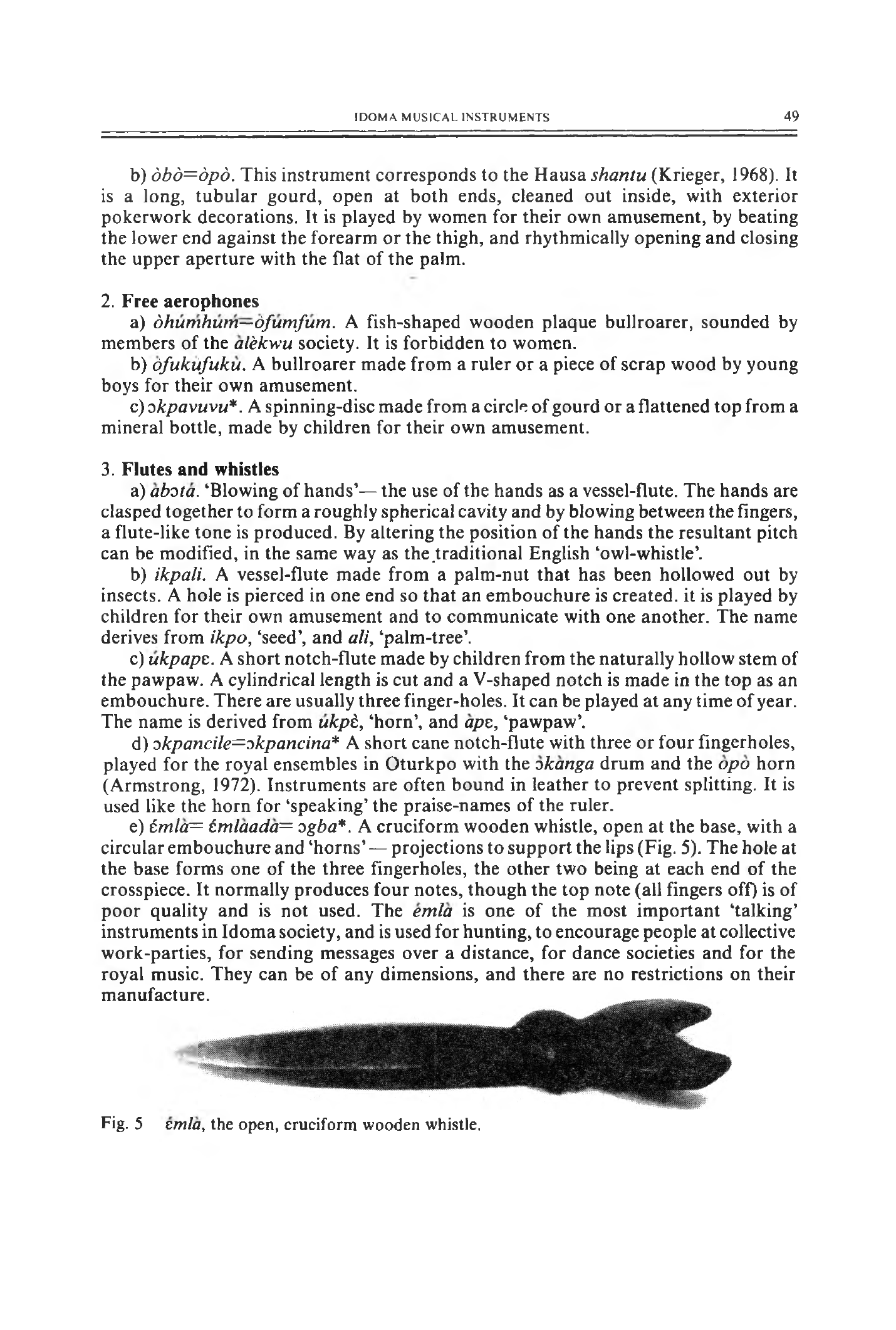
Roger Blench's inventory of Idoma instruments is only a few lines long at the decisive point, but those lines are taxonomically exact. He distinguishes three free aerophones. The òhúmhúm, also called òfúmfúm, is a fish-shaped wooden plaque sounded by the àlèkwu society and forbidden to women. The ofukùfukù is made by young boys from a ruler or scrap wood for amusement. A spinning disc of gourd or bottle-top is listed separately. Blench separates true plaque bullroarers from the rotating disc and then separates the two bullroarers from each other.
The materials are historically suggestive. A school ruler is a straightedge, a standardized commodity, and an almost ready-made rotor. Boys can turn the institution of schooling into noise with a hole and a cord. Yet the modern material does not abolish the ancestor society's fish. The new object is absorbed under its own name. The result is not a fossil but a two-track technology: one shaped and guarded by the cult, the other improvised from whatever lies to hand.
This case also warns against making “miniature” the essence of the double. The Idoma child form need not imitate the fish-shaped senior blade. What passes across the boundary is the acoustic operation, not the iconography. The double can be mechanically homologous while visually refusing the sacred form. Indeed, refusal may be the protection. Boys learn how a flat thing on a cord turns air into a pulse without copying the ancestor society's animal body.
Matsigenka: the clock is the fence
Among the Matsigenka of the Urubamba, France-Marie Renard-Casevitz states the contrast in a parenthesis too sharp to ignore: “the sacred and nocturnal bullroarer” exists alongside others that are children's toys, diurnal. The senior instrument bears sangenari, signs connected with the Master of Thunder and with the spotted coat of the jaguar. Its rumble becomes Thunder's voice and calls great cats to the allied shaman. The child form belongs to daylight.
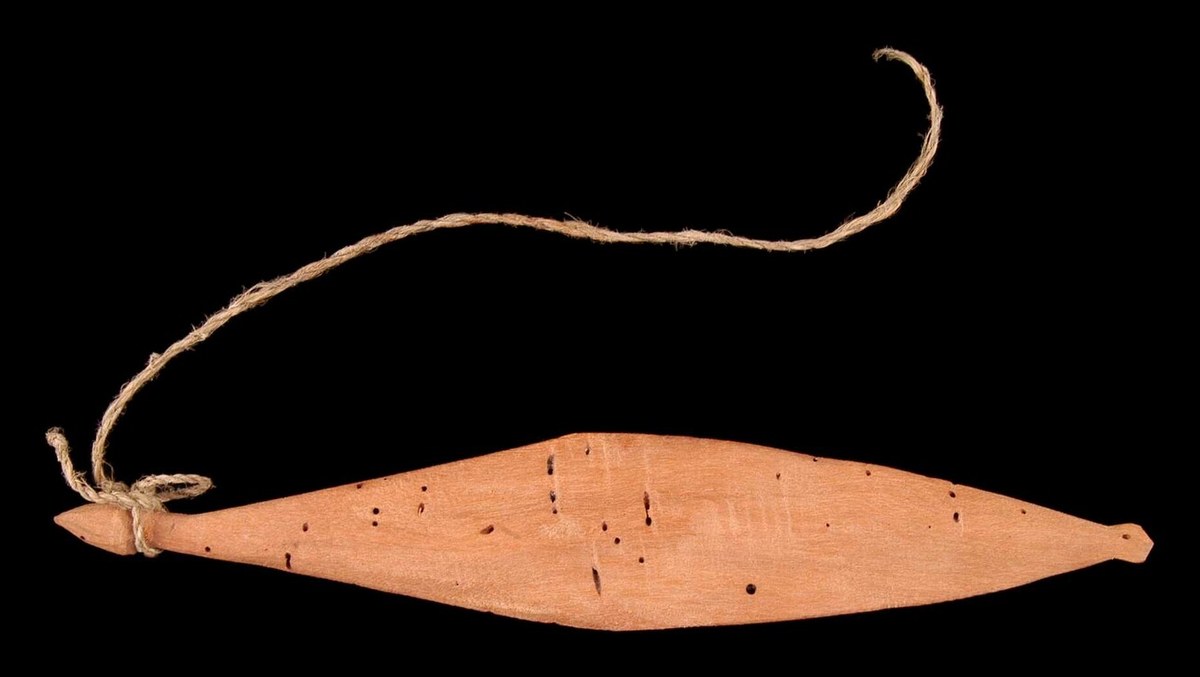
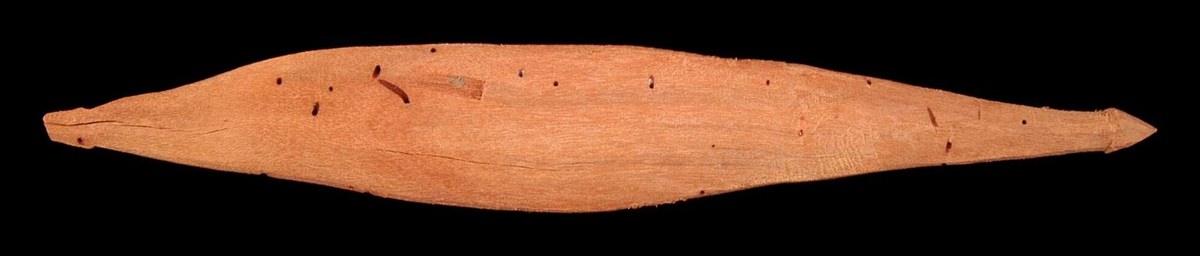
This is the clearest temporal firewall in the corpus. Sound is licensed twice, but consequence attaches to the hour. By day, a child's rotor is a toy. At night, an engraved instrument opens a relation with dangerous nonhuman allies. The difference is not hidden in acoustics alone. It is assembled from time, mark, operator, and expected listener.
The sacred bullroarer is nocturnal; there are others that are children's toys, diurnal.
Renard-Casevitz 1980, p. 263 n. 2, translated from the French
Calling this “software” is useful if it is kept concrete. The wooden blade supplies a physical platform. The social program specifies when it may run, who may run it, which signs are loaded onto it, and what event counts as an answer. A child's blade does not become Thunder's voice because it happens to buzz. The society has not installed that interpretation on it.
Xipaya: geometry controls access
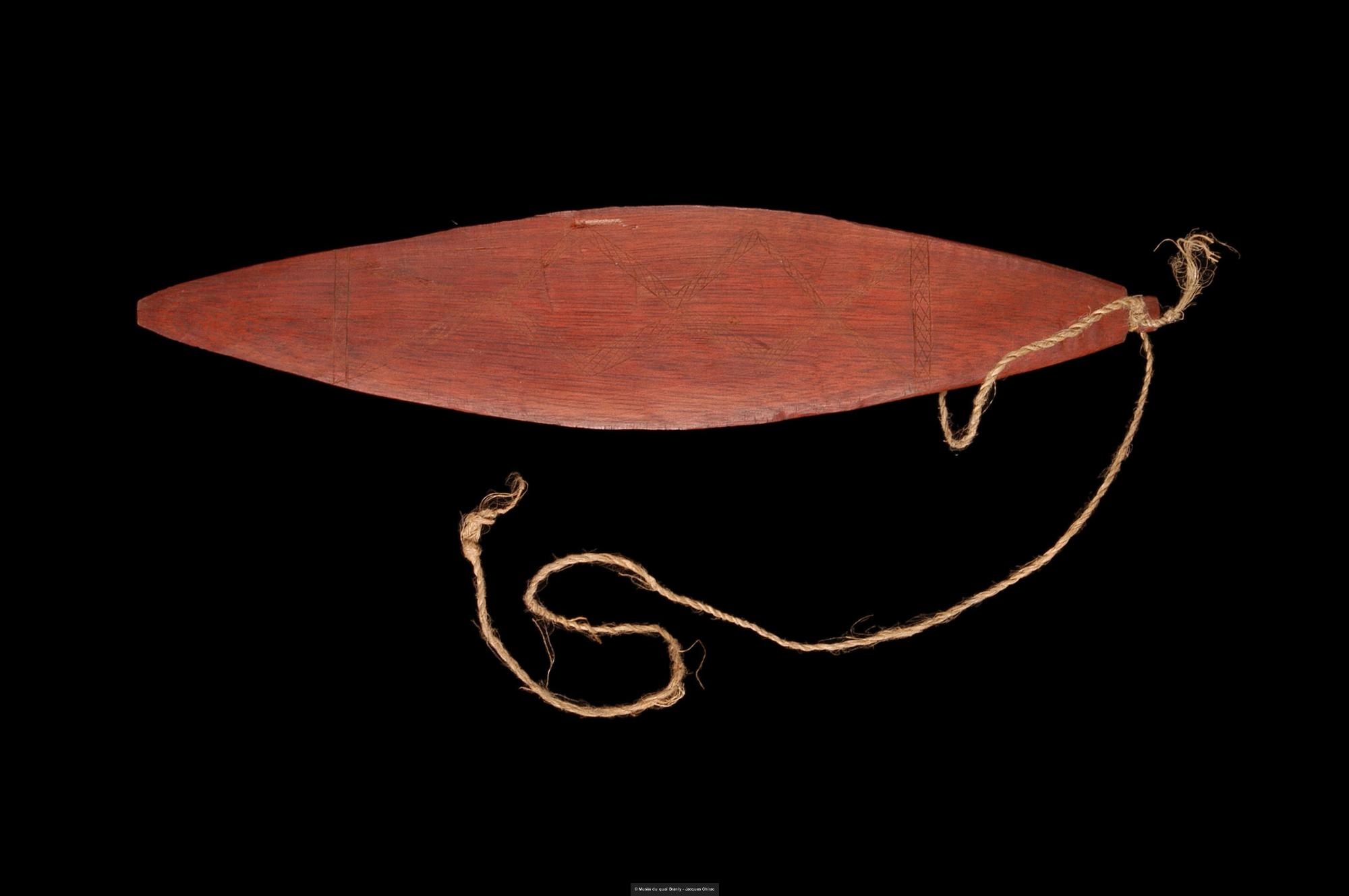
Curt Nimuendajú's 1919–20 account of the Xipaya, whom he wrote as Šipáia, gives a fourth kind of partition. After midnight a bullroarer called warī warī sámį joins the flutes in the all-night Zetáβia dance. People fear even speaking about it because the subject can bring illness or misfortune, and women and children may not approach. Nimuendajú thought the sacred form was probably round or oval. He immediately contrasted it with paddle-shaped examples used as children's toys.
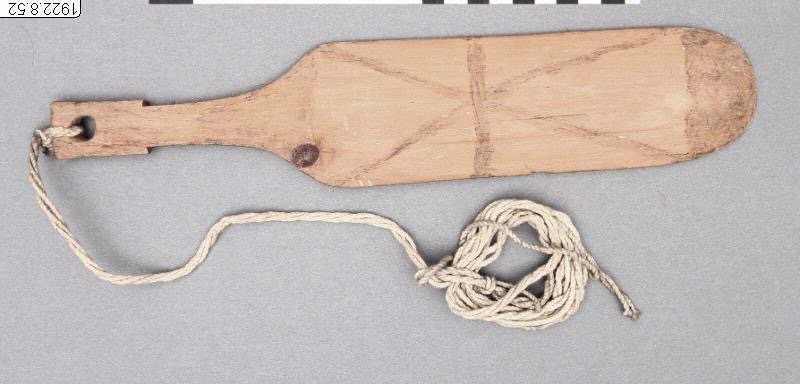
Nimuendajú states the paddle toy and the after-midnight restriction outright. Here shape itself does the distinguishing: a round-oval restricted form on one side, a clearly paddle-shaped child form on the other.
The museum object closes the loop. He collected it himself at Boca do Baú, and its paddle outline is exactly the toy form his Xipaya passage describes: a precise distinction made in one account, matched by an object from the same collecting context.
Xerente: the same buzz, a different interlocutor
Nimuendajú's The Šerente places small boys' “buzzing boards” among ordinary toys. Elsewhere in the same monograph, specialists carry a named bullroarer in an elongated lidded calabash through roughly six days of instruction. Its compound name means the “howling of Hieparo-wawe.” At the appointed place they whirl it, and the being appears. Nimuendajú does not explicitly call the boys' buzzing boards bullroarers, but the paired passages show the relevant transformation: an ordinary whirled buzz becomes a demon-call through a special object, name, container, curriculum, operator, and place.
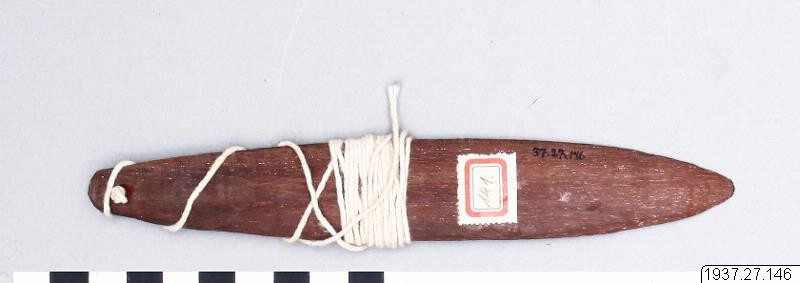
The Xerente case reveals what a double need not share. It may not share a name. It may not be stored in the same place or taught by the same people. It may not be expected to speak to the same listener. From outside, both acts could be described as making a board buzz. From inside, one is child's play and the other is an address with a proper recipient.
Fort McDowell: one accession preserves both tracks
The Fort McDowell Yavapai material is unusually valuable because collector, place, date, and accession hold the functional split together. Object 1911.86.95 is a 26.5-centimetre medicine bullroarer cut from lightning-struck cottonwood. Zigzag lines repeat the lightning in graphic form, and the cord is cotton-seed fibre. Two smaller ual ual in the same 1911 accession are identified as schoolboys' toys. Barbara Freire-Marreco collected both sides of the contrast in a single series.
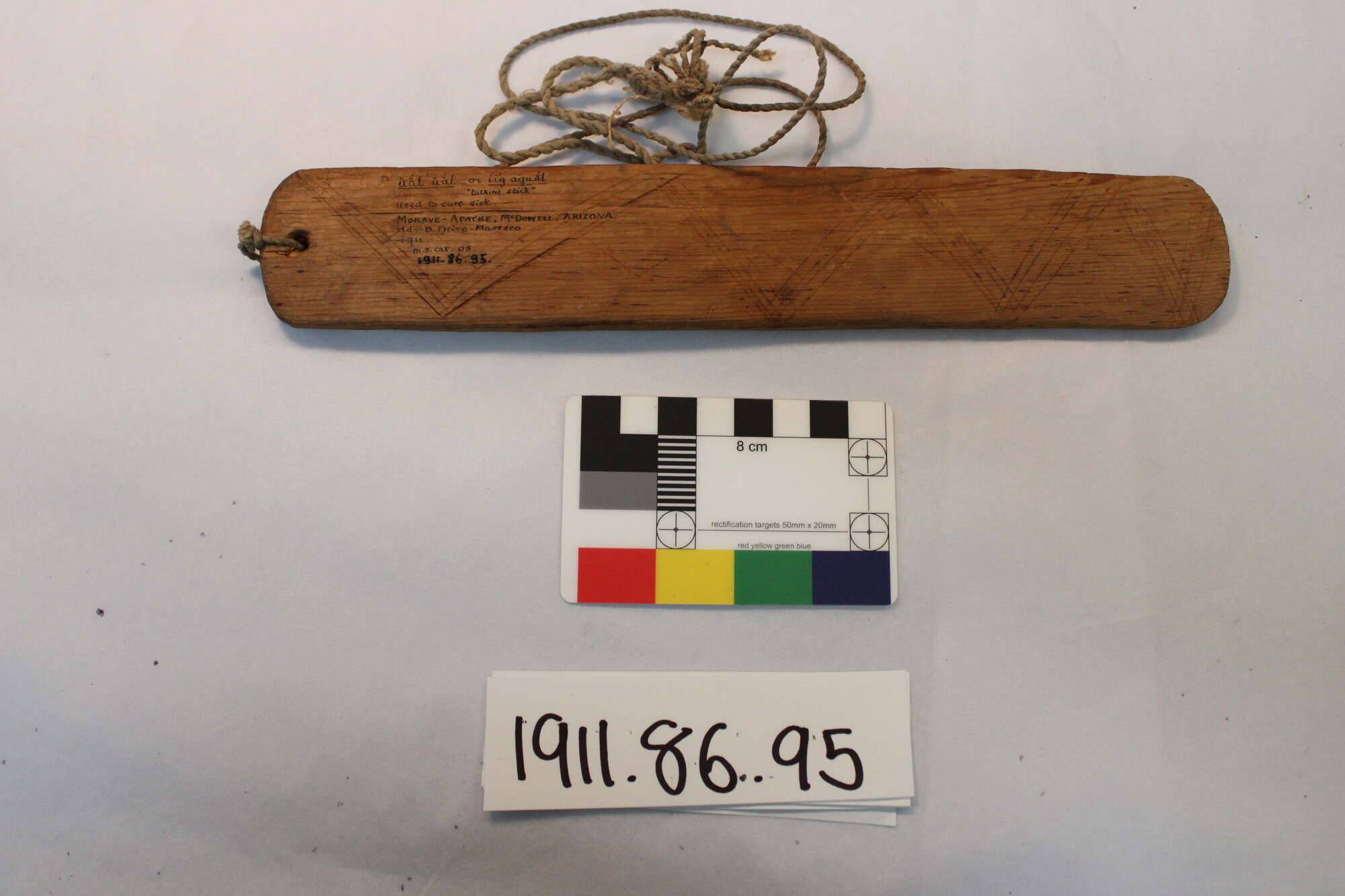
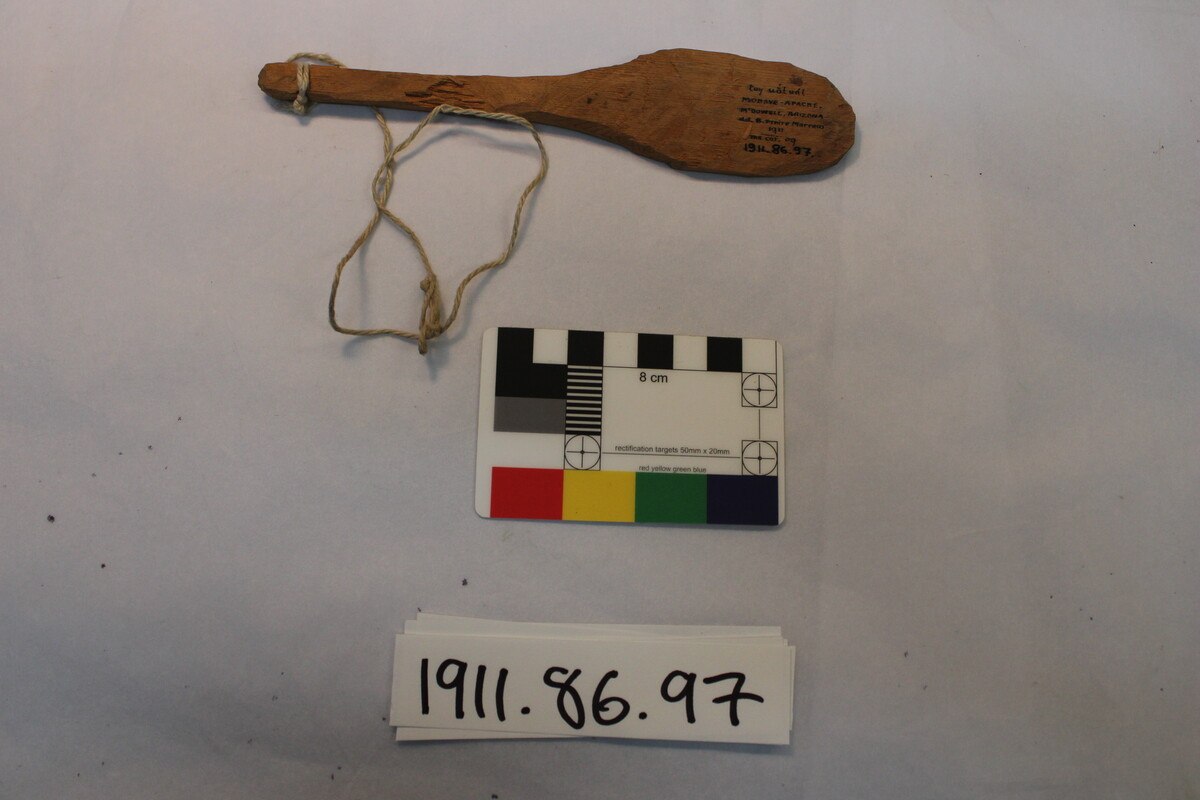
This is not an initiation-secrecy case. Gifford reports that women and children might see the medicine instrument. Its boundary is occupational and cosmological: doctor or dreamer, lightning material, curing, and mountain-spirit summons on one side; small schoolboy toy on the other. A child-safe double can coexist with a senior instrument even when the senior is visible. Permission has more dimensions than concealment.
More ways to divide one mechanism
The same architecture appears in smaller atlas records. Isabel Kelly's Chemehuevi account separates plain wooden children's toys from a notched mountain-sheep-horn instrument used in rainmaking. Material does almost all the work: common wood for play, an animal substance and a marked edge for weather power. S. C. Roy likewise distinguishes the Oraon men's dormitory's sacred sounding objects from the children's toy, which the Oraon call bhūrka. Vocabulary blocks the temptation to treat every rotor as one social species.
These cases suggest at least six independent controls: material, name, geometry, scale, time, and authorization. No society needs all six. Any one may be enough if everyone knows the distinction. The controls can also be redundant, as in the Matsigenka case where hour, engraving, use, and expected supernatural response reinforce one another. Redundancy is precisely what one would expect from a system guarding a high-consequence interpretation.
Mabuiag: the boundary can have a middle
A. C. Haddon's Mabuiag material keeps the division from hardening into a two-way split. The large painted bigu belonged to turtle-fishery ceremony and made a low, deep note. The smaller wainis was high and shrill, kept in the bush, and attached to the same ceremonial field. Women could see the instruments, and islanders reportedly described the practice as “half-play.” Large and small, low and high, ceremonial yet partly open: the system had a middle register.
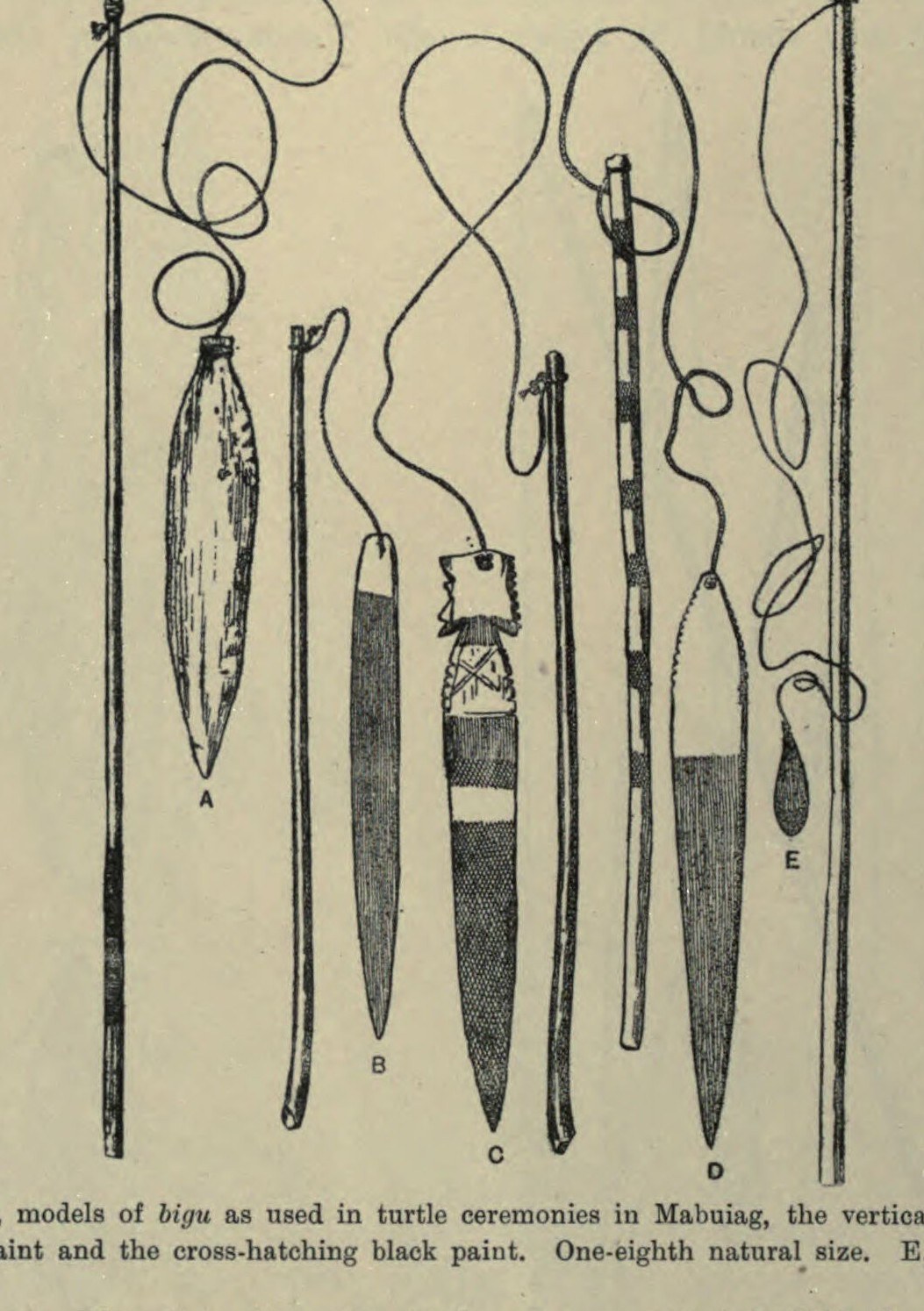
Mabuiag is therefore not a strict child-double case. It is more valuable as evidence that permission can be graduated. The opposition is not always sacred versus profane, secret versus toy, man versus child. A society can build an acoustic ladder with different pitches and publics on adjacent rungs.
The controls break the easy theory
A useful pattern must survive its counterexamples. Among the Mbaya-Caduveo, decorated bullroarers reportedly whirled at funerals were given to children as playthings. The same object crosses the boundary. Among the Upper Tanana, the common form was a child's toy, but Nabesna John mounted one on a long stave for séances and cabin purification. McKennan treated that ritual use as John's own specialization. Here context elevates an available toy rather than producing a separate junior copy.
Similar social problems can generate different solutions. One society duplicates the object. Another reclassifies the same object by occasion. Another creates a graded series. Another lets one specialist appropriate a toy. The comparative discovery is the menu, not one compulsory origin.
It also follows that the label “toy survival” cannot carry a chronological meaning by itself. It may describe the terminus of desacralization, a parallel child technology, a licensed rehearsal, the same ritual object released after use, or a toy promoted into ritual by an innovator. The particulars of each case decide which history is actually present.
A cult can publish a harmless emulator
What, then, is the junior instrument for? The records rarely answer in abstract language. They show children making, sounding, and recognizing it. It may train dexterity, familiarize the ear with pulsed sound, provide amusement, or mark a permissive outer edge of adult knowledge. Those functions can coexist. What matters is that the double allows the mechanism to circulate while preventing the senior interpretation from circulating with it.
This is a striking form of cultural conservation. Absolute secrecy makes a practice brittle; total publicity dissolves its restricted force. A harmless analogue solves both problems. The acoustic idea remains ubiquitous. Children learn that a blade and cord can make an impossible voice. Yet the cult retains the names, biographies, materials, hours, signs, and offices that turn that noise into a being. The public copy keeps the hardware familiar and the ritual program scarce.
The discovery also changes how diffusion should be investigated. A toy beside a cult object may preserve contact between populations, but it may equally arise by internal duplication. The strongest diffusion cases will be those where the boundary itself travels: the same paired names, the same material substitution, the same day-night split, or the same distinctive geometry. A generic resemblance between two buzzing toys is weak. A matched system of permissions is much harder to invent as coincidence.
Children get the air; elders keep the address
Living bullroarer systems often keep a child-safe double beside the restricted instrument: a second form separated by material, name, shape, scale, time of day, or permission. Rouku translates sacred tree wood into coconut leaf. Idoma country sets a ruler beside an ancestral fish. Matsigenka country partitions the sound by day and night. Xipaya evidence points toward geometry; the paired Xerente passages toward custody and supernatural addressee; Mabuiag toward a graded scale of pitch and openness. The counterexamples show other choices from the same menu. The toy is not always the cult's corpse. Sometimes it is the living cult's public emulator: the same aerodynamic revelation, stripped of the dangerous address.
Key sources
- Christian Döhler, Komnzo Lexicon (2022), pp. 34, 65, 78; A Grammar of Komnzo (2018), pp. 348–349; “Birds and places: What the lexicon reveals about multilingualism,” International Journal of Bilingualism 25.4 (2021), pp. 1151–1153; and Döhler with Nakre Abia, Frfr a Kifikifi (Rouku, 2012), Kaipuleohone/Zenodo 5653474.
- Roger Blench, “Idoma Musical Instruments,” African Music 6.4 (1987), p. 49.
- France-Marie Renard-Casevitz, “Inscriptions: Un aspect du symbolisme matsiguenga,” Journal de la Société des Américanistes 67 (1980), pp. 261–295, especially p. 263 n. 2; Musée du quai Branly objects 71.1980.61.48–50.
- Curt Nimuendajú, “Bruchstücke aus Religion und Überlieferung der Šipáia-Indianer,” Anthropos 14/15 (1919–20), pp. 1027–1028; SMVK 1922.08.0052.
- Curt Nimuendajú, The Šerente (1942), pp. 41, 85, 89–90; SMVK 1937.27.0146.
- Pitt Rivers Museum accession 1911.86.95–97; E. W. Gifford, “The Southeastern Yavapai” (1932), p. 237.
- Isabel T. Kelly, “Chemehuevi Shamanism,” in Essays in Anthropology Presented to A. L. Kroeber (1936), p. 138; Sarat Chandra Roy, “The Bull-Roarer in India,” Journal of the Bihar and Orissa Research Society 13 (1927), pp. 56–58, and Oraon Religion and Customs (1928), illustration 16.
- A. C. Haddon, The Study of Man (1898), pp. 306–310; Reports of the Cambridge Anthropological Expedition to Torres Straits, vols. IV–V.
- Alfred Métraux, “Ethnography of the Chaco,” Handbook of South American Indians, vol. I (1946), p. 343; Robert McKennan, The Upper Tanana Indians (1959), pp. 44–45, 102, 152–154.