Atlas Essay —
The Voice in the Armpit
Central and northern Australia · the Kimberley · Pahang, Malaysia · south-eastern Nigeria · the Nigeria–Cameroon border
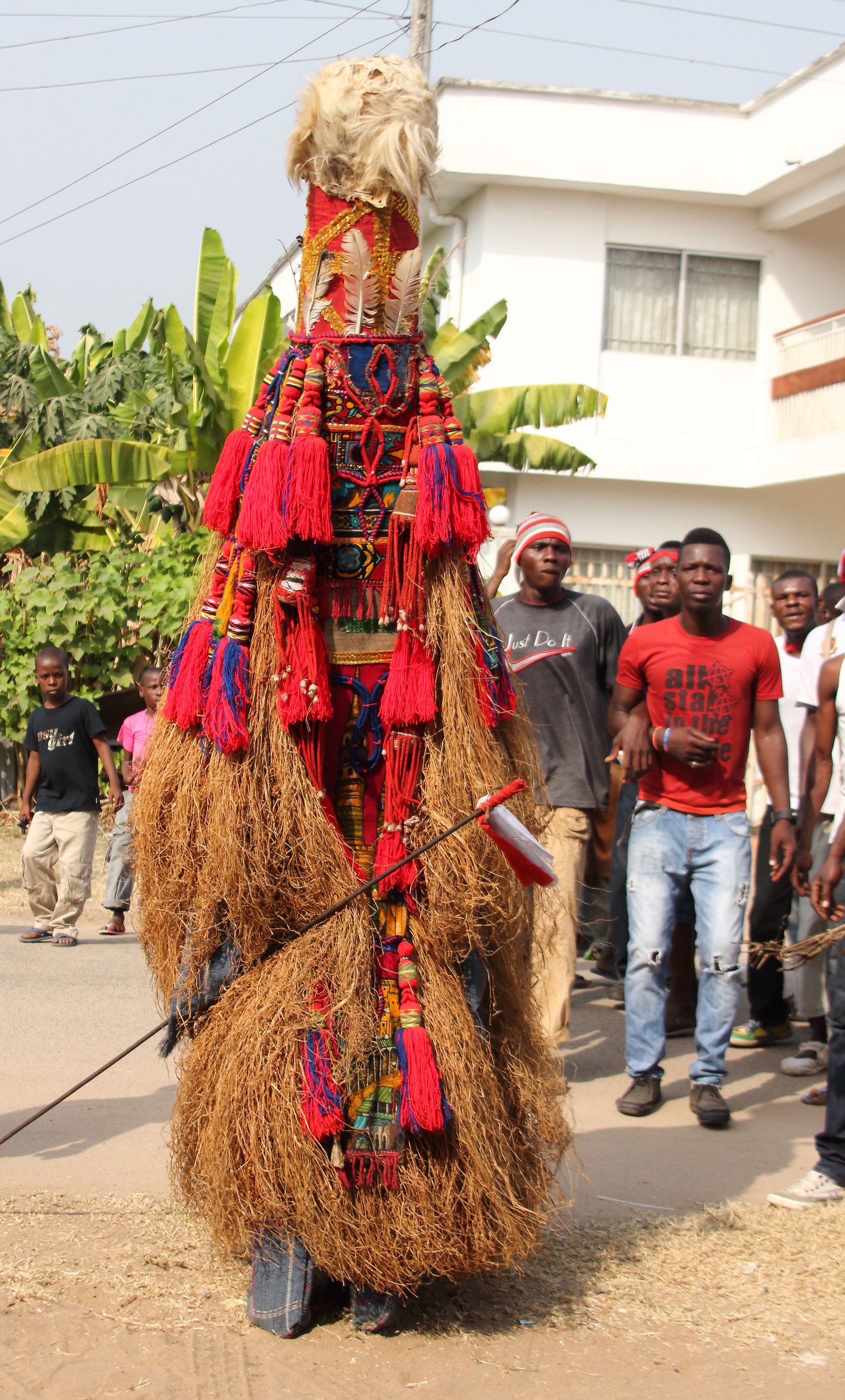
In central Australia an ancestor sleeps with his arms flung out, and a bullroarer comes out from under his armpit and grows in one night into his son. In the Western Australian desert a man creeps up on the women who own the bullroarers and steals their power from under their arms. On the Kimberley coast the roar is the voice of an old white-haired spirit, and it comes from the hair beneath his armpits. In Nigeria the dead return robed and masked, the bullroarer is called their voice, and the voice seems to come from their armpits. As far as we know, no one has set these cases side by side before; this page is original research.
In widely separated traditions the bullroarer’s voice or power lives in, is born from, or is stolen out of the armpit.
In brief
- The Arrernte of central Australia tell how “there emerged from underneath his armpit something in the shape of a bull-roarer”: the first son of the bandicoot ancestor Karora, who woke the next dawn to his father’s loud, vibrating call (Strehlow 1947).
- At Balgo, in the Western Australian desert, the Ganabuda women swung bullroarers until Djalaburu “steals power (maia) from under the armpits” of them; next morning they could hardly make the bullroarers whirl (Berndt 1964, 1984).
- Among the Broome peoples of the Kimberley coast the roar is the spirit Nalja talking, and “his voice comes from the hair beneath his arm-pits” (Bates 1938).
- When the Larrakia of Darwin showed boys the bullroarer, each old man first drew it through his own armpit, so that its strong magic would not enter the boy and swell him; then he drew it through the boy’s. The same touch under the arms opened the board to boys in New South Wales and Queensland.
- The Koma of the Nigeria–Cameroon border buried their smiths and ritual chiefs with bullroarers under their armpits.
- The Igbo of south-eastern Nigeria call the bullroarer “the voice of the manwụ”, the returning dead, whose chirping voice comes from the armpits.

Karora’s son
Ilbalintja Soak lies in the country of the Northern Arrernte (Aranda), north of the MacDonnell Ranges in central Australia. It is the home of the bandicoot ancestor Karora, and the story of how he made his first son was told to T. G. H. Strehlow, who grew up among the Arrernte and spoke their language from childhood. In the beginning all was darkness, and Karora lay asleep at the bottom of the dry soak while a great living pole swayed up from his head toward the sky. Bandicoots came out of his navel and his armpits and burst up through the sod. Karora rose, ate, and lay down again.
“Evening approached. The sun, hiding his face with a veil of hair string and his body with hair-string pendants, vanished from sight, and Karora, with his thoughts turning toward a helpmate, fell asleep, stretching his arms out to both sides.
“And while he slept there emerged from underneath his armpit something in the shape of a bull-roarer. It assumed human form and grew in one night to the stature of a young man fully grown. Karora, feeling that his arm was being oppressed with the weight of something heavy, awoke; and he saw his first-born son lying at his side, his head resting on his father’s shoulder.
“Dawn broke. Karora rose and sounded a loud, vibrating call. The son then stirred into life, got up, and danced a ceremonial dance around his father …”
T. G. H. Strehlow, Aranda Traditions (1947), pp. 7–8, as quoted (abridged) in Joseph Campbell, The Masks of God: Primitive Mythology (1959), pp. 106–107.
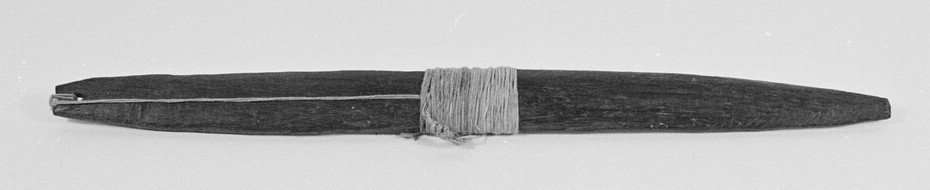
The bullroarer is the first thing born of a man, and it is born from the armpit. It comes as an object and wakes as a person, and the sound that wakes it is a loud, vibrating call. Among the Arrernte the bullroarers proper were the small wooden churinga, bored at one end and strung with hair, and each held the spirit of an ancestor of the creation time.

The Ganabuda women
Some seven hundred kilometres to the north-west, at Balgo on the edge of the Great Sandy Desert in Western Australia, the Walmajarri and Kukatja told Ronald and Catherine Berndt that the sacred things once belonged to women. The Ganabuda women travelled the desert hunting and holding their rites; they swung bullroarers and rode their sacred boards, the darugu, through the sky. The men had nothing. A man named Djalaburu watched them, “astonished to find that they possess darugu and swing bullroarers while the men have no sacred objects.” Then:
“In the night, Djalaburu steals power (maia) from under the armpits of” the women.
R. M. Berndt, “Traditional Morality as Expressed through the Medium of an Australian Aboriginal Religion” (1970; reprinted 1984), p. 186.
In the Berndts’ other telling Djalaburu, “creeping close and watching them secretly one night, discovered that they kept their power (maia) under their armbands,” the bands worn high on the upper arm.
“He succeeded in stealing this. Next morning the women tried to swing their bullroarers, but they could hardly manage to do so; they had lost their power. After that, Djalaburu led them down to where the men were; the men went up to where the women had been, and took over their responsibility for attending to sacred matters. They changed places.”
R. M. and C. H. Berndt, The World of the First Australians (1964), p. 224.
The power that makes the bullroarer whirl sits under the arm. Take it from there and the board will not fly. The men of the dingari who swing it now hold what was stolen from the women’s armpits.
Nalja is talking
On the Kimberley coast of Western Australia, Daisy Bates lived among the peoples of Broome and Roebuck Bay and set down the last stage of a boy’s initiation, the blood-drinking. In the afternoon, while the boy lies at the sacred place caked in the blood he has been made to drink, some of the men slip away into the bush to swing the kalligooroo.
“The boy is frightened. Those who are with him add to his fears, saying it is the voice of Nalja. ‘Nalja ee ngangga!’ (Nalja is talking!), chant the old men. Nalja is the spirit of an old, old man with white hair, and his voice comes from the hair beneath his arm-pits. The word ‘kalligooroo’ is never spoken in the hearing of women or children or the uninitiated, but the voice of Nalja is known to them all. He is a spirit whom to look upon would be death.
“The sound of the kalligooroo comes nearer and nearer, booming weirdly across the twilight. Should the bull-roarer touch a tree in its rotations, ‘Nalja is throwing his boomerang!’ the boy is told.”
Daisy Bates, The Passing of the Aborigines (1938), ch. 5, “The End of Initiation, the Blood-Drinking.”
Then an uncle hides an old bullroarer at the boy’s feet, his guardian pulls it from the ground and swings it, and his father tells him the noise was made by that, and not by Nalja. The boy sleeps with it under his head. In Nalja the armpit is no longer a birthplace or a hiding place. It is a mouth.
Through the armpit
The Larrakia held the coast around Darwin in the Northern Territory. Their women and children were taught that the bullroarer’s roar was the voice of a great old man who had come to take the boys away into the mangrove scrub. An old man described to Baldwin Spencer how the boys learned otherwise, and the men performed it for him. Their eyes covered, the boys heard the old men come out of the scrub whirling the Bidu-bidu. Then their guardians turned them round and uncovered their eyes.
“Presently the old men come close up to the boys, who stand in a row. Each old man, holding one of the Bidu Bidu, comes up to a boy and stands in front of him. First of all he rubs the stick through his own armpit and then across his stomach (Figs. 45, 46). If he did not do this, it is supposed that the strong magic of the Bidu Bidu might enter the boy’s body and cause him to swell up. He then rubs the stick through the boy’s armpit and pokes his stomach with one end of it, after which the boys are told to hold out their hands and the sticks are placed on them. Each one is told that it is Bidu Bidu, that the noise is not a voice but is made by the stick.”
Baldwin Spencer, Native Tribes of the Northern Territory of Australia (1914), p. 155.
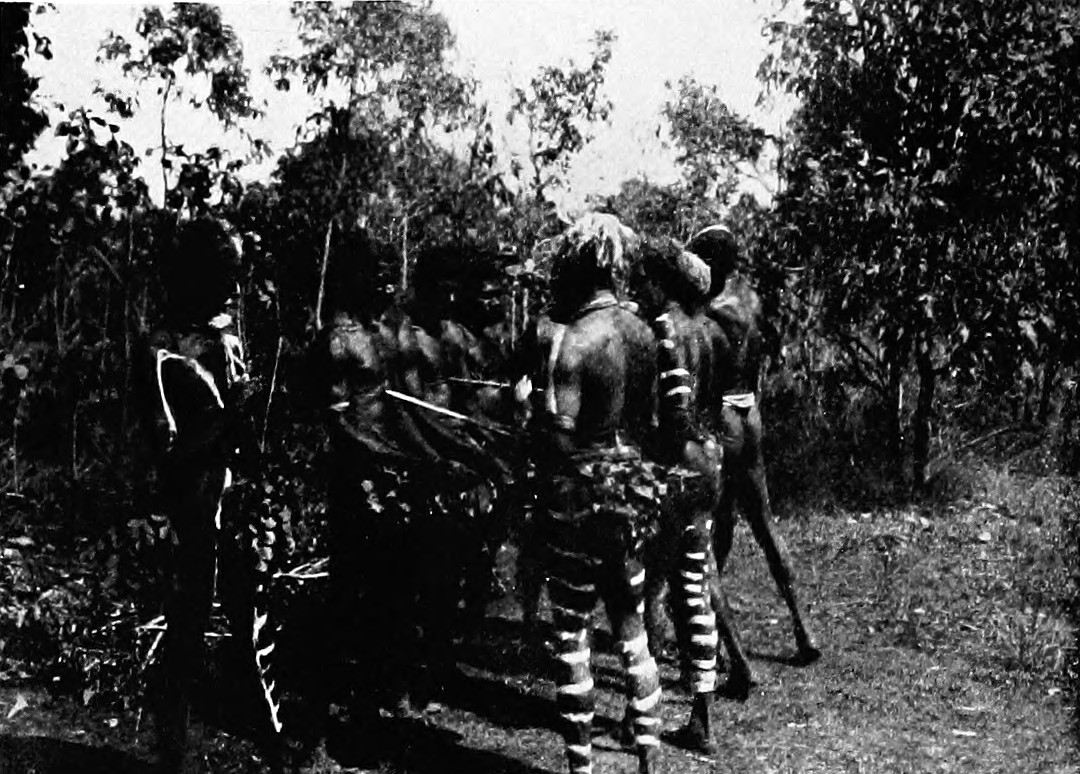
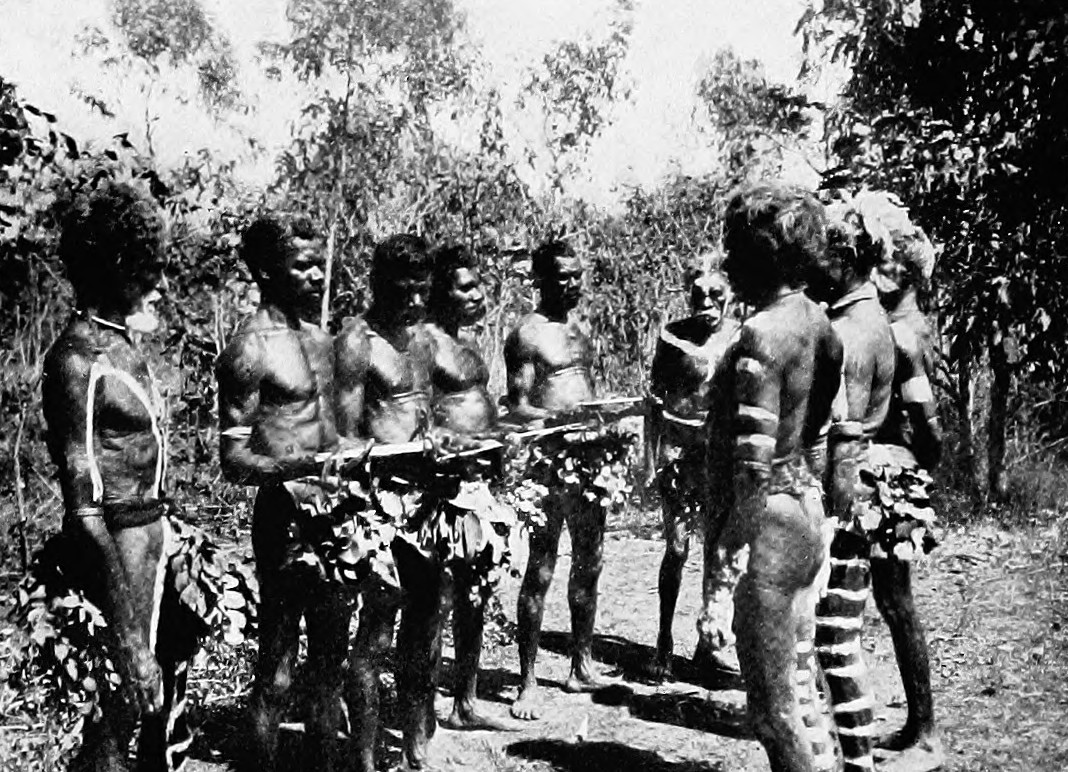
The board carries a force strong enough to swell a boy’s body, and the place to draw it off is the armpit. The old man takes the charge into his own armpit first; only then does the board pass under the boy’s arm and into his hands. Among the Worgait, the Larrakia’s neighbours across Darwin Harbour, a young father reaching a higher grade met the Bidu-bidu the same way: the men “show it to him, pass it under his armpits, and place it on his hands” (Spencer 1914, p. 161).
The touch runs the length of the continent. At the Walloonggurra of the Orara and upper Clarence rivers in northern New South Wales, R. H. Mathews saw an old man come up to each boy with the small bullroarer, the dhalguñgun, rub it “on his breast, penis, under his arms and on other parts of his body,” and hang its string around the boy’s neck (Mathews 1900, p. 71). At the Toara of the Kabi in south-east Queensland, “The bullroarer is rubbed on the penis and navel and also under the arms of each novitiate” (Mathews 1900, p. 143).
The voice of the mmanwu
Around Awka, east of the Niger in south-eastern Nigeria, M. D. W. Jeffreys studied the bullroarer of the Igbo in 1930. It belonged to the society of the dead, the mmọ, whose young men came out at night in the dry season, when bush fires were said to disturb the ghosts, and whirled it to drive the women indoors. At Awka it was called ogiligile, from a root meaning to whirl round and round. “The instrument is also called onu manwụ (the voice of the manwụ)” (Jeffreys 1949, p. 24). The mmanwu is the returning dead man himself, robed so that no part of the body shows, rising from the land of the ghosts through the earth or an ant-hill. And his voice came from under his arms.
“Both the masked and the unmasked manwụ always have the voice disguised by the use of an oduo atfalla placed in the mouth. The resulting noise is a thin chirping sound which is supposed to be the thin piping voice of the voiceless dead. When the mask is worn on the head the voice would seem to come from the region of the armpits of the figure.”
M. D. W. Jeffreys, “The Bull-Roarer among the Ibo,” African Studies 8 (1949), p. 30.
Under the arms of the dead
In the Alantika Mountains, on the border of Nigeria and Cameroon, the Koma sounded iron bullroarers for the ancestors in the men’s cult called vome. Every man passed through its grades over a lifetime and entered the council of elders in old age. When a smith or a ritual chief died, Françoise Dumas-Champion was told, the cult’s own funeral rites put the bullroarers in the grave with him, under his armpits, and took them back when his skull was exhumed:
“It is in this setting that the smith and the ritual chiefs are buried with bullroarers under their armpits. These sacred objects are returned to the cult when the skull is exhumed.”
Françoise Dumas-Champion, “Le mort circoncis,” Systèmes de pensée en Afrique noire 9 (1989), §25 (“C’est dans ce cadre que le forgeron et les chefs rituels sont enterrés avec des rhombes sous les aisselles. Ces sacra sont restitués au culte lors de l’exhumation du crâne.”).
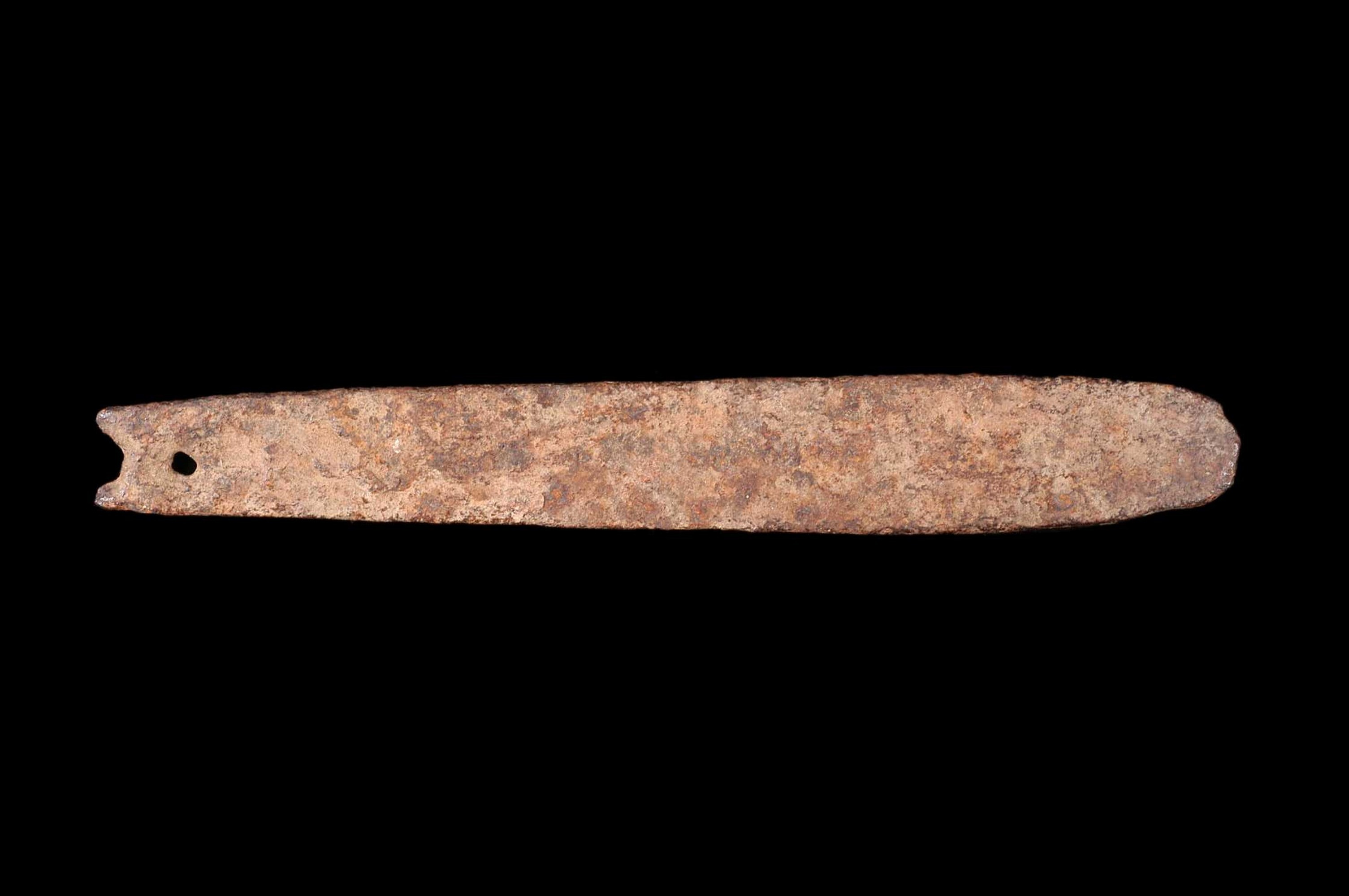
The roarer lies in the armpit through the long dark of decomposition, and comes back to the living with the ancestor’s skull. Far to the east, on the Tekai River in Pahang, Malaysia, the Semaq Beri told Ivor Evans that thunder is the ancestor spirit Nenek, “who makes a noise in his armpits by banging his arms against his sides. He also makes the lightning by flashing about a thin board which is attached to a string (i.e., a bull-roarer)” (Evans 1918, p. 191). The sky’s roar comes out of the ancestor’s armpits, and the bullroarer is in his hand.
The hollow under the arm
Set side by side, the cases make one figure. In central Australia the bullroarer is born from the armpit. In the desert its power is kept there, and stolen from there. On the Kimberley coast its voice issues from there. In the Larrakia rite its strength is drawn off there before a boy may hold it, and on the east coast the boy is rubbed there when he meets it. On the Nigeria–Cameroon border it is laid there in the grave. Among the Igbo it is the voice of the dead, and the dead speak from there. In the Malaysian forest the thunder ancestor sounds his armpits with the bullroarer in his hand.
None of these peoples needed to put the voice there. A spirit could speak from the sky, from the ground, from a tree. They chose the armpit, a hidden hollow of the body close to the heart, where a man holds a thing tight against his side. The swinger’s own body gives the image its force: the board is whirled from the shoulder, and the roar wheels round the arm that drives it. A sound that comes from no mouth needs a body to come from, and the same body comes back across Australia, Africa and Southeast Asia. The Arrernte son lying with his head on his father’s shoulder, the women robbed in the night, the old white-haired man who speaks from his armpit hair, the robed dead of Awka and the thunder in Nenek’s armpits are one idea about where the bullroarer’s voice lives, and that idea has travelled.
Key sources
- T. G. H. Strehlow, Aranda Traditions (Melbourne: Melbourne University Press, 1947), pp. 7–8, as quoted (abridged) in Joseph Campbell, The Masks of God: Primitive Mythology (New York: Viking, 1959), pp. 106–107 and n. 77.
- Erhard Eylmann, Die Eingeborenen der Kolonie Südaustralien (Berlin, 1908), Plate XXXI, fig. 9.
- R. M. Berndt, “Traditional Morality as Expressed through the Medium of an Australian Aboriginal Religion” (1970), reprinted in M. Charlesworth et al. (eds), Religion in Aboriginal Australia: An Anthology (St Lucia: University of Queensland Press, 1984), p. 186 (Djalaburu and the women’s maia).
- R. M. and C. H. Berndt, The World of the First Australians (Sydney: Ure Smith, 1964), p. 224.
- Daisy Bates, The Passing of the Aborigines (London: John Murray, 1938), ch. 5, “The End of Initiation, the Blood-Drinking.”
- Baldwin Spencer, Native Tribes of the Northern Territory of Australia (London: Macmillan, 1914), pp. 155–156 and Figs. 45–46 (Larrakia), p. 161 (Worgait).
- R. H. Mathews, “The Walloonggurra Ceremony,” Queensland Geographical Journal 15 (1900), p. 71; “The Toara Ceremony of the Dippil Tribes of Queensland,” American Anthropologist n.s. 2 (1900), p. 143.
- M. D. W. Jeffreys, “The Bull-Roarer among the Ibo,” African Studies 8 (1949): 23–34, pp. 24 (onu mmanwu), 30 (the voice from the armpits).
- Françoise Dumas-Champion, “Le mort circoncis: le culte des crânes dans les populations de la Haute Bénoué (Cameroun/Nigeria),” Systèmes de pensée en Afrique noire 9 (1989): 33–74, §25, journals.openedition.org/span/1114.
- Ivor H. N. Evans, “Some Sakai Beliefs and Customs,” Journal of the Royal Anthropological Institute 48 (1918), p. 191.