No. PNG171
Buka
Papua New Guinea · Bougainville · Oceania · Sahul
Restricted
guev
urar: at Buka Passage, the class of ancestor spirits, not the bullroarer itself; the guev bullroarer's sound is the urar's voice. guev: the Kurtachi bull-roarer itself; wawiura: to sound it; inuts: the cord.
Etymology. In the Buka Passage and North Bougainville boys' initiation the whirled bullroarer is heard as the voice of the ancestral dead, the urar, sounded at the wapi ceremony, and each bullroarer bears the personal name of the ancestor it represents. Parkinson recorded a closely parallel North Bougainville institution, the ruk-ruk, whose spirits are the ruk — a male form, ruk a tzon, and a female form, ruk a tahol.
At Kurtachi on Buka Passage, guev bullroarers gave voice to named urar — figures of the dead carved for the wapi initiation. A person becomes an urar after death and joins the dead of the clan, unrecognized until some untoward happening reveals it. The myth tells of a woman who came upon an urar in the bush wearing its upe headdress and traded her own small breasts for its heavy ones; that headdress, modelled on the urar's own, is today the central emblem of Bougainville's flag. Beatrice Blackwood, who spent eighteen months there in 1929-31, persuaded young men to draw the urar and part with their bullroarers — spatula-like blades that rumbled low on a cord; some came to her unbidden with bunches of love-magic leaves to trade, taking away her cigarette butts and bandages for their leg ulcers. The guev itself came to the men by murder. A woman found it while chopping firewood and showed it to the other women; the men, learning that they knew, killed them all but some very tiny girls, and have kept it ever since. To the women the boom in the background was the urar saying he was about to eat their sons and brothers. A woman who so much as glimpsed one was put to death. Buka carvers painted their roarers with coloured designs, as they did their paddles. When the wapi closed, the carved urar were burnt. At the Gagan mission on the island's central plateau in January 1935, Patrick O'Reilly and Father Paul Montauban spent a month taking down the initiation from men who knew it — the bullroarer, the climbing rituals of ladders and greased poles, the masks, all of it secret — and, by outright trickery, obtained one or two old instruments. By then no initiation was being prepared or performed anywhere on Buka.
Even a hardened anthropologist cannot hear that ominous roar booming through the forest without feeling its power, and forgetting, for the moment, that it is caused by a bit of wood twirled on the end of a string.
Beatrice Blackwood, Both Sides of Buka Passage (1935), p. 245
Particulars
- Object
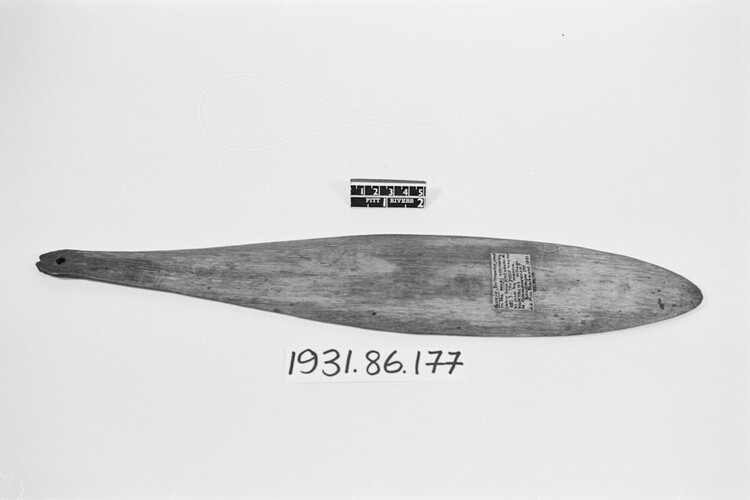
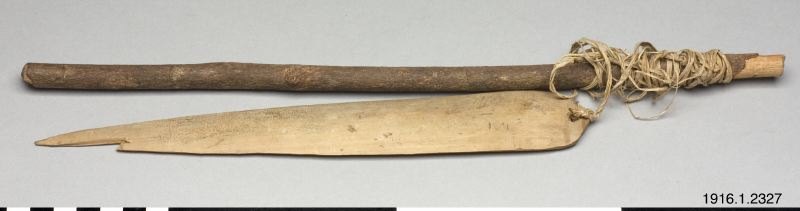
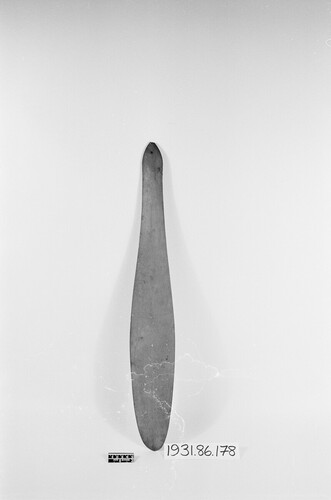
- Flat wooden slats whirled on ordinary twisted fibre string (inuts) and cut from the hard timber of the iwifi or torus tree. The Kurtachi pair in Oxford, PRM 1931.86.177-.178, measure 640 by 94 mm and 430 by 77 mm: the larger a plain slat rounded off below, tapering to a perforated and notched cord end, the smaller carved and decorated. A Buka blade at La Rochelle, H.1590, is 54 x 9 x 1 cm, perforated at one end. Buka instruments were also decorated with coloured designs.
- Function
- At Kurtachi the guev belonged exclusively to the wapi initiation and had no other use; its roar was the voice of a named urar figure made for the rite. Each roarer is male and carries the personal name of the urar it speaks for — Buwo, Upitomet and Tororon among them. One had to be bought with mun, the porpoise- and flying-fox-tooth currency, and several pigs. While the wapi was being prepared and performed, it also worked as a levy between villages: men would go by night and sound the roarer outside a neighbouring village, whereupon that village had to bring out a pig and hand it to the bull-roarer party; before long it came to sound its own roarers outside the first.
Sources
- Beatrice Blackwood, Both Sides of Buka Passage (Oxford, 1935), pp. 194-241, 245, 406-410, 483, 505-527, 596
- Paul Montauban and Patrick O’Reilly, 'Mythes de Buka,' Journal de la Société des Océanistes 8 (1952), pp. 27-28, 34-35
- Paul Montauban and Patrick O’Reilly, 'Mythes de Buka,' Journal de la Société des Océanistes 11 (1955): 37-95, p. 64 n. 21
- K. A. Gourlay, Sound-Producing Instruments in Traditional Society: A Study of Esoteric Instruments and Their Role in Male-Female Relations, New Guinea Research Bulletin 60 (1975), p. 84, table 1, entry 171 View
- Pitt Rivers Museum, Oxford, objects 1931.86.177 and 1931.86.178; Annual Report (1931)
- La Rochelle museum, object H.1590
- McCarthy (1951), p. 142