Atlas Essay —
The Director’s Kit
The bullroarer cults stage their gods with one set of tricks, and the stagecraft travelled with them
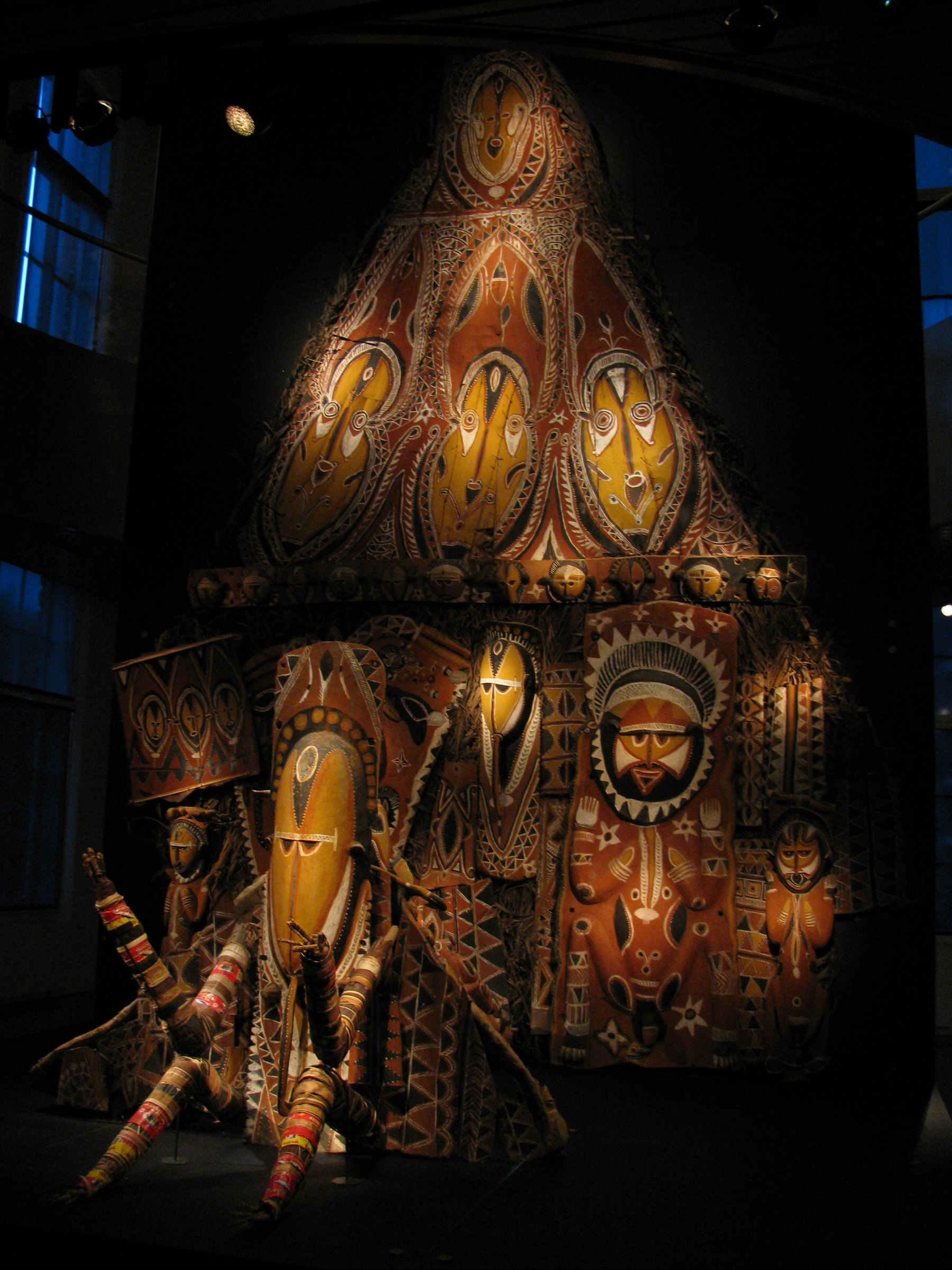
On the morning the boys were taken, in the country between the Hunter and Macleay Rivers on the coast of New South Wales, the men began by covering up the audience. Mothers, sisters and children lay down beside the initiation ring and were heaped over with rugs and bushes, and they were told to hum. Under the hum the boys were led away. Two men stood ready with bullroarers, and the armed men round the ring beat boomerangs together, so that if a roarer’s string snapped no woman would hear the board fall. Days later the rugs came off and the women found a ring of white-painted strangers standing round them, and could not tell which of them were their sons. The surveyor who wrote it down, R. H. Mathews, called the headmen’s work “directing the proceedings.” He was describing a play.
The bullroarer cults share a production grammar, a director’s kit: screens and enclosures, hidden performers and batteries of voices, motion that stands for a spirit’s presence, one sound covering another, and the timed reveal. The staging itself travelled from people to people, and sometimes it was bought whole. The cult went abroad as theatre, and in Greece the theatre of the mysteries became the theatre.
In brief
- The Keeparra of coastal New South Wales used every trick in one rite: an audience screened under rugs and made to hum, roarers that grew louder as the spirit “came,” boomerangs beaten to cover a snapped string, a squirrel’s tail planted in a tree, and the rugs pulled off on a cordon of painted men.
- The same five devices recur in Papua New Guinea, Amazonia, Central Africa and California. None is demanded by the instrument, which works perfectly well in daylight in the open; they are a director’s choices, and choices that recur as a set have been handed down.
- The ethnographers who watched these rites reached for the theatre’s own words. F. E. Williams called the masked cycle of Orokolo, on the Papuan Gulf, “essentially a Drama” and saw it rehearsed behind a palisade; Karl von den Steinen called a Bororo funeral rite in Brazil a Schauspiel, a play.
- When a rite was sold, the staging is what changed hands. Lake Sentani in western New Guinea bought the right to perform a coastal flute cult and built its men’s houses in the sellers’ style; the Yuki of California bought creation lore from the Kato, and their ghosts enter on the same cue from the dance-house roof.
- Aristotle traced tragedy to the leaders of the dithyramb, the song of Dionysus, and the Cambridge classicists Jane Harrison, Gilbert Murray and F. M. Cornford read the Greek play as the mystery rite carried into the open. The rhombos, the Greek bullroarer, sounded in those mysteries, and the Athenian stage kept the kit: a screen called the skene, a thunder machine, a wheeled platform for the reveal, and a god lowered from the sky.

Covered with rugs and bushes
Mathews published the Keeparra in 1897, from the peoples between the Hunter and Macleay Rivers. His account follows the boys from the morning they are taken to the morning they come back, and at the first step he set down the arrangements for the women as carefully as a stage manager setting out the house:
The women and children are also told to lie down, and are covered over with rugs and bushes, some of the men running round amongst them to see that this formality is properly carried out. As soon as the mothers are covered over, they are directed to continue making a low humming or buzzing sound, in order that they may not hear the guardians taking away the novices. While the covering is being placed over the women, a man runs away to the goonambang and tells the men there that everything is ready.
The headmen are walking about directing the proceedings, being sometimes in the ring, and sometimes outside of it.
R. H. Mathews, “The Keeparra Ceremony of Initiation,” Journal of the Anthropological Institute 26 (1897), p. 327
A runner carries the cue. The boys are led off with their heads bowed, “noiselessly,” and when they are fifty or a hundred yards out, the noise begins:
Two men who were in readiness, one on each side of the ring, commence loudly sounding their bull-roarers. All the armed men who are standing round, make a noise by beating together two boomerangs, or any two weapons which they may happen to have with them. This noise is made so that if the string of one of the bull-roarers should break — which sometimes happens — the women would not hear it falling on the ground. One of the men goes into the ring, swinging his bull-roarer, and the other walks along one side near the women. This only lasts a few minutes and then all the men follow after the novices. While this tumultuous noise is going on, the guardians say to each other that they suppose Goign is killing all the women and children in the camp.
Mathews (1897), p. 328
Every element of that minute is staged. The audience is screened and set to cover its own hearing. The voice of Goign, the being who presides over the Keeparra, comes from two men placed on either side, and one walks along the line of covered women so that the voice passes over them. A second noise hides the one failure that could give the first away. And the guardians speak a line, overheard by the boys, that tells them what the noise is doing.
In the bush camp the men gave the novices what Mathews calls “the course of performances.” Its climax was a piece of business planned the night before. Before dawn a headman pretends to see a large brown squirrel go into a hole in a tree, and asks a man to catch it:
The tail of a squirrel or opossum has previously been fastened on the side of this hole by one of the men, unknown to the boys, to convey the idea that the rest of the animal is within. The novices are then brought out and placed standing in a row between the camp and the fires, with their eyes cast down. A man standing at the butt of the tree commences to cut steps as if going to climb it, and a few of the men run about and throw sticks at the squirrel’s tail. Others say, “You should not interfere with Goign’s squirrel, or he will come and kill both us and the boys.” Two bull-roarers are then heard close by, and some of the men call out to those throwing the sticks, “We told you to beware of Goign — here he comes!” … The bull-roarers increase in loudness, and come quite near, and the guardians tell the novices to raise their heads and look. They then see two men swinging each a gonnandhakeen (excrement-eater) on the cleared space beyond the line of fires.
Mathews (1897), p. 333
A planted prop, actors improvising round it, a line to raise the stakes, an entrance built from a voice that grows louder as it comes, and then the order to look. The god is revealed as two men with boards, and the boys are told that to tell a woman what they have seen is death.
The return gave the women their own reveal. On the day the boys came back the women were laid down again round a fire and covered again with rugs, and they hummed again, and the men and boys came in so quietly that no one under the rugs heard them:
The rugs are now taken off the women, and the mothers are called up first, after which the other women are permitted to rise. Owing to the humming noise which they have themselves been making, and the quiet manner in which the men and boys have come in, such of the younger women who have not been to a keeparra before are surprised to see the cordon of “white men” standing around them. On account of the novices’ hair being singed short, and the white paint on their bodies, the mothers are sometimes unable to recognise their own sons.
Mathews (1897), p. 335
The humming that hid the boys’ going hides their coming. The rite opens and closes on the same device, used twice, the second time for the opposite effect. That is a director’s symmetry.

Five tricks
The Keeparra holds the whole kit in one place, but every piece of it turns up on its own across the world of the bullroarer cults.
The screen. At Ilahita, among the Arapesh of the Sepik hills of Papua New Guinea, the initiated men sounded drums, slit-gongs, bullroarers and giant voice-amplifying pipes “inside the screened-off men’s house,” and the women, children and younger men outside heard the spirits’ voices. On the Papuan Gulf the Elema masks were made, and rehearsed, behind a high palisade of palm leaves. Among the Bororo of Brazil, when the roarers flew, the huts “lay as if uninhabited, shut up with mats.” Among the Yuki and Kato of northern California the boys were passed through the wood-hole of the dance house into a dark so complete that the ghosts standing about were invisible.
The hidden performer, and the battery. The Abelam of the Maprik hills, near Ilahita, kept a whole orchestra out of sight: bullroarer, flutes, ocarinas, resonators, soundboards and trumpets, whose noises from inside the towering men’s house were all that women ever knew of the great spirit. A Makah dancer at Cape Flattery, in Washington State, carried a reed instrument “concealed … in his mouth, two strings being attached to it and fastened to his shirt so that he would not swallow it.” At the Potter Valley Pomo thunder ceremony in California four bullroarer men took their posts at the four cardinal points of the assembly house and roared on a signal.
Motion as presence. A whirled board throws its sound everywhere at once, and the ear cannot find it. The cults give it a body by moving the man who swings it. Goign’s roarers at the Keeparra “increase in loudness, and come quite near.” Among the Kuba of the Congo the old men circled the boys’ camp by night with their roarers. On the Northwest Coast the Makah wolves “came out of the woods, entered the village, and circled around the houses.” A voice that approaches, retreats and approaches again is a being on its way.
One sound covering another. The Keeparra boomerangs cover a falling roarer; the women’s humming covers the boys’ going. In the Huon Gulf, on the north-east coast of New Guinea, the Jabim and Kai sang a mourning song at circumcision “to drown the boys’ shrieks and to persuade the women that the balum has actually swallowed the boys who are being ‘mourned.’” The Kwanyama of southern Angola and northern Namibia turned it round and used the roarer to drown the cries of the boys being cut. At the Makah Klokali men rubbed cockle shells together and a whole room took the sound for frogs.
The reveal. At Ilahita the first revelations of the Lefin grade were, in Donald Tuzin’s words, “the truth about the bull-roarer” and “the secret techniques and devices” behind the spirits’ noise. Among the Elema of Orokolo the last stage of initiation led the youths to a lonely place in the bush and showed them how the voice was made. The Keeparra boys are told to raise their heads and look. The last act of these rites is a tour behind the scenes.
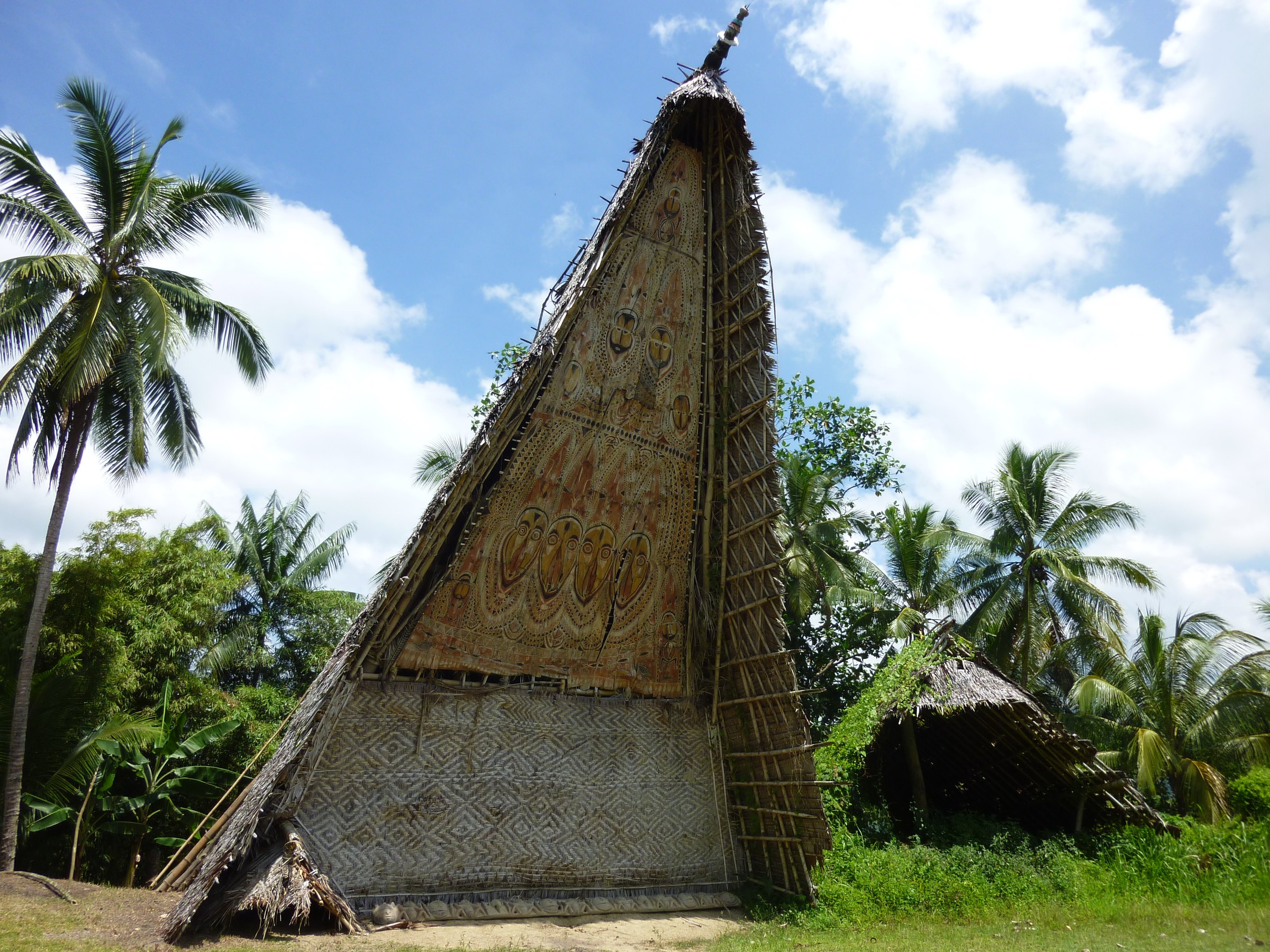
Nothing in the bullroarer requires any of this. A board on a cord roars as well at noon on an open plaza as at midnight behind a screen, and in the Upper Xingu of Brazil Karl von den Steinen watched the Nahuqua swing theirs on the village square “in all unconcern, as they would any everyday tool, and without the women being driven off.” Covering an audience and setting it to hum, planting a squirrel’s tail, sending a voice round the camp, beating boomerangs against a broken string: these are decisions, and they are the same decisions in New South Wales and the Sepik, on the Kasai and at Cape Flattery. The roarer is a prop. The production is what recurs, and a production that recurs as a set of decisions has been learned.
The cycle of ceremonies which it is our main purpose to describe is essentially a Drama, with the bush, the village, and the beach for its Stage, and the whole community for Actors.F. E. Williams, Drama of Orokolo (1940), p. 22
Essentially a Drama
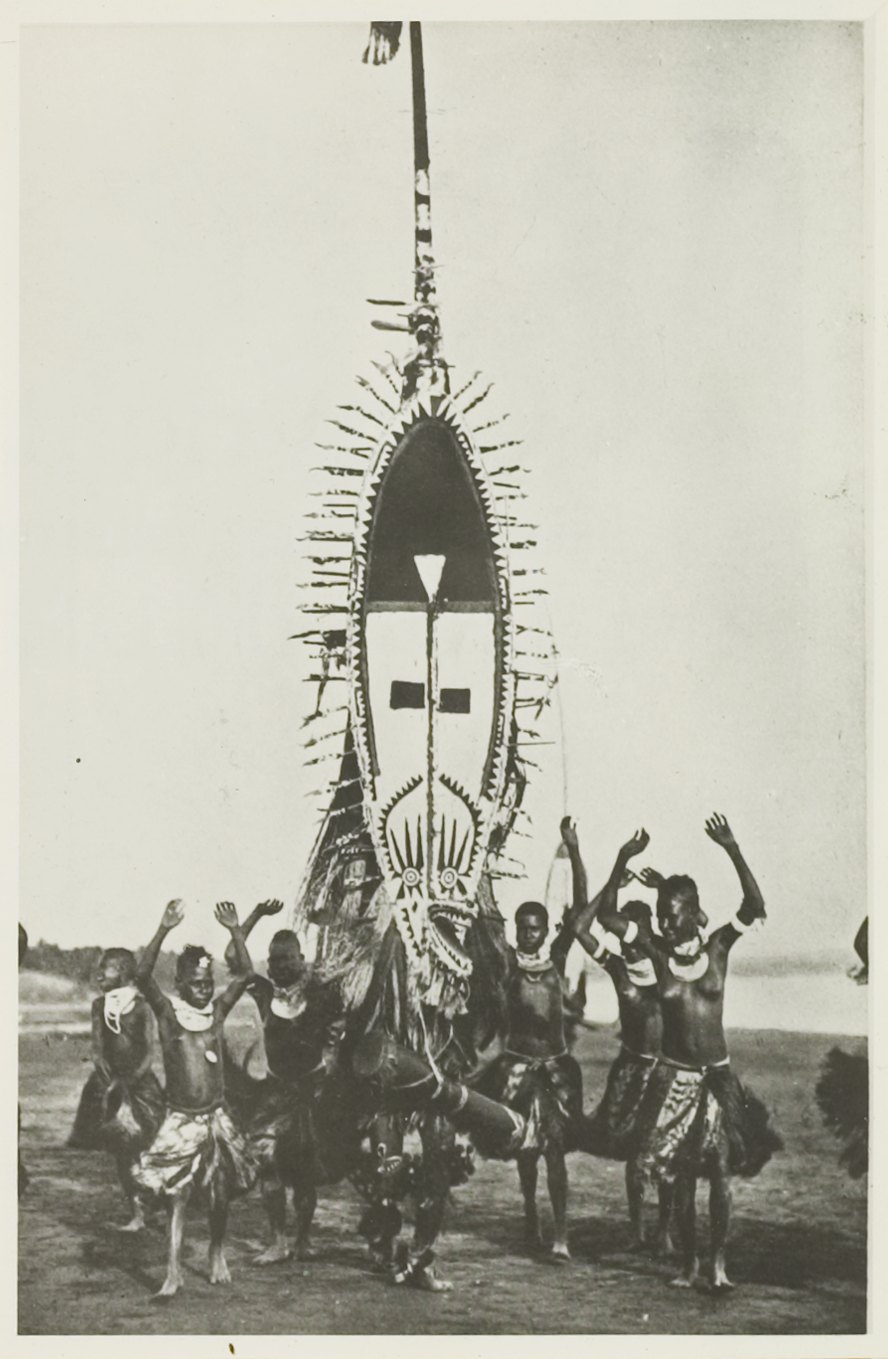
Francis Edgar Williams, the government anthropologist of Papua, spent the 1930s among the Western Elema at Orokolo Bay on the Papuan Gulf, and he named his book for what he saw there. The Hevehe cycle ran for ten, fifteen, twenty years from the cleaving of a coconut to the burning of the masks, inside the great men’s house, the eravo, a hall some thirty metres long. At Orokolo the same word, hevehe, named the roarer, the sea monsters and the great dancing masks, and Williams saw the family likeness in the wood: the mask’s oval face “does at least recall the Elema bull-roarer if we can think of the latter as magnified 150 times.” Their wearers, he wrote, “concealed their bodies with bast and sago-leaf mantles, took drums in their hands, and thus became apa-hevehe, the dancing bull-roarers armed with drums.” The voice grew a body and walked.
Everything about the masks was hidden until it was shown. The lesser masks were made “under cover,” and the young men practised behind a screen:
Sometimes a hirita, a high palisade of palm-leaves, encloses a space of about 12 square yards abutting on the front of the eravo, and in the cool of the late afternoon a number of young men wearing their masks come out to rehearse, all the rest crowding on the veranda to watch and criticize. … The rhythm quickens and the great grotesque figures begin to circle round, each on his own spot and in opposite directions, to the huge amusement of the old man, Berarikere, almost in his dotage, who tells them to kick out better, and shows them from the veranda how to do it.
Williams, Drama of Orokolo, pp. 267–268
An old man on a veranda calling to dancers to kick out better is a director at a rehearsal, and Williams gave the purpose of these sessions in a stage manager’s terms: “to try on the masks and effect adjustments in fitting, balance, &c., and partly to school the performers in the particular steps and drum-rhythms.” The rehearsals were “conducted in concealment”; even in their own village “the women must not see them till they emerge, full-fledged.”
The great masks waited longest. When at last they came out, after the whole cycle, the men had some twenty minutes in the crowded dark of the eravo before it would be light enough, and “every man and boy would be counted on to know his post — beside his own hevehe.” Outside, the women pressed against a screen of palm fronds at the foot of the ramp. Then the thirty-foot door of the eravo, warped by the years, jammed at its top corner while men hauled on vines, and Williams, standing in the crowd, judged the hitch as a critic would: “perhaps the delay added to the tenseness of the drama.”
At that, with a rending of wood and bamboo, the topmost corner was released and the eravo door swung open. Even as it did so the first of the hevehe was standing on the threshold.
There are many dramatic situations in the cycle, but none can compare with this supreme moment when the hevehe, after wellnigh twenty years of confinement, issue forth to commence the brief fulfilment of their existence. In the grey light of early morning the first of them, “Koraia,” stood framed against the blackness of the open door — a tall fantastic figure, silvery white, its coloured patterns in the atmosphere of dawn appearing pale and very delicate. … For a brief moment “Koraia” stood there, the great crowd of spectators gazing in silence. Then, with a thump of the drum and a prodigious rattling of harau, it started down the gangway. Immediately behind it came “Pekeaupe”; and after that, in crowded succession, 120 others.
Williams, Drama of Orokolo, pp. 356–357
The Elema called that morning Mairava, the Revelation. A door that frames a figure against the dark, timed to first light, before a silent house: that is a proscenium and a curtain. The women who had been kept from the masks for twenty years now ran out to dance beside “their own hevehe,” the ones their fathers and brothers wore, and the secret ended in a festival in which the whole village took part.
The most remarkable thing in the whole play
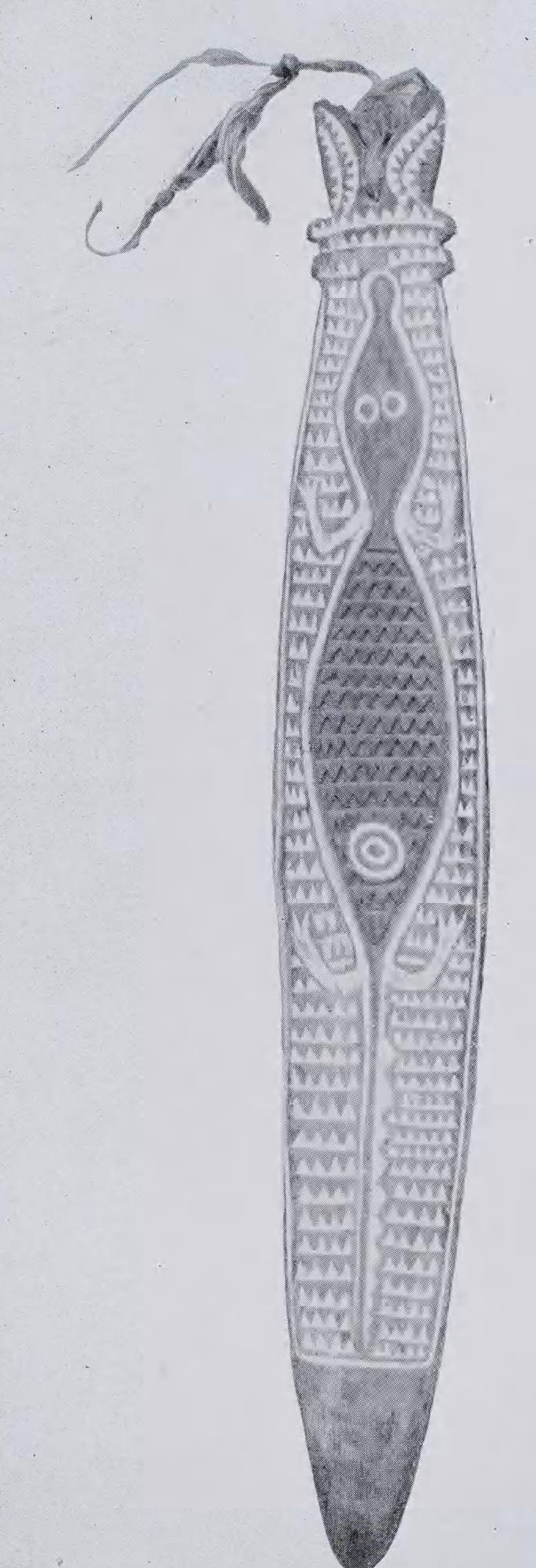
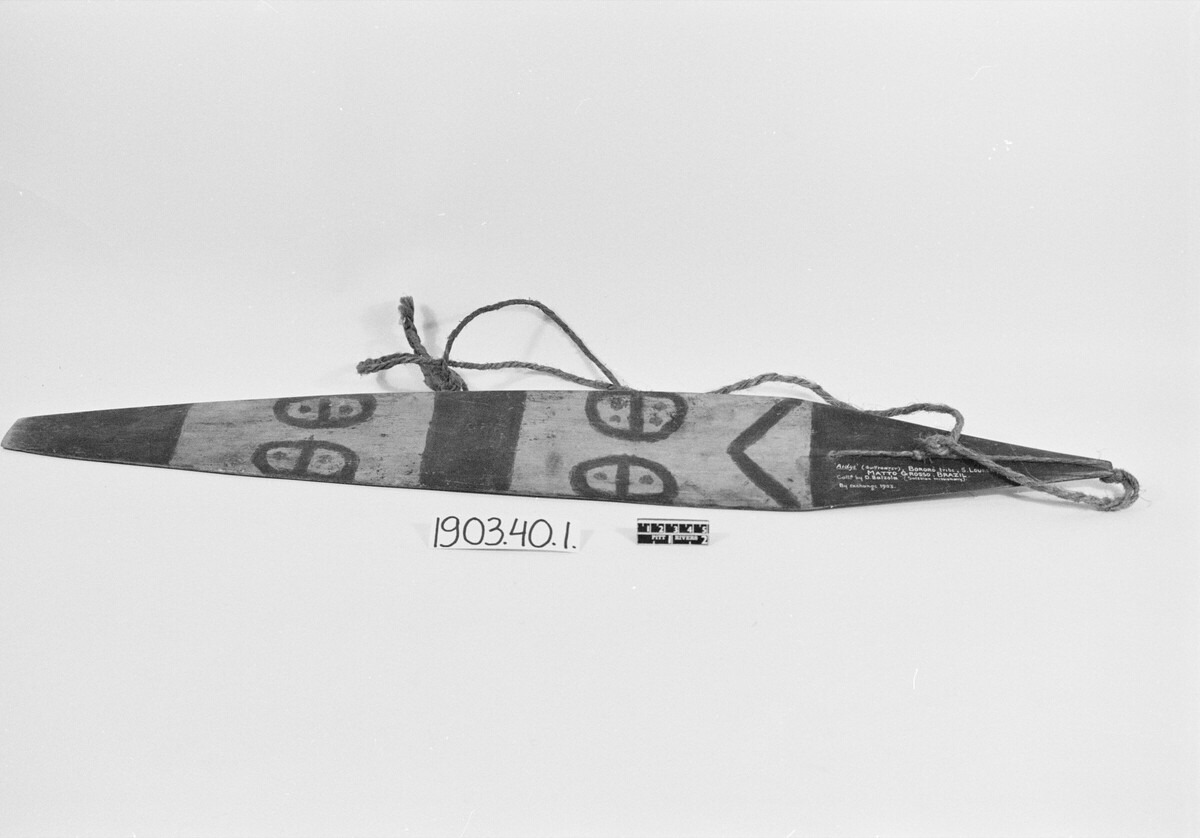
Karl von den Steinen came to the Bororo on the São Lourenço River in Mato Grosso, in central Brazil, in 1888, and stayed for a funeral. The Bororo sounded their roarers only for the dead, and he saw them at Easter, when the belongings of a dead woman, the wife of a man the Brazilians called Coqueiro, were burned. He called what followed “a proceeding with a most interesting pantomime, which deserves a closer description,” and gave one:
Several Bororo appeared from behind the men’s house in full gala dress, hair and body smeared with urucu. … This Bororo in green leafage represented the dead in their present state, buried under a covering of green leaves. … With the little gourd flute the young dead called two old dead, who had long lain in the earth. They were to be present at the giving-up of the belongings, take over their new companion, and satisfy themselves that nothing was being kept back from him.
After a quarter of an hour the troop came back at a run with a fearful halloo; two of them carried on their backs — hurrah, the dead ride fast! — two truly horrible figures, naked, unadorned, smeared all over from crown to toe with wet river clay. With bestial cries the clay monsters leapt about like wild beasts, like enormous blowflies three bullroarers hummed and whizzed through the air — no female being was to be seen far and wide, and the huts lay as if uninhabited, shut up with mats.
Karl von den Steinen, Unter den Naturvölkern Zentral-Brasiliens (1894), pp. 505–506, translated from the German
The actors enter from behind the men’s house, the backstage. One man plays the newly dead, in a costume that shows the dead person’s present state under the leaves. He summons two of the long dead with a flute, and the troupe exits at a run into the forest to fetch them. When it returns, the long dead are two men so plastered with river clay that von den Steinen, who knew them both, “at first hardly recognised” the chief Moguyokuri and the head shaman inside the mud. Meanwhile three roarers fill the air and the women’s huts stand blind behind their mats. Von den Steinen wrote of the climax, when the two old dead stopped to blow on a sick woman and cure her, that it was “in my opinion the most remarkable thing in the whole play,” das Merkwürdigste des ganzen Schauspiels. The German word for the rite is the German word for a stage play.
The finale was staged too. On the third morning the bones went out to be buried, and four young men followed the bearers into the forest: “the first swung a bullroarer, the second and third gave out loud cries of terror, the fourth dragged a broad swathe behind him with a palm leaf, to wipe out the footprints and make it harder for the dead to come back.” Sound, a second sound, and a brush to erase the trail: the dead are escorted off with the full kit.
Real ghosts killed the audience
The Yuki of Round Valley in northern California kept a story about why their ghost initiation is acted. The creator Taikomol founded it, and the first time it was held it went wrong. Alfred Kroeber took the story down:
It is said that this was instituted by Taikomol, but that at first he, or according to another account the bungling coyote, made the ceremony with real ghosts, in consequence of which all the onlooking people died. He then created a fresh set of human beings, and had some of them act as hulk’ilal and all went well.
A. L. Kroeber, Handbook of the Indians of California (1925), pp. 185–186
The myth is a charter for theatre. The real thing kills; the rite works when men play the part. And the Yuki played it with costume, make-up and blocking. The hulk’ilal were painted in broad stripes of black and white, wore false hair of maple bark and wreaths of leaves to hide the face, stuffed grass in their cheeks and bent split twigs from nostril to lip until the face was monstrous. Each night new ghosts were cast in secret:
There is talking in low tones and then the four, six, and eight designated for the next impersonation slip out quietly, so that even the spectators present do not know their identity when they return. They go on a hill to paint and dress. Then they separate in pairs, so as to be able to approach the dance house from different directions.
One of the men inside mounts to the roof and shouts yuhe kokokokoko, as in the Taikomol’s appearance. They answer bá, bá, bá, in long bleats, and as they begin to draw near each other shout brrrrr! A singer with cocoon rattle goes out to meet them with a certain song. They approach and enter singly, each going through the same motions as the Taikomol in his ceremony.
Kroeber (1925), p. 187
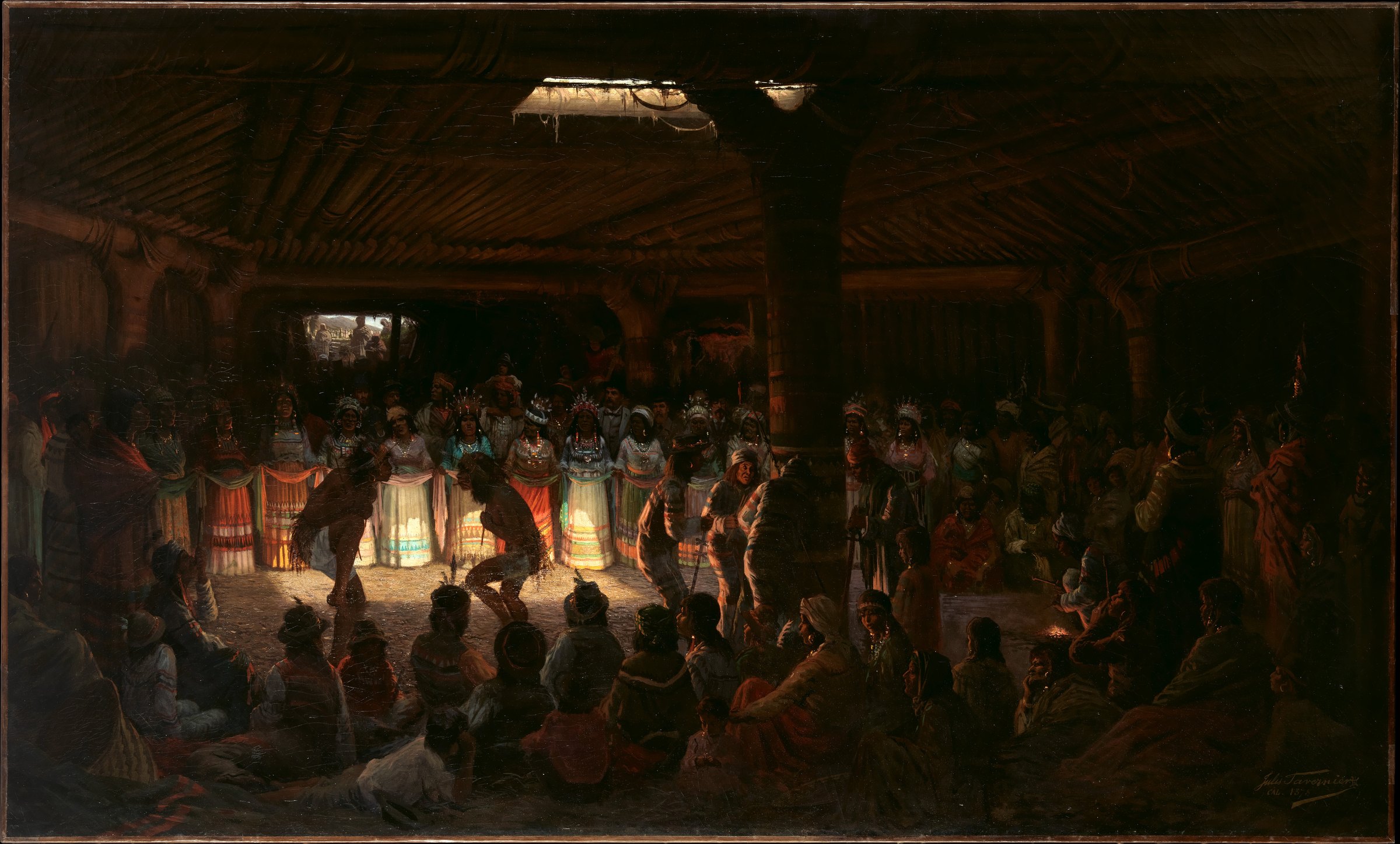
The “same motions” are a fixed piece of choreography. When the Taikomol impersonator came to a sick man, covered head to foot in a feathered net, he “approaches. He stops, retreats, and approaches again. This is counted as four movements. Then, walking backward, he comes close to the house, retreats, approaches again, and comes through the door rump first.” The entrance is counted, and every spirit uses it.
Their neighbours the Kato held the same school, and Edwin Loeb’s account of it has the same cue from the roof, the same answer from the hills and the same counted dance, with a penalty for a fluffed step:
Next the chief called for the ghosts from the roof of the dance house. The four ghosts on the hills whistled to him in reply. … Finally the ghosts set up a mighty halloo and rushed down from the hills. … They had to first dance four times around the center post counterclockwise, and then four times clockwise. If a ghost made any mistake, he had to pay a heavy fine. … After the ghosts had entered, the bullroarers were sounded. The women at home believed that the bullroarers were the voices of the ghosts.
Edwin M. Loeb, The Western Kuksu Cult (1932), pp. 26–27
And the Yuki said where part of their school had come from. Long ago, Kroeber was told, a man of the southern Yuki bought black condor wing-feathers from the Kato, and with them the creation story taught in the Taikomol school: “The feathers were worn, but were also like an American book: the knowledge came with them.” The buyer passed what he had bought to the grandfather of a man born about 1830, “which fact sets the date of the innovation back of 1800.” Because of that purchase the southern Yuki sang the Taikomol songs differently from the other Yuki. What crossed the line between the Kato and the Yuki was regalia, a script and a score, and on both sides of it the ghosts came down from the hills on a call from the roof.
The right to perform it
The bullroarer cults change hands whole, neighbour to neighbour, and often for a price; The Relay follows those hand-offs from Torres Strait to Chad. Look at them again as a theatre historian would, and what was bought is plain. It was a production, with its house, its cues and its effects.
On Humboldt Bay, on the north coast of western New Guinea near the present border with Papua New Guinea, the coastal villages initiated their boys with sacred bamboo flutes, whose music women were told was a cassowary spirit that swallowed the boys and gave them back as men. Around 1900 the men of the coastal village of Nafri taught the rite to the chief of Ayapo on nearby Lake Sentani, expecting valuable beads in return. The anthropologist Simon Harrison, following the Dutch ethnographer Simon Kooijman, tells what the chief did with it:
He managed to make a set of working flutes after some trial and error, and then staged the ritual in his own village, shortly afterwards organising the building of a men’s house there so as to institute the cult permanently.
Simon Harrison, “The Commerce of Cultures in Melanesia,” Man 28 (1993), p. 141
Nafri called it theft, and there were fights and killings until Ayapo paid ten ancient beads, a glass ring and several old drums. Two more lake villages then bought the cult, and with it they took “the architectural style of their cult-houses, with distinctive pyramidal roofs.” The theatre came with the play. Harrison drew the general rule for Melanesia: the sellers kept their title and “extended to the recipients rights to perform it,” a kind of franchise. The word he needed for a sold rite is the word for a licensed play.
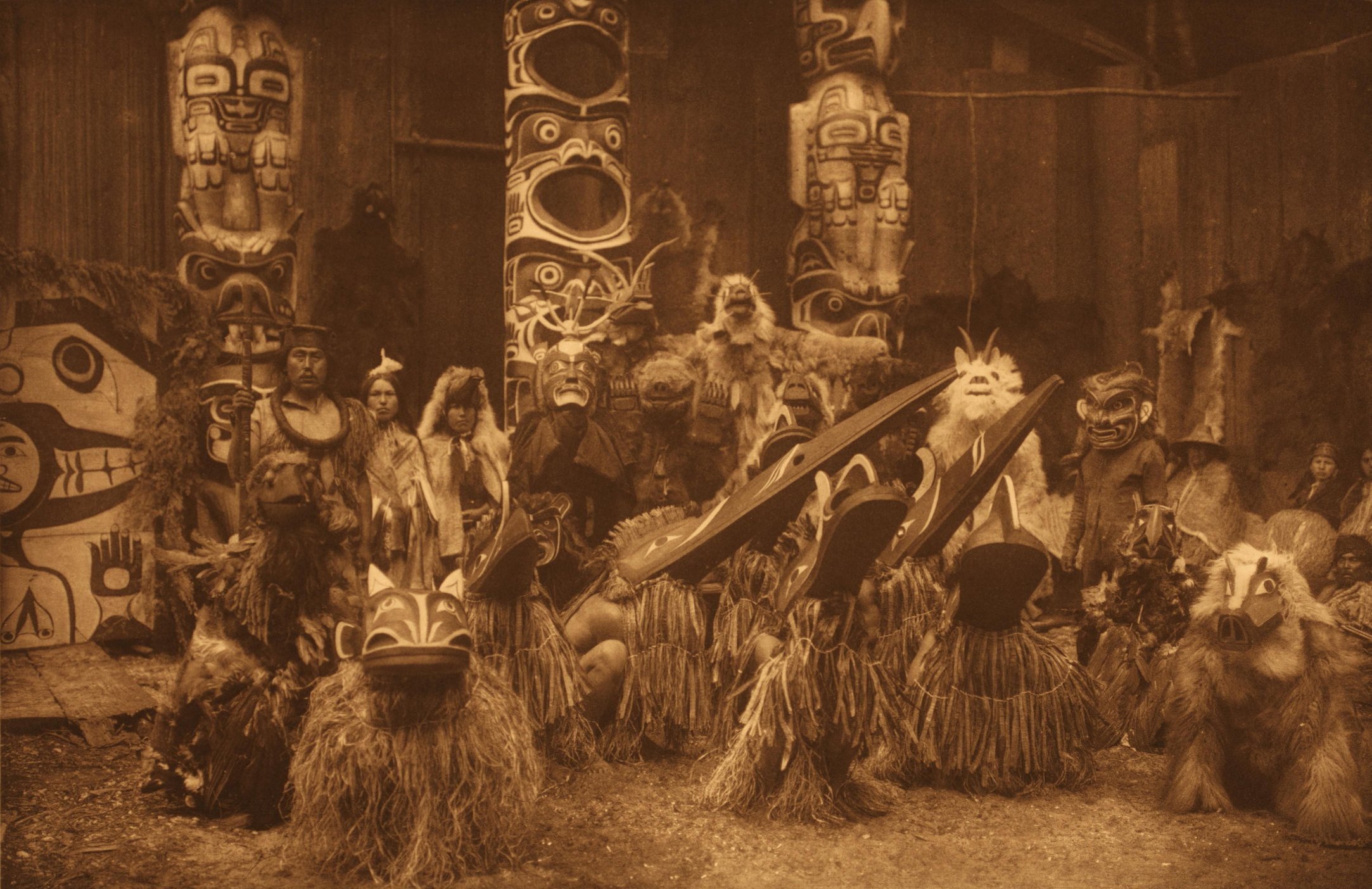
The Makah of Cape Flattery remembered their great winter ceremony, the Klokali, as a thing that came down the coast from the west side of Vancouver Island, “each tribe that it passed through adding something to it,” as Luke Markishtum told Frances Densmore. What it brought was a staging. It opened with an approach from the dark:
At the beginning, a number of men were in the woods around the village with whistles, imitating wolves and pretending to seek the man who had invited the meeting of the Klokali. They came nearer and at last entered his house. Then they took one of the men to be initiated with them and went to the next house where a member of the society lived, thus gathering up all those who were to attend.
Frances Densmore, Nootka and Quileute Music (1939), p. 102
Inside, the instruments of the Klokali “included four or five bull-roarers,” a dancer kept a reed hidden in his mouth, and at a signal “all the people would give the wolf howl. It was a blood-curdling sound when given by a roomful of men.” When a young man accused of lying called on his friends for help, “there was a sound as though frogs were answering. Some men had rubbed cockle-clam shells together, producing a sound like that made by frogs, and the members of the Klokali thought the sound came from living frogs.” And once a master brought in a slave who could not dance, and a chisel was produced; when the crowd parted the handle showed in the slave’s mouth and the blade at the back of his neck, and the slave was alive. Young Doctor, who had given the Klokali three times himself, said he “thought there was a trick somewhere.” The Klokali “closed with dramatic dances on the beach.”
The same traffic runs through the Highlands of Papua New Guinea, where, the anthropologist Terence Hays wrote, people “continually experiment with ritual and cult activities and objects as they are discovered among their neighbors”: the Daribi, by the account of Roy Wagner, “only recently adopted, probably in the 19th century, transverse flutes and associated rituals from their Gimi neighbors.” Among the Nyanga of the eastern Congo, where the circumcision lodge rang with hidden bullroarers and kazoos, the rite moved through a district one lodge at a time: the clan of Komo origin that had first brought it opened the season, and each village took its first boy to the lodge before it to be cut, then carried him home and built its own. A rite of this kind is not a doctrine that spreads by persuasion. It is a show that is sold, rehearsed and put on, and each buyer takes the stage, the effects and the cast list along with the story.
The prop changes, the play does not
The Sentani cult was a flute cult. The Makah used bullroarers among their whistles; the Abelam used them among flutes, ocarinas and trumpets; the Kato among rattles and the drum. In the Upper Xingu the roarer went public and the secret moved entirely into the great flutes, which women may not see. What holds steady across all of them is not the instrument but the staging: an enclosure, a voice from a hidden player, a spirit made present by sound that moves, a second sound to keep the first one safe, and a moment when the initiate is shown the machinery.
The myth of the women who first owned the voice travels with these cults, and so do the boards, the flutes and their names. The staging travels too, and it can travel when the instrument is swapped. A people that took a cult with flutes in place of roarers still took the screened house, the approach, the masking and the reveal. A people that took the roarer without the production took a toy; that is what the Bibbulmun of south-western Australia had when they bought roarers along the trade roads and gave them to their children to whirl in play. Without its director’s kit the bullroarer is a noise. With the kit it is a god.
From the leaders of the dithyramb
The Greeks said where their theatre came from, and they said it was a rite. Aristotle, writing in the fourth century BC, put it in two sentences of the Poetics:
Tragedy — as also Comedy — was at first mere improvisation. The one originated with the leaders of the dithyrambic, the other with those of the phallic songs, which are still in use in many of our cities.
Aristotle, Poetics 4, 1449a, translated by S. H. Butcher (1895), p. 19
The dithyramb was the choral song and dance of Dionysus, and, as the American classicist Roy Flickinger summed up the ancient testimony, it “was at all times intimately associated with Dionysus and at the beginning belonged to him exclusively.” The plays of Athens were performed at his festivals, in his precinct, before his priest’s seat. A century ago a group of Cambridge scholars took Aristotle at his word and followed the line back past the dithyramb into the rites of the god.
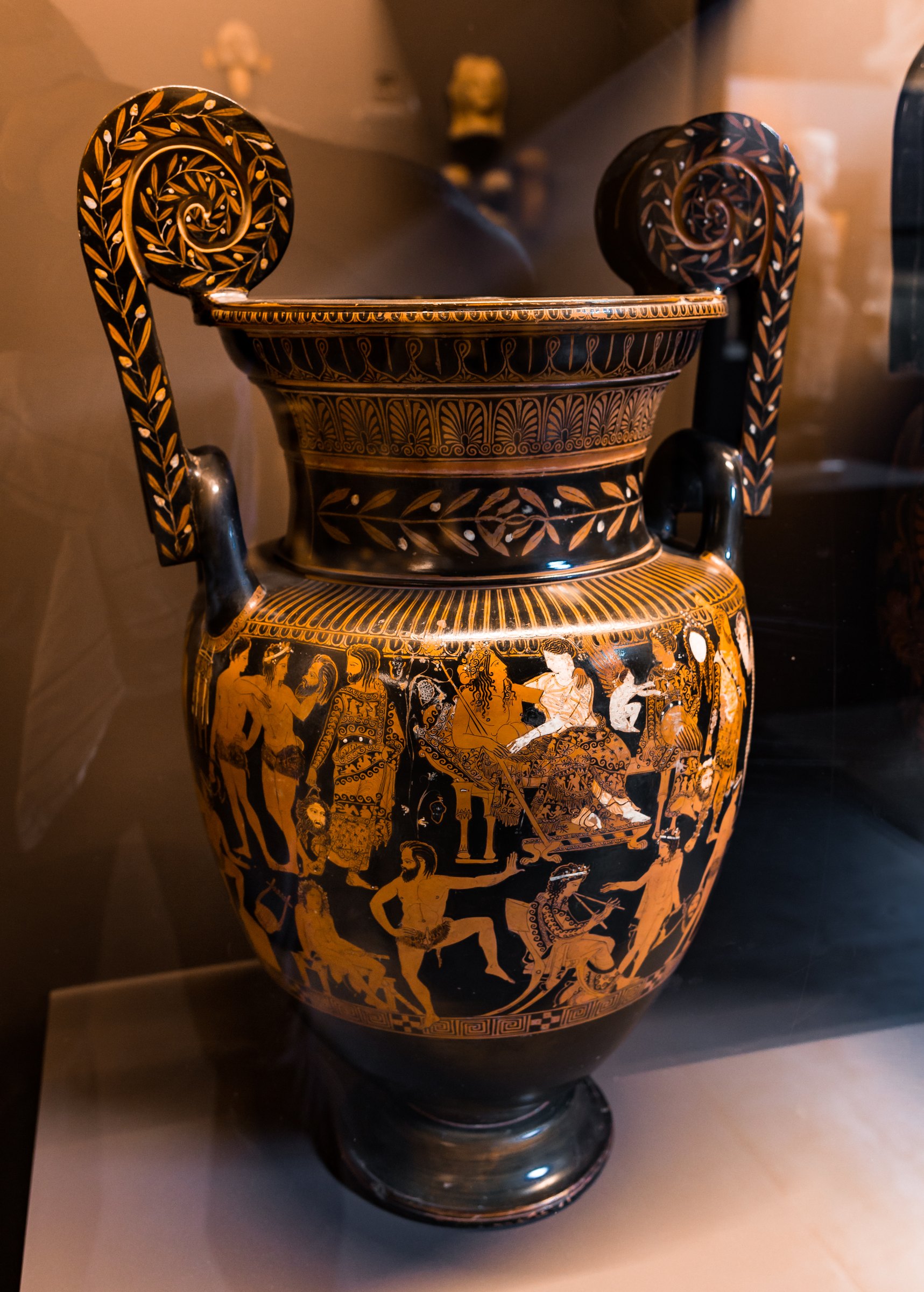
Jane Ellen Harrison led them. Her starting point was a pair of Greek words:
The Greek word for a rite as already noted is dromenon, “a thing done” — and the word is full of instruction. … It is a fact of cardinal importance that their word for theatrical representation, drama, is own cousin to their word for rite, dromenon; drama also means “thing done.” Greek linguistic instinct pointed plainly to the fact that art and ritual are near relations.
Jane Ellen Harrison, Ancient Art and Ritual (1913), pp. 35–36
In Themis (1912) she gave the rite its content. “The Dithyramb, from which the drama arose, was also a dromenon of the New Birth”: a dance, like the armed dance of the Kouretes round the infant god, that killed a child in mime and brought him back. Her definition of a mystery could stand for every rite in this essay: “A mystery is a rite, a dromenon enacted with magical intent.” And the rite of the New Birth, she wrote, “is in its essence the mimetic rite par excellence.” Birth from the fathers cannot be real, so it must be played.
Gilbert Murray, the Regius Professor of Greek at Oxford, added to Themis an excursus on the ritual forms preserved in Greek tragedy. It assumes, he wrote, “that Tragedy is in origin a Ritual Dance, a Sacer Ludus,” a sacred play, “originally or centrally that of Dionysus,” the spirit “who represents the cyclic death and rebirth of the world.” Then he set out the forms that the plays kept long after their stories had wandered from Dionysus: a contest; the god’s suffering and death; a messenger; a lament; and at the end a recognition and a theophany, the god revealed. Two of them are this essay’s kit in Greek dress. The death is not shown:
A Messenger. For this Pathos seems seldom or never to be actually performed under the eyes of the audience. (The reason of this is not hard to suggest.) It is announced by a messenger. “The news comes” that Pan the Great, Thammuz, Adonis, Osiris is dead, and the dead body is often brought in on a bier.
Gilbert Murray, “Excursus on the Ritual Forms Preserved in Greek Tragedy,” in Harrison, Themis (1912), p. 343
The deed happens behind the screen, and the audience hears of it. And the end is a reveal: Murray took from the German scholar Albrecht Dieterich the observation that the sacred play of the mysteries turned “from darkness and sights of inexplicable terror to light and the discovery of the reborn God,” and that tragedy’s recognition scene “must come into Greek tragedy from the Sacer Ludus, in which the dead God is Recognized or Discovered.”
Francis Cornford, the third of the Cambridge group, did the same for comedy. Aristophanes’ plays, he argued in 1914, kept “the surviving fabric of a ritual plot,” and he put his finger on the moment the actor was born. In the phallic procession of the Acharnians the god Phales is invoked “to lend his unseen presence. Let him but appear incarnate in a human form, and we shall have the first actor.” An unseen presence called up by song, and then a man stepping forward in its shape: Cornford’s first actor is the Keeparra’s Goign, coming nearer until the boys are told to look.
While the content has strayed far from Dionysus, the forms of tragedy retain clear traces of the original drama of the Death and Rebirth of the Year Spirit.Gilbert Murray, in Themis (1912), p. 342
The rhombos and the skene
The mysteries of Dionysus had a bullroarer, and the Greeks named it. Clement of Alexandria, mocking the rite about AD 200, quoted the Orphic verses on the toys with which the Titans lured the child god to his death, and in Harrison’s translation the instrument keeps its Greek name: “The cones, the rhombos and the limb-bending toys.” An old commentator on Clement explained the word: the rhombos is “a bit of wood to which a string is tied, and it is whirled round and round at initiation-rites to make a whirring sound.” The philosopher Archytas of Tarentum, in the fourth century BC, used the rhomboi whirled in the mysteries to illustrate pitch: swung slowly they give out a deep sound, swung hard a high one. Euripides put the circling whirr of rhomboi into the night rites of the Mother in his Helen of 412 BC.
Aeschylus brought the mystery onto the stage itself. His lost Edonians told how the rites of Dionysus came to Thrace, and the geographer Strabo preserved its description of the god’s band at work. After the pipes and the bronze cymbals:
Stringed instruments raise their shrill cry, and frightful mimickers from some place unseen bellow like bulls, and the semblance of drums, as of subterranean thunder, rolls along, a terrifying sound.
Aeschylus, Edonians fr. 57, quoted by Strabo, Geography 10.3.16, translated by H. L. Jones (1928), p. 107
Hidden performers, a voice with no visible source, one sound made to stand for another: a tragedian of Athens describing the rite his art came from, in the terms of the director’s kit. Harrison read it so, and she knew where else the kit was used. She had read the Australian reports, among them Mathews on the Wiradjuri of inland New South Wales, and she set them beside Zagreus:
At the moment of initiation the novices are closely covered with blankets and the fearsome din breaks upon them in complete darkness. The roaring, boys and women are told, represents the muttering of thunder, and the thunder — this is the important point — is the voice of Dhuramoolan. … When the boy is actually initiated the central mystery takes the form of a revelation (apokalypsis) of the Bull-Roarer, the boy sees and handles it, and learns to twirl it.
Harrison, Themis (1912), p. 63
The covered audience, the din in the dark, the reveal of the instrument: Harrison found in a New South Wales initiation ground the plot of a Greek mystery, and the Greek word she reached for, apokalypsis, is the word for an unveiling.
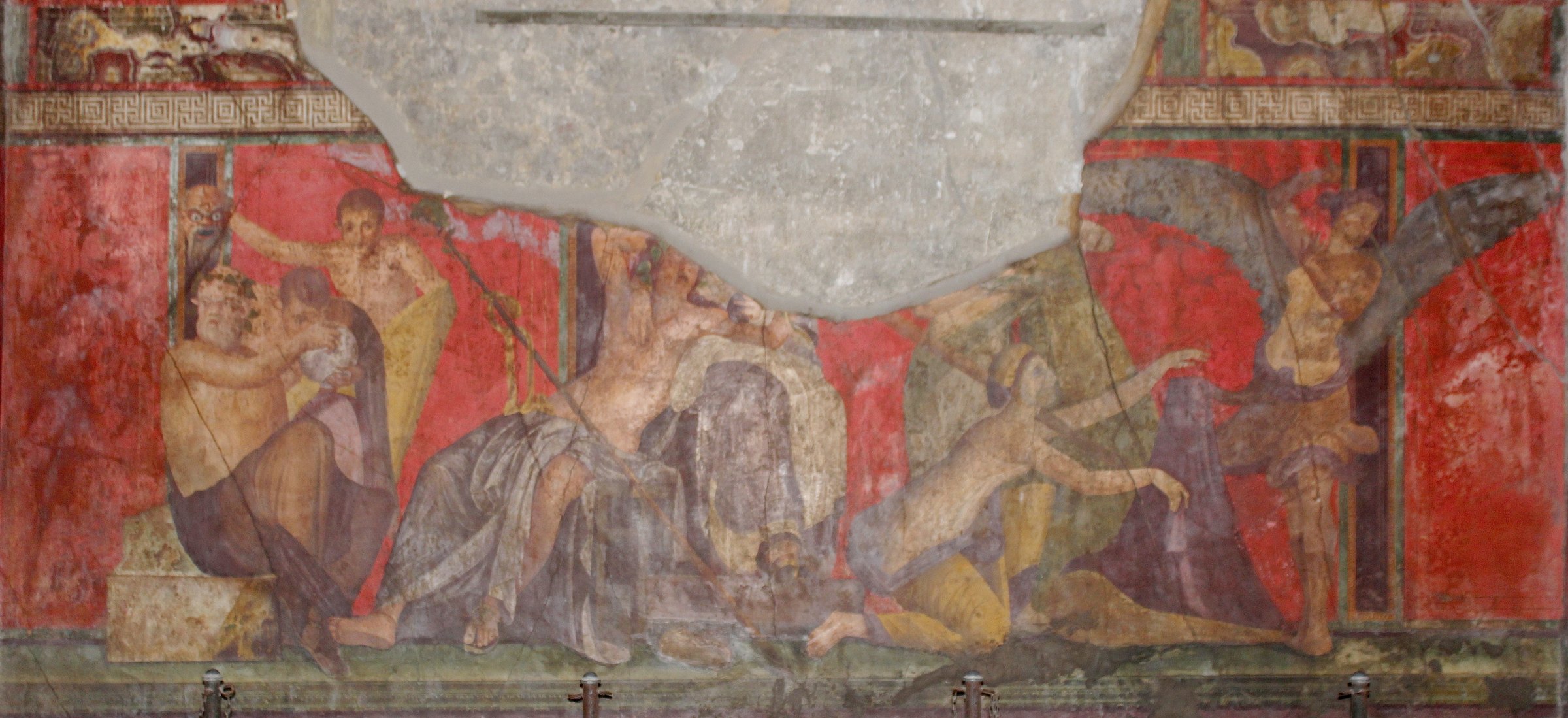
The Athenian theatre kept the machinery. Its stage building was called the skene, and the word meant a booth or tent. “The actor had to play many parts in succession,” the theatre historian A. E. Haigh wrote, “and it was necessary that he should have some room or covered place to change his dress and mask in. A tent or booth was erected for the purpose”; even when the building was stone, “they were still called by the name ‘skene,’ which means properly a booth or tent.” The first piece of the Greek stage was a screen to hide the man who would become the god.
Behind the screen the killing happened, as Murray said, and the audience heard the cries. Then the theatre made its reveal. The ekkyklema was a platform on wheels kept inside the building; a door was thrown open and it was rolled out with a tableau of the deed just done, “the murderer standing beside his victim’s body, with the instrument of death in his hand.” The grammarian Pollux, in the second century AD, said it showed the aporrhêta done behind the skene in the houses: the forbidden things, the same word the Greeks used for the secrets of the mysteries. A crane, the mechane, lowered gods from the sky, and the theologeion showed a god “suddenly upon the platform high up in the background.” And thunder came from behind the scenes on cue:
The “bronteion” was a device for imitating the noise of thunder behind the scenes, and was of a very simple character. Pebbles were poured out of a jar into a large brazen vessel, or else bags were filled with stones and flung against a metal surface.
A. E. Haigh, The Attic Theatre (1889), p. 194
A screen, a voice from behind it, thunder made by hand, a door flung open on what was done in secret, and a god who appears: the Athenian stage is the director’s kit built in stone. Harrison saw the whole movement in a sentence: “the dromenon of Dionysos, his Dithyramb, blossomed into drama.” The rite did not need to be invented again at Athens. It needed only to turn its audience round, to seat the uninitiated in rows and let them watch what the mystery had always staged for their ears.
The cult travelled as theatre
Ethnographers argued for a century over the bullroarer itself, a slat of wood on a cord, and over its myth, the women who first owned the voice and the men who took it. The staging they met and described in the language of the playhouse, because they had no other words for it: Mathews’s headmen “directing the proceedings,” Williams’s “Drama” with its rehearsals and its door, von den Steinen’s Schauspiel, Simon Harrison’s franchise to perform.
The staging is the surest sign of a shared history, because nothing compels it. A board on a string will roar for anyone. A story about women can be told anywhere. But covering an audience with rugs and setting it to hum, sending a voice round a camp in the dark, beating weapons to hide a snapped string, counting a spirit’s four steps to the door, opening a thirty-foot door at first light: those are inventions, and a set of inventions that turns up together on four continents has been passed on. Where history has caught the passing, as at Ayapo and Round Valley and Cape Flattery, what passed was a show with its stage and its effects, paid for in beads and feathers and handed on with its cues.
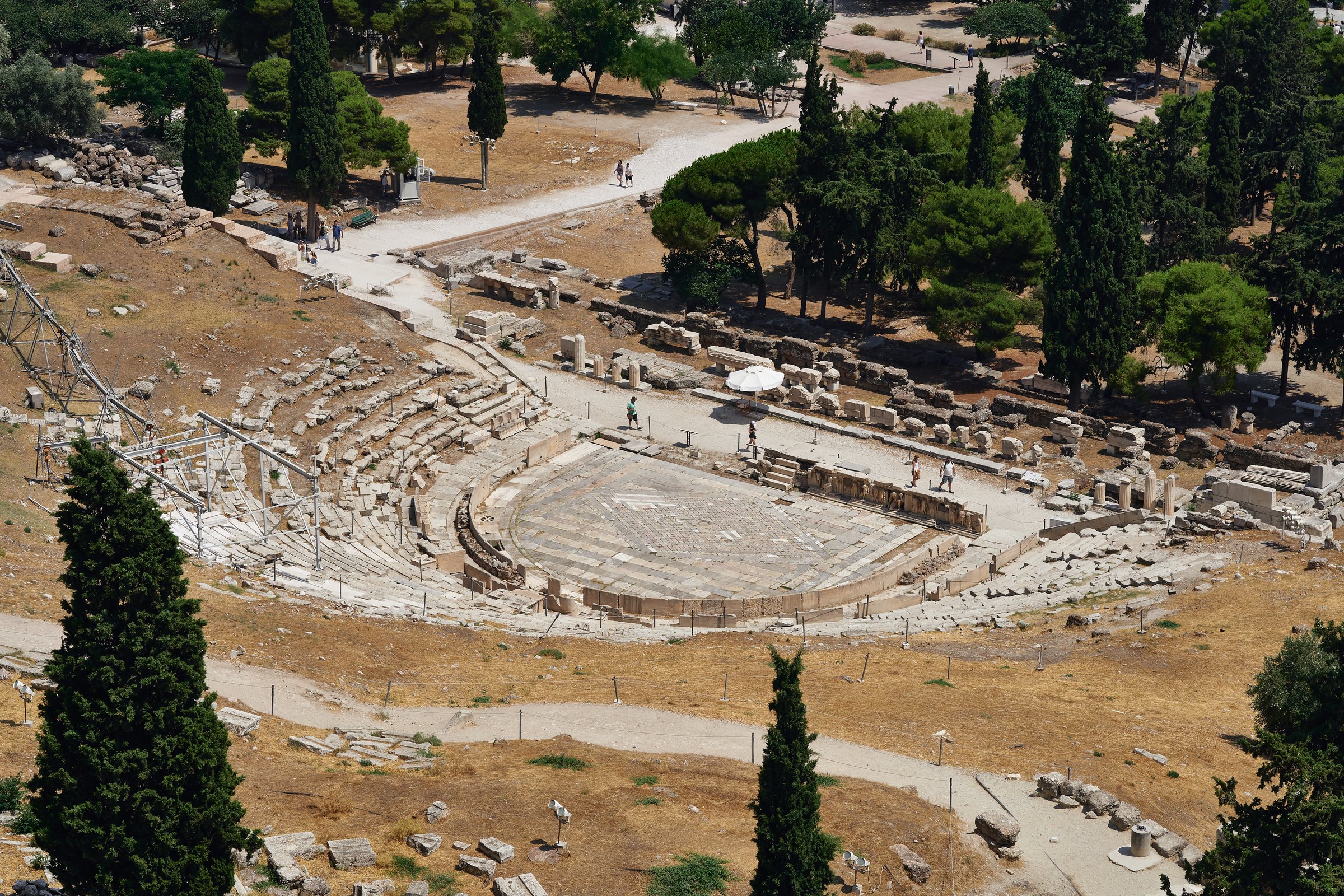
Greece shows how far the show could go. The rhombos roared in the mysteries of Dionysus behind the same screens and before the same reveal, and out of Dionysus’ song and dance the Athenians made the play. The skene began as a booth to hide the actor, the gods still came down on a crane, thunder still rolled from behind the scenes, and the deed done out of sight was still wheeled out at the end and shown. When the first actor stepped out of the chorus at the festival of Dionysus, he was doing what the men of the bullroarer cults had done in every men’s house and bush camp for longer than anyone can count: playing the god where the audience could hear him, and keeping the means out of sight until the moment came to show them. The cult travelled as theatre, and in Athens the theatre stayed.
Key sources
The reading of the bullroarer cults’ shared stagecraft as something passed from people to people, and of the Greek stage as its descendant, is original to this page.
- Mathews, R. H. 1897. “The Keeparra Ceremony of Initiation.” Journal of the Anthropological Institute of Great Britain and Ireland 26:320–340. The rugs and the humming, p. 327; the boomerangs, p. 328; the squirrel’s tail, p. 333; the return, p. 335.
- Williams, F. E. 1940. Drama of Orokolo: The Social and Ceremonial Life of the Elema. Oxford: Clarendon Press. “Essentially a Drama,” p. 22; the dancing bull-roarers, p. 166; the hirita rehearsals, pp. 267–268, 290; the door and Koraia, pp. 355–357.
- Holmes, J. H. 1902. “Initiation Ceremonies of Natives of the Papuan Gulf.” Journal of the Anthropological Institute 32:418–425. The semese stage, via the Orokolo record.
- Steinen, Karl von den. 1894. Unter den Naturvölkern Zentral-Brasiliens. Berlin: Dietrich Reimer. The Bororo funeral play, pp. 505–507; the bone escort, p. 509; the Nahuqua roarer, p. 327. Scanned book.
- Kroeber, A. L. 1925. Handbook of the Indians of California. Bureau of American Ethnology Bulletin 78. Washington. The Yuki ghost and Taikomol ceremonies and the Kato purchase, pp. 185–187.
- Loeb, Edwin M. 1932. The Western Kuksu Cult. University of California Publications in American Archaeology and Ethnology 33(1). Berkeley. The Kato ghost school, pp. 26–27.
- Densmore, Frances. 1939. Nootka and Quileute Music. Bureau of American Ethnology Bulletin 124. Washington. The Makah Klokali, pp. 101–104, pl. 11. Scanned book.
- Harrison, Simon. 1993. “The Commerce of Cultures in Melanesia.” Man, n.s., 28(1):139–158. Nafri and Ayapo, after Kooijman, p. 141.
- Hays, Terence E. 1986. “Sacred Flutes, Fertility, and Growth in the Papua New Guinea Highlands.” Anthropos 81:435–453. The Daribi flutes from the Gimi, p. 437 n. 3.
- Biebuyck, Daniel P. “Circumcision Rites among the Nyanga.” Mukumo field documentation, fieldwork 1952–56, published 2017. The lodges and their order, pp. 1–2, 13. PDF.
- Tuzin, Donald F. 1982. “Ritual Violence among the Ilahita Arapesh.” In Gilbert H. Herdt, ed., Rituals of Manhood: Male Initiation in Papua New Guinea. Berkeley: University of California Press. The Lefin revelations.
- Howes, David. 2015. “Sensation and Transmission.” In Michael Bull and Jon P. Mitchell, eds., Ritual, Performance and the Senses. London: Bloomsbury, pp. 155–156. The screened men’s house at Ilahita.
- Gourlay, K. A. 1975. Sound-Producing Instruments in Traditional Society: A Study of Esoteric Instruments and Their Role in Male–Female Relations. New Guinea Research Bulletin 60. Canberra. The Jabim and Kai mourning song, p. 43, after Neuhauss 1914.
- Butcher, S. H. 1895. Aristotle’s Theory of Poetry and Fine Art. London: Macmillan. Poetics 4, p. 19. Scanned book.
- Flickinger, Roy C. 1918. The Greek Theater and Its Drama. Chicago: University of Chicago Press. The dithyramb and Dionysus, p. 8. Scanned book.
- Harrison, Jane Ellen. 1912. Themis: A Study of the Social Origins of Greek Religion. Cambridge: Cambridge University Press. The rhombos, pp. 14, 62; the Wiradjuri blankets and the apokalypsis, p. 63; the dithyramb and the New Birth, p. xi and ch. II. Scanned book.
- Murray, Gilbert. 1912. “Excursus on the Ritual Forms Preserved in Greek Tragedy.” In Harrison, Themis, pp. 341–363.
- Harrison, Jane Ellen. 1913. Ancient Art and Ritual. London: Williams and Norgate. Dromenon and drama, pp. 35–36. Scanned book.
- Cornford, Francis Macdonald. 1914. The Origin of Attic Comedy. London: Edward Arnold. The ritual plot, p. vii; the first actor, p. 51. Scanned book.
- Clement of Alexandria. Exhortation to the Greeks 2.17–18. Translated by G. W. Butterworth. Loeb Classical Library. London: Heinemann, 1919. Scanned book.
- Archytas, fragment 1. In Hermann Diels, Die Fragmente der Vorsokratiker, 4th ed. Berlin: Weidmann, 1922. Scanned book.
- Euripides. Helen 1358–1368. In Euripides, vol. 1, translated by A. S. Way. Loeb Classical Library. London: Heinemann, 1912. Scanned book.
- Strabo. Geography 10.3.16, quoting Aeschylus, Edonians. In The Geography of Strabo, vol. 5, translated by H. L. Jones. Loeb Classical Library. London: Heinemann, 1928, p. 107. Scanned book.
- Haigh, A. E. 1889. The Attic Theatre. Oxford: Clarendon Press. The skene, pp. 103–104; the ekkyklema, pp. 185–186; the theologeion and bronteion, pp. 193–194. Scanned book.