Atlas Essay —
The Elder Brother
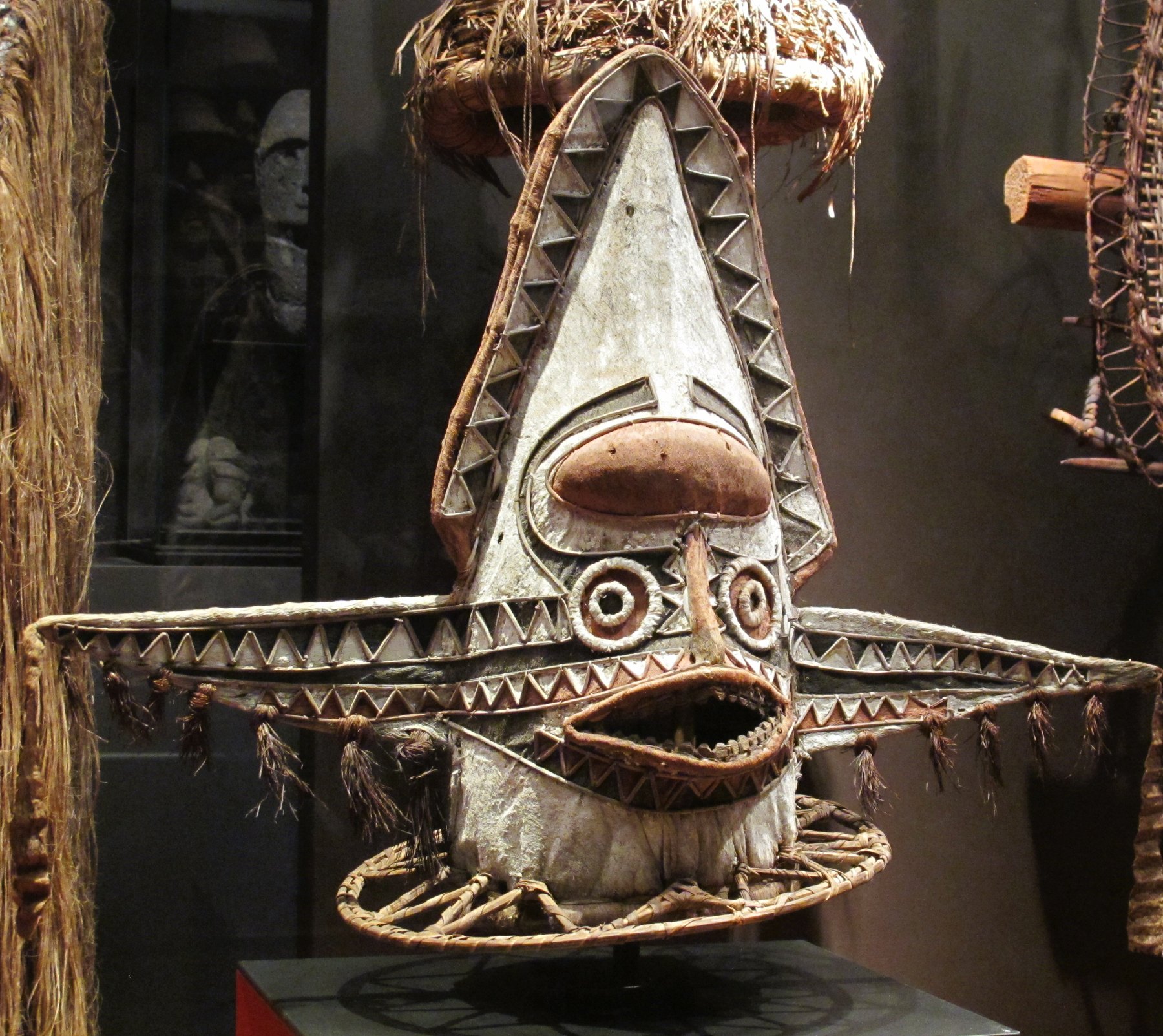
In a men’s house on the Gulf of Papua, in southern New Guinea, an old man opens a bulky package among the copra sacks. Inside lie fifty bullroarers and more, carved with men, crocodiles, lizards and snakes. He leans back “with the air of one revealing a secret” and says a single word: hevehe. It is the name of the roarer. It is also the name of the great masks, fifteen feet tall and more, that come out of that same house to dance on the beach, and three tribes of the central Elema use it to mean “snake.”
The great masks and carved boards of the Papuan Gulf are bullroarers grown huge. The bullroarer is the real original; the boards in the men’s house and the masks on the beach are its magnified children.
In brief
- The shapes match. The Elema bullroarer is a flat pointed ellipse some eighteen inches long, and the face of the hevehe mask “answers to the above description with surprising exactitude, except in regard to material and size.” F. E. Williams called the masked dancers “the dancing bull-roarers armed with drums.”
- The names match. At Orokolo, a large village of the Elema people on the Gulf coast, hevehe means the bullroarer, the sea monster and the tall mask, and in three neighbouring dialects it means “snake.” The Orokolo name for the roarer, kaiavuru, is the Purari Delta name for the great wicker monster of the men’s house.
- The family says so. The Elema call the bullroarer the elder brother of the masks. In their story of the first people, the first woman gave birth to a bullroarer, then to a mask, then to a taller mask, and only then to a human child.
- A. C. Haddon saw “every gradation” of size, form and decoration between the bullroarers and the carved tablets of the men’s houses. In the Purari Delta the roarers lay beneath the wicker monsters, and the first monster-house was floored with bullroarers.
- On the cliffs of Mali in West Africa, the Dogon give their bullroarer and their wooden-serpent Great Mask one name, and call the tall plank mask the little brother of the “mother of the mask,” the roarer’s own name.
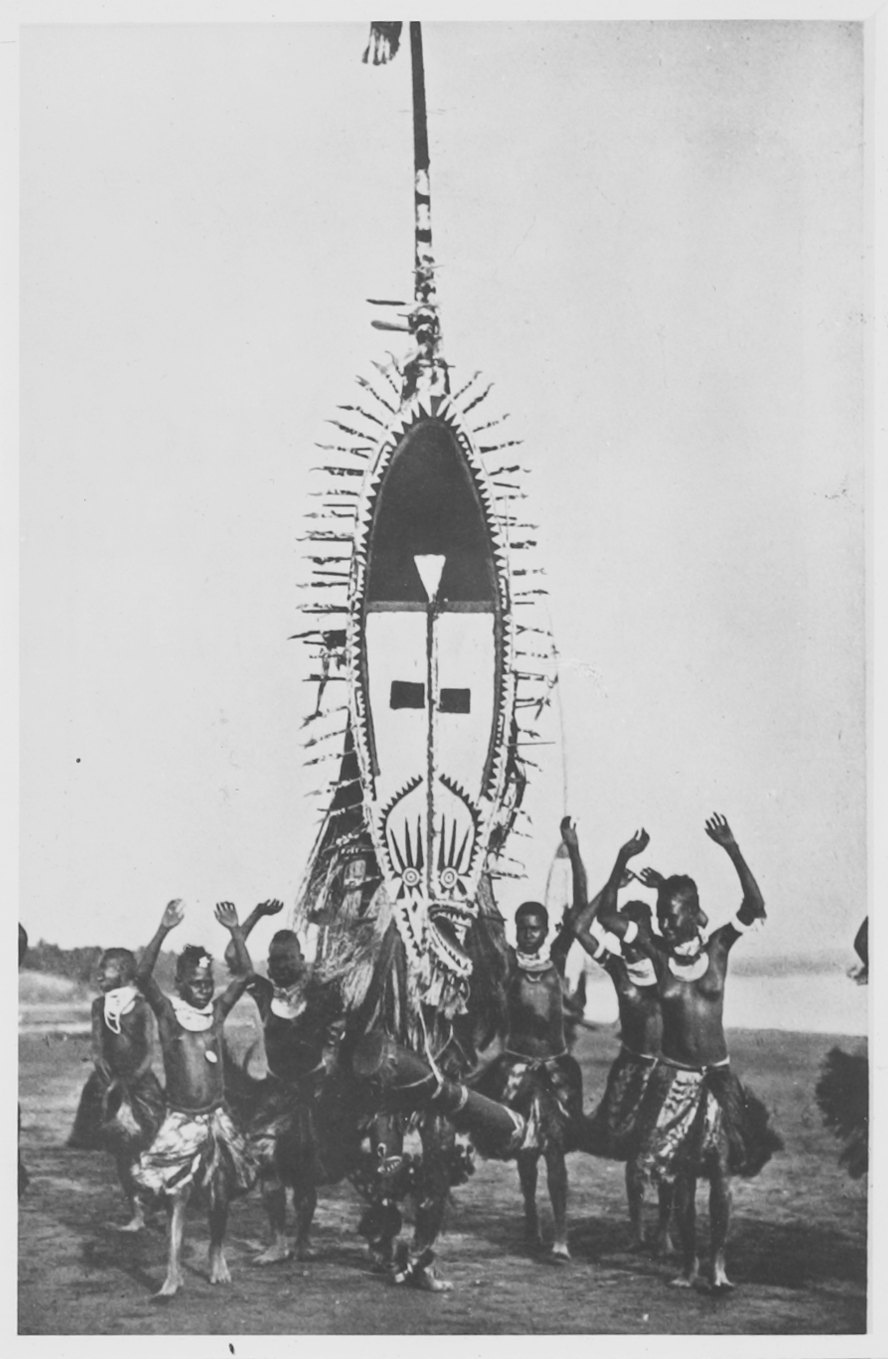
From fifteen inches to fifteen feet
The Elema live along the eastern shore of the Gulf of Papua, between the Purari Delta and Cape Possession. West of them lies the Purari Delta, where the great river breaks into a maze of channels and the villages of the Namau peoples stand on its banks. F. E. Williams, the government anthropologist of Papua, spent the 1920s and 1930s in the men’s houses of both. In 1939, in a letter to the journal Man, he named the three great sacred things of the Elema and said what they were:
“…e.g., of the Bull-Roarer, the Hohao (corresponding to the Kwoi of the Purari Delta), and the tall masks called Hevehe, all belonging to the Elema people. The very shape of the material objects concerned (though their size may vary from less than 15 ins. to more than 15 ft.) is enough to suggest that the real original is the bull-roarer; and there is (at any rate in the cases of the first and third) better evidence for a common origin than that of mere form.”
F. E. Williams, “The Kaiamunu-Ebiha-Gi Cult in Papua,” Man 39 (1939), no. 50, p. 48
The three are one shape at three sizes. The bullroarer is a flat, narrow slat, pointed at both ends, swung on a cord until it roars; its voice is the voice of the spirits the men keep. The hohao is the same pointed oval cut from the plank of an old canoe, four or five feet high, painted with a face and set up in the men’s house. The hevehe is the same oval again, built of cane and bark-cloth inside the men’s house, tall enough that its wearer walks inside a mantle of sago leaves beneath it. Set them side by side and the series reads in one direction. The small sounding thing came first, and the boards and masks are that thing grown huge.
Plate I
One shape at three sizes
Roarer and board
A. C. Haddon saw it first. In 1894, in The Decorative Art of British New Guinea, he published a carved board from an Elema men’s house at Kerema, at the eastern end of the Elema coast, and pointed out that it was cut and decorated on both faces like a bullroarer. Four years later he set out the case in full in The Study of Man, writing of the Gulf ceremonies in which the tall masks appear:
“In connection with the same ceremonies at which the masks are employed, certain flat, or slightly biconvex, ellipsoidal wooden objects are used, which are generally prolonged at one end into a handle, and are perforated at the other. They are often adorned at the side with vegetable fibre. Their shape bears a close resemblance to that of a bull-roarer, and I have ventured to suggest that they may have arisen from this implement, which we have seen is used in this district during the initiation ceremonies. An objection to this view might be urged from the circumstance that among those people who employ the bull-roarer during initiation ceremonies, the implement is so sacred that it may not be exhibited to any woman or uninitiate. But these objects are not actual bull-roarers, and even if they are modelled upon the bull-roarers, their relatively large size and their decoration alter their character, and it is very improbable that any initiate would inform the uninstructed that there was any resemblance between the two objects. These ceremonial tablets, as I have termed them, vary from about twenty inches to sixty inches in length, and, so far as I know, without exception they bear delineations of the human form or face.
“Very similar to these ceremonial tablets are some oval wooden slabs that Mr. Chalmers has recently sent to this country from the mouth of the Fly River, on which are carved conventionalised human faces, associated with simple patterns; some he describes as ‘gope-gope, charms hung in new houses for good luck … gope, house charm … gope, figure-head of canoe, gives good passage, and is thought a wonderful charm.’ I suspect these, too, are in reality bull-roarer derivatives.”
A. C. Haddon, The Study of Man (1898), pp. 240–41
Haddon’s tablets are the hohao of the Elema and the kwoi of the Purari Delta. Williams later described the Elema boards as “a pointed ellipse some 4 or 5 feet high and 12 to 18 inches wide,” cut from old broken canoes and painted with “a highly conventionalized human face.” The Purari bullroarer carries the same face at a fraction of the size: its carving, Williams wrote, “appears in most cases to represent a human face.”
In 1914 Haddon went into the Purari men’s houses himself, and he came out sure of it:
“If the bull-roarers, imunu viki (crying imunu), represent ancestral ghosts, the tablets may be (as I suggested long ago) hypertrophied bull-roarers and I have seen every gradation between them as to size, form, and decoration.”
A. C. Haddon, “The Kopiravi Cult of the Namau, Papua,” Man 19 (1919), no. 91, pp. 178–79
Every gradation is there in the museums. Plate II lays eight Gulf objects in a row, from a hand-held roarer to boards four and five feet long. At one end are bullroarers from Maipua, a Purari Delta village, and the Elema coast. Next comes a slat from Iari in the Purari Delta, where Williams found the roarers kept in bags in the men’s houses with no hole for the cord: “the bull-roarers cannot roar.” A roarer that no longer sounds has already become a board. After it come the Koriki board-roarer called koe, and then a board from Goaribari Island in the Kikori delta, west of the Purari, more than four and a half feet long, still pierced at one end for a cord, which the Pitt Rivers Museum catalogues as a bullroarer derivative. The hohao and the gope close the row with the same oval and the same face, and, as Haddon noted, a handle at one end and a hole at the other.
Plate II
Every gradation, from roarer to board
 1
1 2
2 3
3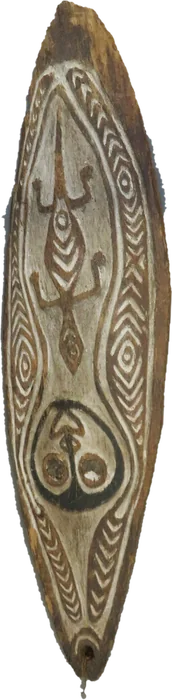 4
4 5
5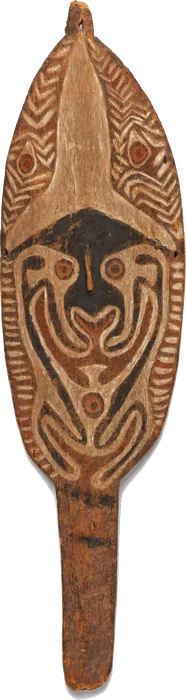 6
6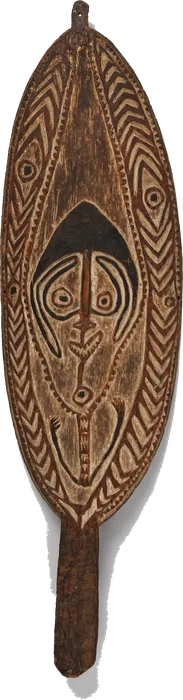 7
7 8
8Hevehe
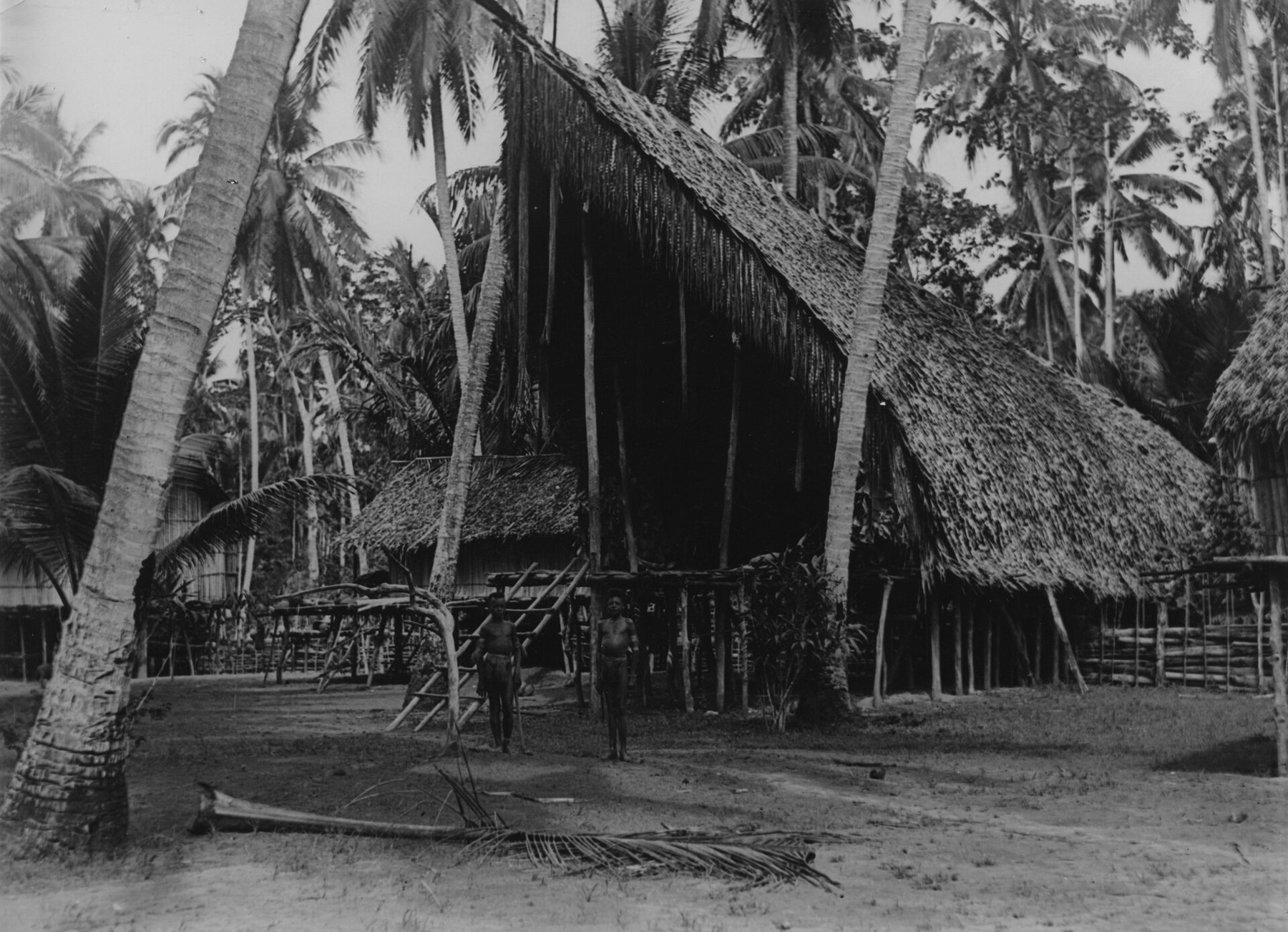
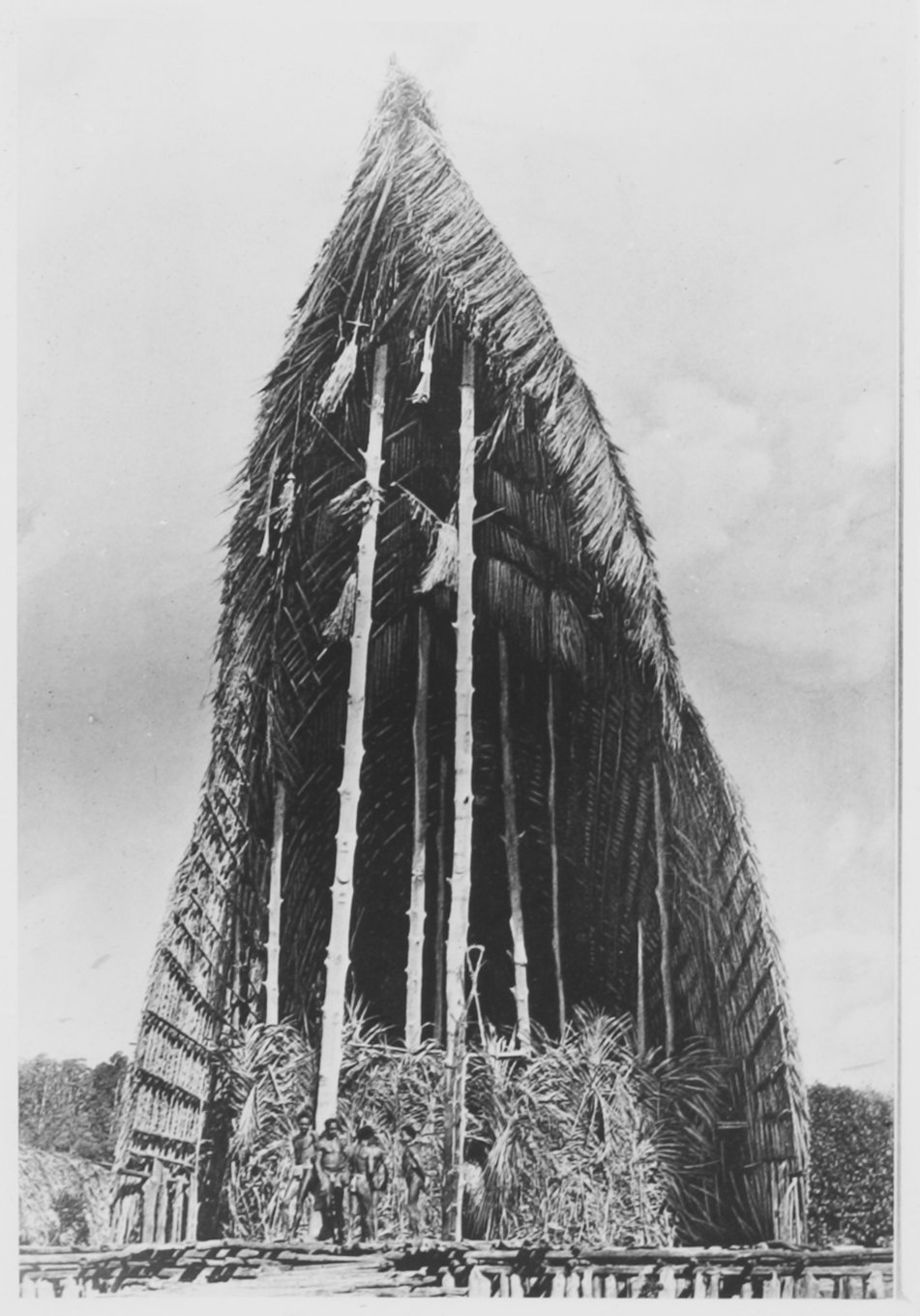
The Elema men’s house, the eravo, is the largest building in the village, a tall hall that rises to a peaked gable over the beach. The masks are built inside it, and the bullroarers are kept inside it. Williams describes what a visitor finds there. Copra dries in the smoke and sacks of it lie on the floor, and among the rubbish lies a package that might be taken for one more copra sack:
“But not every one will lay hands on this; and when some old man … opens it, he does so very carefully. Several bundles of large bull-roarers are revealed totalling perhaps fifty and more. They are much like bull-roarers in other parts of the world, but big specimens and comparatively broad; and they are in many cases well decorated with incised motifs, human, crocodile, lizard, or snake.… whereas the hohao are often more or less recent in origin, these bull-roarers are thought to date from the very foundation of things.”
“When in our exploration of an eravo we come upon the bundle of bull-roarers, the old man who unwraps it will probably lean back with the air of one revealing a secret, and utter the single impressive word, ‘hevehe’. This may well come as a shock since we have hitherto been using that word for something so widely different. But the fact remains that hevehe is also the name most commonly used for bull-roarer.”
F. E. Williams, Drama of Orokolo (1940), pp. 158–59, 162
The word runs through the whole family. Williams sorted the Orokolo usage into three kinds, each with its own qualifier, and noted that in speech the people drop the qualifiers:
“First of all there are be’ure hevehe, which means literally ‘hevehe from under the ground’: these are the bull-roarers. Secondly, there are ma’ure hevehe, or more often simply ma-hevehe, which means ‘hevehe from under the water’: these are certain monsters inhabiting the sea and great rivers. Thirdly, there are apa-hevehe, which means ‘drum-hevehe’: these are the masks, or the beings represented by the masks.… It should be noted that all three categories are commonly referred to in the same way by the native, i.e. without qualifying the word. Bull-roarers, marine monsters, and dancing-masks are all hevehe.”
F. E. Williams, Drama of Orokolo (1940), pp. 163–64
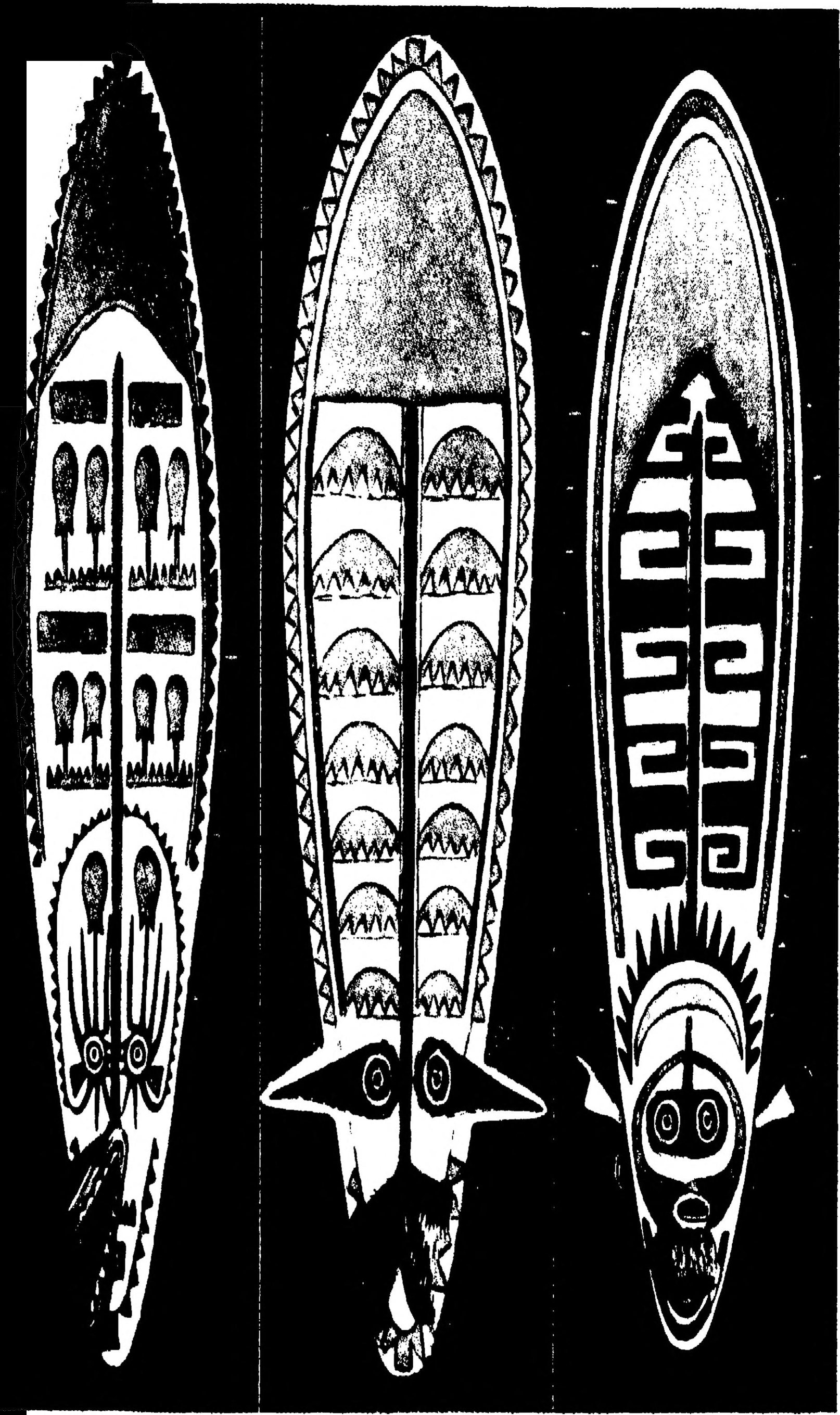
Every Orokolo mask is a hevehe, and so is every roarer in the bundle. Each mask belongs to a lineage and carries that lineage’s design, and Williams drew the designs flat, as if the cane frame had been laid on the floor of the eravo. Drawn flat, they are bullroarers: a long pointed oval, a central ridge, a face low on the body and a mouth at the narrow end where the roarer’s cord runs.
Williams, plate XXVIII
Specimens of hevehe designs
The Purari Delta tells the same story in another word. Another common Orokolo name for the bullroarer is kaiavuru, and Williams wrote in 1936 that he was “confident” it “is simply the Orokolo rendering of the Purari Delta word kaiemunu or kaiaimunu, which is there applied ordinarily to the large wicker-work monster kept in the interior of the men’s house.” In Drama of Orokolo he added that among the Western Elema the word “is applied loosely to the hohao, to the bull-roarer, and to the sorcerer’s marupai.” The roarer, the carved board and the monster answer to one name on this coast, as the roarer, the sea monster and the mask answer to another.
The dancing bull-roarers
Williams set the two shapes side by side:
“The bull-roarer is a slab of wood, some 18 inches or so in length, flat, narrow, and in outline roughly elliptical. The hevehe mask, or rather the face of it (the remaining features being regarded as adjuncts), answers to the above description with surprising exactitude, except in regard to material and size. The mask, then, does at least recall the Elema bull-roarer if we can think of the latter as magnified 150 times; and indeed its appearance is such that I can think of no other object to compare it with. It is not beyond the bounds of possibility, then, that in origin the hevehe masks were actually made to represent huge bull-roarers. Their wearers concealed their bodies with bast and sago-leaf mantles, took drums in their hands, and thus became apa-hevehe, the dancing bull-roarers armed with drums.”
F. E. Williams, Drama of Orokolo (1940), p. 166
Set his own drawings side by side and they prove the point. Beside the Orokolo roarers he traced from rubbings stand four of his mask designs. The roarers carry the same pointed oval, the same long body and the same face as the masks. Even the forked “fish-mouth” at the roarer’s cord end, which Williams says “recalls the Elema ‘fish-mouth’ drum,” has its answer at the foot of the masks, which end in an open mouth.
Plate III
The elder brother and the younger
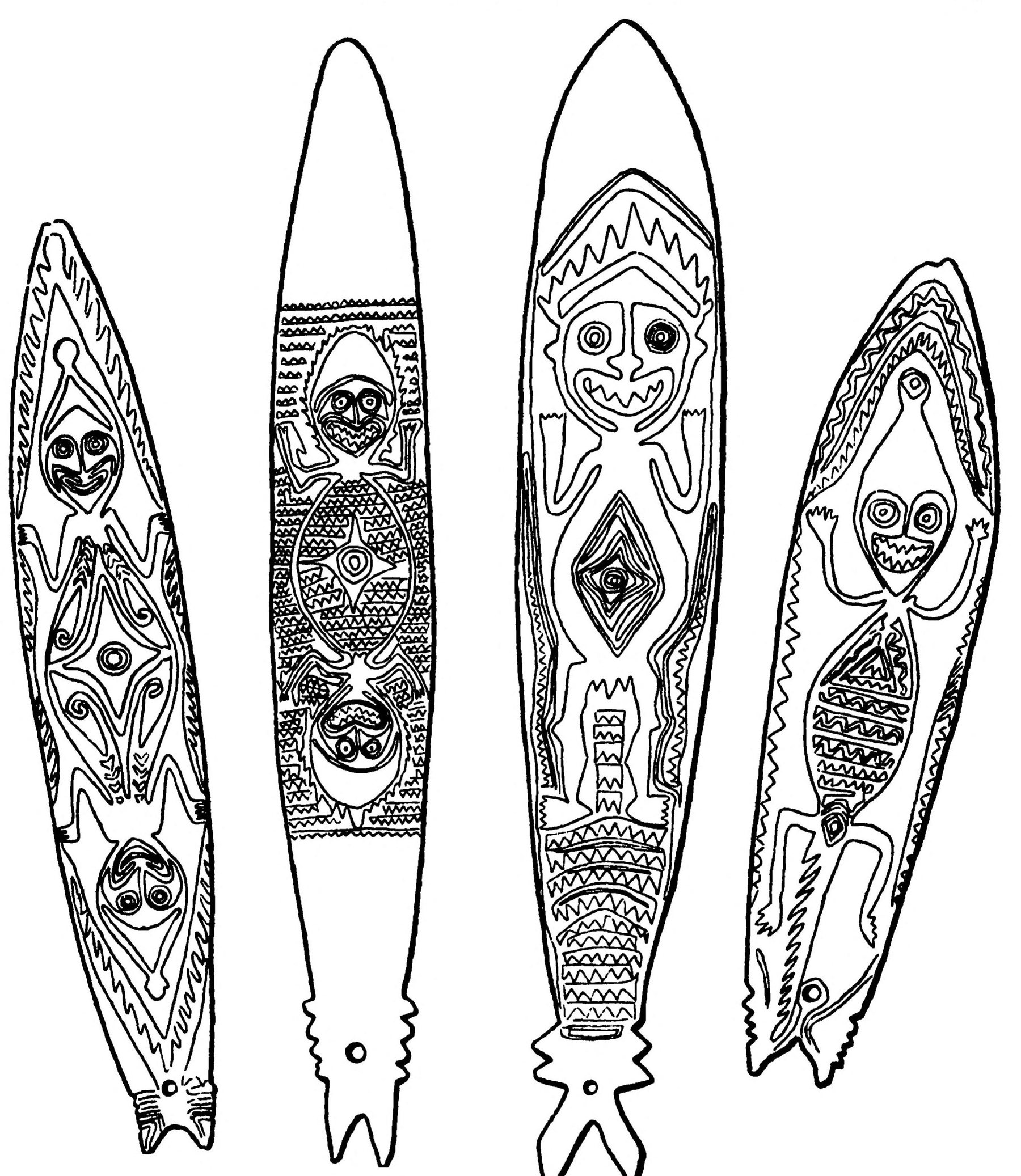
Bullroarers · Orokolo, traced from rubbings, longest 24¼ in.
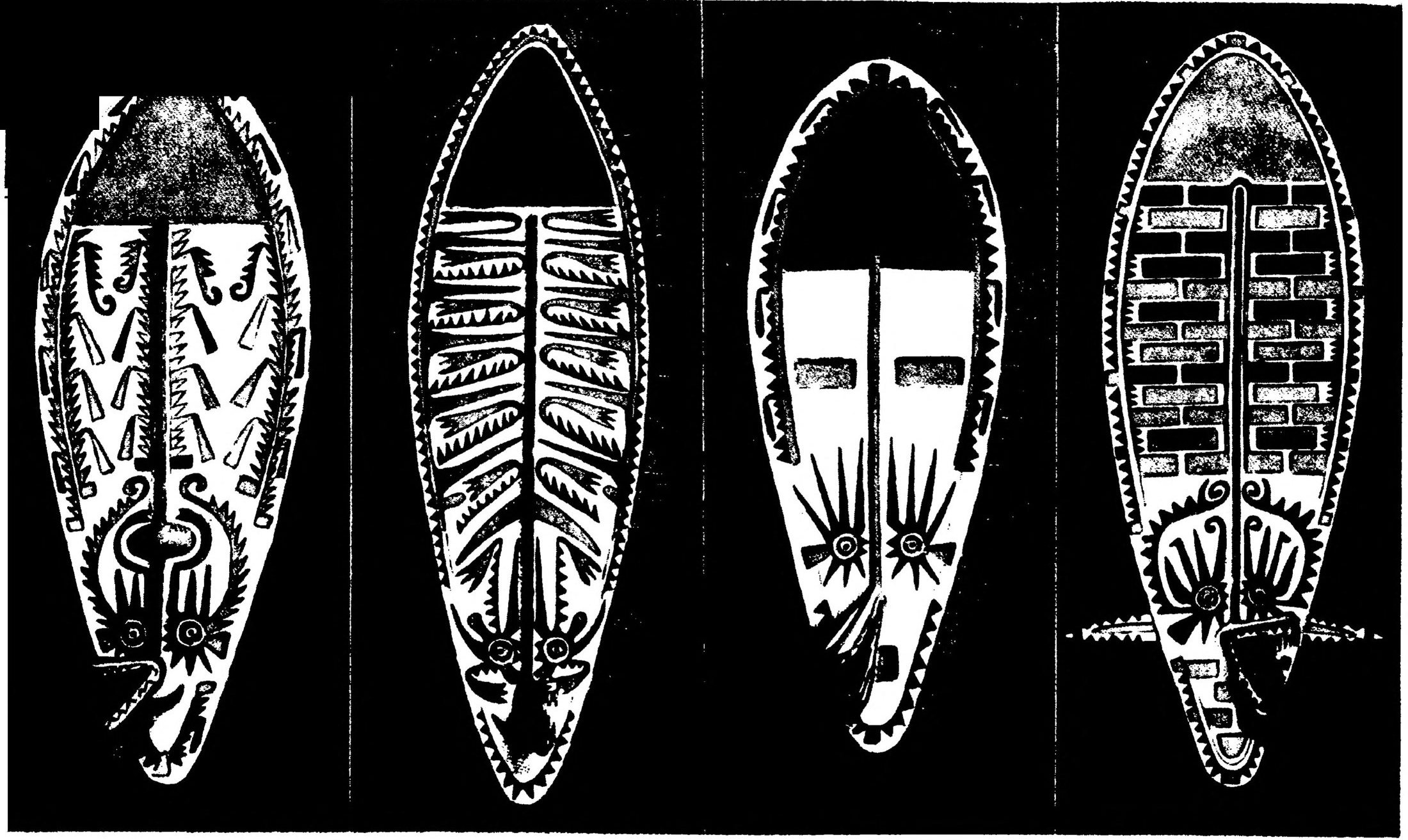
Hevehe masks · Purari, Vailala, Nabo and Kauri designs, fifteen feet and more
Williams added that no Orokolo man had ever pointed out the likeness to him. Haddon had already said why: no initiate would tell the uninstructed that the great object resembled the small one, since the small one was the secret. They told it in the language of family instead.
The elder brother
The Elema keep three secret cults, each with its own initiation: the Bull-Roarer, Kovave, and Hevehe, the greatest of them. They rank them as brothers:
“Further we may recall the fact that bull-roarer and hevehe are said to stand to one another in the relation of elder brother and younger brother (akoreapo and akoreheare).… Kovave, the third secret ceremony, is akore-heare hekai, the ‘little’ or youngest brother.”
F. E. Williams, Drama of Orokolo (1940), p. 206
The elder brother never leaves home. The bullroarer, Williams heard, is “karigara pupu, ‘a sacred thing of the village’, always at home; whereas the hevehe, however long they may stay, are merely visitors.” The masks are built, danced through a cycle that can run for years, and at its end slain and burned. The roarers in their bundle date “from the very foundation of things.”
The Elema story of the first people puts the roarer first. Williams took it down at Orokolo. Hare, the sky-man, made a man and a woman out of sand at Popo, behind Arihava, the next village to Orokolo, spoke to them, and they rose and mated. The woman’s first child was a bullroarer:
“It was a thing of mere bones, without flesh, and when it cried it made a noise like a bull-roarer, not like a baby.”
F. E. Williams, Bull-Roarers in the Papuan Gulf (1936), myth 1 (1977 reprint, p. 84)
Hare told the parents it was a hevehe, and that they must hide it and initiate their later children to it. The woman’s next child was a kovave mask, and the next an apa-hevehe, the great mask. Only after that did she bear a human child, and he was initiated to the three things born before him. The bullroarer is the firstborn of the first mother, and the masks come after it as its younger brothers.
Another Elema story makes the mother and the instrument one being. Uravu was an old woman who heard two branches of an oro tree rubbing together in the wind and poured out food at the foot of the tree, thinking it a spirit’s voice. “She herself,” Williams was told, “made the first bull-roarer under the inspiration of the noise; but she also is the bull-roarer, and the bull-roarer is Oro Uravu.”
The snake in the men’s house
The oldest meaning of hevehe is “snake.” Williams found it in the dialects of the central Elema tribes:
“…in the Berepa, Keuru, and Opau dialects the word ‘hevehe’ is the generic name for ‘snake’.… in the older cult itself the bull-roarer is most commonly represented to the uninitiated as a snake. They hear its extraordinary voice, are duly impressed (or pretend to be), and bring offerings of food to placate it.… It may take the imaginary forms of a variety of creatures; but predominant among them is that of the monstrous snake. It may thus come about that the word for snake is applied to the esoteric object which represents it. The bull-roarer becomes a hevehe; more specifically be’ure hevehe, the sort that dwells underground.”
F. E. Williams, Drama of Orokolo (1940), pp. 164–65
At Keuru, where the snake is called hevehe, the snake was the only explanation Williams was given: the women believed that the creatures they heard but never saw were snakes, and “that the men in the eravo make them howl by poking their tails with a stick.” At Orokolo the roarers were snakes or lizards “from obo, the great carpet snake, downwards,” and a great roarer could bear the name Obo. At Muru, inland of Arihava, the finest and oldest roarers Williams saw, two relics named Hevehe Pairapo and Kwaeva, had come from another men’s house, “moving crookedly along the ground, like snakes, and leaving in their track the bed of Kiravi Creek.”
The snake then grows. The underground snake becomes the monster under the water, the ma-hevehe of the sea and the great rivers, and the favoured Orokolo account of the masks is that they are the sea monster’s own children, come up out of the sea. “The hevehe masks are properly called apa-, or drum-, hevehe,” Williams wrote; “so they are thus the sea monster’s children carrying drums.” At every size the family is the same: a serpent’s voice whirled in the dark, a monster in the river, a fifteen-foot mask walking out of the sea.
The monster in the dark house
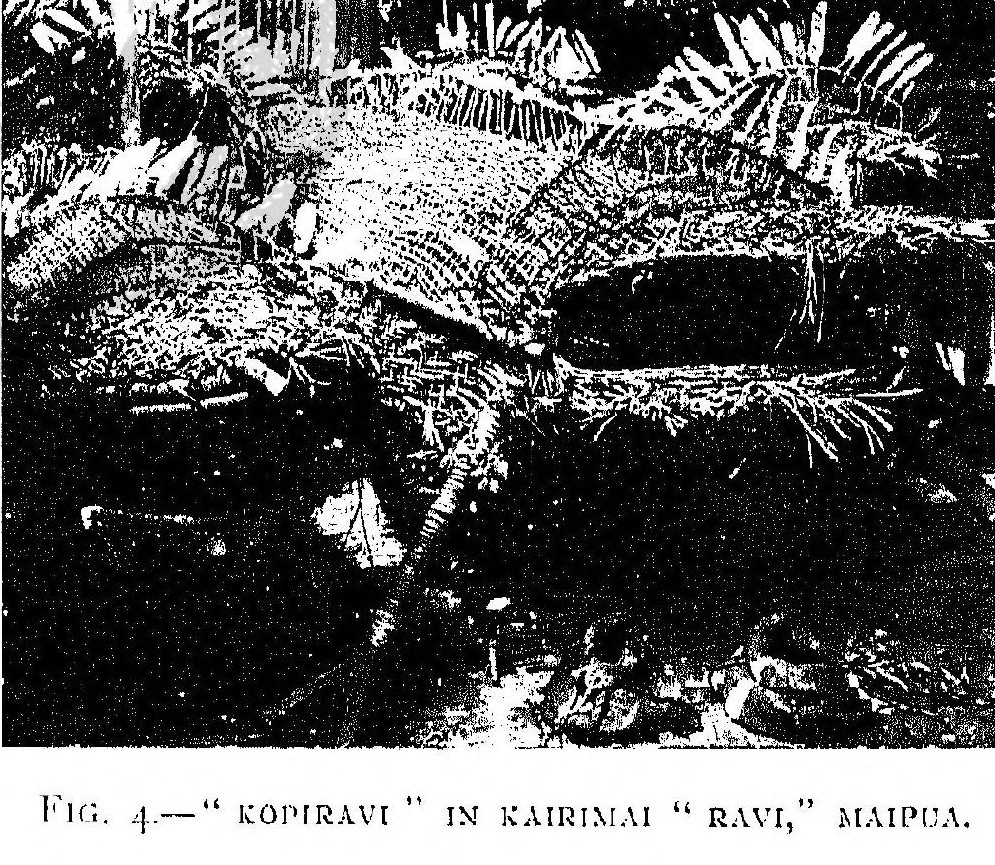
West of the Elema, in the Purari Delta, the family has a fourth member, and it is the largest of all. At the back of the great men’s houses, the ravi, stood the kaiaimunu: wicker monsters with open jaws, big enough to swallow the boys at their initiation. Haddon looked in on them at Maipua in 1914:
“On peering over the screen into the gloomy ‘holy of holies’ … a double row, up to ten or a dozen, of large, hollow, basketwork monsters (kopiravi), with wide gaping jaws and four wooden legs.… Bull-roarers are laid beneath some of them. Each kopiravi, or kai-ia-imunu (sky imunu) has its name.… no native woman is ever allowed to see them.”
A. C. Haddon, “The Kopiravi Cult of the Namau, Papua,” Man 19 (1919), no. 91, pp. 178–79
The bullroarers lay beneath the monsters and spoke for them. The roarers of the Purari were called imunu viki, “weeping imunu,” and the Swiss ethnographer Paul Wirz, working beside the Wapo, a river of the western Gulf, put it plainly in 1931:
“The agibe and kaiaimunu cult is the same as in the Wapo district, and the kaiaimunu are represented as bullroarers.”
Der agíbe- und kaiaimunu-Kult ist derselbe wie im Wapo-Gebiet und werden die kaiaimunu als Schwirrer dargestellt.
P. Wirz, report in the Abhandlungen und Berichte of the Dresden museums (1931)
Wirz followed the kaiaimunu across the Gulf, and in 1937 he reported that the one name could cover a wickerwork monster that swallows the novices, a bullroarer, a shield and a canoe. The monster, the roarer and the carved boards are one being at different sizes. The Koriki, the largest tribe of the Purari Delta, put the roarer at the foundation of the monster itself. Their bullroarers are called upura, and Williams recorded their account of how the first monster was made:
“The legend of its origin with the Koriki is that Iri and Kai, when they built the first kaiemunu as a house for themselves, made upura to act as floor-boards.”
F. E. Williams, The Natives of the Purari Delta (1924), p. 171
The first monster stood on bullroarers. The roarers were the ground it was built on and the voice it spoke with, and among the Namau they were its knives: Haddon was told that the bodies of victims thrust inside the monster overnight “were cut up with bull-roarers, cooked, and eaten.”
The same family in Mali
Halfway around the world, on the Bandiagara cliffs of Mali in West Africa, the mask society of the Dogon keeps the same family in its caves. The greatest of its objects is the Great Mask, imina na, a wooden serpent many times the height of a man, carved for the Sigui festival held once in sixty years and kept in the masks’ cave. The smallest is the bullroarer, and they share a name. Marcel Griaule wrote that the roarer takes on “the power of that object, whose voice it is considered to be and whose name it bears,” and he added:
“The same term, imina na, Great Mask, is used without distinction for the wooden serpent and for the bullroarer.”
Le même terme imina na, Grand Masque, est employé indifféremment pour désigner le serpent de bois et le rhombe.
M. Griaule, Masques dogons (1938), p. 254 and n. 2
Michel Leiris collected the roarers at Sanga, Touyogou and Yougo in 1931. There, he wrote, “they are called imina na, or ‘mother of the mask,’ a name they share, at Sanga and Touyogou, with the great ritual woods.” Among the Dogon “mother” means the great one: “one will say, for example, ‘mother of the snakes’ for a big snake.” The roarers are cut “like the masks, from kapok wood.” At the drinking in the masks’ cave, the chief of the masks pours millet beer “on the bullroarer first, then on the sirigè mask,” the plank mask that stands several metres over its dancer’s head. His informant Ambibè told him what the sirigè was to the roarer: it is “the little brother of the mother of the mask.”
Plate IV
Mother of the mask and her little brother
 1
1 2
2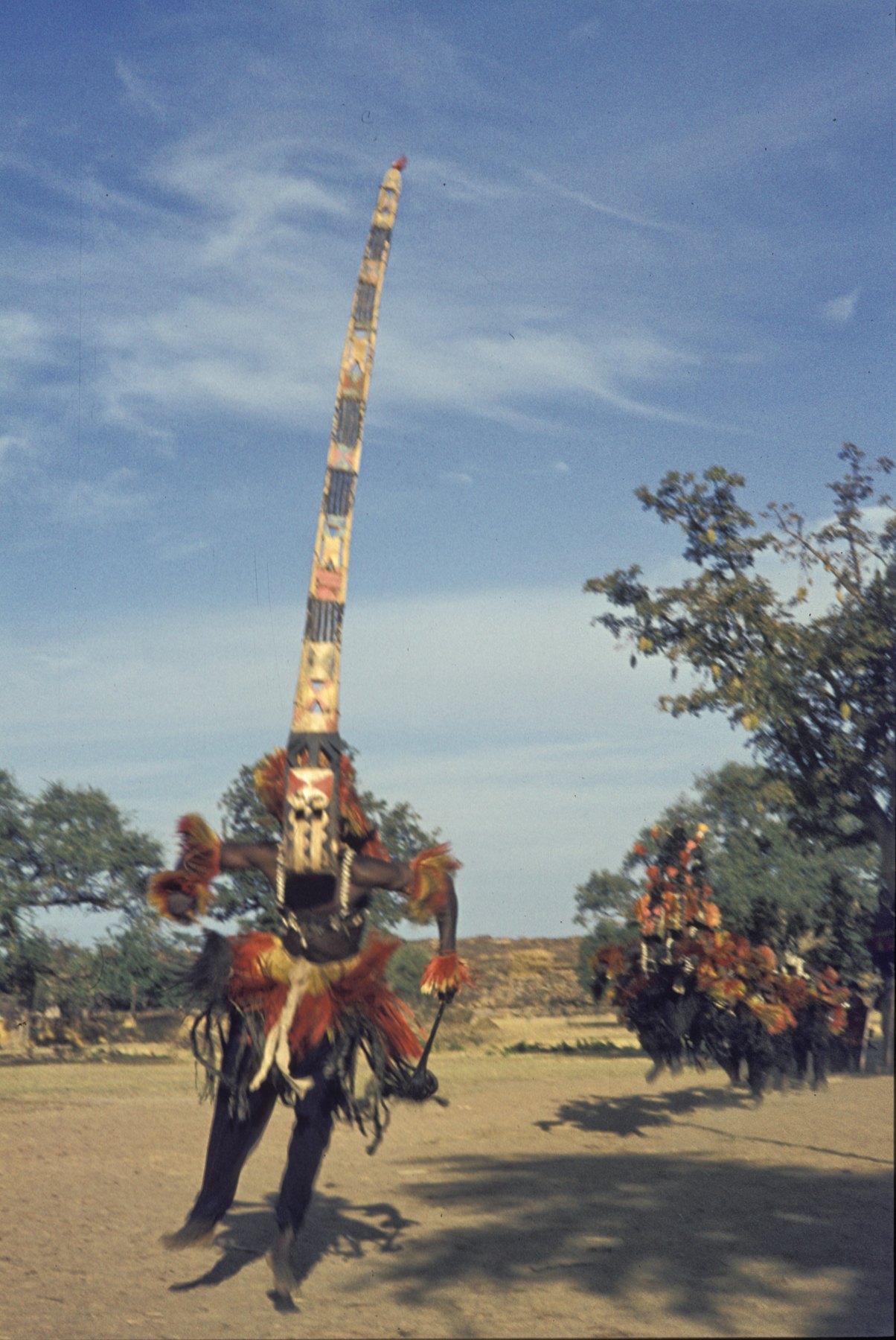 3
3The Dogon story of the masks’ beginning puts the two together from the start. In Griaule’s account the Andoumboulou, the small people who lived in the cliffs before the Dogon, left behind the wooden mask and an iron bullroarer, and a woman found them. The roarer still speaks for the mask on the night after a death: Leiris recorded that the great wood “that shares with the bullroarer the name ‘mother of the mask’” is carried to the dead man’s house, while the roarer is whirled outside the village. At Yougo the roarer made at the Sigui was consecrated on the altar of the Andoumboulou, kept in the house of the cave’s chief, and whirled at the death of a man old enough to have seen two Sigui.
On the Gulf of Papua and on the Bandiagara cliffs the family has the same members. There is a bullroarer that speaks in a serpent’s voice. There is a great serpent-being of wood or cane that bears the roarer’s name. There is a tall mask of the dance that is the roarer’s younger brother. In both places the roarer stands senior to all of them. The family it heads runs from one side of the world to the other.
The real original
The great masks and carved boards of the Papuan Gulf are bullroarers grown huge. The bullroarer is the real original. It is the small pointed oval with a face on it, kept in a bundle among the copra sacks of the men’s house. Cut from canoe-wood at four or five feet it becomes the hohao, hung with the same face in the men’s house. Built of cane at fifteen feet it becomes the hevehe, which walks out of the sea and dances on the beach. Woven of wicker large enough to hold a boy, it becomes the kaiaimunu, which swallows the novices and stands on bullroarers for a floor.
The men who keep these things say everything around it. They call all three hevehe, and the oldest meaning of that word is “snake.” They call the roarer the elder brother and the masks its younger brothers. They tell how the first woman bore a crying thing of bones before she bore the masks, and only then bore a human child. Williams’s rubbings, laid beside his mask designs, match them; Haddon saw every gradation between roarer and board, and the museums hold the series from end to end. Far away in Mali the same family stands in the masks’ cave, with the roarer as the mother and the plank mask as the little brother.
When the old man at Orokolo leaned back from his bundle and said hevehe, he was not changing the subject from the masks. He was showing their original.
Key sources
Williams, F. E. 1939. “The Kaiamunu-Ebiha-Gi Cult in Papua.” Man 39, no. 50, p. 48 — “the real original is the bull-roarer.”
Williams, F. E. 1940. Drama of Orokolo: The Social and Ceremonial Life of the Elema. Oxford: Clarendon Press — hohao, pp. 154–55 (kaiavuru = kaiaimunu, p. 155); the bundle of roarers, pp. 158–59 and fig. 7; “Hevehe and Bull-Roarer,” pp. 162–66 (the three hevehe, the snake, “dancing bull-roarers,” p. 166); elder and younger brother, karigara pupu, p. 206; Uravu, p. 203 n. 2; mask designs, plates XXVIII–XXIX; the Nabo hevehe, plate 51.
Williams, F. E. 1936. Bull-Roarers in the Papuan Gulf. Anthropology Report 17. Port Moresby: Government Printer; reprinted in E. Schwimmer (ed.), Francis Edgar Williams: “The Vailala Madness” and Other Essays (1977) — kaiavuru and kaiemunu, p. 78; roarers as snakes, the Keuru tails, the masks as “gigantic bull-roarers,” pp. 80–81; myth 1, the woman who bore a bullroarer, p. 84; obo the carpet snake, p. 97, and the roarer Obo, n. 28; the Muru relics and Kiravi Creek, p. 102 (reprint pagination).
Williams, F. E. 1924. The Natives of the Purari Delta. Anthropology Report 5. Port Moresby — the roarer’s carved face, p. 165; Iari roarers that “cannot roar,” p. 165; imunu viki, p. 166; the Koriki floorboards of upura, p. 171.
Haddon, A. C. 1894. The Decorative Art of British New Guinea. Cunningham Memoir 10. Dublin: Royal Irish Academy, pp. 102–04 and pl. VI — the Kerema board carved like a bullroarer.
Haddon, A. C. 1898. The Study of Man. London: Bliss, Sands — “The Bull-Roarer,” pp. 240–41 (ceremonial tablets and gope).
Haddon, A. C. 1919. “The Kopiravi Cult of the Namau, Papua.” Man 19, no. 91, pp. 178–79 and plate M — the monsters, the roarers beneath them, “every gradation.”
Wirz, P. 1931. Field report in Abhandlungen und Berichte der Museen für Tierkunde und Völkerkunde zu Dresden — “die kaiaimunu als Schwirrer dargestellt.” Wirz, P. 1937. “Kaiamunu-Ebiha-Gi-Cult in the Delta-Region and Western Division of Papua.” Journal of the Royal Anthropological Institute 67: 407–13.
Griaule, M. 1938. Masques dogons. Paris: Institut d’Ethnologie — the Andoumboulou find, pp. 59–60; the Great Mask and the Sigui; the roarer as the Great Mask’s voice and namesake, pp. 253–54 and nn.
Leiris, M. 1934. “Rhombes dogon et dogon pignari.” Bulletin du Musée d’Ethnographie du Trocadéro 7: 3–10 — “mother of the mask,” p. 3 and p. 9 n. 2; kapok wood and the libation, p. 5; the sirigè as “little brother,” p. 10 n. 13; the death night, p. 3 and p. 10 n. 17; the Yougo roarer, p. 6.
As far as we know, Plates II and III, which set the Gulf roarers beside the boards and Williams’s rubbings beside his mask designs, are original to this page.