Atlas Essay —
The Scholars Who Saw a God Become a Toy
Gato, Ethiopia · Arad and Esztelnek · Lisse · the Landes · the Indies and New Guinea · the Bibbulmun country of Western Australia
In the mid-1930s a German expedition crossed the highlands of southern Ethiopia and stopped among the Gato. Children there were swinging a flat board on a cord to scare birds off the fields. Elsewhere on the same journey, among the Darassa, the expedition found the same board kept as a cult instrument and hidden in fear from women. Their report set the two side by side: there a cult implement, “here a children’s toy.” The whole history of the bullroarer is in that contrast, and it was written down not by a theorist but by travellers standing in the field with the toy in front of them. They are not alone.
In brief
- The bullroarer’s descent from sacred instrument to child’s toy is not a theory laid over the evidence after the fact: the scholars who handled the toys said so themselves, in print, in six languages, of toys on four continents.
- In southern Ethiopia, Adolf Jensen’s expedition found the board a Darassa cult instrument and, among the Gato, a Gato children’s toy.
- Jaap Kunst wrote that across the Indies the bullroarer had “descended to the status of a children’s toy,” while in New Guinea it remained the voice of the spirits.
- Daisy Bates recorded that the most sacred objects of Central Australia were traded west to the Bibbulmun, “whose children whirled them in play.”
- In Europe the same descent was written down by an Italian historian of religion, two Hungarian ethnographers, a Dutch archaeologist, a French ethnomusicologist and the standard Greek lexicon.
The bullroarer’s descent from sacred instrument to child’s toy is not a theory laid over the evidence after the fact: the scholars who handled the toys said so themselves, in print, in six languages, of toys on four continents. Andrew Lang called the process “survival” in 1884, and the companion essay How a God Becomes a Toy traces its stages through Europe.
One word, two lives
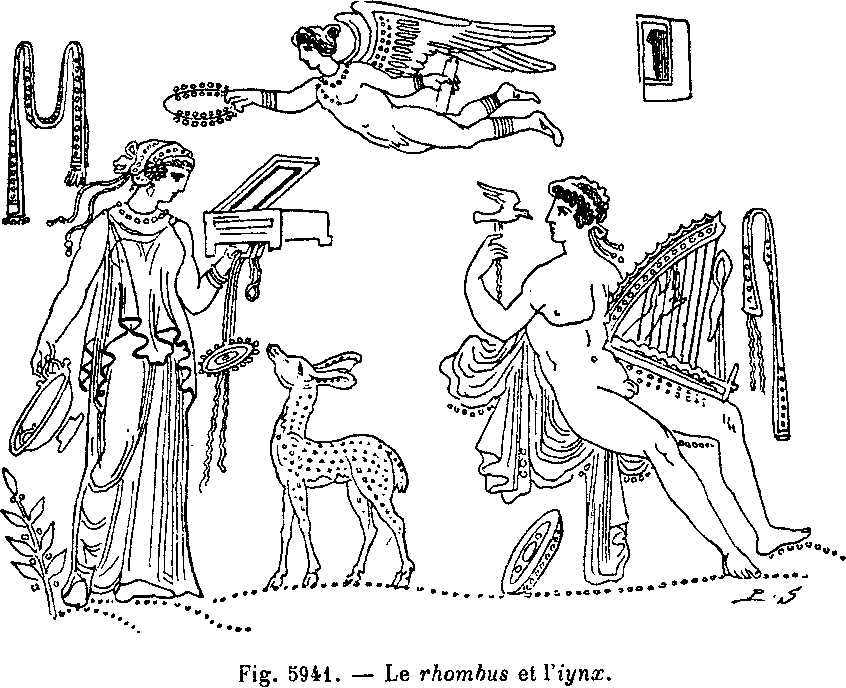
The standard dictionary of ancient Greek gives the whole story in a single entry. Under rhombos, Liddell, Scott and Jones define the “bull-roarer, instrument whirled round on the end of a string, used in the mysteries,” and then, a few citations on, “as a boy’s toy.” The god’s voice and the plaything share a headword because the Greeks used one word for both.
Raffaele Pettazzoni, the founder of the history of religions in Italy, wrote the entry “Rombo” for the Enciclopedia Italiana in 1936. He quoted Haddon’s judgement that the roarer was the most ancient, widespread and sacred religious instrument known, and then set out the fall as a law:
“From this original holiness and sacredness the bullroarer gradually declines until it becomes a magical instrument in the hands of some witch or sorcerer, or else a simple toy in the hands of boys. Traces of this process of decline are found in ancient Greece, and even in the world of the primitives itself.”
Da questa sua originaria santità e sacralità originaria il rombo scade gradualmente fino a diventare uno strumento magico in mano a qualche strega o stregone, oppure un semplice giocattolo in mano ai ragazzi.
— Raffaele Pettazzoni, “Rombo,” Enciclopedia Italiana (1936)
His first example was the Sicilian lapuni, “the big bee,” which Giuseppe Pitrè had described in 1883 as a boy’s plaything: a thin slat a third of a metre long, whirled on a string until it hummed. The same lapuni, at Mistretta, was still being sounded by adults in Holy Week in place of the silenced church bells.
The boys of Arad, the boys of Esztelnek
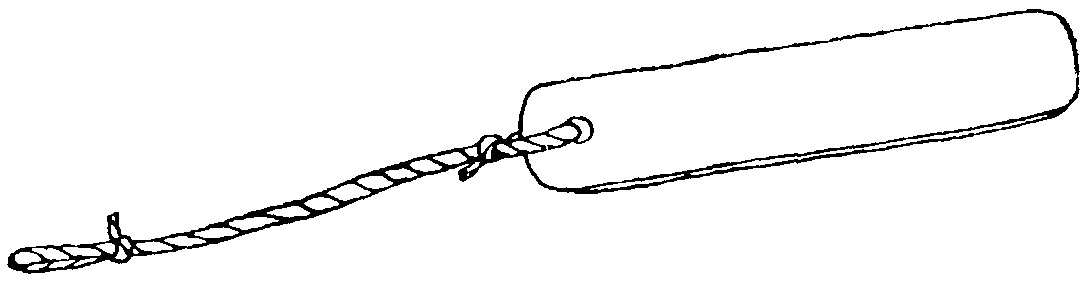
Vilmos Tolnai had swung one himself. In 1920 he remembered the early 1880s in Arad, then in Hungary and now in Romania, when ten or fifteen boys at a time would stand on the embankment of the Maros and tirelessly “drive” the zúgattyú, switching to the left arm when the right grew tired. He gathered its other names from across the country, from the Göcsej to the Bácska, and then he turned the toy around:
“Among the Australian and Polynesian peoples the zúgattyú is not a children’s game but a signalling tool, used partly at worship and partly in war; I have seen many fine specimens of it in the ethnographic collections of Paris and Leipzig.”
— Vilmos Tolnai, “Zúgattyú,” Ethnographia 31 (1920), p. 114
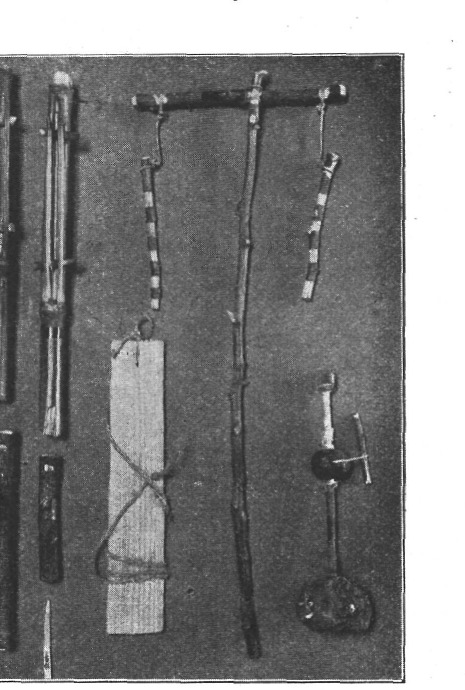
Sixty years later Klára Gazda said it outright. In Esztelnek, a Székely village in the Carpathians of eastern Transylvania, older boys carved the surrogtató with a pocketknife for their younger brothers and sisters, and smeared it with mud to make it roar louder. In her notes she wrote what the boys were holding:
“This plaything, widespread in other civilised countries too, is in truth a very ancient noise-making instrument, which natural peoples use as a signalling tool at their initiation ceremonies and on occasions of war.”
— Gazda Klára, Gyermekvilág Esztelneken (1980), note 84 to item 392
The ivory blades of Holland
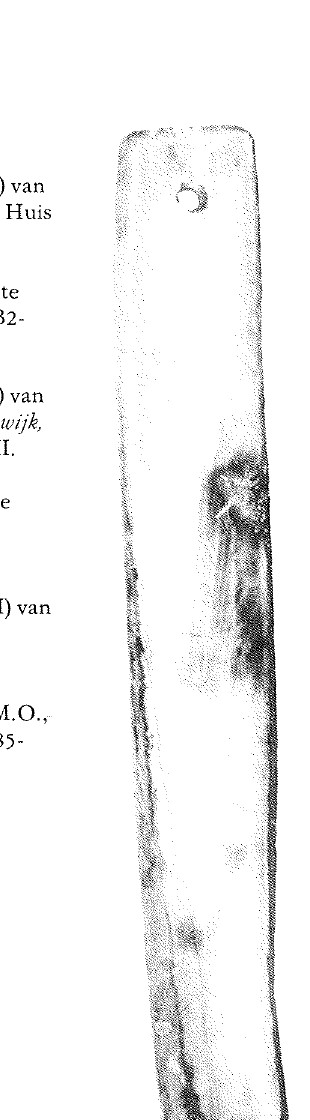
The Dutch dig up their bullroarers. Bone and ivory snorrebotten, “whirring bones,” turn up in medieval and early modern town sites across the Low Countries. When V. T. van Vilsteren catalogued them in 1987, among the ivory blades from Lisse and Beverwijk, he opened the entry with their origin:
“The snorrebotten probably began as ritual objects, but among us they have degenerated into children’s toys… Both types also occur among many natural peoples, and their sound imitates, so the interpretation runs, the voice of the wind.”
Waarschijnlijk ontstaan als rituele objecten, maar bij ons verworden tot kinderspeelgoed zijn de snorrebotten.
— V. T. van Vilsteren, Het Benen Tijdperk (1987), p. 52
Verworden is a strong word. It means to decay, to go to the bad. An archaeologist writing a museum catalogue of bone tools reached for it because the fall was the most obvious thing about the object in front of him.
Sacred here, a toy over there
The sharpest witnesses stood on a frontier, with the sacred instrument on one side and the toy on the other. The Ethiopian report from the opening is one. In full:
“The bullroarer, among the Darassa still a cult implement and anxiously hidden from women, is here a children’s toy that serves to drive the birds from the fields.”
Das Schwirrholz, bei den Darassa noch ein kultisches Werkzeug und vor den Frauen ängstlich verborgen, ist hier ein Kinderspielzeug, das dazu dient, die Vögel von den Feldern zu vertreiben.
— A. E. Jensen, Im Lande des Gada (1936), p. 178
The word that carries the argument is noch, “still.” Among the Darassa the board is still sacred; among the Gato it has already fallen. On the same page the expedition found the Gato’s old age-grade government, the gada, gone: an old man said it had last been kept before his grandfather’s time, and that he had heard of it as a boy. The toy and the lost institution were noticed together. Otto Zerries, gathering the expedition’s reports on the Konso peoples of Gato and Gidole, summed them up: the roarer’s “cult significance has been lost here.”
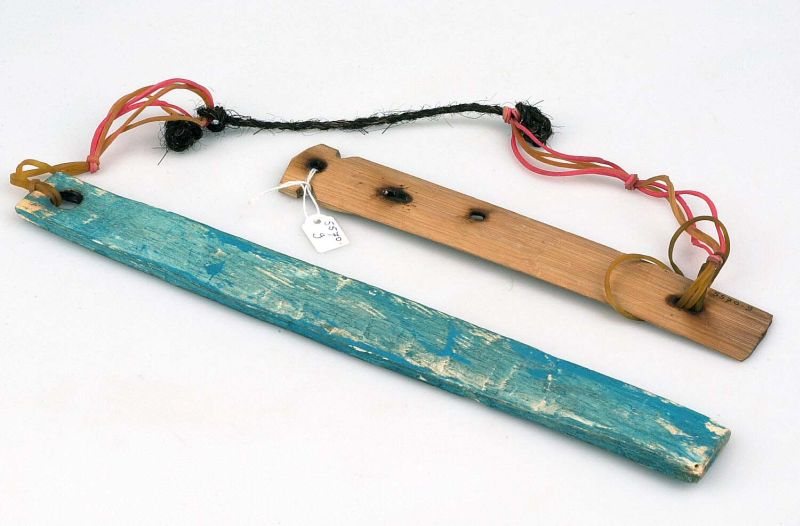
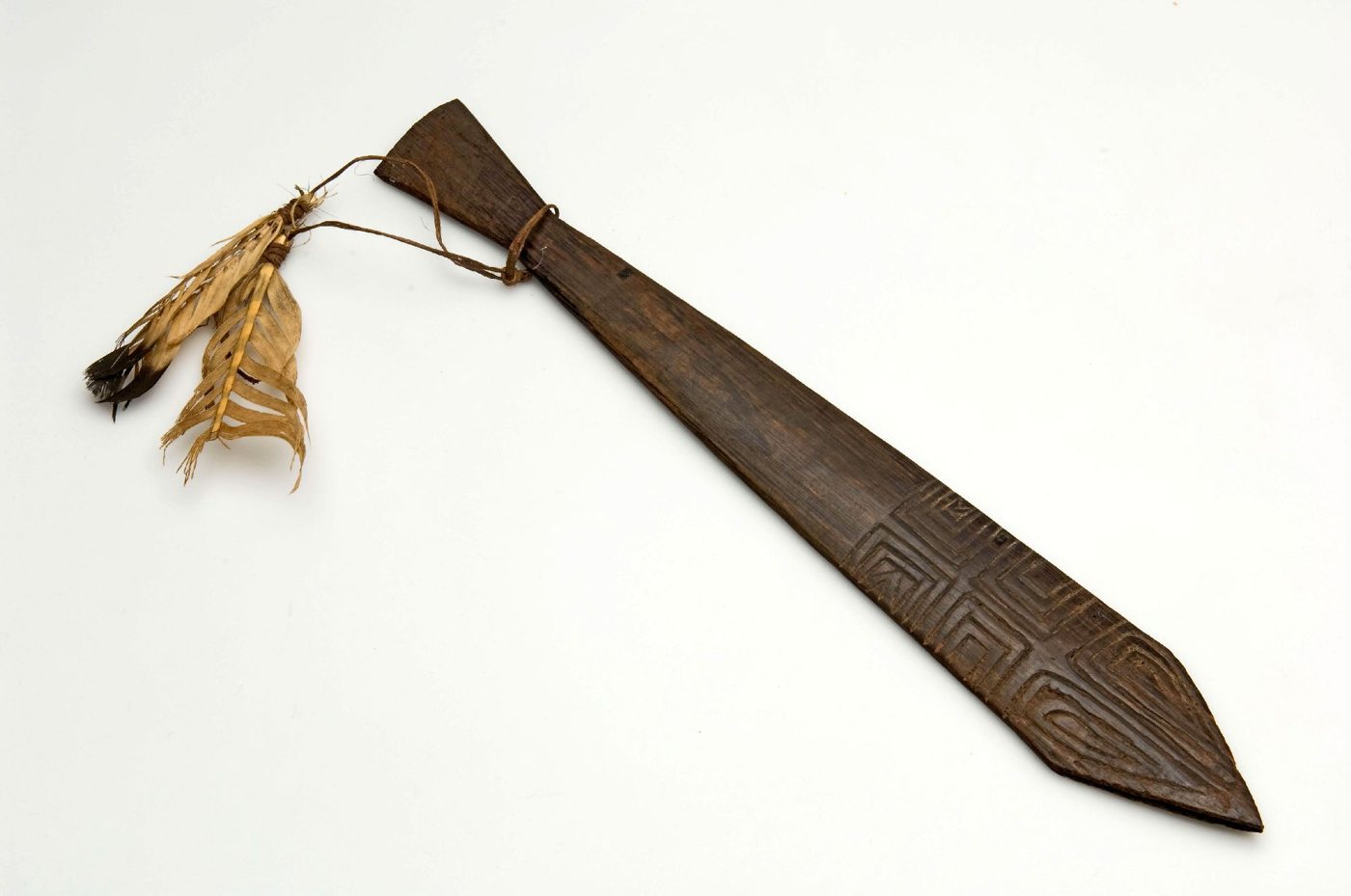
Jaap Kunst, the Dutch scholar who gave ethnomusicology its name, drew the same frontier across an ocean. Writing in 1950 on the music of western New Guinea, he began his entry on the bullroarer with it:
“While in the Indian archipelago the bullroarer, almost everywhere it still occurs, has descended to the status of a children’s toy, in New Guinea it has still kept its old magical function as the voice of the spirits entirely intact.”
Terwijl in de Indische archipel het snorrebot vrijwel overal, waar het nog voorkomt, is afgedaald tot de status van kinderspeeltuig, heeft het in Nieuw-Guinea nog zijn oude magische functie van geestenstem volledig behouden.
— Jaap Kunst, De inheemse muziek in Westelijk Nieuw-Guinea (1950), § XXIV
His New Guinea example was the Marind-anim of the south coast, whose roarer, carved in the shape of a fish, was the voice of the giant Sosom at the Sosom feast. For the Indies he pointed to his own book on Flores, where he had recorded the bamboo roarer as a boys’ instrument. He also wrote down the two exceptions he knew, the Minangkabau of Sumatra and some Dayak peoples of Borneo, where the roarer kept something of its power. The exceptions are the point: the toy is what the instrument becomes once its rite is gone.
Down the trade road
Daisy Bates watched the fall happen in transit. Describing the great exchange routes that crossed Aboriginal Australia, carrying pearl shell, ochre, spears and shields hundreds of miles from where they were made, she added a footnote:
“Bull-roarers, the most sacred Central Australian objects, were bought by the Bibbulmun, whose children whirled them in play.”
— Daisy Bates, The Passing of the Aborigines (1938), ch. 11, “With the Desert Tribes”
The Bibbulmun are the Noongar people of the south-west corner of Western Australia, some two thousand kilometres from the Arrernte ceremonial grounds where such boards were hidden from women and shown only to initiates. The object did not change on the way. Its setting did. Once it had left the country of the ceremony that made it sacred, it arrived among the Bibbulmun as a bought thing, and the children took it. Jesse Hammond, who knew the south-west from a working life there, drew the local woondah in 1933 among the ordinary tools, with a plain caption: swung on a string to make a buzzing noise.

Under the working use
Sometimes the sacred function sank into work instead of play, and a witness saw it there too. In June 1965, at Commensacq in the pine forests of the Landes in south-western France, the resin-tapper Léonce Mano carved a burrumbe for two ethnomusicologists from Paris and told them what it had been for: driving wild boar out of the maize, a use that lasted until 1939. Marie-Barbara Le Gonidec, writing about the survey, said what lay beneath the work:
“In Europe this is not explicit, and its first function, the magico-religious one, hides beneath a use described as purely practical: here it would put the boar or the wolf to flight… Whatever the case, the idea is always the same: to hold an ‘evil’ at bay with a frightening sound.”
— Marie-Barbara Le Gonidec, “Le rhombe,” Les Réveillées (EHESS)
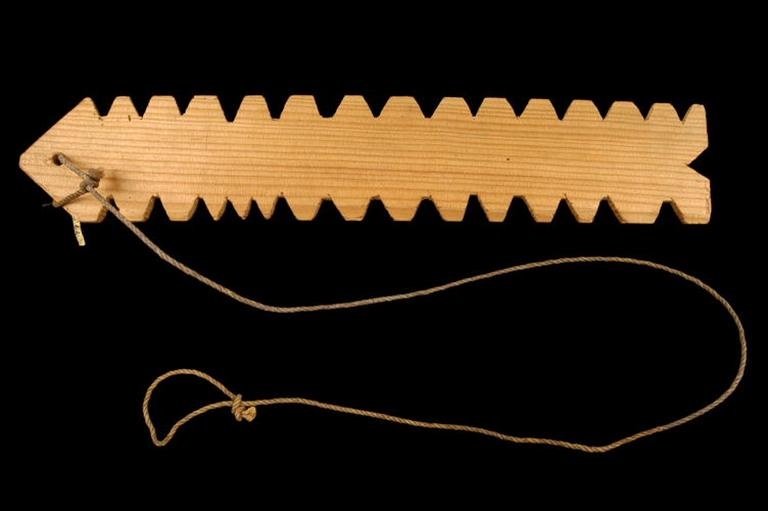
One witness made the argument with a single noun. By the time Sibyl Marcuse compiled her dictionary of musical instruments in 1964, the Polish whip-roarer, the kind herd-boys swung in Galicia and children in West Prussia, was filed under czurynga, the Polish spelling of the Arrernte tjurunga, the name of the most sacred objects in Central Australia. Her entry reads: “bull-roarer of Poland, now a child’s toy, made of a narrow board fastened to the lash of a whip and whirled.” The dictionary gave the Polish toy the name of the Australian sacred object, and the word now.
The witnesses agree
The field witnesses were not defending a theory. Tolnai was remembering his boyhood. Gazda was cataloguing a village’s toys. Van Vilsteren was describing bone tools for a museum. Jensen’s expedition was writing up a journey, Kunst was surveying the music of a colony, and Bates was explaining a trade route in a footnote. Each one held the toy, knew the sacred instrument, and wrote that the second had become the first. They worked in Italian, Hungarian, Dutch, German, French and English, about toys in Europe, Africa, Asia and Australia, and they said the same thing.
That is the strongest evidence a thesis can have. The bullroarer’s descent from sacred instrument to child’s toy is not a theory laid over the evidence after the fact: the scholars who handled the toys said so themselves, in print, in six languages, of toys on four continents. Lang called it survival. Pettazzoni called it decline. Van Vilsteren called it decay. Kunst said the roarer had descended, and the Ethiopian expedition put it in one word, still. Wherever the rite died, the board stayed, and the children picked it up. The full European sequence, from the Greek mysteries to the fen boy’s toy, is traced in How a God Becomes a Toy.
Key sources
- Bates, D. 1938. The Passing of the Aborigines. London: John Murray. Ch. 11, “With the Desert Tribes,” footnote on the continental trade route (the Bibbulmun buying Central Australian bullroarers for their children).
- Gazda Klára. 1980. Gyermekvilág Esztelneken. Bucharest: Kriterion. Item 392 and fig. 57, p. 237; note 84 to item 392 (the toy as “a very ancient noise-making instrument”).
- Jensen, A. E. 1936. Im Lande des Gada: Wanderungen zwischen Volkstrümmern Südabessiniens. Stuttgart: Strecker und Schröder. P. 178 (the bullroarer a Darassa cult implement and a Gato children’s toy).
- Kunst, J. 1950. De inheemse muziek in Westelijk Nieuw-Guinea. Amsterdam: Indisch Instituut. § XXIV with nn. 201–202 (the Indies toy against the New Guinea spirit-voice; the Minangkabau and Dayak exceptions).
- Le Gonidec, M.-B. “Le rhombe.” Les Réveillées, EHESS (the magico-religious function hidden beneath the Landes rhombe’s practical use; Léonce Mano at Commensacq, 1965).
- Liddell, H. G., R. Scott and H. S. Jones. A Greek–English Lexicon, s.v. ρόμβος (“used in the mysteries”; “as a boy’s toy”).
- Marcuse, S. 1964. Musical Instruments: A Comprehensive Dictionary. New York: Doubleday. S.v. czurynga.
- Pettazzoni, R. 1936. “Rombo.” Enciclopedia Italiana. Rome: Istituto della Enciclopedia Italiana (the decline from sacred instrument to magical tool or “semplice giocattolo”; Pitrè’s Sicilian lapuni).
- Tolnai Vilmos. 1920. “Zúgattyú.” Ethnographia 31: 113–114 (Arad in the 1880s; “not a children’s game but a signalling tool” among Australian and Polynesian peoples).
- Van Vilsteren, V. T. 1987. Het Benen Tijdperk: Gebruiksvoorwerpen van been, gewei, hoorn en ivoor 10.000 jaar geleden tot heden. P. 52, cats. 83–85 (“probably began as ritual objects”).
- Zerries, O. 1942. Das Schwirrholz. Stuttgart: Strecker und Schröder. P. 31 (the Konso roarer’s lost cult significance).