No. BONANZINGA2013-001
Mistretta Sicily lapuni Holy Week bullroarer
Italy · Sicily · Messina Province · Europe · Mediterranean
Sacred / spirit
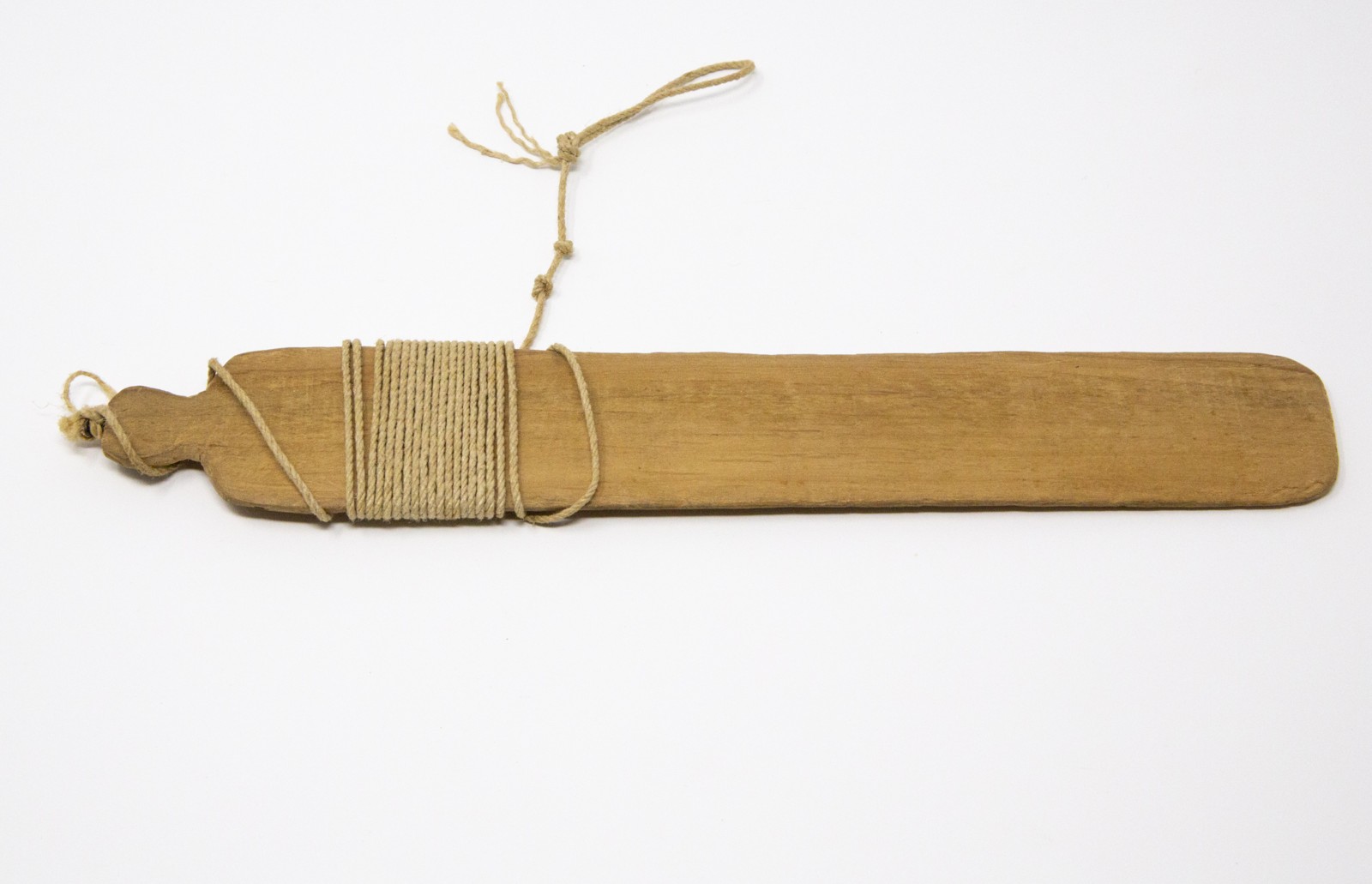
lapuni
Source term: rombo / lapuni
lapuni (Sicilian; Italian apone, 'big bee'): the bullroarer, named for its imitation of the male bee's hum
When Mistretta’s church bells fell silent for Holy Week, adults took up the lapuni: rectangular wooden slats whirled on long cords, their drone compared in Sicily to the hum of a male bee. In neighboring San Fratello, the same lapuni took a different shape: small triangular wooden slats rather than Mistretta’s rectangular blades.
il lapuni venga adoperato anche dagli adulti, durante le cerimonie della Settimana Santa, quando le campane sono legate
the lapuni is used also by adults during Holy Week ceremonies, when the bells are tied
Cocchiara 1938, pp. 127-128, quoted in Bonanzinga 2013
Particulars
- Object
- Wooden lapuni: rectangular at Mistretta and triangular in specimens from neighboring San Fratello. Pitrè describes the broader Sicilian form as about 15 × 6–7 cm, with an approximately 80 cm cord fixed to one end and rapidly whirled by hand.
- Function
- At Mistretta, adults sounded the lapuni during Holy Week when the church bells were tied; no particular use was recorded for the San Fratello specimens.
Sources
- Sergio Bonanzinga, in Giovanni Paolo Di Stefano, Selima Giorgia Giuliano and Sandra Proto (eds.), Strumenti musicali in Sicilia (2013), p. 64
- Giuseppe Cocchiara (1938), pp. 127-128, quoted in Bonanzinga (2013), p. 64
- Giuseppe Pitrè, La famiglia, la casa e la vita del popolo siciliano (1913), pp. 431-432 View
- Giuseppe Pitrè (1883), p. 415, cited in the Bonanzinga/Cocchiara source chain