No. HAD1898-003
Galicia San River bzik bullroarer
Poland · Ukraine · Galicia · San River · Eastern Europe
Play / practical
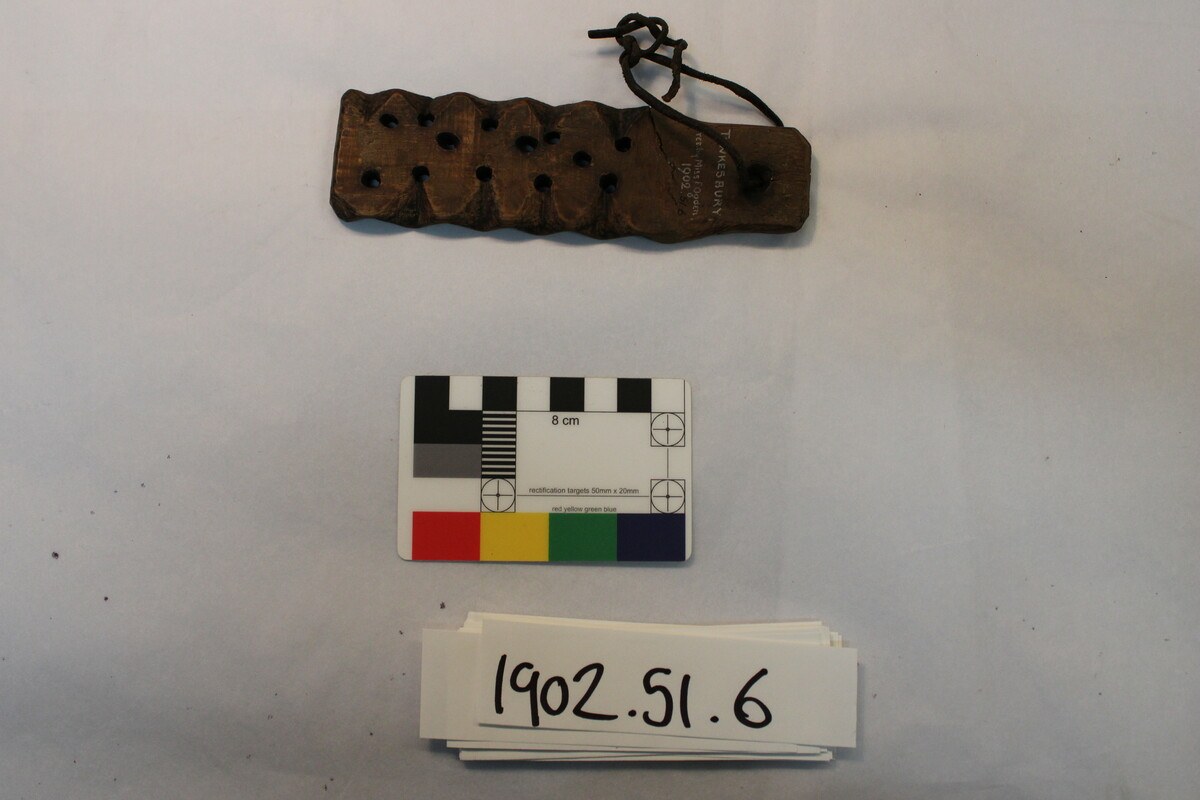
czurynga
Source term: bzik / bull-roarer
bzik (Polish/Galician): the buzzing tuning effect of the whirled wood; idiomatically, a screw loose. Schwirrholz (German): whirled-wood, i.e. bull-roarer.
Along Galicia's San River, herd-boys tied a notched wooden slip to a whip and swung it as the cattle came home. The rising bzik dropped into a low organ note; calves kicked and danced before the whole herd bolted for the village. A man acting foolishly was said to 'have a bzik' — and Figura, whose boyhood memory this was, claimed the French card game bezique took its name from the bull-roarer, by way of a Polish soldiers' game called bzik.
As soon as the bull-roarers are started the calves stretch out their tails into the air, and kick out their hind legs, sometimes to the right, sometimes to the left, as if they were dancing. After some minutes the old cattle follow the young ones, and there is a general stampede to the village. Therefore one says in Galicia that a man whose brain is not quite right has a 'bzik!'
F. Figura, "Das Schwirrholz in Galizien," Globus 1896, p. 226, quoted in Haddon, The Study of Man (1898), p. 287
Particulars
- Object
- Elongated ruler-like wooden slat, notched on both narrow edges near one end, fixed to a whip by a simple loop and swung in a circle. In Poland such whip-mounted boards measure 15-60 cm (6-24 in.).
- Function
- Herd-boys use a whip-mounted bullroarer to excite or drive cattle.
Sources
- Franz Figura, “Das Schwirrholz in Galizien,” Globus 70 (1896), p. 226 View
- Sibyl Marcuse, Musical Instruments: A Comprehensive Dictionary (1964), s.v. czurynga
- A. C. Haddon, The Study of Man (1898), p. 287