No. GONCZI1914-001
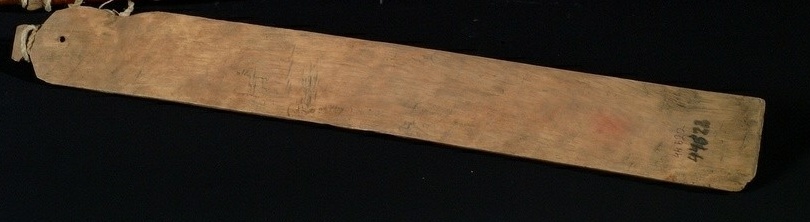
Kissziget (Göcsej) whip-mounted zúgattyú
Hungary · Zala county (Goecsej region) · Central Europe
Play / practical
búgató / büngik (Gönczi); zúgattyú (museum term)
Source term: búgató
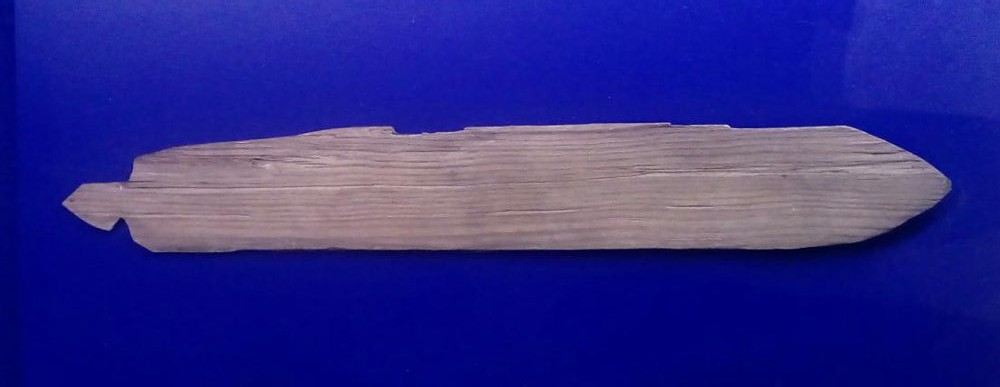
búgató (Göcsej Hungarian; dialect büngik) - a whirled bull-roarer toy: a ruler-like board pierced or notched at one end, swung in a circle on a strong cord, sometimes from a whip handle. Museum standard term: zúgattyú.
Children in Göcsej sent the búgató humming in circles: a flat, ruler-like board on hemp cord, sometimes held directly and sometimes driven from a stick like a whip. The Kissziget example preserves the more spectacular rig—a forty-centimetre hardwood blade flying from a half-metre handle.
A bugatuk vagy büngik... kisebb-nagyobb vonalzó-szerű deszkácskák. Ezeknek egyik végét kilyukasztják... és ennek végét megfogva, a deszkát köralakban csóválják, mely a gyors mozgás következtében zúg-búg. Némelyik búgatónak a madzagját nyélre kötik s ezzel a nyéllel hajtják.
The bugatuk, or büngik, are smaller or larger ruler-like little boards. One end is pierced... and holding the cord's free end, the board is whirled in a circle, which hums and roars from the rapid motion. On some, the cord is tied to a handle, and it is driven with this handle.
Gönczi Ferencz, Göcsej (Kaposvár, 1914), p. 546.
Particulars
- Object
- Ruler-like hardwood blade, 40.5 × 4.9 × 0.4 cm, with a carved neck holding 23 cm of hemp cord tied to a 49 cm whip-stick handle; NM 44622.
- Function
- Children’s toy, driven in circles from a whip handle until it hummed and roared.
Source
Gönczi Ferencz, Göcsej s kapcsolatosan Hetes vidékének és népének összevontabb ismertetése (Kaposvár, 1914), p. 546; Néprajzi Múzeum (Museum of Ethnography), Budapest, inv. NM 44622