No. HAD1898-004
West Prussia Marienwerder Schwirrholz
Poland · West Prussia · Central Europe
Play / practical
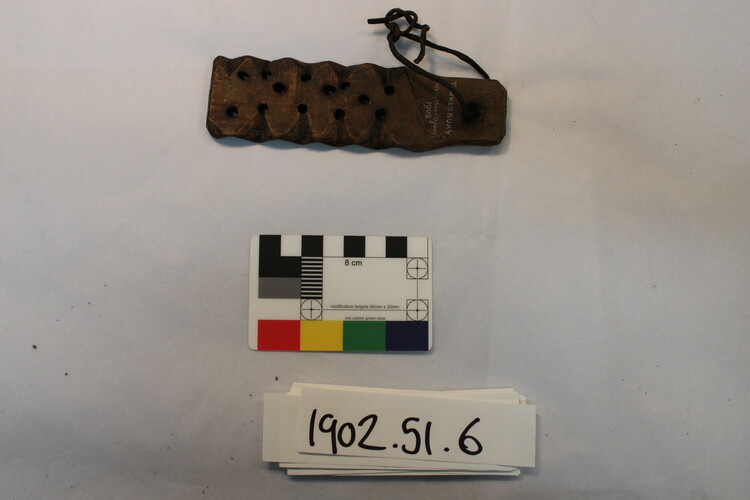
czurynga
Source term: Schwirrholz
Schwirrholz = German for bull-roarer (literally "whirring wood"); burren = the local West Prussian verb for the whirring of the whip-mounted toy.
At Gut Neudörfchen in the early 1860s, children made a light wooden Schwirrholz a handspan long and fixed it to a whip; cutting, balancing, and swinging it took real skill, and not every boy could raise the same voice from the toy. Around 1870 the district's Germans emigrated to America and Poles took their place — leaving Haddon to wonder whether the whirring toy went with the emigrants or passed to the newcomers' children.
In West Prussia, near Marienwerder, the true bull-roarer (Schwirrholz) has been noted by Siedel [sic]. A narrow piece of light wood, a span in length, was fastened to a whip, the whirling of the whips was called burren, and not every boy could do this equally well; the success depended also partly on the length and weight of the bull-roarer as well as on the nature of the whip.
Haddon 1898, The Study of Man, pp. 285-286, citing H. Seidel, 'Das Schwirrholz in Westpreussen,' Globus 70 (1896), pp. 67–68
Particulars
- Object
- Handspan-long narrow board of light wood, carefully cut and fixed to a whip.
- Function
- Children's game requiring a well-balanced board, suitable whip, and practiced circular swing.
Sources
- H. Seidel, “Das Schwirrholz in Westpreussen,” Globus 70 (1896), pp. 67–68 View
- A. C. Haddon, The Study of Man (1898), pp. 285–286, citing Seidel (1896)