No. HAJNAL1906-001
Torzsa (Savino Selo) zúgó / Windbrummer
Serbia · Bácska (Bács-Bodrog county), Kingdom of Hungary · Central Europe
Play / practical
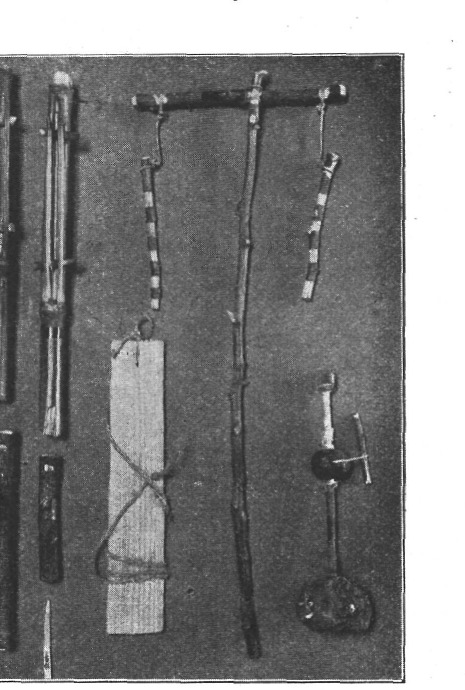
zúgó (Hajnal's Hungarian caption); Windbrummer (local Danube Swabian/German term, per Tolnai 1920:114)
Source term: zúgó (Windbrummer)
zúgó: Hungarian, 'the humming/droning one,' from zúg 'to hum, drone, roar'; Windbrummer: German/Danube-Swabian dialect, 'wind-hummer' — the term Tolnai 1920 records as used locally in Torzsa itself.
A pine slat about as long as a walking cane, pierced at one end and strung on a cord: whirled overhead, it slices the air with a sound like rushing wind. Torzsa's German-speaking children, out on the flat farmland of the Bácska, built their own zúgó — Windbrummer, in their local dialect — alongside handmade whistles, a corn-stalk fiddle bowed with spit-dampened bark strings, and a potato-weighted spinning top.
A mellette látható zúgó (Windbrummer) egy darab 75—80 cm. hosszú 6—7 cm. széles fenyőfaszilánk, melynek egyik végén lyukat fúrnak, spárgát kötnek rá és forgatva hasítják a levegőt, mire az úgy zúg, mint a szél.
Next to it can be seen the zúgó (Windbrummer): a piece of pine-wood chip 75-80 cm long and 6-7 cm wide, in one end of which a hole is bored, a cord tied on, and by swinging it they cleave the air, whereupon it hums like the wind.
Hajnal Ignácz, 'Bácskai gyermekjátékok,' Néprajzi Értesítő 7 (1906), p. 59, Fig. 3.
Particulars
- Object
- A pine-wood slat about 75-80 cm long and 6-7 cm wide, pierced with a hole at one end and fitted with a cord.
- Function
- Whirled overhead by the cord through its pierced end so the board spins on its long axis and 'cleaves the air,' humming like the wind; one of a set of homemade noisemaking toys the German-speaking children of Torzsa built for themselves.
Source
Hajnal Ignácz, 'Bácskai gyermekjátékok,' Néprajzi Értesítő 7 (1906), p. 59, fig. 3; Tolnai Vilmos, 'Zúgattyú,' Ethnographia 31 (1920), p. 114