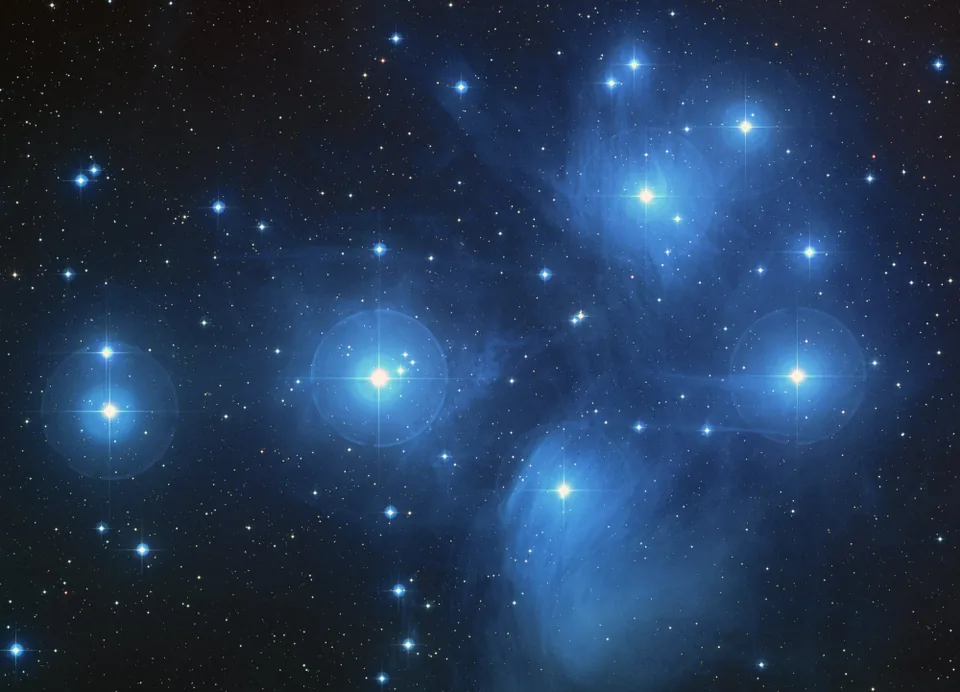
The Seven Sisters and the First Mystery · VI of VII
When the Stars Open the Lodge
Walpi, Arizona · Northwest Amazonia
Southern Africa · Central Mexico
Four boys climb out of a kiva into the November cold. They wear horned helmets. Bells announce their passage through the sleeping pueblo. Inside the kiva they have left, the Pleiades and Orion set the hour for the night’s rites. New fire, novices, and serpent emblems belong to one ceremony.
The Pleiades belong to the initiation complex: across continents, their movements govern the remaking of people and the renewal of the world.
In brief
- At Walpi in 1898, novices patrolled the mesa by night, fire was drilled to song, and the Agave society timed its night rites by the Pleiades and Orion. In the same kiva men sang with bells while holding wooden serpents, and in a separate Winter Flute rite in 1900 a priest twirled the bull-roarer before the chiefs’ badges and on the kiva roof.
- In northwest Amazonia, the Barasana hold their great initiation when the Pleiades stand low in the west at dusk. At midnight the novices eat coca from a beeswax gourd that stands for the Pleiades and Woman Shaman, while men play the Jurupari flutes.
- Among the Xhosa the Pleiades are isiLimela. Their June return brings the initiates out of the circumcision school, and a man counts his years of manhood by them afterwards.
- For the Mexica, the Pleiades crossing the midnight sky authorize another fifty-two years. A flame kindled on a captive’s chest passes to the temples and then to every household.
01 · The Hopi kiva
Boys, bells, and the November stars
Walpi stands on a narrow mesa in northeastern Arizona. In November 1898, J. Walter Fewkes watched its New Fire ceremony, Wuwuchim. Four ritual societies occupied four kivas, the ceremonial rooms entered through their roofs. One room held the fire-drilling. Another, Tcivato-kiva, housed the Kwakwantu, or Agave society. Its chief personated the Fire God. Its younger members were learning what it meant to belong.
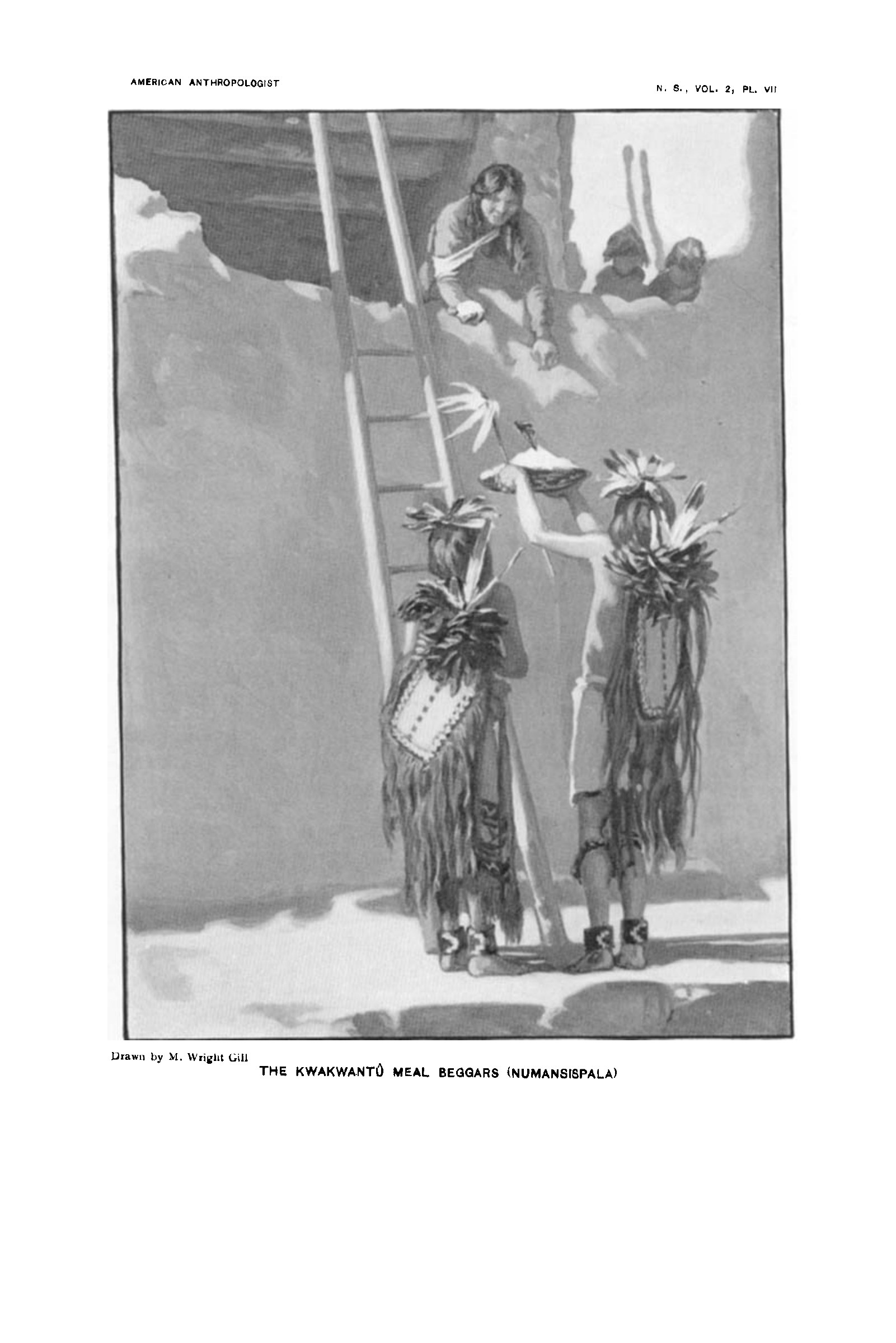
Four novices, about sixteen years old, put on horned helmets, took bells and ears of maize, and followed an older priest out through the hatch. They ran between shrines on difficult paths in the frosty dark. Their conductor carried antlers and a great agave club. The bells could be heard through the pueblo. After about half an hour they returned; other patrols followed during the night. This was initiation enacted as movement, endurance, costume, and obedience to a man who knew the route. Fewkes, pp. 99–100.
Wuwuchim came round every November, and every fourth year it swelled into the full initiation. Fewkes saw the short form, patrols and all. Admission to the societies was not a single night’s performance but a stage in the recurring renewal of the year.
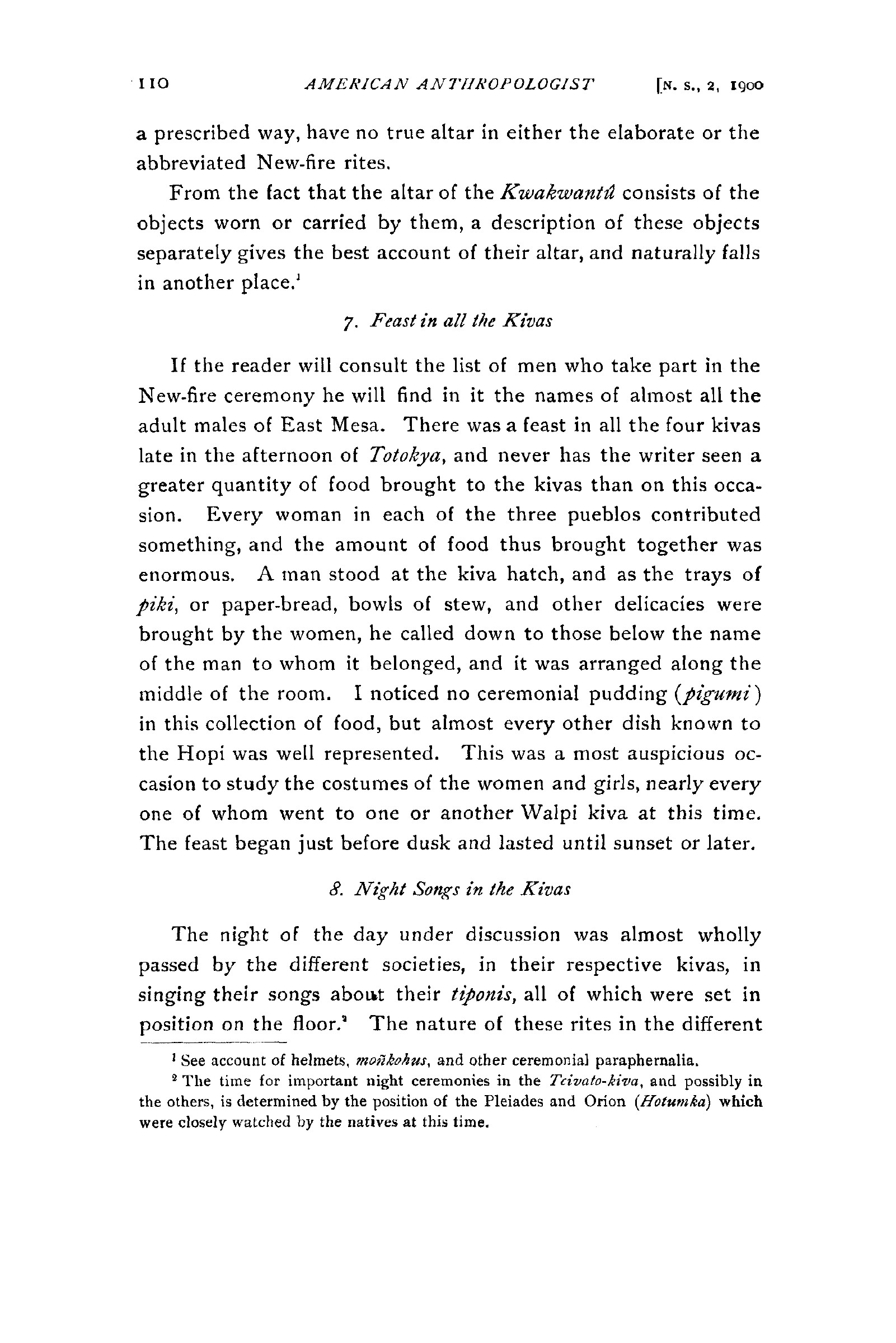
The sky governed the work inside. In Tcivato-kiva the important night ceremonies began when the Pleiades and Orion stood in the right place. The society conducting the boys’ passage watched two constellations to order its sacred night.
“determined by the position of the Pleiades and Orion”
J. Walter Fewkes, on the timing of important night ceremonies in Tcivato-kiva, 1900, p. 110 n. 2.
02 · The serpent in the kiva
The serpent was already in the room
Inside that same kiva, the men held wooden images of the Great Snake. The chief began his song in a low voice; the others accompanied it with copper bells. An agave rod struck the stone floor. The rhythm grew fierce. Prayer-sticks were being consecrated, and each man carried a serpent while the room sounded around him. Fewkes, pp. 113–114.
The snake images were small, slightly curved agave slats, painted white, with a horned serpent’s head carved at one end. They were carried horizontally by a string. A much larger serpent-headed club went with the leaders of the novices on their midnight patrols. Serpent, sacred wood, boys, restricted interior, ritual sound, and the Pleiades–Orion pair thus meet within the same ceremonial institution.
The slats were carried, not whirled. Bells and the agave rod on the stone made the noise. In Australia one sounding board is both the serpent and the voice; at Walpi the two jobs are split between a carved snake in the hand and the din around it. The ceremony is the same shape with the work divided.
The whirled board has its own place in Walpi’s winter kivas. In the Winter Flute rite, a one-day meeting of the Flute priests held in even years, the chiefs’ three sacred badges were set in a ridge of sand behind the sipapu, the opening to the world below. Eight songs were sung over them. “During the sixth and eighth songs Momi, of the Tciia clan, arose, and stood before the three sacred badges of the chiefs, twirling the whizzer or bull-roarer, after which he repeated the same act on the roof of the kiva.” The rites are separate, but they share the mesa and the winter round of kiva ceremonies. Fewkes, 1903, pp. 29–30.
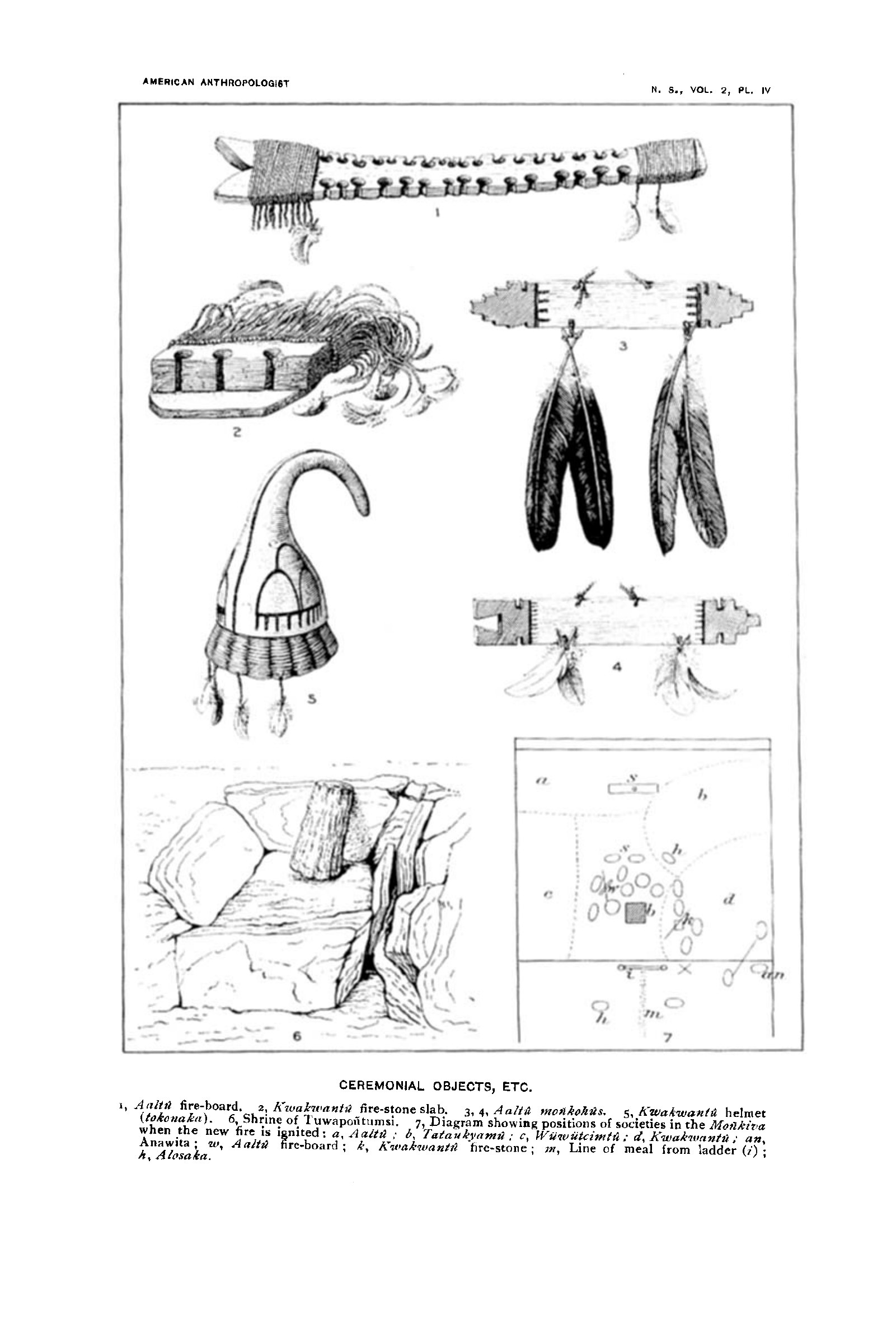
The flame itself was made to music. In the fire-making kiva the drills began turning with the song, to bells and rattles of tortoise shell and deer hoof. The societies did not carry fire in. They made it together, and the new year had a visible centre.
Walpi also remembered how the institution arrived. The Rain-cloud clans, the priests told Fewkes, brought the Agave society up from Palatkwabi, the Red Land to the south, and brought the Plumed Snake cult with it. Ceremonial powers have bearers, journeys, and arrivals. The lodge remembers being founded.
03 · The Amazonian house
Orion becomes the ancestral instrument
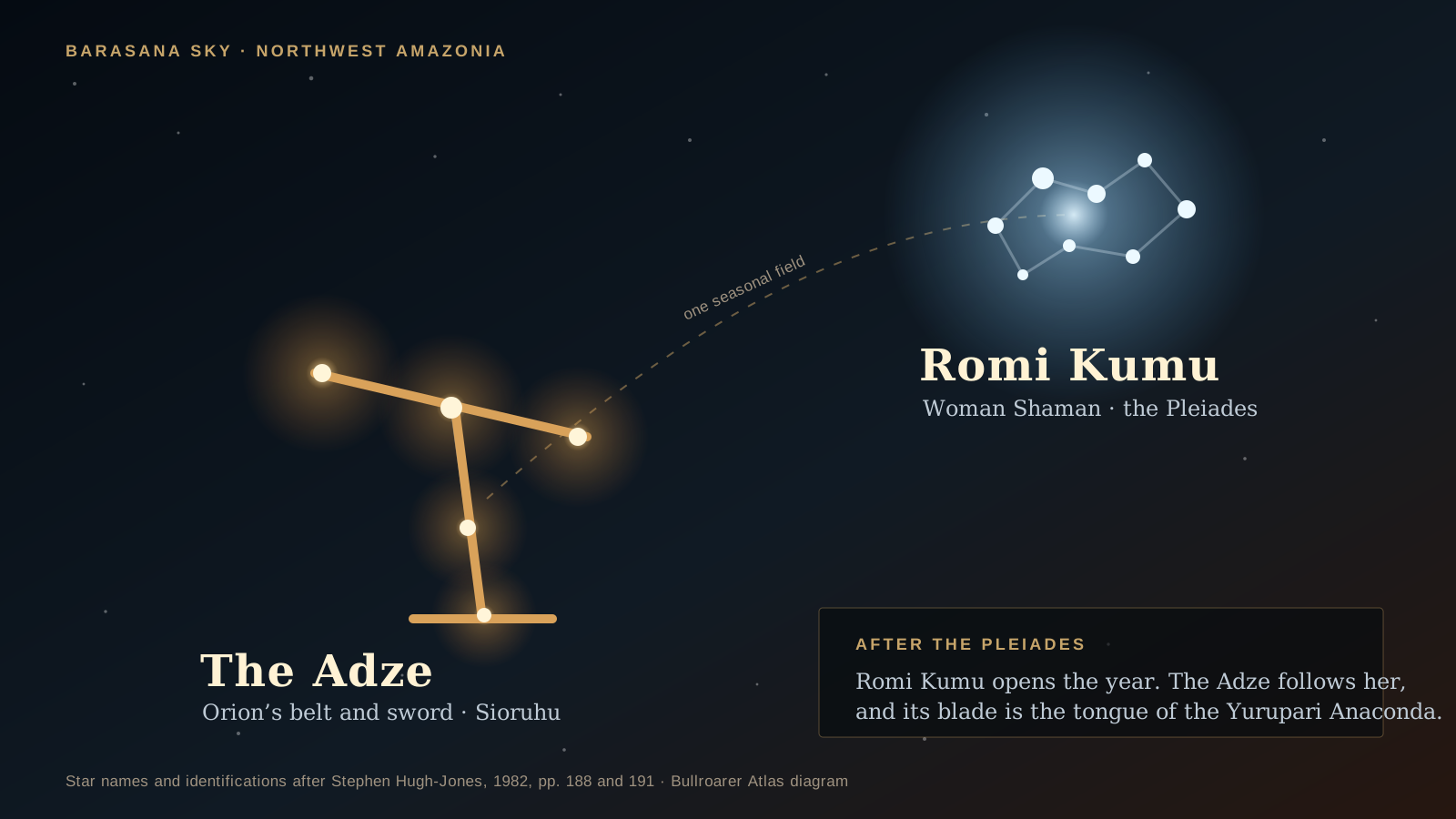
Travel south to the Vaupés, in the northwest Amazon on the Colombia–Brazil border, and the Pleiades–Orion relation becomes more intimate. Among the Barasana, Stephen Hugh-Jones found the two star groups built into the anatomy of the ancestral being and the instruments used in initiation. The Pleiades correspond to viscera and head; Orion to a long bone. His belt and sword are an adze. The sky is a disassembled ancestral body whose parts are also ritual tools. Hugh-Jones, 1982, p. 188.
This is the branch followed in The Palm and the Pleiades. Palm-wood flutes and trumpets sound as ancestors; the ceremonial house encloses boys and brings them through a rebirth managed by adult men. The Pleiades also belong to Romi Kumu, Woman Shaman, and her wax gourd. Female power, the stars, the instruments, and the making of men sit in one cosmology.
The Pleiades open that house. The Barasana hold their great initiation, He wi, at the end of the dry season, in March or April, and the stars set the night:
The timing of this rite is determined by the position of the Pleiades, which should be low on the western horizon at dusk.
— Stephen Hugh-Jones, “The Pleiades and Scorpius in Barasana Cosmology” (1982), p. 200
Inside, the instruments that are the ancestors’ bones are brought up from their hiding places under the river and given voice by the men who play them. At midnight two men representing the sun play the sacred flutes up and down the east–west axis of the house. At that moment the initiates eat coca from a gourd of beeswax. In Hugh-Jones’s words, the gourd “represents the Pleiades, the sky, and Woman Shaman as a female principle”, while the flutes represent Jurupari Anaconda and Scorpius “as a male principle.” The Barasana believe that if the rite were not held regularly, the universe would end. Woman Shaman’s stars set the date, the men’s instruments sound, and at the climax the boys eat from the gourd that stands for the Pleiades. Hugh-Jones, 1982, pp. 200–201.
The unit that endures is not a wooden object but an institution: an ancestral body made present, instruments held by initiated men, boys passing through a dangerous interior, and a sky that times or embodies the passage. Different societies keep it in different media.
The Amazonian house is both an observatory and a contested womb. The women who held its instruments first have their own story in The Voice Was Hers.
04 · Southern Africa
A man counts his years by the Pleiades
Among the Xhosa of South Africa, the Pleiades are isiLimela, the cultivating or digging stars. Their return before dawn in June opens the agricultural year. But the count is also personal. Men reckon their years of initiated manhood through the returning cluster. A man’s standing is measured against the sky he has lived under since his passage out of boyhood.
The poet S. E. K. Mqhayi praised Chief Silimela under that name, and the praise turns on the pun: the chief is the Pleiades, the stars that give men their years, and the Xhosa royal house owns them. His own recording of the poem survives from the early 1930s. Mqhayi, “A! Silimela.”
The count begins at a ceremony. The appearance of isiLimela set the coming-out of the abakwetha, the boys of the circumcision school. The fields and the men start their new lives on the same morning. The stars do not just tell people when to dig. They place a generation of men inside the succession of years. Hodgson, 1985, p. 25.
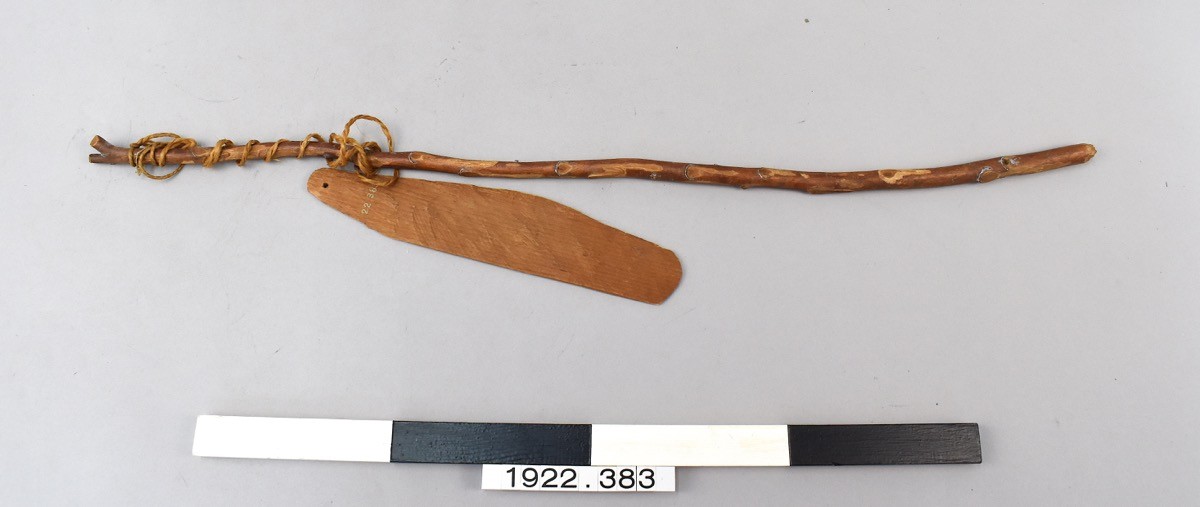
The bullroarer stood beside those initiates. In 1885 Mrs Carey-Hobson told the Anthropological Institute of white-painted abakwetha she had seen at the Cape, one of whom whirled a buzzing instrument she took to be the nodiwu. Tylor, reviewing the Australian evidence that same decade, added that in South Africa the bullroarer made rain and warned women away from initiation. White clay, a circumcision school, a whirled board, and the Pleiades overhead: the Xhosa lodge has the same furniture as the Australian one. Carey-Hobson, p. 325; Tylor, p. 265.
Here the stars stay inside initiation after the ceremony ends. Each return of the Pleiades is another year lived on the adult side of the line. The lodge closes; the cluster keeps counting.
05 · The Mexica world
The whole world waits for a flame
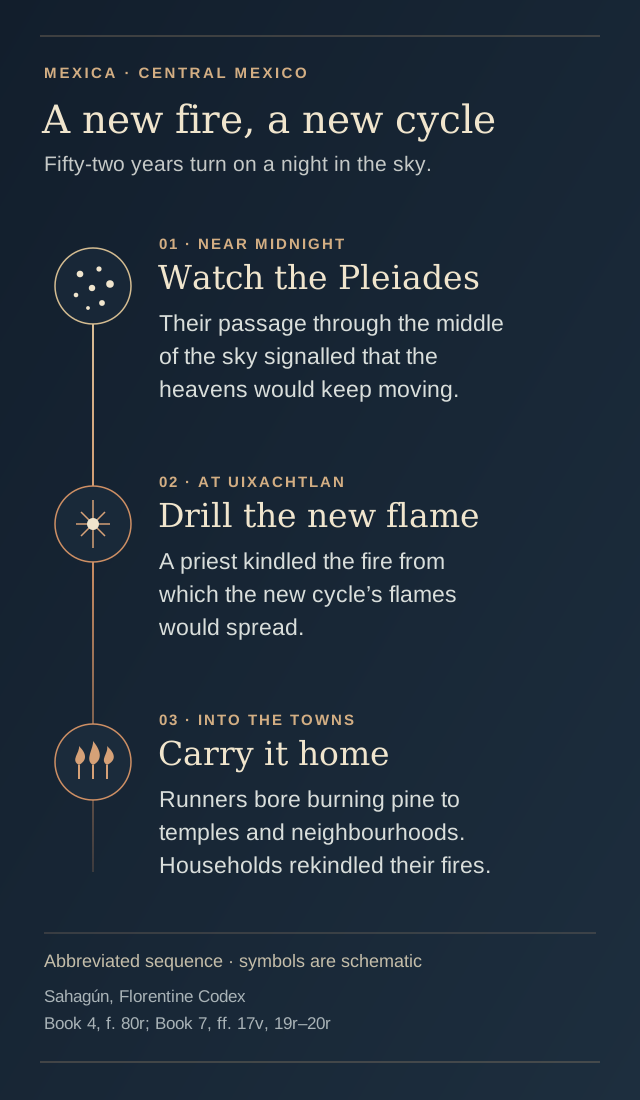
In central Mexico, the scale expands from a generation of novices to the life of the polity. At the completion of a fifty-two-year cycle, the Mexica extinguished their fires and waited. Priests watched the Pleiades approach the middle of the midnight sky. If the stars continued their passage, the heavens were still turning and another cycle could begin. The new fire would make that continuation tangible.
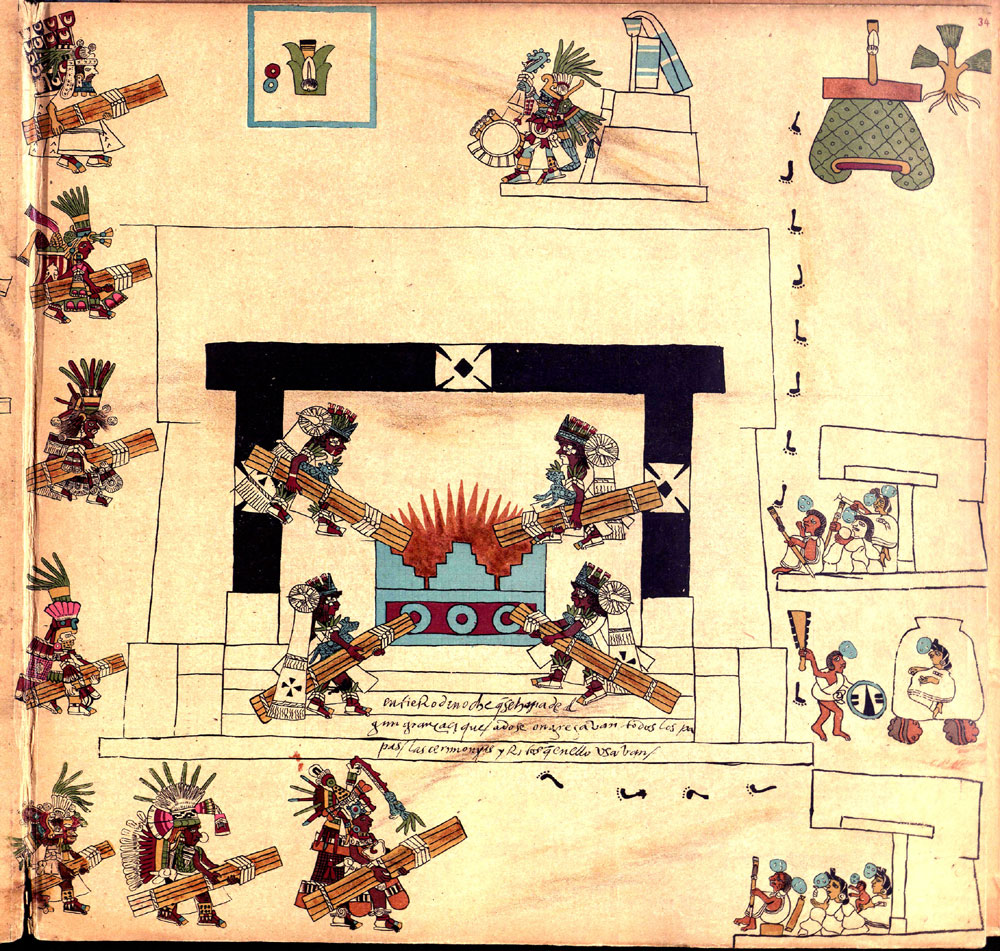
The Florentine Codex, compiled by Bernardino de Sahagún and his Nahua collaborators, sets the watch for the Pleiades in its account of the count of years. At midnight on Huixachtlan, the hill now called Cerro de la Estrella in Mexico City, priests worked a fire drill on the chest of a captive. When the flame caught they killed him and offered his heart. A great fire rose from the first spark. Book 4, fol. 80r–v; Book 7, chs. 9–10.
Runners carried the new fire outward. The temples received it, then the households. The people renewed their possessions and surroundings along with their hearths. The waiting, the peril, the sacrifice, and the redistribution of flame gave an abstract span of years a body and a route. Time did not simply continue. Priests had to bring it back to the people.
This is the renewal of a world, not of a boy. But the shape is the initiation’s shape. A whole city passes a night with its fires out and its ordinary life suspended, and comes out with a new allotment of time. The Pleiades authorize the crossing. Where the Barasana house remakes boys and Walpi renews fire inside an initiation festival, the Mexica turn the same night into the survival of the world.
Orion is there too. The Nahua constellation Mamalhuaztli is the fire drill, and Michael Coe placed it in Orion’s Belt and Sword, where Karl Taube follows him. The stars that sanction new time hang beside the heavenly implement that makes the fire. Taube, p. 210.
06 · The inheritance
An institution larger than its instrument
The strongest connection runs through the operations. At Walpi, new fire, boys, serpent effigies, ritual sound, and two watched constellations occupy one festival. In the Amazon, the Pleiades set the night of the great initiation, and the same two star groups become parts of the ancestral body and its instruments. Among the Xhosa, the cluster measures the life acquired through initiation. In Mexico, it allows the renewal of the polity through a flame born out of mortal danger.
These are branches of one inherited institution. Instruments can be replaced. Annual rites can expand into great cycles. A ceremony that remakes a person can be elaborated into one that remakes a people. What endures is an arrangement of powers: elders hold the knowledge, the ordinary world is interrupted, a dangerous passage is staged, and a renewed life begins under the authority of the stars.
Australia keeps the stellar drama itself: the Seven Sisters and Orion, the hunter who pursues them. The Americas put the same two constellations to other work: dividing a body, making a tool, timing the night, lighting a fire. The stars keep their authority while their roles change, and that is how an institution crosses oceans.
The bullroarer is one embodiment of the complex, not its boundary. Follow only the whirling board and the trail seems to vanish wherever a flute, trumpet, bell, or drum takes over. Follow the remaking of human beings under an ancestral sky and the trail continues through the closed house, the sounding kiva, and the extinguished city.
The Pleiades belong to the initiation complex: across continents, their movements govern the remaking of people and the renewal of the world. The stars are not the scenery above the mystery. They are the powers that open the lodge.
Key sources
- J. Walter Fewkes, “The New-Fire Ceremony at Walpi,” American Anthropologist 2 (1900): 80–138. Pp. 80–82 distinguish the festival, societies, and kivas; p. 93 describes fire-making and sound; pp. 99–100 describe the novice patrols; p. 110 n. 2 names the Pleiades and Orion; pp. 113–114 join serpent effigies and sound in Tcivato-kiva; pp. 134–136 describe the introduction traditions and distinguish snake from rain-cloud slats. Plates IV and VII illustrate the same festival.
- J. Walter Fewkes, “Hopi Katcinas Drawn by Native Artists,” Twenty-first Annual Report of the Bureau of American Ethnology (1903), pp. 29–30, for the Winter Flute rite and Momi’s whizzer before the chiefs’ badges and on the kiva roof.
- Stephen Hugh-Jones, The Palm and the Pleiades: Initiation and Cosmology in Northwest Amazonia (1979), pp. 188–197 for the Pleiades–Orion bodily and instrumental correspondences; pp. 222–225 for the men’s symbolic production of the initiates. His “The Pleiades and Scorpius in Barasana Cosmology” (1982), pp. 183–201, supplies the stellar identifications shown in the diagram: the Adze as belt and sword at p. 188, correcting the 1979 identification (p. 201 n. 5). Pp. 200–201 give the Pleiades timing of He wi and the beeswax gourd at its midnight climax. The fuller Amazonian account and bibliography are in The Palm and the Pleiades.
- S. E. K. Mqhayi, “A! Silimela,” recording and archival description, early 1930s; isiXhosa transcript, p. 2. The University of Cape Town’s EMANDULO archive explains the manhood-year count and the poem’s double use of Silimela. Its commentary draws on Jeff Opland and S. E. K. Mqhayi, “Two Unpublished Poems by S. E. K. Mqhayi” (1977), pp. 27–53.
- Janet Hodgson, Ntsikana, doctoral thesis (University of Cape Town, 1985), p. 25, on isiLimela, the June return, the abakwetha coming-out, and years of manhood. Keith Snedegar, “Stars and Seasons in Southern Africa” (1995), p. 534, also summarizes this connection through Hodgson’s 1982 study.
- Mrs Carey-Hobson, discussion following Howitt’s “The Jeraeil,” Journal of the Anthropological Institute 14 (1885), p. 325, on the instrument seen among initiates. E. B. Tylor, review of Fison and Howitt’s Kamilaroi and Kurnai, The Academy, 9 April 1881, pp. 264–266, especially p. 265, for the regional rain-making and initiation-warning report. George McCall Theal, Kaffir Folk-Lore (1882), p. 209, describes the nodiwu, childhood fright, and wind. Theal’s title uses the colonial term of his day.
- Bernardino de Sahagún and Nahua collaborators, Florentine Codex: Book 4, appendix, fol. 80r–v, on the Pleiades and the fifty-two-year count; Book 7, ch. 9, fol. 17v, on drilling the fire and sacrifice; chs. 11–12, fols. 19r–20v, on the distribution of the fire and general renewal. Digital Florentine Codex, Getty Research Institute.
- Karl Taube, “The Turquoise Hearth: Fire, Self Sacrifice, and the Central Mexican Cult of War” (2000; collected edition 2022), p. 205 and n. 29 for Alexander Stephen’s 1891 Hopi observations; p. 210 for Michael Coe’s identification of Mamalhuaztli with Orion’s Belt and Sword.