Atlas Essay — 2026-08-11
Flood Myths of Sundaland
The drowned Sunda Shelf and Wallacea, the islands beyond its eastern edge

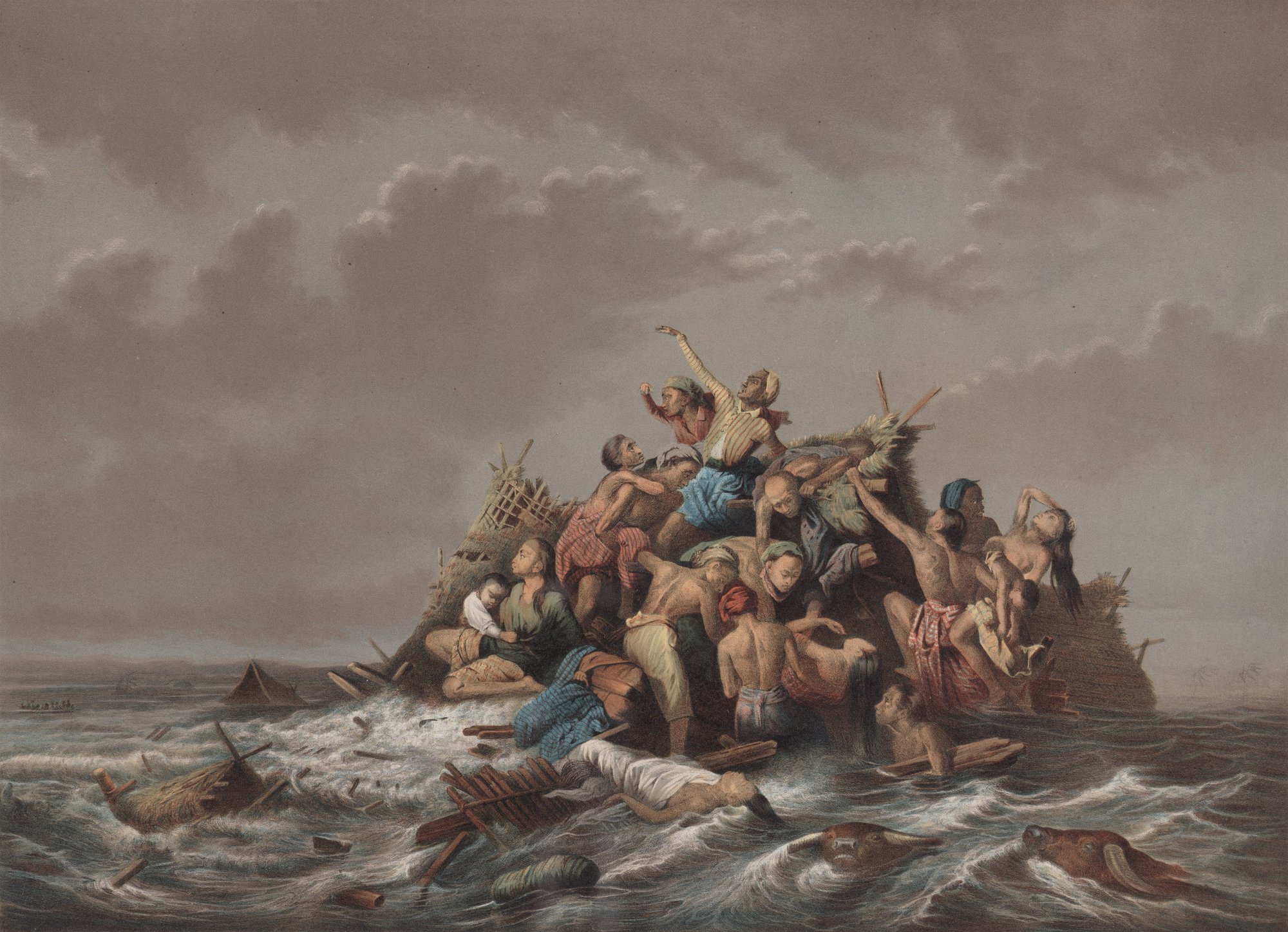
Alor and Pantar were once one land. Alorese histories say the water split them, cut the small islands loose between them, and sent people walking toward the mountains before the way became sea. Archaeology reconstructs the same change: at the close of the Ice Age, Alor, Pantar, Pura, Rusa and their neighbours were a single island. From the Malay Peninsula to Sumba, the same shape recurs. The water comes; when it goes, it leaves behind the arrangement people still live inside — the harvest law, the two moieties, the order in which the domains were founded, the fire in the bamboo.
A crossing walked before it drowned
The Alorese hold several related histories, and they do not agree in their details. In one, the ancestors walk from Rusa toward Pantar with the water coming up behind them. In another, Alor and Pantar are one country until a great flood separates them and the small islands surface between. A third remembers a kingdom on Rusa swallowed by the sea, and survivors climbing into the Pantar highlands, where the settlements they founded still stand in the order they arrived and hold their precedence by that order.
That last clause is the one to hold on to. The story is not only about water. It is the deed to a set of villages.
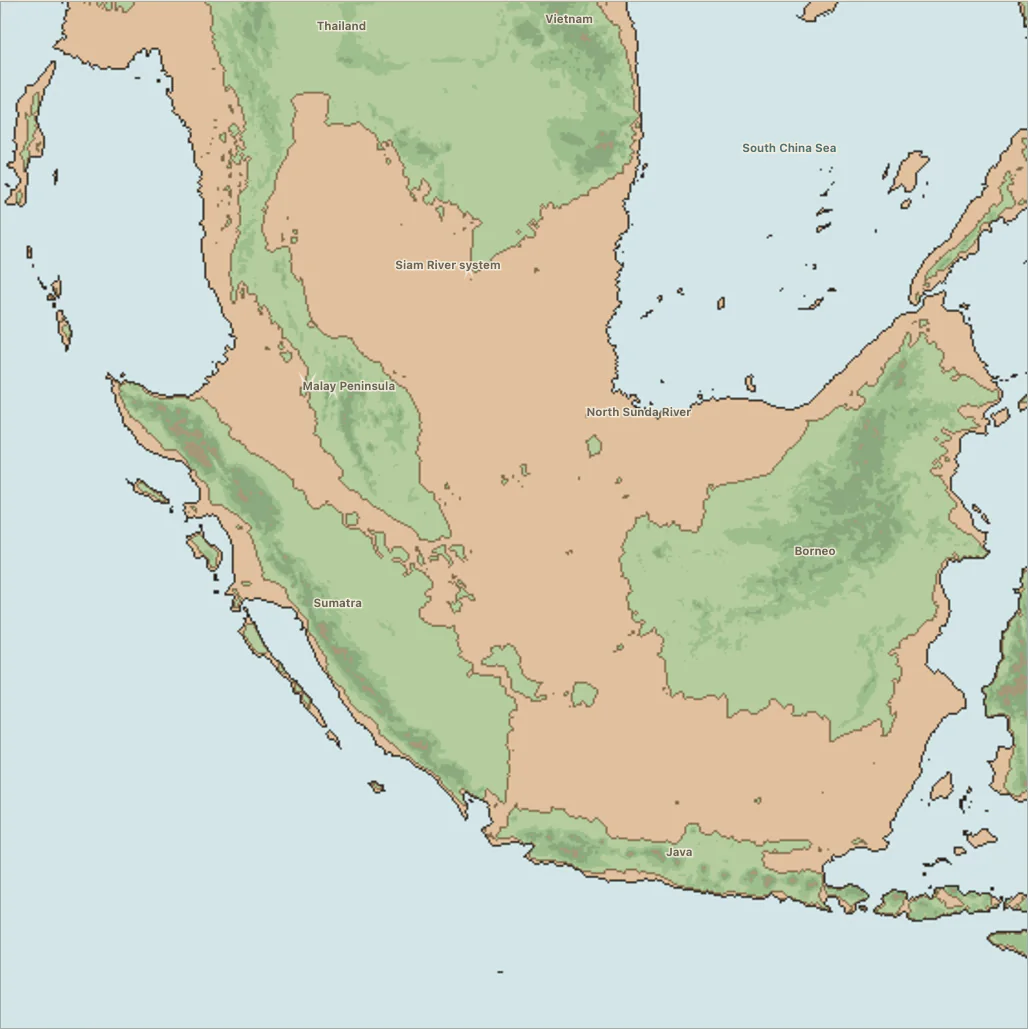
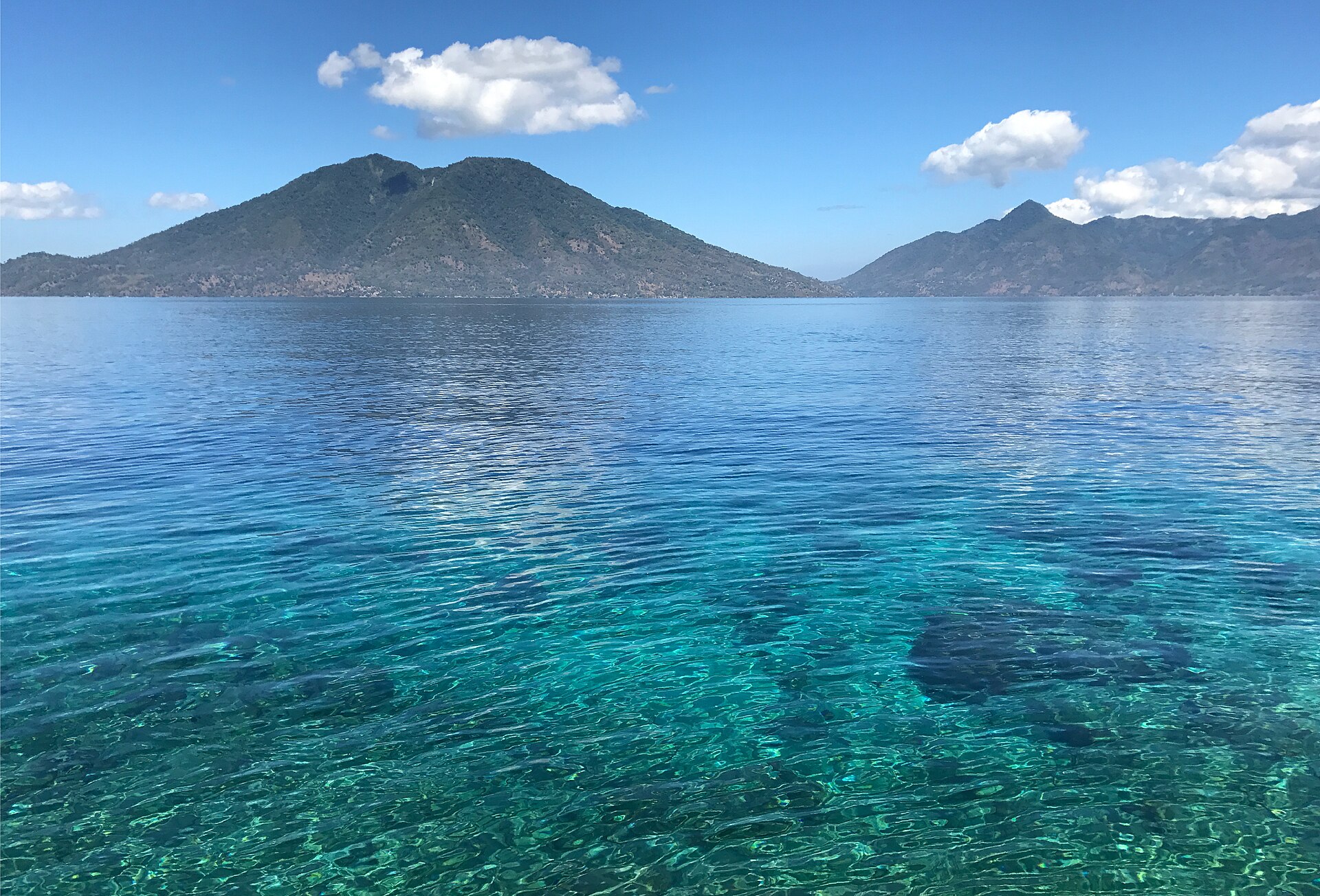
Kealy and colleagues’ shoreline reconstruction puts Alor, Pantar, Pura, Rusa, Kambing and their neighbours inside one coastline whenever the sea stood low, and breaks the Alor–Pantar connection in the early Holocene. Sulistyono and colleagues recorded the oral histories in their living form. The two accounts describe the same event from opposite ends of eleven thousand years.
Some of the material is younger. Koli Rawang and the drowned-kingdom episodes are placed locally in the thirteenth to fifteenth centuries, and layering of that kind is normal in a tradition that has been useful for a long time. Under it sits the plainer claim, the one the histories open with and the one the seafloor agrees to: Alor and Pantar were one country, and they are not now.
The line that became Bali Strait
The Manik Angkeran story opens by stating, as a fact requiring no argument, that Bali was joined to Java. Everything that follows is the account of how it stopped being so. The young man gambles away what his father gave him, goes to the dragon Naga Basuki for gold, is killed and restored; and at the end the priest Sidi Mantra draws a line across the neck of land with his staff. Water runs into the line. The line becomes the strait, and it does not close again. Father and son are left on opposite islands, each with obligations the other cannot discharge.
A telling published by the Buleleng regency keeps the living local form, with the Hindu names and the moral drama intact. Those names are later architecture. Under them sits a fact that the archaeology does not dispute: Bali stood on the eastern rim of the Sunda landmass and was joined to Java whenever the sea fell far enough to expose the sill, which it did repeatedly and last of all within the span of modern human occupation.
What the story does with that fact is the interesting part. It converts a drowned isthmus into a jurisdiction. The strait is not described as a loss; it is described as a boundary with people on either side of it who now owe each other different things. That move — water in, order out — runs the length of the region.
The instrument and the flood
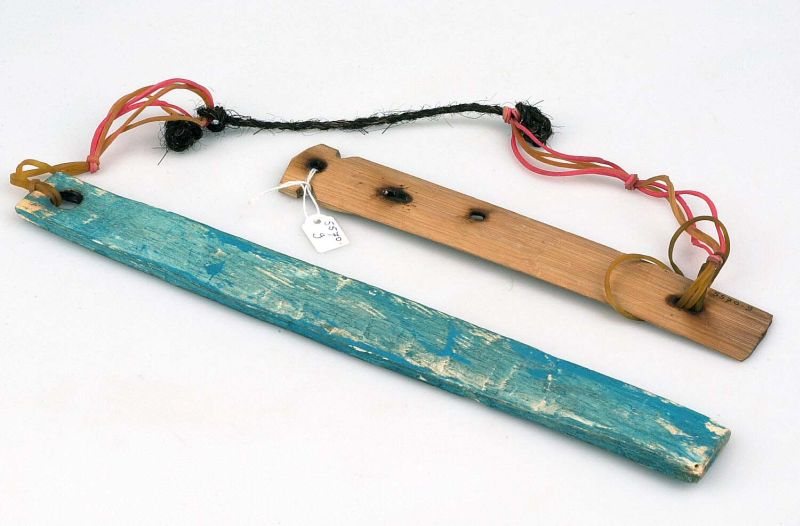
On the Malay Peninsula the bullroarer and the flood are one subject. The instrument is not beside the story of the water; it is the machinery inside it.
In the 1910s Ivor Evans was on the Tekai River in Pahang among the people he called the Sakai-Jakun — the Semaq Beri. He asked what thunder was. Thunder, they told him, is the noise the spirit Nenek makes by clapping his arms against his sides to sound his armpits. And the lightning that comes with it is Nenek flashing a thin board tied to a string. Evans, who knew the object when he saw it, glossed the board as a bullroarer.
Now look at what the floods do on that same peninsula. Every Peninsular tradition on this map is a thunder-and-storm flood. At a Kelantan circumcision feast the animals are set fighting and the crowd loses its manners, and the water comes down off the mountains onto the settlement; only the servants sent out for firewood are elsewhere when it arrives. On Gunung Raja the Temuan couple sit out the storm inside a gaharu tree, living on its soaked pulp. Among the Orang Seletar the water rises to Gunung Pulai and the houseboats are tied to the mountain until the ropes part.
The peninsula also keeps the rule running the other way: sound that must not be made. At Ijok in upper Perak, some children copy the call of the sagwong hornbill. Thunder and lightning answer, and the grandmothers Yak Lepeh, Yak Manoid and Yak Takel open the ground and bring the water up from underneath it. Every Negrito in that country drowns except one halak — a shaman. The camps that went under are still pointed out near Ijok, and the notes of the sagwong and the chorh may not be copied to this day. Above Jeram on the Pahang the offence is burning lice, or dressing a monkey up to be laughed at, and the village goes down into the ground with one house-post left standing; on the Jinteh in Ulu Pahang it is painting a pet macaque’s face to look like a person’s, and the water comes up from below with a dragon in it. A cosmology in which whirled sound makes the thunder is also one in which the wrong sound, the wrong laugh, calls the water — and the prohibitions are still kept.
So: the sky-spirit makes lightning by whirling a board on a cord, and what comes with the lightning is the flood. Swung sound is how thunder is made; thunder is what brings the water. That is one cosmology described from two directions: from the sky by the Semaq Beri, from the ground by every flood on the peninsula.
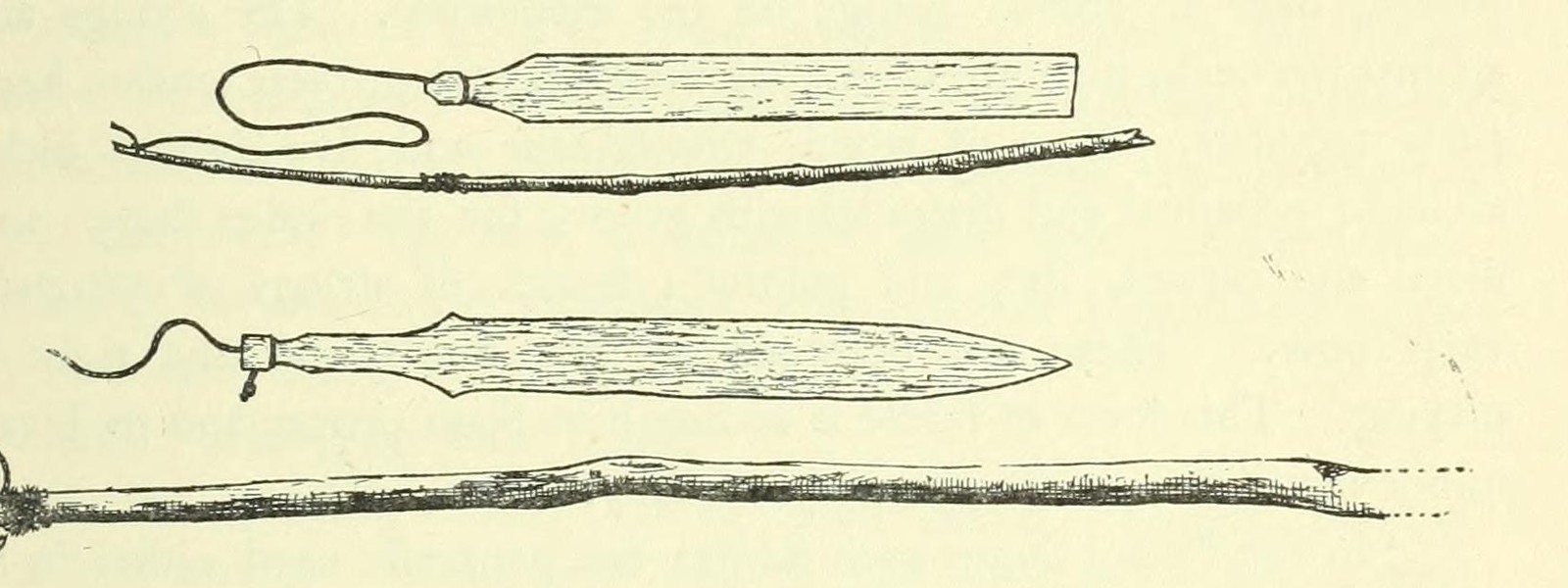
On Flores the same cosmology surfaces with a snake in it. The little bamboo jata is taken into the fields at Ende and swung to call rain, and eastward among the Lio children are warned off it: the noise is said to sound like a poisonous snake on the move, and to be capable of bringing the real animal near. Rain called by a whirled blade, and a snake in the sound of it — in a stretch of country where the Riung floods are rain sent as punishment and the Bornean floods of the same family begin with the killing of a snake.
The snake taken for a fallen log
Men went out from Kampong Tudu in the Tempasuk district of northern Borneo for fencing wood, and found a great trunk lying on the ground. They cut into it, and it bled. They walked the length of it and found a head. It was an enormous snake.
They staked it down and killed it, flayed it, carried the meat back and held a feast on it, and out of the skin they made a great drum. Then they beat the drum to try it, and it made no sound at all. They kept trying it, and for a long time it stayed silent. Then in the middle of the night the drum began to sound on its own — Duk, Duk, Kagul; Duk, Duk, Kagul — and a hurricane came and took the village away. Some houses went out to sea with the people still inside them. Others came down at Tempasuk and at other places along the coast, and those are the villages that stand there now.
“Then in the middle of the night the drum began to sound of itself: ‘Duk, Duk, Kagul; Duk, Duk, Kagul’… and a hurricane came and carried away the village.” — I. H. N. Evans, ‘Folk Stories of the Tempassuk and Tuaran Districts’, JRAI 43 (1913), pp. 469–470
An instrument refuses to be played, then speaks when nobody is touching it, and the catastrophe arrives on the sound. The Dusun put a sounding instrument at the heart of their flood, and its voice is what calls the storm in.
The other half of it is across the mountains in Sarawak. In the Iban telling of the same serpent — the sky-python taken for a log, cut up and cooked — the sections of bamboo are set on the fire, and voices come out of the bamboo. They are not the voices of anyone present. They curse the hills and the plains and call on the waters to swallow them up. Only then does the sky darken and the rain begin. The account was published in 1906 by Leo Nyuak, himself Iban, in Edmund Dunn’s translation. In that telling what ends the water is recovery: rice, and friction fire from the dog and the creeper, restart the world.
Two neighbouring peoples on one island; the same serpent, mistaken in both for a fallen tree and found to bleed; and in both the flood is announced by a sound coming out of a vessel made from — or cooking — the snake’s body. On Flores the family keeps the structure and swaps the animal: at Vangka the men of Tado bring fish up from the coast, the villagers who have never seen a live one put two into a pig trough to watch them swim, the whole place is still laughing when the sky breaks, and it rains for seven days and seven nights. In the uplands at Vongko Ngandong a burning brand is tied to a dog’s tail so it will carry fire to the next house in the rain; the dog runs mad in circles in the yard, everyone laughs out loud, and the village goes down into the ground. Where it stood there is a lake, and the lake is called Tivu Ngandong.
And in the same Riung district, Arndt was told what it costs to own such an instrument. At Nggolo Vulu, Lindi and Latji found a drum down at the shore: two mborong trees were bringing it to the beach, and it was sounding with nobody striking it. They carried it home — the female drum, Kalaur — and Latji made a male to match her, Radja Bheco. After the feast a Dheva came to them in a dream and set the terms. The drum may not be brought out and beaten at will: beat it at the wrong time, he said, and I will send storm and rain and let a great flood come. It may not be kept in a house either. So it hangs in a cave beside the village, and it is lent to anyone holding the paras, the buffalo-spearing feast, and returned with buffalo and pigs — and if it is not returned that way, the weather comes.
The Dusun drum announces a flood; the Riung drum holds one in reserve. On both islands the instrument that sounds of itself speaks with the flood’s voice, and it is kept under contract — found at the water, sexed and named, housed in a cave rather than among people, brought out for exactly one ceremony, and able to drown the country if the terms are broken.
The mouse names its price
West of Lake Poso in central Sulawesi, at Wawo mPebato, the sea came up over the land and put every mountain under except the summit of Pebato. A woman named Indo i mPaloa got aboard a pig’s trough and rowed it with a pot-ladle, and she alone stayed alive. When the ground dried she bore a son; when he was grown he became her husband.
Then she went looking for seed rice, and found a sheaf caught high up in a tree where the water had left it, out of reach. A mouse offered to fetch it down. But the mouse named its price first: from this time forward the mice would eat their share of every crop.
She agreed. The agreement holds. When there are only a few mice in the field the To Pebato are not troubled about it — they say the mice have come to take what is lawfully theirs. The rice that feeds the world is rice a mouse untied from a treetop, and the fee is paid every harvest, in the field, in perpetuity.
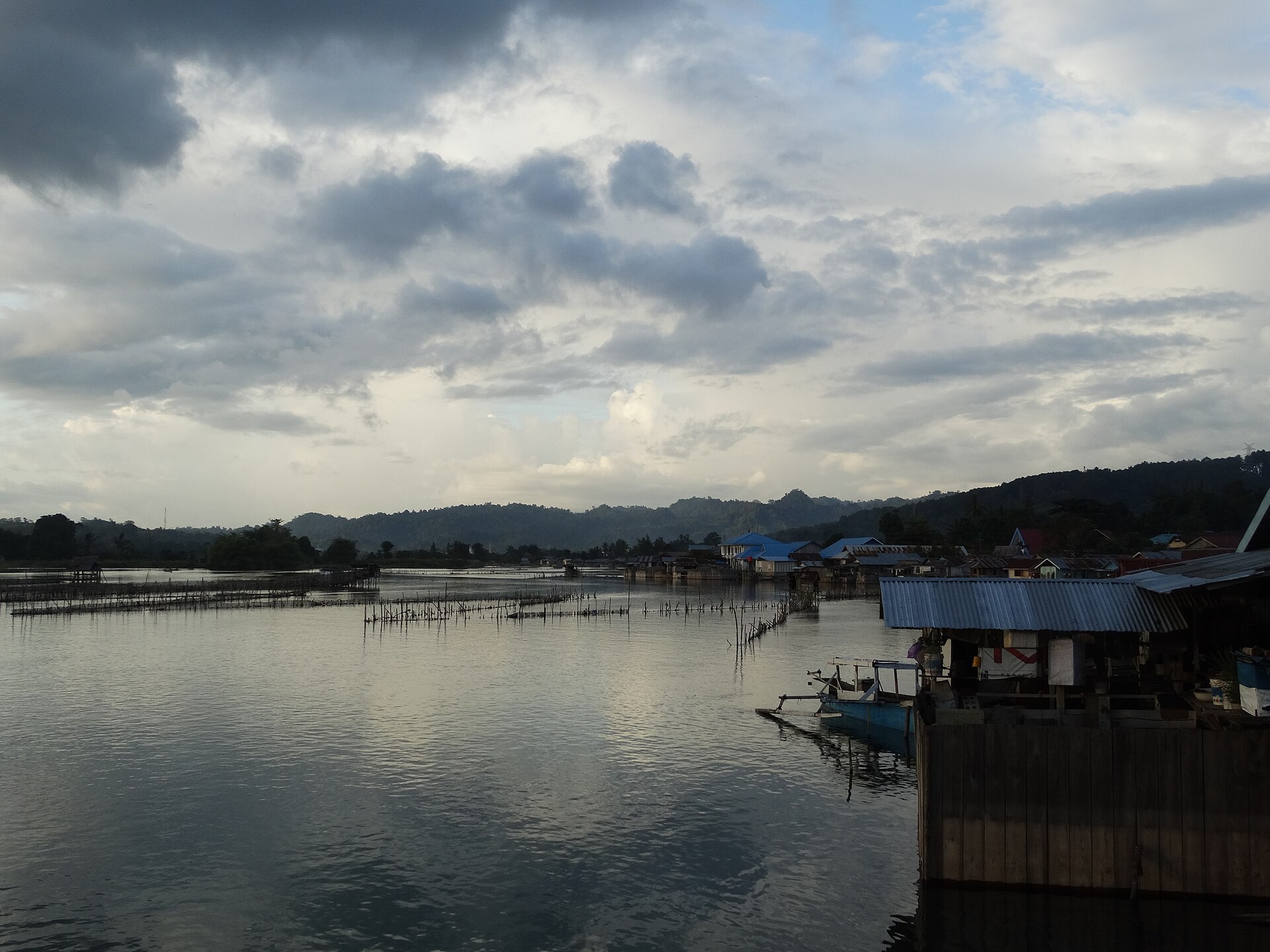
That story is a contract, concluded in the first days after the water, between the To Pebato and the mice, and the farmers in the field still honour it. The flood is the moment the terms were agreed.
The Mori of Tinompo, inland to the east, take the same structure and solve a harder problem with it. A man got word that a great water was coming, built a boat that could be shut over the top, and went into it with his wife, three sons, four daughters, the animals and the rice. Everyone else died. The Mori call the flood bomba osio, the nine waves: nine times the water carried the boat up to the sky and nine times set it back on the earth.
Then they came out, and there was one father and one mother and no way forward. A brother and sister slept facing each other. A mosquito bit the brother hard; he struck at it; and by that movement his sister conceived. Ask the Mori whether the two were guilty and the answer is no — simply no. The mosquito answers for it. The people go free.
That is a legal instrument dressed as a joke, and it is doing serious work: it licenses the descent of an entire people from an act the people themselves prohibit. Traditions on this map take the same route again and again — the To Pebato mother and son, the Mori siblings, the Mandaya woman and her son Uacatan at Cateel, Wigan and Bugan in the Ifugao mountains. One neighbour states the reverse as law. In the Bugis La Galigo, siblings may not become a couple, and the sanction is named: the country will submerge, it will be ruined, and none of the people in the world will be saved. The act that restarts humanity all along this map is precisely what sinks it in Bugis law, and there the flood is the penalty clause attached to the prohibition.
In the northern Kankanay country the siblings hold out, and the whole aftermath waits on a joke. Kabunian raises the seas until only one mountaintop is left, and on it the first two creatures on earth, the brother and sister Lumawig and Bangan. When the water falls he orders them to marry so the earth can be peopled again. They refuse, because they are brother and sister, and say they will do it only if he can make them laugh. He finds a way. They have four children, and the four children are dealt the world: one is given the cañao to perform, and his line becomes the Igorot; the second is set to weave abel cloth and becomes the ancestor of the Ilocano; the third is given the power of issuing commands; and the fourth is made a spirit dwelling in stones and trees, ancestor of the tumungaw and mangmangkik, who are still blamed for illness and typhoons and still named in ritual. The laughter licenses the marriage, and the marriage deals out the ceremony, the craft, the command and the spirit world in a single hand.
What the water hands back
The pattern is not confined to these islands. In the Chinese southwest Wang Xianzhao sorted 232 minority flood texts by how they finish and found that 79 per cent of them end by instituting something — the clans, the surnames, the division of the peoples, the marriage rule, the first ceremony. The flood is the hinge between a former arrangement and the present one, and the present one is what the story exists to authorise.
Island Southeast Asia does it at least as thoroughly. The clearest case in the region is on Seram.
In the account van der Crab published in 1862, the water covers everything, and then the mountain Nusaku comes up out of it. Three men are living on the mountain: Uli Lima, Uli Siwa and Uli Ase. The bird Marapati brings word that other mountains have surfaced. Uli Ase goes off to the new islands — and those islands are the Uliassers still — on the chart, in the shipping notices, in the name of a district. Then the Ceramese divide into the Pata Siwa and the Pata Lima, the moieties of nine and of five, which organised alliance, warfare and ritual across the island into the twentieth century.
One story: an archipelago named after a man, and a whole population sorted into the two halves it is still sorted into. That is not a memory of a disaster. It is a founding charter that happens to open with water.
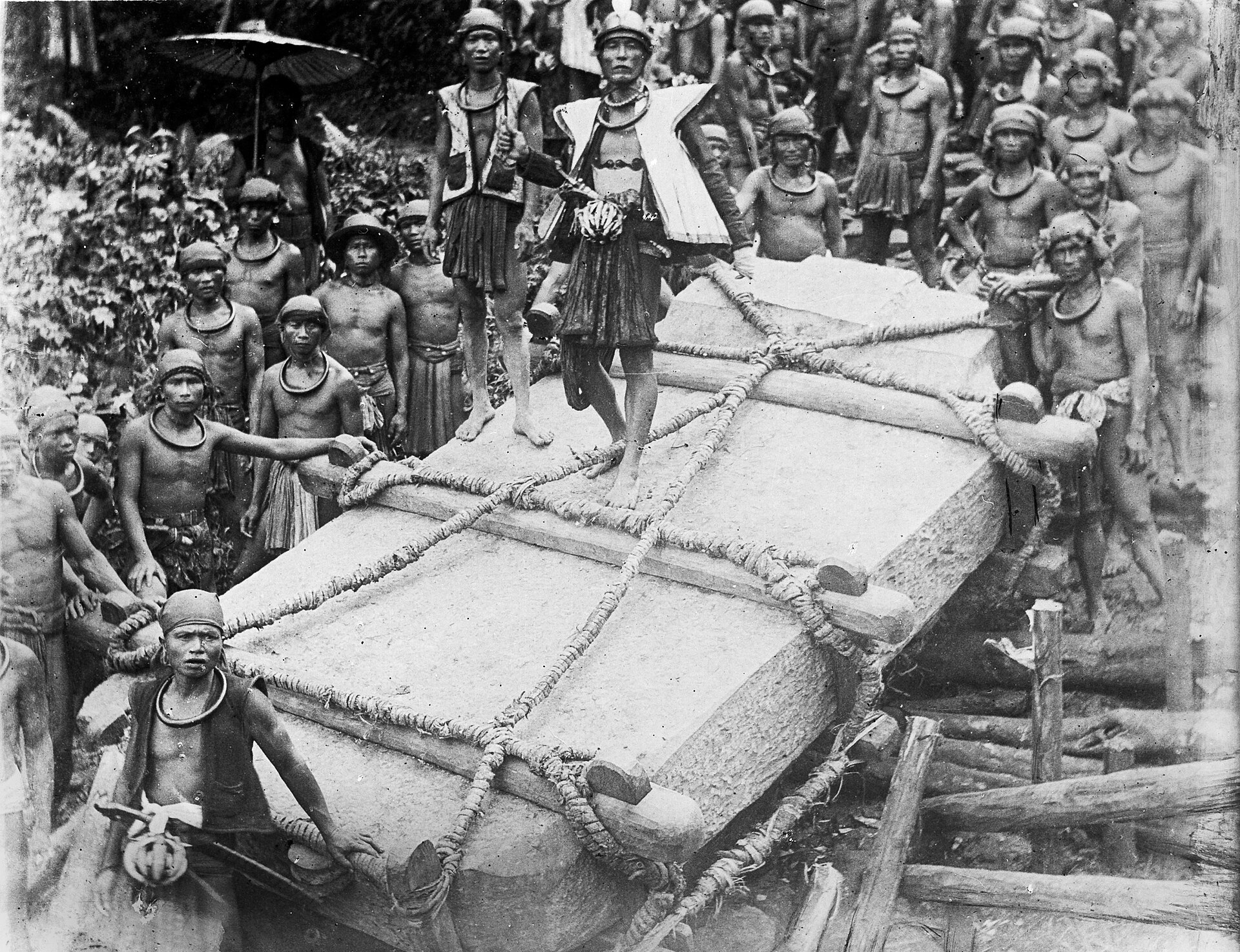
Nias states its charter with an heirloom. The mountains of the island quarrel over which of them is highest, and the ancestor Balugu Luomewona settles the strife by throwing his golden comb into the sea, where it becomes a giant crab that blocks the sea’s drains. The water rises until only a few summits are left; when the outlets reopen, the island returns and the survivors come down from the peaks. That, the islanders say, is how the great ancestor ended the quarrel between the mountains — and the quarrelsomeness is proverbial among his descendants still. In Sundermann’s telling the hand that throws the comb is a woman’s: Silewe Nazarata, his wife, floods the world to humble the proud.
Once you are looking for the charter, the map fills up with them. At Vangka on Flores the rain stops only when the elders take a chicken and a pig to the spring and the sacrificial post and set them before Mori Keraeng with the formula: we offer these in place of our bodies, because we laughed at the fish; let pig and chicken die, and let us not die. That exchange is not a detail of the plot. It is the exchange, still performed, and the prohibition it enforces — no laughing at animals — is a live rule of conduct in the district. The Riung flood is the case law behind it.
At Mount Mugao in eastern Lepanto the survivors are given tobacco and a law: the sacred eels of Mugao are protected, under threat of another destruction. At Boawae the ancestor Dooy survives the water in a ship, and his grave and a seven-masted model of that ship stand inside the harvest ceremony. At Lakimola on Rote the sea agrees to withdraw when it is shown an animal whose hairs it cannot count — a cat wins the argument — and a sea eagle brings back soil and seed; the restoration became an annual harvest offering, which is to say the flood produced a calendar. Among the Tambunan Dusun, Muhgumbul’s boat comes to rest at Nunuk Ragang and his descendants disperse as the named Dusun groups; the story is a genealogy of the district. Among the Higaunon and Agusanon of Mindanao, as Oona Paredes shows, the panud holds genealogy, land claim and law together in a single narration, which is why it is still recited.
Even the briefest tellings on the map do this. The Tinguian “Hidden Fire” has no punished crowd, no ark, no repopulation: Kaboniyan sends a flood that covers all the land, and fire, with nowhere dry to stand, goes into bamboo and stone and iron. That is the whole story. Its economy is its force. It exists to explain why a man with a length of bamboo and a stone can still make fire, which is the most practical charter of all.
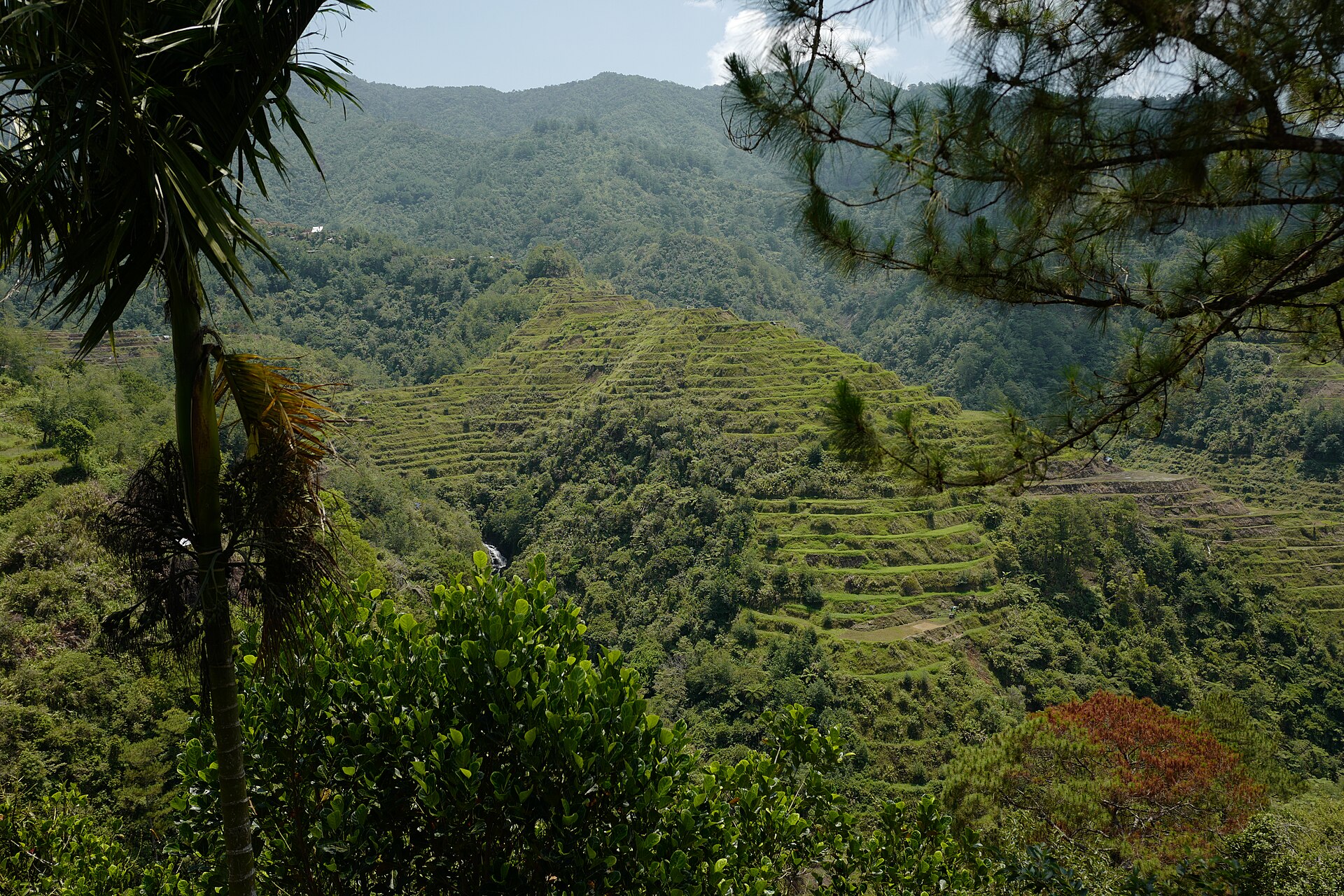
And in the Bontoc account taken down by Seidenadel in the language itself, the flood is not a punishment but a public-works project: Lumawig’s sons decide that a flat world is bad for hunting, and inundate it on purpose so that the mountains will come out rough. A brother and sister survive on Pokis, a dog and a deer fetch fire from Kalauwitan, and reeds become the rest of the people. The Cordillera is the deliberate output.
The bridge that is not there
On the north coast of Sumba, at Cape Sasar, the origin is recited in paired ritual couplets, one line answering the other:
The ancestors of long ago came to the distant cape of Sasar, from another land, the foreign land; the forefathers of ancient time came to the adze-shaped stone bridge, from across the seas, the strange land. — the Kodi panggecango couplets, in Janet Hoskins, The Play of Time: Kodi Perspectives on Calendars, History and Exchange, p. 33
They walked over on stone, the recitation says, and the stone is not there now.
From the cape they went out and took the island, and the taking is named in order: Lord Ngedo to Kodi, Lord Wango to Rara, then Ede, Manola, Manekka, Lombo, Karendi, Bukambero, Weyewa, Gaura, Lamboya, Rua, Wanokaka, Lauli, Lawonda, and Kambera of the different speech. The sequence is not decoration. The order in which the domains are named is the order in which they were founded, and the houses that hold them hold them by that order — in ritual precedence, in who speaks first, in who owes what to whom. It is the most complete charter on this map: an entire island's political geography, in couplets, entered by a bridge of stone.
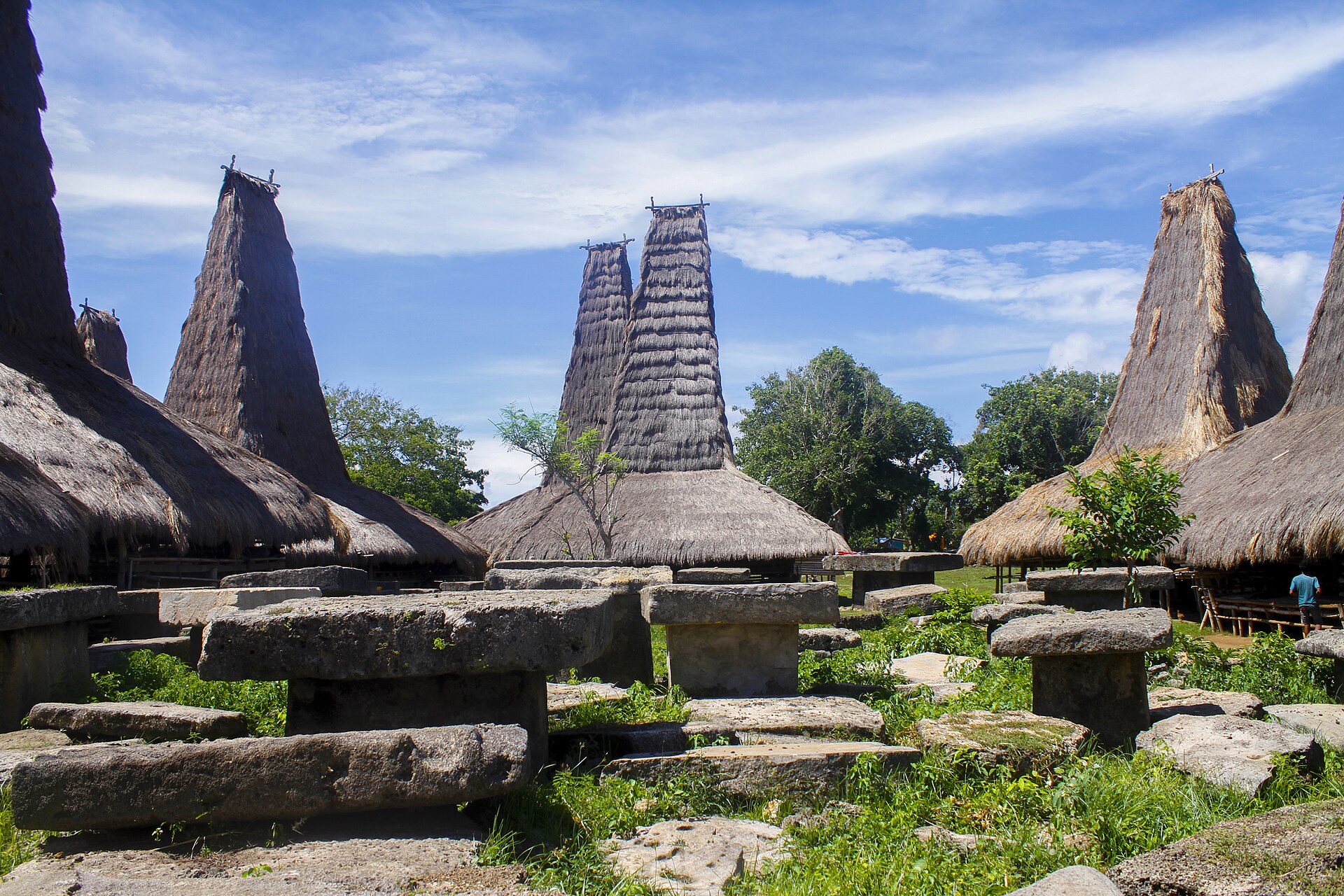
The bridge was never a causeway, and what it actually is turns out to be the better thing.
Sumba was never joined to Sumbawa or to Flores. It is not shelf; it is an uplifted continental fragment riding the fore-arc ridge, and the straits around it are deep and stayed open through the entire Pleistocene. No glacial lowstand, however severe, exposes that floor. There is no drowned causeway off Cape Sasar for the stone bridge to be, and there never was one to remember.
What there is, is a crossing. The Austronesian arrival on Sumba runs outward from this same cape — the language and the genetics both trace it from there — and a sea route travelled by people who arrive from “the foreign land” and then proceed to found every domain on the island in a fixed sequence is exactly the thing a recitation of this kind is built to hold. The stone bridge is the route rendered as pavement: a way that could be walked, once, by the ancestors, and that no one can walk now. The recitation is not wrong about the past. It is telling the truth about an arrival in the register available to it.
The sailfish that broke Luang
Farther east, in Indonesia’s southern Banda Sea, a betrayed husband rides a sailfish against his own island. His wealthy elder brother has married his wife; with an old woman of the sea to help him, the younger brother calls up the fish and orders it to break Luang so completely that no one will speak its name again. The fish leaps across the land, slices off islets and makes the whole island shake. People flee to the surrounding islands. His grandmother pleads for him to leave a remnant. She becomes a boulder at the cape, and the fish becomes an island: the destruction stops with both of them still visible in the water.
A separate telling on nearby Damer follows a boat away from ruined Luang. Its rudder catches in algae on a mountain summit. As the sea falls, the voyagers descend, naming the places where they stop; the voyagers take the name Surlialy and claim kingship as the island’s first arrivals. Luang’s broken coastline is also a genealogy of the surrounding islands. The places left above water tell who arrived, where they landed and who holds the land.
Mapped traditions
All mapped traditions
| No. | Place and tradition | What the story remembers | World after the water | Story and landscape | Source |
|---|---|---|---|---|---|
| Drowned land and island separation | |||||
| 1 | Rusa / Alor–Pantar Strait — Alorese oral histories | Alor and Pantar begin as one country. Rising water breaks the crossing, separates Rusa and Kambing, and sends survivors toward mountain refuges. | The survivors establish named settlements whose order preserves their routes out of the drowned country. | Kealy and colleagues reconstruct Alor, Pantar, Pura, Rusa and their neighbours as a single landmass at the glacial lowstand, with the crossings drowning as the sea came up. The Alorese place their own drowned kingdoms in the thirteenth to fifteenth centuries, so the settlement order the histories preserve is later than the breaking of the land bridge they begin with. | Sulistyono and colleagues, Alorese oral historiesIBDA’ 22.2 (2024). Kealy and colleagues reconstruct Alor, Pantar, Pura, Rusa and Marisa as one lowstand landmass, in Quaternary Science Reviews 249 (2020), 106599 |
| 2 | Bali Strait / Pura Segara Rupek — Manik Angkeran tradition | Bali and Java begin as one land. Sidi Mantra draws a line with his staff, and water fills it to make Bali Strait. | Father and son remain on opposite islands, and the new strait becomes a social boundary. | Bali stood on the Sunda shelf and was joined to Java through the glacial lowstand; the strait is postglacial. The Hindu characters and the moral plot are later layers, and no published study sets the Sidi Mantra story against the drowning of that connection. | Buleleng government, origin of BaliThe official living telling explicitly begins with Bali and Java joined and ends with the new Bali Strait |
| 3 | Nias — Niha giant-crab deluge | The mountains of Nias quarrel over which of them is highest. The ancestor Balugu Luomewona throws his golden comb into the sea, where it becomes a giant crab that blocks the sea’s drains, and the water rises until only a few summits are left. | When the outlets reopen the island returns and the survivors come down from the peaks. That, the islanders say, is how the great ancestor settled the strife between the mountains — and the strife is proverbial among his descendants still. | The account is clearly marine, but it describes blocked drainage and a temporary flood rather than a permanently changed coast. | Chatelin’s Nias account, summarized by FrazerFrazer I, p. 219, from Chatelin, TBG 26 (1880), p. 115; in Sundermann, Die Insel Nias (1905), pp. 70 sq., it is Balugu’s wife Silewe Nazarata who throws the comb |
| 4 | Enggano — Enggano tradition | The tide climbed over the whole island and drowned everyone except one woman. Swept along in the water, she lived only because her hair caught in the thorns of a tree. When the tide fell she climbed down into an empty world. Hunger drove her first inland and then to the shore, where she saw a fish slip inside one of the corpses left by the flood. She struck the body with a stone to drive the fish out and chased it back toward the interior. | Instead of the fish, she found a living man. He told her that he had been dead until someone knocked upon his body and restored him. Together they returned to the shore and struck the other drowned people, bringing them back to life and repopulating Enggano by resurrection. | Helfrich’s Enggano account, summarized by FrazerFrazer I, pp. 219–220 | |
| 5 | Mount Lakimola, Bilba, Rote — Bilba tradition | The sea covers all but Lakimola and agrees to retreat if shown an animal whose hairs it cannot count. A cat defeats it. | A sea eagle restores soil and seed, and the recovery enters an annual harvest offering. | The story names a marine flood and refuge mountain, but the sea retreats and no study links it to a permanent change of shoreline. | Jonker and Fanggidaej, “Rottineesche Verhalen”Rottinese text with Dutch translation, pp. 427–428 |
| 6 | Baligiyan / Gingoog — Higaunon and Agusanon Manobo | A giant crab, the kayumang, decided to make its home in the pusud hu dagat—the navel and drainage valve of the sea. With the outlet blocked, the ocean rose over the world until only the tallest mountains remained. Gahomon, also called Apu Intampil, was heavily pregnant and alone when a magical giant python carried her to a summit in northern Mindanao. Looking across the new water-world, she made a terrible resolution: if her child was a girl, she would kill the baby rather than leave her in a world without a future; if it was a boy, mother and son would have to begin humanity again. | The python wrestled the crab away from the sea’s navel and the water drained. Gahomon bore a son, Mugdantal, raised him and later had children with him; their children married one another and restored the population. Their son Pabuluson became a great ancestor of the Higaunon and Manobo peoples. The panud preserves this as genealogy, settlement history and customary law while confronting descendants with the sumbang—incest—at the beginning of their world. | Oona Paredes, Higaunon and Agusanon memoryp. 341; panud, genealogy and settlement history | |
| Deluges and renewed worlds | |||||
| 7 | Johor — Benua-Jakun: Pirman and the pulai ship | Water lies beneath a thin skin covering the world. Pirman breaks it and seals a man and woman inside a pulai-wood ship. | The pair emerges after the water falls, and their descendants begin human life again. | The story names no coast or island changed by the flood. | Skeat and Blagden, Pagan Races of the Malay Peninsula IIpp. 355–357; Frazer I, pp. 211–212 |
| 8 | Kelantan — Malay flood at a circumcision feast | A feast with animal fights and public disorder is followed by a flood rushing from the mountains. Servants away gathering firewood survive. | The absent servants become the remnant after the punished settlement is destroyed. | Water from the mountains suggests a river or flash flood more readily than an invading sea. No dated event has been identified. | Skeat and Blagden, Pagan Races of the Malay Peninsula IIpp. 357–358 |
| 9 | North Sumatra — Batak: Debata renews a dirty earth | Debata sends a flood to cleanse an old earth. A pair survives on the highest mountain. | A clod of earth grows into new land where human life begins again. | This is a moral creation story rather than a named coastal memory. Its missionary-era wording may also have shaped the form in which it was recorded. | Batak account summarized by FrazerFrazer I, p. 219 and notes |
| 10 | Batang Lupar–Tiang Laju — Iban: Simpang Impang | People gathering vegetables sat upon what they thought was a fallen log. Their knives made it bleed: it was a giant python. They cut it apart and began cooking its flesh. Rain then fell for days, drowning every person and animal except one woman, a dog, a rat and a few small creatures that reached the summit of Tiang Laju. There the woman noticed the dog sheltering beneath a warm creeper as wind rubbed it against a tree. By copying that friction she made the first fire. She took the creeper as her husband and bore Simpang Impang, a half-person with one eye, arm and leg. | Simpang Impang found rice hidden by Rat, who swore that rats would forever take rice from human fields. Wind scattered the grain, so Simpang Impang travelled with his animal companions to demand payment. Fish, Swift and Ant defeated Wind in trials of diving, jumping and passing through a blowpipe. When Simpang Impang finally burned Wind’s house with his father, the fire-drill, Wind surrendered. Unable to pay in gongs, he completed the young man’s missing side—giving humanity two eyes, arms and legs. | Hose and McDougall, The Pagan Tribes of Borneo IIpp. 144–147; compare Roth I, pp. 301–302 | |
| 11 | Sarawak — Iban Trow in the mortar-canoe | When the flood began, Trow turned a lesong—a great wooden mortar used for pounding rice—into a boat. He embarked with his wife and carried a dog, pig, fowl, cat and other animals into the deep. The unlikely vessel outrode the inundation, and when the water fell its passengers returned to land. | With nearly everyone gone, Trow decided that restoring humanity required more wives. He fashioned one from a log, another from stone and still others from whatever came to hand, then married them all. Before many years had passed, the household numbered about twenty children. They learned to cultivate the earth and became ancestors of several Dayak peoples, including the Tringus. | H. Ling Roth, The Natives of Sarawak and British North Borneo Ip. 300; Frazer I, pp. 221–222 | |
| 12 | Bukit Arai, upper Kapuas — Ot Danum boat survivors | A flood covers the country until only Bukit Arai on the Mandai remains. A few people survive in prahus through three months of water. | They descend and repopulate the river country when the water falls. | Its named upper-Kapuas refuge makes the story geographically exact, but no particular ancient flood has been proposed. | C. A. L. M. Schwaner, Borneo IIDutch original, p. 151 |
| 13 | Mount Nusaku, Seram — Ceramese | The water covered everything, and then the mountain Nusaku came up out of it. Three men were living on the mountain: Uli Lima, Uli Siwa and Uli Ase. The bird Marapati brought word that other mountains had surfaced. | Uli Ase went off to the new islands, and those islands are the Uliassers. The rest divided into the Pata Siwa and the Pata Lima, the moieties of nine and of five, which organised alliance, warfare and ritual across Seram into the twentieth century. An archipelago named after a man, and a population sorted into the two halves it is still sorted into. | The island setting is clear and Nusaku has not been securely located, and van der Crab gives no changed shoreline. What the account carries is not a coastline but a charter: the naming of a group of islands and the founding of the moiety system. | P. van der Crab, De Moluksche EilandenBatavia: Lange, 1862, pp. 212–213; digested by Frazer, Folk-Lore in the Old Testament I, pp. 223–224 |
| 14 | Boawae, Flores — Nage ship of Dooy | Dooy survives a flood in a ship. A grave and a seven-masted model preserve his voyage in harvest ceremony. | The ancestor’s ship becomes a sign of renewed social and ritual life around Boawae. | The surviving ceremony shows the story’s importance, but it cannot reveal the age or physical cause of the flood. | G. Beker, Nage/Flores account1913, pp. 623–626, especially p. 625; Frazer I, pp. 224–225 |
| 15 | Kiangan — Ifugao: Kabigat closes the rivers | Kabigat closes the rivers, and water rises over the valleys for three days. People and animals climb the mountains. | When the water falls, new mountains and valleys remain and the earth is prepared for settlement. | The account precisely explains Cordillera drainage and landforms, but no dated event has been linked to it. | Dixon, Oceanic Mythologypp. 178–179, citing Beyer p. 112 |
| 16 | Mount Amuyao–Kalawitan — central Ifugao: Wigan and Bugan | After drought, people dig into the river’s grave. A spring bursts out and floods the valleys, leaving Wigan and Bugan on Mount Amuyao or Kalawitan. | They reunite after the water falls and become ancestors of the renewed valleys. | The water comes from an inland spring, so a local flood fits better than ancient sea rise. It is a different story from Kabigat closing the rivers. | Dixon, Oceanic Mythologypp. 179–180 and cited Ifugao sources |
| 17 | Mabudbodobud–Mount Pokis — Bontoc: Lumawig’s sons | Lumawig’s sons decide that the flat world is bad for hunting and deliberately inundate it so the mountains will become rough. A brother and sister survive on Pokis. | A dog and deer seek fire at Kalauwitan, the siblings marry, and reeds become additional people in the mountainous world. | The story is an explicit making of the present mountain landscape, although no dated physical event has been connected to it. | Carl Wilhelm Seidenadel, First Grammar of Bontoc IgorotBontoc text and interlinear translation, pp. 485–507, especially 485–489 and 506–507 |
| 18 | Abra River uplands — Tinguian / Itneg: Hidden Fire | Kaboniyan sends a flood that covers all land. With nowhere dry to remain, fire hides inside bamboo, stones and iron. | The flood explains why people can later draw fire from bamboo and stone. | This brief primordial flood is an origin of fire, not a story of punished people, named survivors or repopulation. No particular landscape event has been proposed. | Fay-Cooper Cole, Traditions of the Tinguianp. 189, tale 63, ‘Hidden Fire’ |
| 19 | Bukidnon — giant crab and the three-layer raft | A moon before the catastrophe, a wise man ordered the people to build an immense raft. They felled great trees, laid the timbers three layers thick and lashed them tightly together, then tethered the whole vessel by a long rattan cord to a great pole driven into the earth. A giant crab crawled into the sea and displaced it across the world. White water poured from the hills while the ocean rose above even the highest mountains. The people and animals aboard the raft lived; everyone outside it drowned. | When the water fell, the raft settled close to the survivors’ former home. The pole had held and the long rattan tether had prevented them from drifting away. Those aboard were now the only people left in the world. | Mabel Cook Cole, Philippine Folk TalesBukidnon ‘Flood Story,’ pp. 125–127 | |
| 20 | Mapula River / Davao highlands — Ata: the eagle’s offer | Manama, greatest of the spirits, wove the first eight people—men and women—from blades of grass. They became ancestors of the Ata and their neighbours. Long afterward water covered the whole earth. Every Ata drowned except two men and one woman, and the flood swept those three far from Mapula, the river country remembered as the people’s first home. | A great eagle found the survivors and offered to carry them home on its back. One man refused. The other man and the woman accepted, climbed onto the bird and returned through the air to Mapula. The telling ends with that divided choice: two restored to the ancestral country, one left behind by his own decision. | Fay-Cooper Cole, The Wild Tribes of Davao Districtpp. 122–124, especially p. 124 | |
| 21 | Cateel, eastern Mindanao — Mandaya: Uacatan and his mother | The Mandaya world holds a great lake in the sky. Rain is the spray from its waves; when spirits are angered, they can break its banks and loose torrents upon the earth. In the Cateel telling, a great flood kills every human being except one pregnant woman. Alone after the extinction of the world, she prays that the child inside her will be a boy. Her prayer is answered, and she names her son Uacatan. | When Uacatan grows up, he takes his mother as his wife. Their children become the Mandaya. The story does not disguise the cost of beginning again: with every other person dead, the renewed people descend from the one union that remained possible. Elsewhere among the Mandaya, at Mayo, a separate origin tradition avoids both flood and incest by hatching the first couple from eggs laid by the limokon bird at opposite ends of a river. | Fay-Cooper Cole, The Wild Tribes of Davao Districtpp. 164–165, Cateel and Mayo origin traditions | |
| 22 | Bandung basin — Sundanese Sangkuriang | Sangkuriang dams the Citarum and nearly makes a lake and boat before dawn. Dayang Sumbi fakes sunrise; he kicks the boat into Tangkuban Parahu, and the failed dam lets the water drain. | The drained basin, mountain, river and traces of a vanished lake form the present landscape. | A lake did occupy the Bandung basin, the last of them draining in the late Pleistocene, and the story ends with a failed dam letting the water out of exactly that basin. No published study sets the Sangkuriang narrative against the palaeolake. | Noorduyn and Teeuw, Three Old Sundanese PoemsBujangga Manik, lines c. 1450–1455; later full versions vary |
| Community histories and landscape transformations | |||||
| 23 | Gunung Pulai–Johor Strait — Orang Seletar | Water rises to Gunung Pulai. Families tie their houseboats to the mountain, but broken ropes carry separate groups into Johor Strait, Singapore and beyond. | The scattered boats become different Orang Asli peoples and establish their marine ranges. | The route crosses country drowned with the Sunda Shelf. One teller’s forty-day flood may reflect a later biblical layer. | Tok Batin Salim Palon, Katy and Kais, ‘Seletar Folklore’Named community tellers; compare Singapore NHB Sembawang guide |
| 24 | Gunung Raja, Titiwangsa Mountains — Temuan: the celau flood | For the Temuan, celau joins offence to catastrophe. Laughing at a strange-looking animal—a turtle or worm, for example—can anger Muyang and bring lightning, storm and a great flood. In the origin story, Mamak Bongsu and his sister Inak Bongsu alone escape the deluge. They cling to the tallest gaharu, or eaglewood, tree on Gunung Raja and keep themselves alive by eating its rain-soaked pulp. | When the water drains away and the ground dries, the brother and sister come down from the tree and have children. Their descendants begin humanity again, and Gunung Raja stands at the beginning of the Temuan world. The old flood is also a present rule: do not turn an animal’s strangeness into a joke, because celau is the transgression and the storm that answers it. | Chan and colleagues; Temuan community accountChan et al., pp. 23–24; Temuan celau account at oocities.org/etemuan/celau.html | |
| 25 | Muhgumbul–Nunuk Ragang, Tambunan — Tambunan Dusun: Muhgumbul and the red banyan | People forgot restraint and spoke forbidden, hurtful words, so Kinoingan sent a flood. The good man Muhgumbul learned through repeated dreams that rain would last seven months and seventy days. By the seventh night he knew what to load into his boat: his wife, six sons, one daughter, seven dogs, food, weapons and tools. The vessel came to rest beneath Nunuk Ragang, the enormous red banyan at the centre of Dusun origins. | From Nunuk Ragang’s ashes grew rice, yam, tapioca and tobacco, and Muhgumbul’s family became the renewed people. When their descendants dispersed, shelters and landmarks gave the groups their names: Tuwawon, Tagahas, Tibabar, Bundu, Gunnah, Palupuh, Kohub and Kureo. The flood therefore ends at a Tree of Life and begins a charter for food, ancestry and the divisions of the Tambunan Dusun. | Low Kok On, ‘Tambunan Dusun Origin Myth’pp. 31–37; based on Thomas Rhys Williams’s 25-informant collection | |
| 26 | Kabugao region, Apayao — Isneg: the ocean and the cat’s coconut | When an envious anito saw people living easily, it withheld rain until streams dried, plants withered and animals died. The people prayed to a kindly anito. On the seventh day rain and wind arrived with terrible force; for three days the water rose until every creature drowned. When it withdrew, the floodwater became the ocean. | A second Isneg flood leaves only one mountaintop crowded with survivors. A man sees a cat afloat on a coconut and asks for it, but the cat refuses to surrender its last possession. After the water falls, the coconut takes root and the cat comes to live with the man. Isneg women still give a cat coconut when one asks during grating: its claim began when the world was water. | Laurence L. Wilson, Apayao Life and Legends1947, pp. 95–97 | |
| 27 | Karagawan–Mount Wayan — Isneg: Magtongay cuts the tether | Magtongay was hewing a board for a new house when one of his beloved birds spoke: build a boat instead, for a flood is coming. He obeyed and tethered the vessel to a tree with a long rattan. When the storm broke, he boarded with his dog, cats and birds. The boat was too small for everyone, so his brother took Magtongay’s wife and children on a raft that drifted to Mount Wayan. | The water climbed until Magtongay had to cut the rattan. After drifting for two days, he landed among strangers whose speech he could not understand. He learned their language and their ways and made a life among them, but he never saw his family again. The flood becomes a migration story whose decisive moment is not rescue but the severing of the line home. | Laurence L. Wilson, Apayao Life and Legends1947, pp. 110–111 | |
| 28 | Mount Mugao, eastern Lepanto — Bontok: tobacco for the first marriage | After the flood drowned every living thing, Kabunian saw a fire shining on the one summit left above water. A young man and woman had survived there, warming themselves on Mount Mugao. They took the bedraggled visitor for another castaway and refused to believe he was Kabunian. They also refused his command to marry and refill the empty earth—until he revealed a living tobacco plant. With their last pipeful gone and every field soaked, the pair accepted his bargain. | Their descendants became the peoples of the earth. At Mugao they also inherited another covenant: sacred eels live in a spring-fed pool and must never be killed or injured, or the next destruction will come in fire and brimstone. Children feed the eels and sing to their queens. The first marriage, tobacco and the protection of the pool all belong to the same renewal of life. | ‘Mount Mugao: Philippine Great Flood’American Chamber of Commerce Journal 8(7), July 1928, p. 7 | |
| Sea, lake and island origins | |||||
| 29 | Bontoc valley–Mount Pokis — Bontoc: fire from Kalowitan | Water covered the lower country until Fa-tang-a and his sister Fu-kan were alone on Mount Pokis. Every fire had gone out. Lumawig saw them, told them to wait and went to Mount Kalowitan to obtain a new flame. By the time he returned, Fu-kan was pregnant. He left the siblings together and watched from above as their child was born and the water withdrew. | Fa-tang-a, Fu-kan and the baby descended, and their children multiplied into the restored population. Lumawig later returned to order the life of their descendants: he taught them cultivation, established their men’s houses and names, and commanded them not to lie, steal or commit adultery, but to live together as brothers. Survival on Pokis becomes the beginning of Bontoc society, not merely the end of a flood. | Albert Ernest Jenks, The Bontoc Igorotpp. 201–204 | |
| 30 | Kenaboi–Jelebu — Mantra / southern Orang Asli: white turtle | Batin To’ Entah finds water beneath a jelutong stump. A white river turtle emerges with an immense quantity of water; great animals fail to kill it, but mouse-deer succeeds. | The released water becomes the sea, transforming a freshwater world into the coast people inherit. | As an origin of the sea in country beside the drowned Sunda Shelf, the story invites a deep-landscape reading without naming a dated transgression. | Skeat and Blagden, Pagan Races of the Malay Peninsula IIpp. 339–341 |
| 31 | Rawa Pening — Javanese: Baru Klinting | After villagers mock and reject him, Baru Klinting plants a stick they cannot pull out. When he removes it, water erupts, submerges the village and forms Rawa Pening. | Nyai Latung survives in a rice mortar because she had shown hospitality; the drowned village becomes the living lake landscape. | The tradition gives the lake a sudden watery and ground-shaking origin. No study identifies one event, but its named landform makes it a plausible geomorphic memory. | Arini and Amalia, living Rawa Pening traditionpp. 3–11, especially 9–10; compare Tri Wahyuni 2016, pp. 41–48 |
| 32 | Romang and neighboring islets — Romang sailfish cycle | A giant sailfish cuts through Romang, separates Black Island at Ivory Water, and knocks Maupora, Broken Island and Mosquito Island free. | A chain of named coastal features becomes the island world inhabited today. | Published research treats the itinerary as a local geomorphic tradition and compares Indonesian island-cutting myths with abrupt coastal change, without assigning a dated Romang event. The tradition is not a recent one: Riedel names Roma first among the remnant islands in 1886, a century before the modern study. | Aone van Engelenhoven, ‘The Spoor of the Mythical Sailfish’; Riedel 1886van Engelenhoven, pp. 259–263 within the wider pp. 251–286 study. Anchored a century earlier by J. G. F. Riedel, De sluik- en kroesharige rassen tusschen Selebes en Papua (The Hague: Nijhoff, 1886), p. 312, which names Roma first among the islands left as the wreckage of one great land destroyed by Upulero in the form of a great sailfish, herui: archive.org/details/ldpd_6940987_000 |
| 33 | Luang archipelago / Lüondona-Wietrili — Luang and Southwest Maluku sailfish traditions | A sailfish destroys Lüondona-Wietrili, scattering its people and leaving a remnant. In one Luang telling, a younger brother rides the fish against his own island after his wealthy elder brother marries his wife. The fish slices off islets and shakes the land until the rider’s grandmother pleads for a remnant: she becomes a boulder at the cape and the fish becomes an island. Another telling makes the destruction a punishment. After people cut the rattan joining earth to sky and taunt their kin above, Upulero descends as a sailfish and wrecks the great land of Luang and Sermata. | Survivors settle the surrounding islands. Roma, Makisar, Leti, Moa, Lakor, Dama, Luang, Sermata, Babar and the Tanimbar group remain as fragments of the lost land. A separate Damer account follows a Luang boat caught by its rudder on an algae-covered mountain summit. As the water recedes its voyagers descend, naming their stopping places, take the name Surlialy and claim kingship as the island’s first arrivals. | Patrick Nunn compares the loss of Lüondona-Wietrili with land sinking during an earthquake. Wide reefs surround the small surviving island of Luang; the sailfish traditions turn that broken coastal geography into the origins of neighbouring islands and their settlements. | Nunn; van Engelenhoven; Riedel; Sandra PannellNunn, ‘Myths recalling rapid coastal submergence’; van Engelenhoven, pp. 251–286. The primary is J. G. F. Riedel, De sluik- en kroesharige rassen tusschen Selebes en Papua (The Hague: Nijhoff, 1886), p. 312: archive.org/details/ldpd_6940987_000; Sandra Pannell, “Of gods and monsters,” A World of Water (2007), pp. 77–79, for the distinct Luang revenge and Damer settlement accounts. |
| Harvest law, moieties and the founding of domains | |||||
| 34 | Wawo mPebato, west of Lake Poso — To Pebato: Indo i mPaloa and the mouse’s price | The sea covered every mountain except Wawo mPebato. Two pregnant creatures survived together: the woman Indo i mPaloa and a mouse, riding in a pig’s trough and paddling with a pot-ladle. After the water fell, an uprooted tree drifted ashore with a sheaf of seed rice caught in its branches. The mouse offered to climb for it, but named her price first: mice must forever receive a share of every crop. | Indo i mPaloa agreed. She bore a son and later married him; their son and daughter became the ancestors of humankind. The rescued rice fed the renewed world, and the mouse’s bargain still governs the harvest. A few mice in a field are tolerated because they have come for what is lawfully theirs—the payment promised when the last seed rice hung beyond human reach. | Adriani & Kruijt, De Bare’e-sprekende Toradja’s van Midden-CelebesDerde Deel, p. 386; compare Eerste Deel, pp. 19–20 and 247 | |
| 35 | Tinompo, Mori country — Mori (To Tinompo) | A man got word that a great water was coming. He built a boat that could be shut over the top, and went into it with his wife, three sons, four daughters, animals and rice. Then the flood came and killed everyone else. It is called bomba osio, the nine waves: nine times the water carried the boat up to the sky, and nine times set it back on the earth. | When it was over they came out and lived on the earth. But there was one father and one mother, and no way forward. A brother and sister slept facing each other; a mosquito bit him hard, he struck at it, and by that movement his sister conceived. Ask whether the two were guilty and the answer is no — simply no. The mosquito answers for it, and the people go free. | The nine waves — each lifting the boat and setting it down — describe a wave train rather than a rising water level, which is tsunami morphology. Nothing dates it, no coast is named, and Tinompo is inland; the enclosed boat with animals and rice is a widely diffused ark form. | J. Kruyt, “De Moriërs van Tinompo”BKI 80 (1924), pp. 33–217, at pp. 129–130 |
| 36 | Vangka, Riung district, north Flores — Riung | Men from Tado came up to Vangka selling fish, and the Vangka people, who had never watched a fish, asked to see one alive. Water was poured into a pig trough and two fish let into it, and when the fish swam up and down the whole village shouted with laughter. The laughing was still going on when the sky broke: lightning on every side, thunder, and rain as though poured from jars, seven days and seven nights. The streams went over the country, and the sea began to rise. Arndt was given the same story a second time with the ending turned over. A man from Tado brought dried fish up to Vangka, and when they asked him how a fish moves he said upright, and they would not believe him; so he fetched a live one and laid it in a trough of water, and when it swam up and down they laughed aloud. This time the storm came with an earthquake in it, and crocodiles came up with the water, and every inhabitant of the village died. | The elders took a chicken and a pig to the spring and the sacrificial post and set them before Mori Keraeng: we offer these in place of our bodies, because we laughed at the fish; let pig and chicken die, and let us not die. Then the rain stopped. That is the exchange, and it is still the exchange: a life for a life, and no laughing at animals. In the second telling nobody bargains and nobody is spared. One woman was out in the field, already pregnant, and she alone came through it; she bore a boy, and married him, and the Vangkanese descend from the two of them. Three crocodiles that had eaten a dog, its mate and their pup were left behind on the drying ground and turned to stone, and those stones are called nganga uadsa. | “The sea began to rise” is the only marine clause in the Riung corpus, and it sits inside a seven-day rain that overflows the rivers — which reads as a storm surge coinciding with catastrophic runoff, a real and recurring north Flores hazard. Nothing ties it to the Pleistocene. The second telling adds an earthquake and named petrified landmarks, and no scholar has matched the nganga uadsa stones to a place on a modern map. | P. Arndt, “Aus der Mythologie und Religion der Riunger”TBG 75 (1935), pp. 333–393, at pp. 347–349; the second Vangka telling at p. 349; the Ria variant at pp. 346–347 |
| 37 | Vongko Ngandong, Riung uplands — Riung (Varukia telling) | Ndival and Lobak had given the commandment: you shall not mock the animals. In a village called Vongko Ngandong there was hard rain, and one house had fire and the next did not. Bring us fire, the neighbours called. In this rain? Tie it to the dog’s tail and we will call him over. So they did, and the dog came down into the yard running mad in circles with its tail burning, and the people laughed out loud. | The storm came at once — lightning, thunder, rain past all bearing — and the village went down into the ground. Where it stood there is a great lake, and its name is Tivu Ngandong, and it is there today. The sanction did not end with the lake. In the same district, at Nggolo Vulu, Arndt was told of a drum that Lindi and Latji found at the shore: two mborong trees were bringing it down to the beach, and it was sounding with nobody striking it. They carried it home — the female drum, Kalaur, and Latji made a male to match it, Radja Bheco — and after the feast a Dheva came to them in a dream with the terms. The drum may not be brought out and beaten at will: beat it at the wrong time, he said, and I will send storm and rain and let a great flood come. It may not be kept in a house either. So it hangs in a cave beside the village, and it is lent out to anyone holding the paras, the buffalo-spearing feast, and returned with buffalo and pigs — and if it is not returned that way, the weather comes. | A village that sinks into the ground and is replaced by a standing lake is subsidence language rather than flood language, and Flores is volcanically and seismically live with real crater and sag-pond lakes. The Teding variant adds that the sanction operated until the Company and Christianity arrived. | P. Arndt, “Aus der Mythologie und Religion der Riunger”TBG 75 (1935), p. 350; Teding parallel pp. 350–351; the drums of Nggolo Vulu at pp. 351–353 |
| 38 | Kampong Tudu, Tempasuk district — Dusun | Men went out for fencing wood and found a great trunk lying on the ground. They cut into it and it bled. They walked to the end of it and found a head: it was an enormous snake. They staked it down and killed it, flayed it, carried the meat home and held a feast on it, and out of the skin they made a great drum. They beat it to try it and it made no sound at all, for a long time. Then in the middle of the night it began to sound on its own — Duk, Duk, Kagul; Duk, Duk, Kagul — and a hurricane came and took the village away. | Some houses went out to sea with the people still inside them. Others came down at Tempasuk, and at other places, and those are the villages that stand there now. | A storm that carries houses out to sea and scatters a population along a coast describes a severe surge on the low, flood-prone Tempasuk plain. Nothing in it requires deep time. What it carries is a charter and a drum that sounds of itself. | I. H. N. Evans, “Folk Stories of the Tempassuk and Tuaran Districts”JRAI 43 (1913), pp. 422–479, at pp. 469–470 |
| 39 | Mount Bakkara, Lake Toba — Toba Batak | From the beginning the earth rode on the head of the serpent Naga Padoha. He grew tired of the weight and shook his head, and the earth slid off and sank, and there was nothing in the world but water. Batara Guru’s daughter Puti Orla Bulan asked leave to go down, and came riding a white owl with a dog beside her, and found no place to put her foot. So her father let a mountain fall out of the sky for her to live on: Bakkara, which stands in the Batak country still. | All the rest of the land grew out from that mountain. The earth was set back on the serpent’s horns and the dipping swallow bound him hand and foot so it could never fall again — but he still shakes his head, and that is what an earthquake is. Puti Orla Bulan bore three sons and three daughters, and everyone alive descends from them. | Purely cosmological. The earth resting on a serpent, sliding off and being handed back is a cosmographic model, not a remembered event, and the mountain is dropped from heaven rather than exposed by falling water. Its only observational content is unrelated to floods: the serpent’s head-shaking explains earthquakes, which Sumatra has in quantity. | W. E. Maxwell, “Aryan Mythology in Malay Traditions”JRAS 13:3 (1881), pp. 399–409, at pp. 406–407, quoting Marsden’s History of Sumatra, itself footnoted to Verhandelingen Bataviaasch Genootschap 1787 (Radermacher) |
| 40 | Cape Sasar, north Sumba — Kodi and West Sumbanese | Recited in paired ritual couplets: the ancestors of long ago came to the distant cape of Sasar, from another land, the foreign land; the forefathers of ancient time came to the adze-shaped stone bridge, from across the seas, the strange land. They walked over on stone, and the stone is not there now. | From the cape they went out and took the island — Lord Ngedo to Kodi, Lord Wango to Rara, then Ede, Manola, Manekka, Lombo, Karendi, Bukambero, Weyewa, Gaura, Lamboya, Rua, Wanokaka, Lauli, Lawonda, and Kambera of different speech. The order they are named in is the order the domains were founded, and the houses that hold them hold them by that order. | The drowned-bridge reading has to be refused: Sumba was never joined to Sumbawa or Flores. It is an uplifted continental fragment on the fore-arc ridge, separated by deep straits that stayed open through the entire Pleistocene, and no glacial lowstand exposes that floor. What the stone bridge plausibly is, is a crossing route remembered as pavement — the Austronesian arrival that genetics and language on Sumba trace outward from this same cape. | Janet Hoskins, The Play of Time: Kodi Perspectivesp. 33; the panggecango couplets |
| Refuges, rafts and the sorting of peoples | |||||
| 41 | Padas valley, Tenom district, Sabah — Timugon Murut | A great flood covers the earth and kills everyone but one man, who climbs a tall coconut palm; in some tellings the palm grows higher as the water rises. When the flood begins to fall he throws down an old coconut three times to test the ground. The first two sink into the mud. The third bounces, and he climbs down. | A woman covered in ringworm meets him and says everyone else is dead and he should marry her. He does not believe her and goes off to look for his friends. While he is away she makes a doll out of clay, chews betel and spits the red juice over it, and it comes alive as a young woman. Because that first woman was made of earth, people die. The couple's children come alternately a son and a daughter, and their parents take each pair away to another headland — the tongue of land between a river and its tributary, where a Murut longhouse is built — to found a settlement. That is how the world was filled again. | No submerged district, moved coast or divided island is named. The story makes humans, mortality and the Murut settlement pattern; the shelf drowning is not in it. Kunsil bin Marali of Mantailang told it, and Ketua Kampong Katab bin Bauli of Pantungon told a second version. | D. J. Prentice, The Murut Languages of Sabah§9.1 ‘Tutunungon ra rosob — The story of the flood’, ANU thesis (1969), summary and interlinear text at pp. 415–417ff. The Pacific Linguistics edition of 1971 paginates this at pp. 241–251. |
| 42 | Kelabit Highlands, Bario, Sarawak — Kelabit | All the peoples began in the Kelabit Highlands and were washed downriver by a great flood. Each built a raft. The Kelabit raft was made of the heaviest wood and came to rest among the mountains. The Kayan, Kenyah and Iban, on rafts of medium weight, came to rest in the lowlands. The Malays, on the lightest raft of all, went the whole way to the coast. | The water left a human geography behind it. Highland, river and coast are held by different peoples, and the weight of a raft explains why neighbours on one river system live at different heights of it. | The raft weights reproduce a real upland-to-coast gradient, but they do it by sorting peoples rather than by remembering drowned ground. No published work connects the account with a drowned shelf, a lake outburst or any other physical event. | Ramy Bulan, ‘Kelabit Traditions in Transition’Borneo Research Journal 5 (2011), p. 29, citing Lian-Saging 1976/77, Talla 1979 and Saging & Bulan 1989. The fuller telling is at Yahya Talla, The Kelabit of the Kelabit Highlands, Sarawak (1979), pp. 13–15. |
| 43 | Kabayan, Benguet — Chiva ni Pulag — Ibaloi: the first mountain after the flood | Before Benguet had a single mountain or hill, people wandered across a flat world and answered quarrels with murder. Kabunian resolved to end the violence. He warned one couple in a dream that a flood was coming, and they obeyed him by building a boat. Rain fell through days and nights until the old level country disappeared beneath the water. | When the rain stopped and the flood began to fall, the tip of a mountain broke the surface. The couple brought their boat to that first summit and settled there; their descendants became the Ibaloi. Chiva ni Pulag therefore creates a people and a landscape together. The wandering life of the violent plain ends, and Ibaloi life begins on the newly risen mountains and hills of Benguet, among the rivers and creeks that divide them. | Bagamaspad and Hamada-Pawid, A People’s History of Benguet, through FernandezAriel C. Fernandez, ‘Exploring the Pangasinan-Cordillera Connection’, The Cordillera Review 1(2), pp. 121–123, quoting Bagamaspad and Hamada-Pawid (1985), p. 33 | |
| 44 | Northern Kankanay country, Bauko–Sabangan — Kankanay / Kankanaey | Kabunian commanded the waters of the seas to rise until all the existing land was inundated. The only place untouched was a mountaintop, where the first two creatures on earth, the brother and sister Lumawig and Bangan, had taken refuge. When the flood subsided Kabunian ordered the two to marry so that the earth could be populated again. They refused, because they were brother and sister, and said they would do it only if the Supreme Being could make them laugh. He found a way, and they were tricked into it. | They had four children. One was given the task of performing the cañao, and his descendants became the Igorot. The second was assigned to weave abel cloth and became the ancestor of the Ilocano. The third was given the power of issuing commands, and his descendants became known as the ‘Merkanos’. The fourth was destined to be a spirit inhabiting stones and trees, ancestor of the tumungaw and mangmangkik, who are still blamed for illness, typhoons and epidemics and still named in ritual. | Purely cosmological. The sea covers an undifferentiated world and an unnamed mountain is the refuge; nothing is said of a lost crossing, a former coastline or a drowned settlement. The story exists to authorise kinship, ethnic identity, ceremony, weaving and the spirit world. | E. Maranan, ‘Kankanay’, National Library of the Philippines monograph1994 cultural-community monograph, PDF p. 9, the paragraph beginning ‘Part of Kankanay cosmology’ |
| 45 | Mount Pulag, from Lusod — Kalanguya, Ibaloi and Kankanaey | In the early times a terrible flood came to the Kalahan, the mossy forest around Mount Pulag. A couple named Wa-a and Gomiya tried to escape it by climbing toward the peak, and the higher they climbed the higher the water followed, until at a certain point it stopped rising. They had brought nothing with them, and the deluge had wiped out all the plants, so they lived below the peak on the fish the water left behind as it drained. Six other people came through it in an improvised wooden boat. | The couple and the six others increased, and their descendants are the Ibaloi, the Kankanaey and the Kalanguya who live around the mountain. Pulag remains the refuge the three peoples share, and the home of the biyaw, the lesser ampasit and the spirits of the dead. | A sacred-mountain refuge charter, not a sea-level memory: a flood climbing to Pulag’s summit cannot be read literally, and no published author connects it to a particular lake, landslide dam or coastal change. This is the Lusod telling and is a separate tradition from Chiva ni Pulag, with named survivors, six boat companions and three descendant peoples. | Jacoba and Dubao, ‘(Re)Discovering the Sacredness of Mount Pulag’Religion and Social Communication 20(2) (2022), p. 189; the Lusod telling, recorded at Kabayan on 8 February 2022 (note 9, p. 186). |
| Vanished lands, punished villages and an island made by hand | |||||
| 46 | Barasadi, west of Tanimbar — Selaru and Yamdena (Tanimbar) | There was an island west of Tanimbar called Barasadi, and a sorcerer on it named Lakawena, whom his neighbours entertained with palm wine every day until they fell out with him badly and he went a long time without any. So he went and tapped the sugar palm himself. He killed one of his slaves and painted the blood over the flower-clusters. Dudilaa was offended by it and made the sap run — not a trickle but a flood — until the island went down and the sea swallowed two-thirds of the people on it. | A few came ashore on Yamdena at the height of the river Veterleli. A cock flew from Barasadi and came down on a stone there, and the stone is called Watmanu for that reason, and it is still reckoned moli, sacred, today. The people of Selaru and of Yamdena count themselves from that landing. The island is gone; the stone the cock touched is what is left of it, and two peoples are founded on it. | Tanimbar sits on the outer arc of the Banda subduction system, a fore-arc ridge with documented vertical motion, so a subsided islet west of Yamdena is not in itself implausible. But the story’s machinery is a sorcerer, a blood offering and an offended sky-god, and the agent that drowns the island is palm sap rather than the sea. Nunn makes his coseismic subsidence proposal for the Luang complex to the west, not for here. What is solid is the social fact: two peoples who say their ancestors came from somewhere that is now water. | J. G. F. Riedel, De sluik- en kroesharige rassen tusschen Selebes en PapuaThe Hague: Nijhoff, 1886, p. 276. |
| 47 | Tanimbar and Timorlaut — Tanimbarese | Ask on Tanimbar where the islands came from and the answer is that they did not come, they were left. There was one great land here. The sërui, or surui, a monster fish, destroyed it. | What remains is the archipelago. Not made and not raised — broken off. The scatter of islands is read as a record of damage, and the fish is the reason the country is not one country. | This is the claim Patrick Nunn addressed for the Luang complex, extended to the Tanimbar group, and the whole Southwest Maluku arc is seismically live with coseismic subsidence a published mechanism for the neighbouring islands. Nobody has published it for Tanimbar itself. What stands is a regional drowned-land tradition, told at an island on a subsiding arc. | J. G. F. Riedel, De sluik- en kroesharige rassen tusschen Selebes en PapuaThe Hague: Nijhoff, 1886, p. 309, in the Tanembar and Timorlao chapter. |
| 48 | Fate and Lelu, Riung uplands, north Flores — Riung (Ria telling) | Coast men from Riung carried dried fish up to Fate, in the mountains, where nobody had ever watched the animal alive. So they went back down, caught a live one, put it in a bamboo of water and brought it up still swimming. Pour water into a trough, they said, and put the fish in. Then they left, and got clear of the district before anything could happen. On every mountain between Fate and Lelu — Lelu is old Riung — they drove an iron nail into the ground, cracked an egg on it and scattered rice around it. | From Lelu they turned and looked back. There was lightning over Fate and thunder over Fate and rain coming down on the village as though it were being poured out. The Fate people died in it, for laughing at a fish swimming in a trough. They are eels now, with speckled throats, because they had their neck ornaments on when it came; and those eels have ears like people, with rings in them, and you can go and look. | The water is rain on a mountain village, the moral is animal-mockery and the payload is an eel aetiology; no coast moves and nothing stays under. This is the third member of the mockery type, beside Vangka and Vongko Ngandong. | P. Arndt, “Aus der Mythologie und Religion der Riunger”TBG 75 (1935), pp. 333–393, at pp. 346–347, section d) Flutsagen, no. 1. |
| 49 | Savu (Rai Hawu) and Raijua — Savunese (Hawu) | Savu had been flooded, and what the water left behind was not an island but two mountains standing apart with sea between them, Merèbu and Kebuhu. Kika Ga, the first male ancestor the genealogies count, came from the far west shortly after the water and came ashore at Wadu Mea, Red Rock, at the foot of Merèbu. He married and settled on the mountain, and then he went and dug ground out of Raijua and carried it across, and filled the gap until the two mountains were one. | That joining is the island of Savu, and the debt on it has never been closed out. At the hole thanksgiving the Savunese put soil into a tiny perahu and launch it back toward Raijua — repaying, a handful at a time, the land the island is standing on. | Savu is a low uplifted island with two high points, and a higher relative sea would in fact leave Merèbu and Kebuhu as two islets with the saddle between them under water — which is the configuration the tradition describes, followed by the saddle being filled in. | Geneviève Duggan and Hans Hägerdal, Savu: History and Oral Tradition on an Island of IndonesiaSingapore: NUS Press, 2018, pp. 20–21, quoted on Asian Textile Studies (linked), which cites p. 20 for the excavation of Raijua. Teffer 1876, p. 351, reports that Raijuans and Savunese alike descended from one ancestor, Kieka, the first resident of Randjoewa. |
| Islands thrown down to hold the sea flat | |||||
| 50 | Central Panay uplands — Pintados mountaineers, recorded 1582 | In the beginning there is only sea and sky. A kite, with nowhere to alight, sets the two against each other, and the sky, to hold the water down, throws all the islands of the archipelago into it. | The islands are the weight that keeps the sea flat, and the world of people is dealt out along with them — chiefs, timaguas, slaves, the blacks, the Spaniards, and the duty of revenge the Pintados call mavaris. | The oldest recorded Philippine cosmogony, taken down in Panay in 1582. It is not a deluge survived but a sea subdued: it explains why there is an archipelago at all, rather than remembering one being made. | Miguel de Loarca, Relacion de las Yslas Filipinas (1582)Blair and Robertson, The Philippine Islands, vol. V, pp. 121, 125–127 |
| 51 | Manila and the Tagalog country — Tagalog, recorded 1663 | Sky and water are the whole world, and a kite flying between them has nowhere to rest. It provokes them to war, and the sky pelts the sea with islands to quiet it. | The islands stay where they fell. The first man and woman step out of a split bamboo, and the ranks of Tagalog society are separated among their children. | Colin recorded this at the northern end of the archipelago eighty-one years after Loarca recorded it at the southern end. Two independent witnesses, far apart, give the same charter for how the islands came to be lying in the sea. | Francisco Colin, Labor evangélica (1663)Blair and Robertson, The Philippine Islands, vol. XL, pp. 73–74 |
| 52 | Lake Bato and the Bicol coast — Bicolano Ibálong: Onos ends Handyong’s golden age | Handyong and the serpent-woman Oriol had cleared Ibálong of monsters. Rice covered the lowlands; Ginatong made tools and measures, Hablon the loom, Dinahong pottery and Sural an alphabet. Handyong built the first canoe and proclaimed laws protecting life and honour. Then Onos sent a deluge. Hantik, Colasi and Isarog erupted together, and the earth shook so violently that the sea withdrew from Pasacao and the mainland broke apart. | Pasacao’s isthmus stood dry. Malbogon tore away as an island, where the sibyls Hilan and Lariong lived. The Inarihan turned east. At Bato a great mountain sank and a fish-filled lake appeared in its place. Dagatnon vanished from the Gulf of Calabanga, though the Dumagat who came from there lived on at Catmon. Ibálong remained a powerful kingdom, and the singer moved on to Bantong’s last monster-hunt in a country whose coast, rivers and mountains had been remade. | Ibálong, the Castaño–Retana Spanish text with Luis G. Dato’s translationSpanish stanzas 34–51; first published by José Castaño in Retana, Archivo del bibliófilo filipino I (1895), pp. 54–55 | |
| 53 | Cagayan de Misamis — Bisayan: Dumagat opens the world-water pipe | Bathala, god of the land, ruled peacefully and kept the dove and the bright-plumaged crow as his favourite pets. Then Bathala’s subjects began stealing fish—the subjects of Dumagat, god of the sea. Dumagat demanded satisfaction, but Bathala gave him none. In retaliation, the sea god opened the great pipe through which the waters of the world pass and flooded Bathala’s dominions until nearly everyone had drowned. | When the water had fallen somewhat, Bathala sent the crow to look for survivors. It found corpses floating everywhere, landed on one and began to eat, forgetting its mission. The faithful dove discovered the crow and brought it home. Bathala flung his great inkstand at the disobedient bird, turning its plumage black and condemning it to remain a hated scavenger; the dove became his favoured pet. The deluge is the beginning of the crow’s colour and appetite, not a story of a surviving couple founding humanity again. | Dean S. Fansler, ‘How the Crow Became Black’Filipino Popular Tales (1921), tale 79, pp. 420–421; narrator Vicente L. Neri of Cagayan de Misamis, who learned it from his grandmother | |
| Water from beneath the earth, and one summit above it | |||||
| 54 | Ijok, upper Perak — Menik Kaien and Kintak Bong Negritos | Some children copy the call of the sagwong hornbill. Thunder and lightning answer, and Yak Lepeh, Yak Manoid and Yak Takel open the ground and bring the water up from underneath it. | Every Negrito in that country drowns except one halak. The camps that went under are still pointed out near Ijok, and the notes of the sagwong and the chorh may not be copied to this day. | Evans is careful that the name henweh belongs to what follows the storm — the water rising and the ground subsiding — and not to the storm itself. In karst and alluvium that reads as collapse and groundwater flooding, a real and repeating process, but nothing in the text reaches back to the end of the Ice Age. | Ivor H. N. Evans, The Negritos of Malaya (1937)p. 173; earlier telling from the same informant in Evans, Studies in Religion, Folk-lore and Custom (1923), pp. 153–154 |
| 55 | Above Jeram, Pahang River — Bera and Kemaman Sakai-Jakun | Someone burns lice in the fire — in another telling, dresses a monkey up and laughs at it. The storm comes, and the village above Jeram goes down into the ground. | One post is left standing where the houses were. It is why nobody in that country burns lice or mocks a dressed animal. | One village and one surviving marker: almost certainly a local subsidence or bank collapse on the Pahang. Real ground loss, undated, and small. | Ivor H. N. Evans, Studies in Religion, Folk-lore and Custom in British North Borneo and the Malay Peninsula (1923)p. 206 |
| 56 | Jinteh River, Ulu Pahang — Semai | People paint a pet macaque’s face so that it looks like a person’s. The thundersquall flattens the settlement, the water comes up from below, and a dragon rises out of it and eats the survivors. | Where the houses stood there is a deep swamp. The dragon is still in it, and people who pass by will not go in. | Dentan reports the shape at its plainest: inhabited ground permanently converted to standing water at a named spot. A debris flow, an avulsion or a peat collapse would each do it. | Robert K. Dentan, Blood and Thunder: Notes on Semai Ethnometeorology, Southeast Asia Journal (1976)pp. 38–39 |
| 57 | Gunung Marapi, West Sumatra — Minangkabau, from the tambo | The first Minangkabau arrive by ship when there is nothing to arrive at. Every land is still under the water, and only the tip of Marapi breaks the surface, no bigger than an egg. They put in there. | The water falls, the land rises out of it, and they walk down into the slopes and valleys that become the three luhak. Pariangan on Marapi’s flank is the first village and the place where the adat was laid down, and the council halls are still built in the shape of the ship. | The narrative logic is the Sundaland story inverted — a world under water, one summit above it, and the land repopulated from that summit downward as the sea withdraws. The tambo attaches the ship to Iskandar Zulkarnain, which dates the framing to the Islamic period; the landfall on a drowned world is the older and undated part. | Tambo Alam Minangkabau, in Tsuyoshi Kato, Matriliny and Migration (1982)Notes, quoting Datoek Batoeah Sango, Tambo Alam Minangkabau, p. 28; Pariangan as adat centre per Taufik Abdullah, Indonesia 2 (1966), n. 26 |
Other floods on the same islands
Some of the traditions here are cosmology rather than event. From the beginning, the Toba Batak say, the earth rode on the head of the serpent Naga Padoha. He grew tired of the weight and shook his head; the earth slid off and sank, and there was nothing in the world but water. Batara Guru’s daughter Puti Orla Bulan asked leave to go down, and came riding a white owl with a dog beside her, and found nowhere to put her foot — so her father let a mountain fall out of the sky for her to stand on: Bakkara, which is in the Batak country still. All the rest of the land grew outward from that mountain. The earth was set back on the serpent’s horns, and the swallow that dips as it flies bound him hand and foot so it could never fall again. He still shakes his head, though, and that is what an earthquake is.
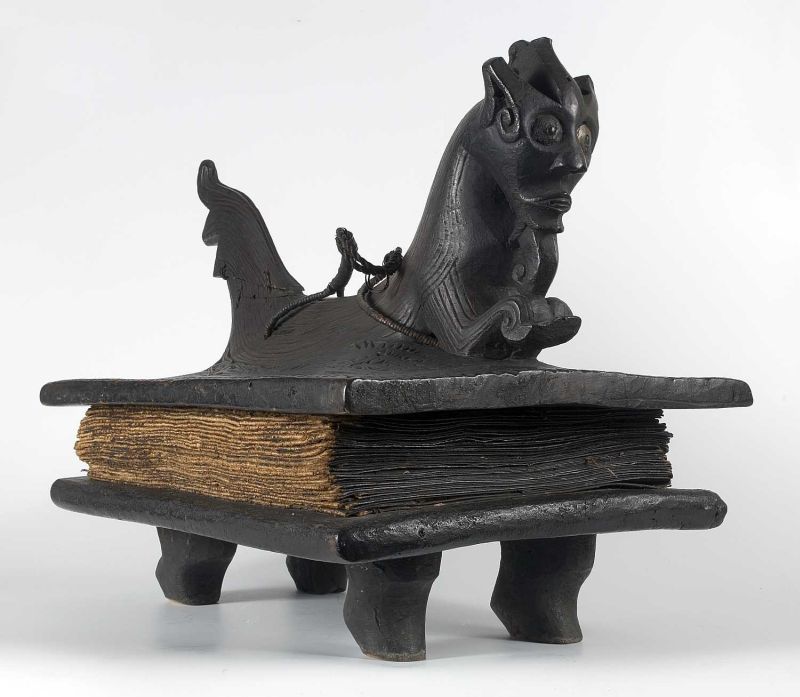
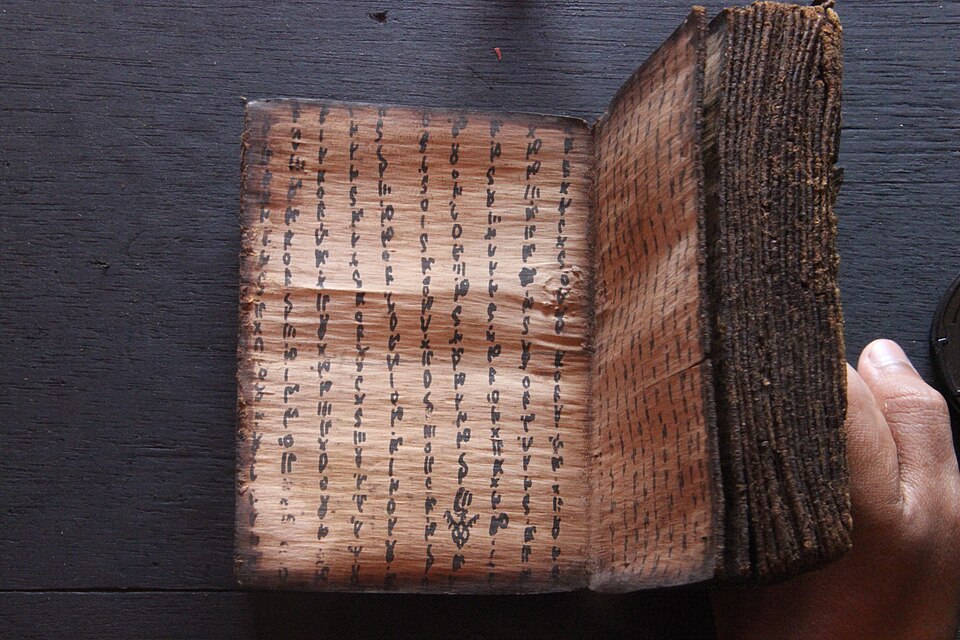
Other traditions turn water directly into a named landform. In the Bandung basin, Sangkuriang dams the Citarum and is close to finishing a lake and a boat before dawn when Dayang Sumbi fakes the sunrise; he kicks the boat over, and it is Tangkuban Parahu — the upturned prau — on the skyline, while the unfinished dam lets the water out of the basin. Lakes did occupy that basin, the last of them draining in the late Pleistocene. The story hands you the mountain, the river, the drained plain and the vanished lake in a single unbroken account.
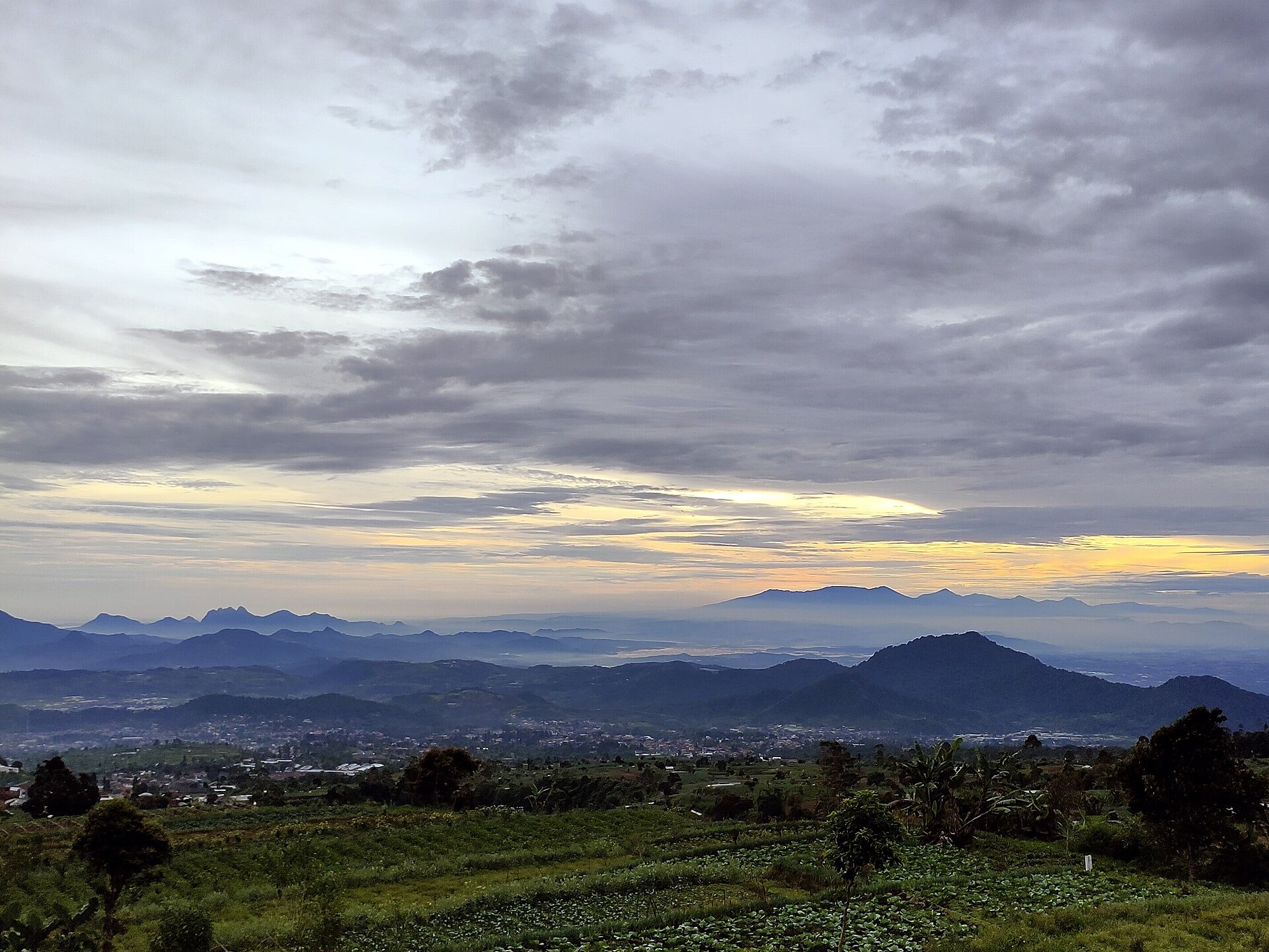
In Central Java, Baru Klinting is mocked and turned away by a village, and plants a stick that none of them can pull out of the ground. When he pulls it out himself the water comes up after it, and the village is gone. Nyai Latung survives in a rice mortar because she was the one who fed him. The water that came up out of the hole is Rawa Pening, and people fish it and farm its margins today.
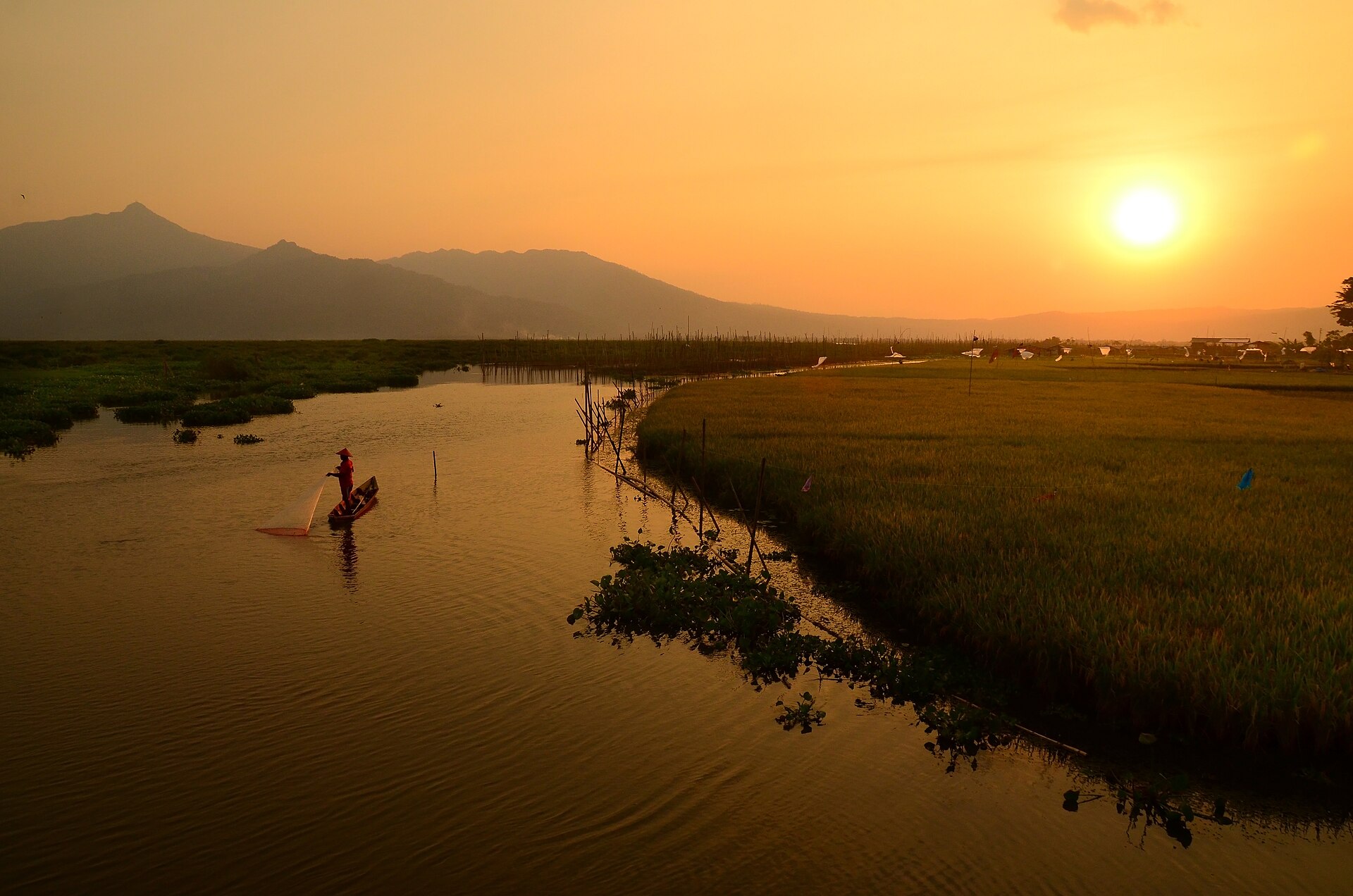
On Timor, in Tetun-speaking Koba Lima, a rice bird pecks through the rock that blocks the waters’ way north. Three rivers drain through the opening, and southern coastal plains emerge. People carry spring water and a banyan branch down from Fatumea, pour the water into the soil and plant the branch. Their descendants still guard those plains through ritual: keeping habitable land is work the ancestors began and the living continue.
On Romang the sailfish leaves an itinerary: Black Island parts from the coast at Ivory Water, and Maupora, Broken Island and Mosquito Island are knocked free. Luang remembers a larger country shattered into islands; Patrick Nunn compares its loss with land sinking during an earthquake. Luang today is a small island at the centre of a wide reef flat. The lost country lies around the remnant, under shallow water, where the sailfish left it.
And in the Peninsula, Batin To’ Entah finds water under a jelutong stump, and a white river turtle comes out of it with an immense quantity of water behind. The great animals fail to kill the turtle; the mouse-deer succeeds. The released water is the sea. It is an origin of the sea, told in country that stands at the edge of the drowned Sunda Shelf, by people whose ancestors watched that sea arrive.
Two Sumatran traditions carry a date: smong on Simeulue, from the tsunami of 1907, and the Syair Lampung Karam, from Krakatau in 1883. They show what a carried instruction can do. In 2004 the word smong emptied Simeulue’s coast, and the island lost a handful of people where its neighbours lost tens of thousands. A story held an order across a century and the order was obeyed.
That is what the rest of this map is doing, at longer range and on other subjects. The flood is the moment the terms were set. It gave the To Pebato the mice’s share of the harvest and the Riung the pig and the chicken paid in place of a body; it gave Seram its two moieties and named the Uliassers; it gave the Ifugao their valleys, the Bontoc their rough mountains, the Tinguian the fire in the bamboo, and Sumba the order in which sixteen domains were founded and are still held. Water took a world apart and handed back another, and the one it handed back is the one people are living in.
Key sources
Map. Terrain: GEBCO; sea levels: Lambeck et al. 2014.
The Alor–Pantar case pairs Sulistyono et al. 2024 with Kealy et al. 2020 and O’Connor et al. 2017. The Bali comparison uses the Buleleng telling above, Voris’s Pleistocene shoreline maps, and Solihuddin on Sunda Shelf sea rise.
The Seram charter is van der Crab, De Moluksche Eilanden (1862), pp. 212–213, for Nusaku, the bird Marapati, Uli Lima, Uli Siwa and Uli Ase, the naming of the Uliassers, and the division into Pata Siwa and Pata Lima; Frazer’s digest of the same material is at Folk-Lore in the Old Testament I, pp. 223–224. The Dusun snake-drum is I. H. N. Evans, ‘Folk Stories of the Tempassuk and Tuaran Districts’, JRAI 43 (1913), pp. 469–470; the Iban voices in the boiling bamboo are Leo Nyuak, ‘Religious Rites and Customs of the Iban or Dyaks of Sarawak’, translated by Edmund Dunn, Anthropos 1 (1906), p. 17, with the fuller cycle in Hose and McDougall, The Pagan Tribes of Borneo II, pp. 144–147. The To Pebato mouse is Adriani and Kruijt, De Bare’e-sprekende Toradja’s van Midden-Celebes, Derde Deel, p. 386, with the Poso marine shells at I, pp. 19–20 and 247; the Mori nine waves are J. Kruyt, ‘De Moriërs van Tinompo’, BKI 80 (1924), pp. 129–130. The Riung material is P. Arndt, ‘Aus der Mythologie und Religion der Riunger’, TBG 75 (1935), pp. 347–351. The Sasar couplets are Janet Hoskins, The Play of Time, p. 33. The Bugis prohibition is Koolhof 1999, p. 375. Philippine tellings are Seidenadel, Jenks, Cole, Beyer and Wilson; Borneo, Schwaner, Roth and Hose; and Paredes for the Higaunon and Agusanon panud. Each card in the table gives the individual work and locator.
Luang’s sailfish and the Damer settlement account: Sandra Pannell, ‘Of gods and monsters’, in Peter Boomgaard (ed.), A World of Water (2007), pp. 77–79.
Balthasar Kehi and Lisa Palmer, “Hamatak halirin: The cosmological and socio-ecological roles of water in Koba Lima, Timor”, Bijdragen tot de Taal-, Land- en Volkenkunde 168 (2012), pp. 453–454 and 459–460, for the rice bird’s drainage, the transplanted spring and continuing protection of the southern plains.
The bullroarer records are the Atlas’s own: the Semaq Beri thunder-board is Ivor Evans in JRAI 48 (1918), p. 191; the Ende and Lio jata and the region’s other roarers are catalogued at All records, each with its own source. As far as we know, the pairing of the Semaq Beri thunder-board with the Peninsular storm floods is original to this page.
Continue the series: Sahul, East Asia, South Asia, the Mediterranean Near East, Doggerland, North America, South America, and the coasts where it is not remembered. The series hub, Twelve Drowned Worlds, maps the drowned landscapes the nine essays are standing on.