No. EXH2026-032
Semaq Beri (Evans's Sakai-Jakun) lightning bullroarer myth
Malaysia · Tekai River, Jerantut district, Pahang · Southeast Asia · Malay Peninsula
Function not recorded
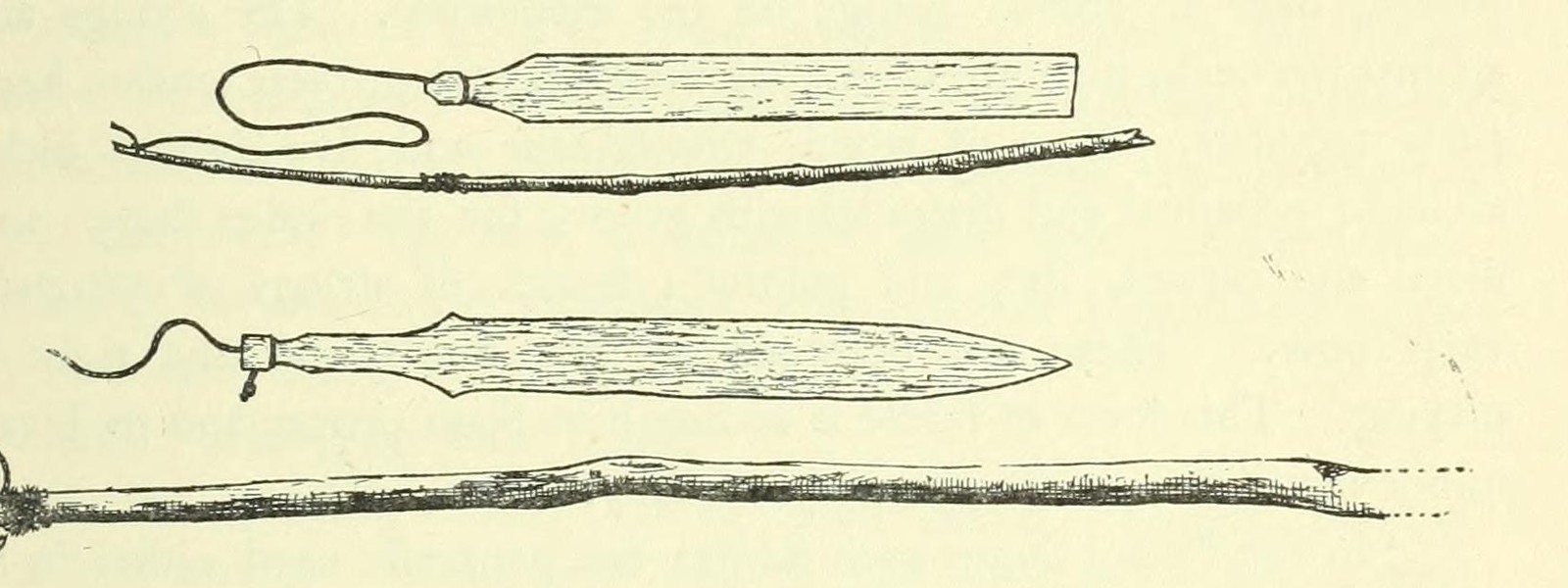
Source term: bull-roarer (Evans's gloss)
Among the Sakai-Jakun whom Ivor Evans met on the Tekai River in Pahang in the 1910s, thunder was the noise the spirit Nenek — the word means "ancestor" in Malay — makes by banging his arms against his sides to sound his armpits; the lightning that comes with it is Nenek flashing a thin board tied to a string, which Evans glossed as a bull-roarer. The same people held that an anteater holds up the sun, bringing night when it curls its body around it and day when it unrolls. On the Tekai the instrument appears only in the sky, as the thunder spirit's means of making lightning flash; down on the east coast, the Malays knew the bull-roarer too.
Thunder, they say, is caused by a spirit called Nenek (Mal. = ancestor), who makes a noise in his armpits by banging his arms against his sides. He also makes the lightning by flashing about a thin board which is attached to a string (i.e., a bull-roarer).
Evans, "Some Sakai Beliefs and Customs," JRAI 48 (1918): 191
Particulars
- Object
- Thin board attached to a string (mythic lightning-maker).
- Function
- Not recorded.
Source
Ivor H. N. Evans, 'Some Sakai Beliefs and Customs,' JRAI 48 (1918), p. 191