Atlas Essay —
The Hound in the Dark
In New Guinea, West Africa and Australia the bullroarer is a dog, and those who hear it are its quarry
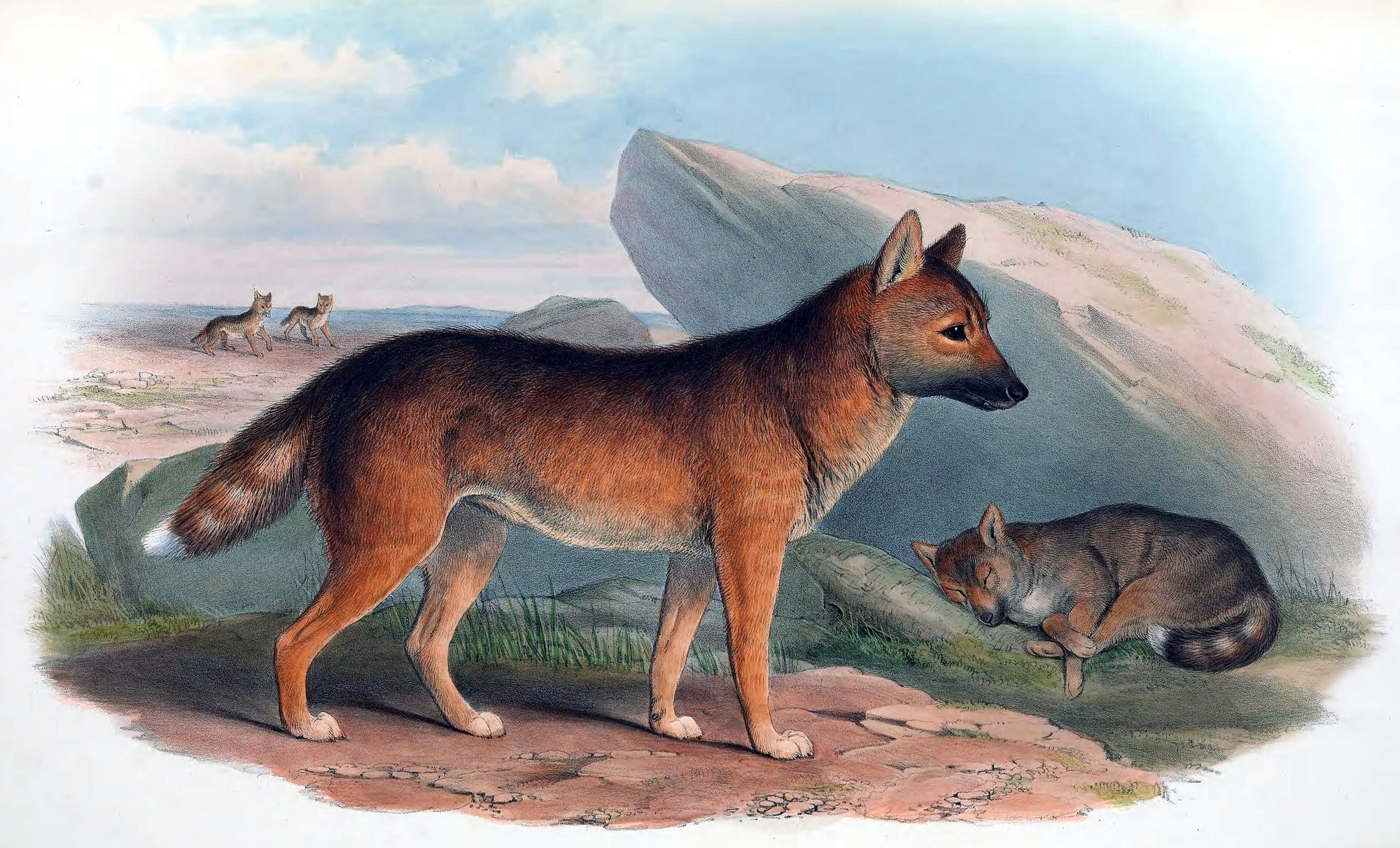
In Nigeria, while the women bolt their doors, the town cries, “Hark! that is old grandfather’s dog.” The dog is a slat of wood whirled on a string. On an island off New Ireland in Papua New Guinea the same sound runs a dead man’s spirit through a dark village, and when it stops the spirit is dead. Boys in the Papuan mountains hear it coming for them. In the Australian desert the dogs are flesh: they follow the first roar made on earth to the men who are making it, and cut off their heads.
From the Papuan mountains to the Niger and the Australian desert, the bullroarer’s roar is a dog on the hunt, and the people it is sounded for are its quarry; where it is not the dog, it calls the dogs.
In brief
- Among the Yagwoia of Papua New Guinea the bullroarer at initiation is “a hair-raising voicing of an invisible dog.” It announces that the “dog will capture the marsupial,” the novices, and the capture is “their insemination by the senior initiates.”
- On Tatau, off New Ireland in Papua New Guinea, on the night before a burial, men run through the dark village whirling bamboo bullroarers under a shower of fire spears. The sound is the wild dog from the bush chasing the dead man’s spirit. “When the bullroarers stopped, this spirit was killed.”
- The Yoruba told Leo Frobenius that the great Oro boards are the dead grandfather, and that the slender board weighted with a stone axe is “old grandfather’s dog; he is barking here, he is barking there.” Peoples of the upper Niger told him their roarers were the ancestors “and their dogs.”
- Across West Africa the small roarer beside the great one is a dog: the “little dog of the Komo” beside the Manding mother, “the dog of the little akata” beside the Efik cow, and the Dii “little dog” that yaps beside the panther.
- In Hausa the bullroarer is kura, the hyena. Under its Zaria name, fatauci, no woman may see it; at Katsina hunters whirled a corn-stalk kura to call their dogs. The Yagwoia likewise sound the bullroarer to excite their hunting dogs.
- The Kaytetye of Central Australia say two wild dogs heard the first bullroarers made on earth, crept up, said “they smell very good,” and cut the makers’ heads off. On the Brisbane River the new initiates camped apart for three months, making their small roarers bark like dogs.

The dog will capture the marsupial
The Yagwoia are an Anga people of the high forest where Papua New Guinea’s Morobe, Gulf and Eastern Highlands provinces meet. Their world is the body of one being, Imacoqwa, who is the sun and the moon and who once climbed the trees as a marsupial and flew up into the sky. Under a secret name the same being is a hunted animal and the thing that hunts it:
“As this personage he is both the possum=man (the prey that is killed) and the hunter (predator) who killed him. The killer=predator Wuiy-Malyoqwa also has the animal forms of the dog and the harpy eagle, the two animals which in fact hunt marsupials.”
Jadran Mimica, Imacoqwa’s Arrow (2025), p. 58.
Both hunters come for the boys. The eagle comes in the open. The man who pierces the novices’ noses does it with a bone that is the harpy eagle’s claw and beak, which “seizes and penetrates the marsupial’s (=novice’s) nose,” and when he has finished he makes the gesture and the cry of a harpy eagle that has just killed a marsupial (Mimica 2025, pp. 58–59). The dog never shows itself. It is a sound.
“Another manifestation of this canine aspect of Imacoqwa’s (=Wuiy-Malyoqwa) being is the sound of bull-roarers used during the initiations, hunting magic (to excite the dog, which is administered a special bespelt mixture), and warfare (to excite the warriors and frighten their prey). In the initiations the sounding of the bull-roarers is intended as a hair-raising voicing of an invisible dog. It announces an act one of whose condensed meanings is that the ‘dog will capture the marsupial (=novices)’. The ‘capture’ in question is their insemination by the senior initiates.”
Mimica (2025), p. 59 n. 25.
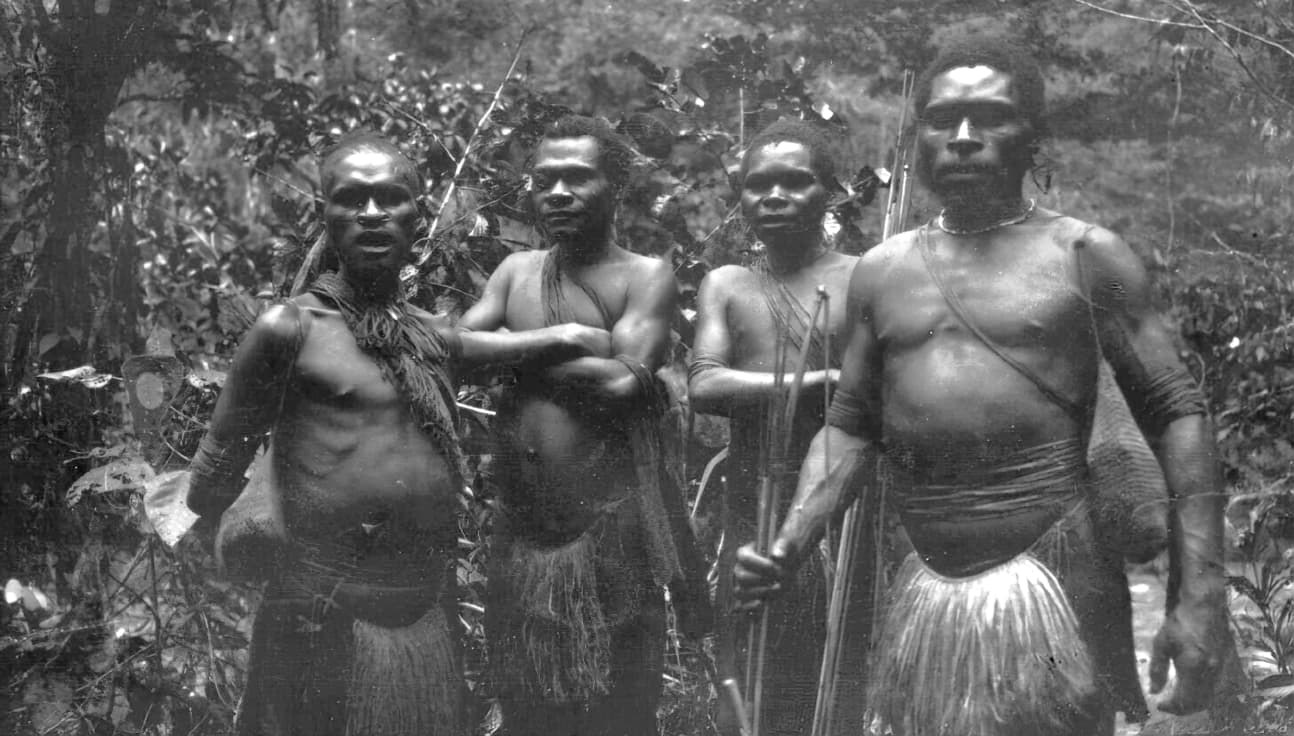
The boys are game, the older youths are the pack, and the roar in the dark is the pack giving tongue. The Yagwoia carry the figure into war. The dog form of Wuiy-Malyoqwa belongs to one of their territorial groups, the Iqwaye, whose men were called the “Iqwaye dogs,” because whenever they killed a person in battle “they voiced ‘Wuiiy—Awk, awk, awk… !’ that is, like a dog which has just caught a marsupial” (Mimica 2025, p. 59 n. 25). The bullroarer itself began in a dog’s mouth: it is the tongue pulled from the primal dog.
The wild dog from the bush
Some eight hundred kilometres to the north-east, the Tabar Islands lie off the coast of New Ireland in Papua New Guinea. They are the reputed home of malagan, the carvings, songs and rites with which a clan finishes its dead. On 28 January 1984 a clan leader named Pamas died at Pekinatinis hamlet on Tatau. Michael Gunn was there. On the second afternoon a dozen young men sat in the ritual enclosure “making teter bull roarers from dry bamboo stems shaved thin,” and tying coconut husk to bamboo shafts for fire spears. At ten past ten that night the village square opposite the dead man’s house was full of people and no lamp was lit.
“In complete silence and absolute darkness groups of fire spears were suddenly thrown up into the air from behind both the men’s house and the woman’s house opposite. Plenty of spears landed on the roof of Pamas’s men’s house, but none actually set fire to it. Then out from the malagan ritual site came a group of [Saterir] and [Keis] men whirling bull-roarers, running underneath this shower of fire and right through the village square into the darkness toward the saba tree at the far end of the hamlet. When the noise of the bull-roarers had been replaced by silence, lamps were lit and people sat around the village square in small groups, chatting quietly.”
Michael Gunn, Malagan Ritual Art on Tabar, New Ireland (1992), p. 26.
The village had heard a hunt. The sound of the bullroarers “gave the kupuin mucgur sound of the wild dog from the bush chasing the spirit of the dead man.”
When the bullroarers stopped, this spirit was killed.Michael Gunn, Malagan Ritual Art on Tabar (1992), p. 27
Songis’s group of young men had worked the fire spears and the wild dog, and at the pig feast that followed his was the hunter’s share, the pig’s head (Gunn 1992, p. 27). Pamas was buried the next morning.
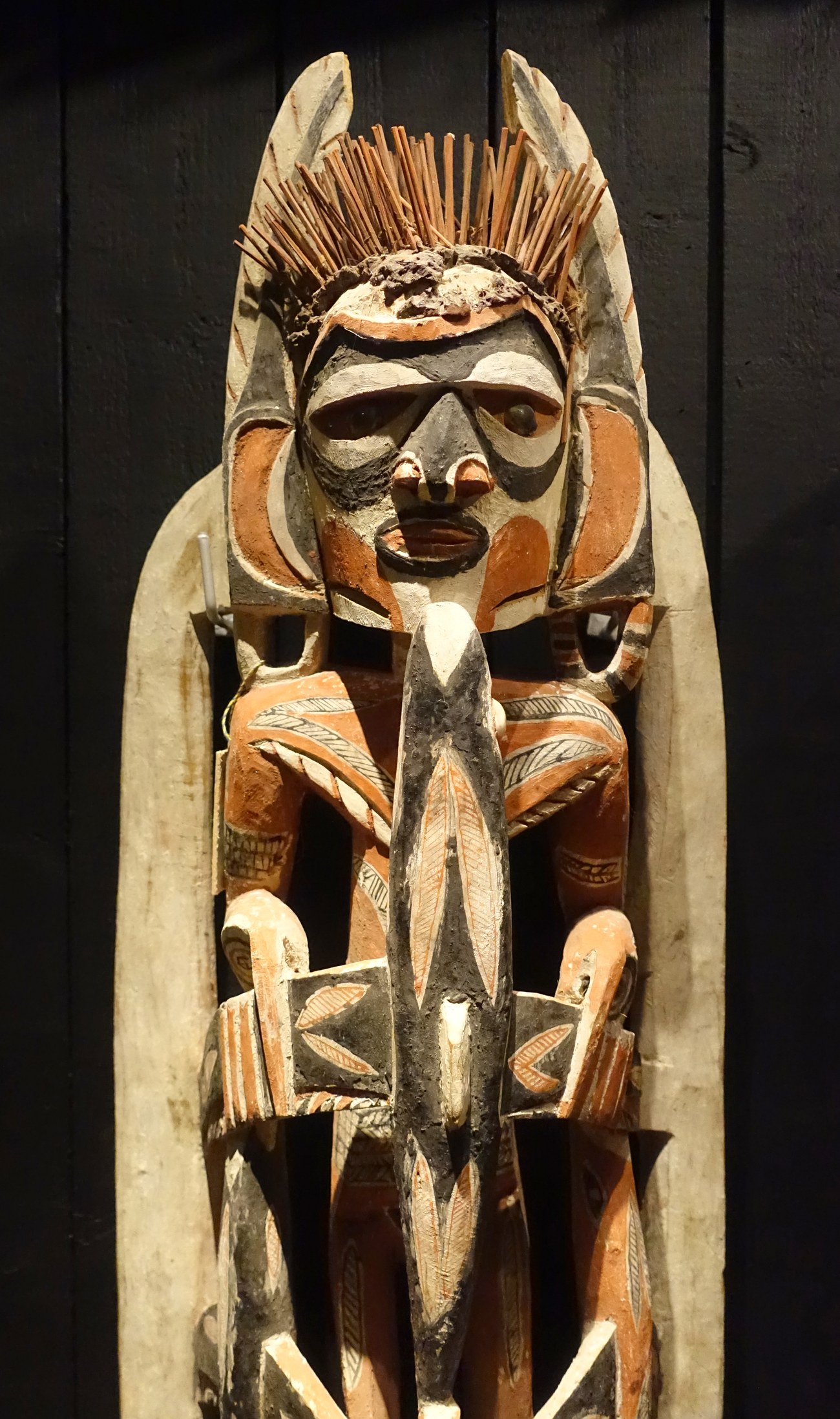
The dog belongs to Madas, one of the malagan traditions Pamas had owned, and Madas is the malagan of the worst things. Several of its songs are about incest. Its old initiations, Gunn was told, “are reputed to have involved incestuous activity which was carried out between a brother and sister under a mat and in front of the malagan men,” an act “terminated by spearing the two to the ground.” The wild dog, used with the fire spears and the bullroarers “to ‘kill’ the dead man’s spirit during the night prior to the burial,” was one of the parts of Madas that people called “no good” and tied to the night (Gunn 1992, p. 135).
Old grandfather’s dog
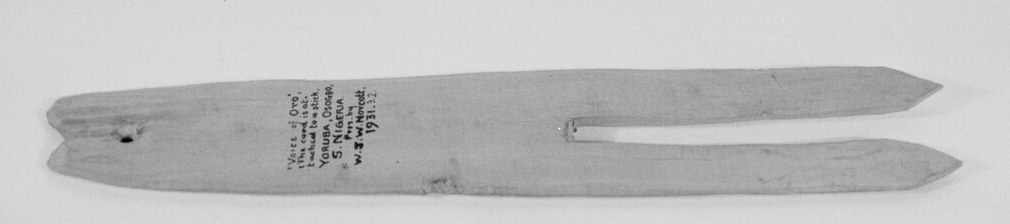
The same dog barks on the other side of the world. Among the Yoruba of south-western Nigeria the bullroarer is Oro, the night voice that drives every woman indoors. In 1910 the Yoruba gave Leo Frobenius the story of how the Oro boards began. A poor man, whose wife was sick like every woman in the land, cut flat boards in the forest, bored them, and whirled them on a string. He taught his sons in secret. Then he brought the boards home:
“He laid the Oro on the earth in the Gondu and said: ‘This is my great Father. We will give him a ram and a dog to eat. But we will give him a dog first of all, because my great Father once got lost. The dog showed him the road. Without the dog my great Father would not have found the way.’ …
“At evening the old man said: ‘My old grandfather will come out to-night and take the food which I have brought him.’ When he said this, all the women ran away (because they were frightened). The sun was going down. They went in and made fast the doors behind them. After that the old man gave his sons the buzzers. They began to twirl them. One jumped here, then he jumped there. He was heard in this place, he was heard in that. It was a great, it was a mighty noise. The folk said: ‘Listen! hark! that is the old dead grandsire himself’ (Baba Oro). One son was tall and slender, and had bound a stone (an old stone axe-head) in the middle of his Oro. The people said: ‘Hark! that is old grandfather’s dog; he is barking here, he is barking there.’ The people shouted: ‘Adja Aka-oko. Hekwa Oro! Hekwa Oro!’ The women were indoors.”
Leo Frobenius, The Voice of Africa (1913), vol. 1, pp. 168–169.
Two voices go through the town. The deep one is the dead man. The second, from a board with an old stone axe-head bound to it, is his dog, running loose ahead of him, heard now in one street and now in the next. Adja in the people’s shout is ajá, the Yoruba word for dog. The women do not look to see which is which.

The legend, Frobenius wrote, “connects the buzzers with a dog,” and it was not alone: “I also heard these bull-roarers spoken of by the peoples of the Upper Niger as being the voices of long bygone ancestors and their dogs” (Frobenius 1913, vol. 1, p. 169). At Brass in the Niger Delta, where the roarer came down from Oro, the first one was swung to tell a king that his son, a hunter, and the son’s dog had died together in a ditch.
The little dog
The upper Niger is Manding country, and there the dog has a name. The Komo is the great men’s society of the Malinke and Bambara of Mali and Guinea. When the circumcision knife has done its work, Henri Labouret wrote in 1934, a huge humming voice comes out of the bush and says slowly, “I am hungry,” until the eldest guardian cries back, “Mother, O Mother, be patient, the children are too young.” The voice is the komo-ba, the mother of the Komo, a forged iron bullroarer some forty centimetres long swung far off by a strong man. Labouret’s list of the society’s instruments sets a dog beside her: “Komo-ulu-ni, little dog of the Komo, a bullroarer of wood or of iron, some thirty centimetres long” (Labouret 1934, ch. V). The mother who will swallow the boys has a dog.
At Calabar, on the Cross River in south-eastern Nigeria, M. D. W. Jeffreys collected the Efik names of musical instruments in 1919. Akata is the bullroarer, and there were two:
“Ebua ekpri akata = The dog of the little akata. Akata is the generic name for the bull-roarer which is regarded as sacred by these peoples. As a consequence, beyond the name, no information about it was obtainable. …
“Enang ekpri akata = The cow of the little akata. It, like the ebua ekpri akata, is regarded as sacred. It is a much larger bull roarer than the ebua and may be used only by members of the Ekpo secret society. Ekpo = ghost and this society holds its revels at night and the wailing of the enang ekpri akata is regarded as a ghostly voice.”
M. D. W. Jeffreys, “Efik names of some musical instruments,” African Music 4(2) (1968), p. 70.
The Dii of the Adamawa plateau in northern Cameroon tell their women that the roar from the circumcision bush is a panther. Jean-Claude Muller found the dog beside the panther three times over. In one of the boys’ chants the word “dog” is an “allusion to the circumcised who have beaten the leopard and who are now superior to the women” (Muller 2002, p. 87). A piece of wood that brings luck to the whole class of boys is called “little dog” or zág waa, “little leopard.” And in some Dii villages “the circumcised boys hide in their caps a miniature bullroarer also called ‘little dog,’ because it imitates the yapping of a dog when the initiates work it” (Muller 2002, p. 100; translated from the French).
| People | The great roarer | Its dog |
|---|---|---|
| Yoruba, Nigeria | Baba Oro, “the old dead grandsire himself” | The slender board weighted with a stone axe: “old grandfather’s dog” |
| Manding Komo, Mali and Guinea | Komo-ba, the mother, forty centimetres of iron | Komo-ulu-ni, “little dog of the Komo,” thirty centimetres of wood or iron |
| Efik, Nigeria | Enang ekpri akata, the cow, the wailing of a ghost | Ebua ekpri akata, “the dog of the little akata” |
| Dii, Cameroon | The panther of the circumcision bush | The “little dog” in the boy’s cap, which yaps |
From the upper Niger to the Cameroon highlands, some two and a half thousand kilometres, the arrangement holds. A great roarer is the being itself, grandfather, mother, ghost or panther, and a smaller one beside it is a dog.
The hyena that calls the hounds
Between the Niger and Lake Chad, in the Hausa country of northern Nigeria, the animal in the bullroarer is the other pack hunter of the night. G. P. Bargery’s Hausa dictionary of 1934 gives the word kura its first meaning, “the spotted hyena,” and further down the entry, “a bull-roarer.” Under the Zaria word for the same instrument he set down what it did:
“fatauci. A ‘bull-roarer’ used in Pagan rites. (= kura.) fatauci ba ganin mata ba, a ‘bull-roarer’ is a thing which women must not see. (In Pagan districts this instrument is rigorously kept from the sight of women. When being used all females must hide in their houses, or they will die!)”
G. P. Bargery, A Hausa-English Dictionary (1934), s.v. fatauci II; s.v. kura 1(a), 5(a).
Under its Zaria name the roarer clears the women from the night. Two hundred kilometres north, at Katsina, the hyena went hunting. In 1933 P. G. Harris gave the Pitt Rivers Museum the musical instruments he had collected in northern Nigeria, among them a pair of corn-stalk clarinets “used as dog-calls in hunts” and, straight after them in the museum’s report, a “kura of corn-stalk, perforated and whirled on a string, used as above” (Pitt Rivers Museum, Annual Report 1933–34). The hunters whirled the hyena and the dogs came in.
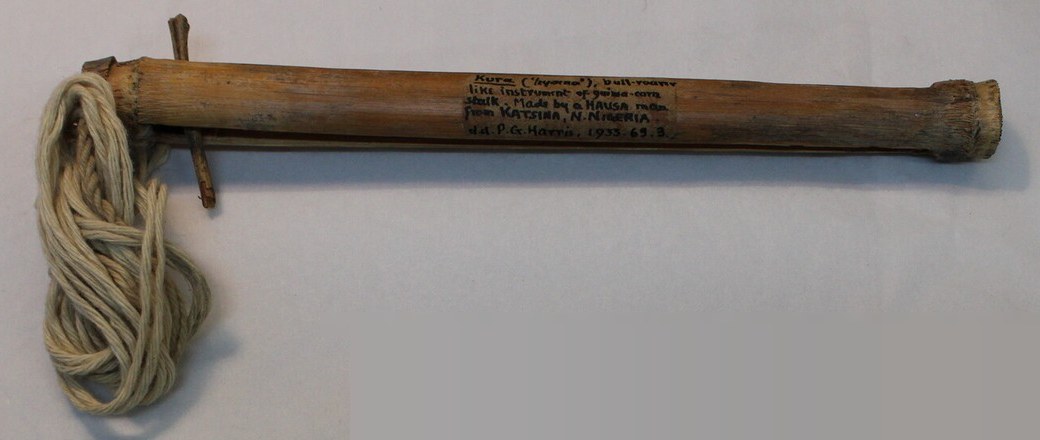
The voice of one pack hunter calls the other. The Yagwoia use theirs the same way. Their bullroarer, the voice of the invisible dog, is also sounded as hunting magic, “to excite the dog, which is administered a special bespelt mixture,” and in war “to excite the warriors and frighten their prey” (Mimica 2025, p. 59 n. 25). In the Papuan mountains and on the Nigerian savanna one instrument sets the pack running and sends everything else to ground.
Barking round the Bora ring
In Australia the dog is in the sound itself. The Turrbal of the Brisbane River in Queensland had two bullroarers at their initiation, the great Bugerum and the Wobblekum, “about four inches long by an inch wide.” The boys sat by day with opossum rugs over their heads, under armed sentries “prepared to spear any boy who might be tempted to look up or laugh.” The women and children believed the unearthly sounds were made by the medicine-men swallowing the novices, “and a woman who attempted to spy out the ceremonies would have been certainly killed” (Howitt 1904, p. 596). When it was over the boys were dressed as men: “Dogs’ tails and snakes’ skins were tied round the head” (p. 597). The gathering closed with days of fighting between the tribes. “A man who was killed in this fighting was eaten, and such a catastrophe was the signal for the cessation of hostilities.” After that the Kippurs, as the new men were called, were kept from the women for about three months, “each night going into the bush to camp by themselves, and taking with them their respective Wobblekums, which they sounded, making with them sounds like the barking of dogs” (p. 599). A Brisbane collector, W. I. Weatherill, who gives the Moreton Bay name as “Wobbilcong,” described another roarer at work inside the ring:
During the whole of this ceremony one of the old men walks around the Bora circle whirling the Wilmurra and barking like a dog.W. I. Weatherill, in the Catalogue of the Crosby Brown Collection of Musical Instruments, vol. II (1914), p. 45
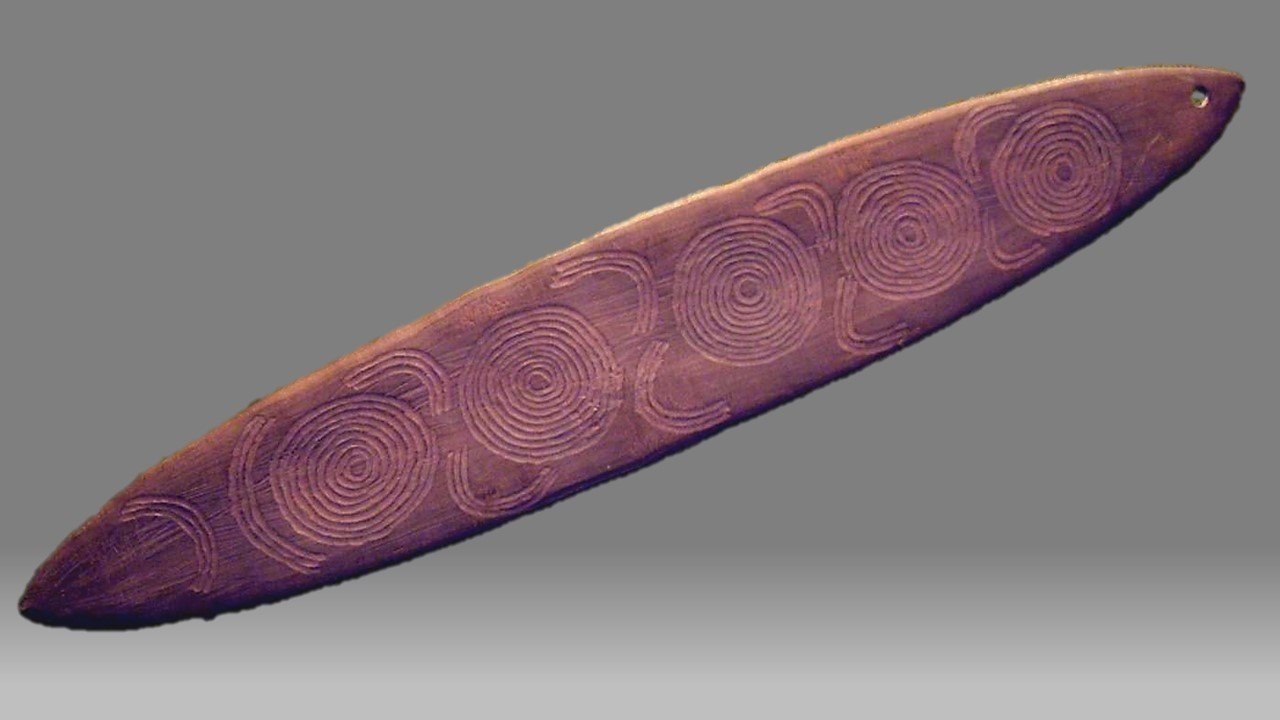
In Central Australia the dogs are in the first story the bullroarer has. It belongs to the Kaytetye, north of Alice Springs in the Northern Territory. Two men of the Dreaming, the Tumana, copied the sky-being Atnatu’s roar with a board of mulga wood and swung it all day long.
“Two wild dogs living not very far away, at a spot called Arungatairidina, heard them and said, ‘Hullo, what is it making that noise?’ … Then the two dogs quietly sneaked up to Arungalla, and there they smelt the men and said, ‘Oh, they smell very good.’ Each of them then chased one of the Tumanas, and caught them just as they were going down into holes in the ground. The wild dogs cut the men’s heads off, and then went back to their own camp.”
Baldwin Spencer and F. J. Gillen, The Northern Tribes of Central Australia (1904), p. 420.
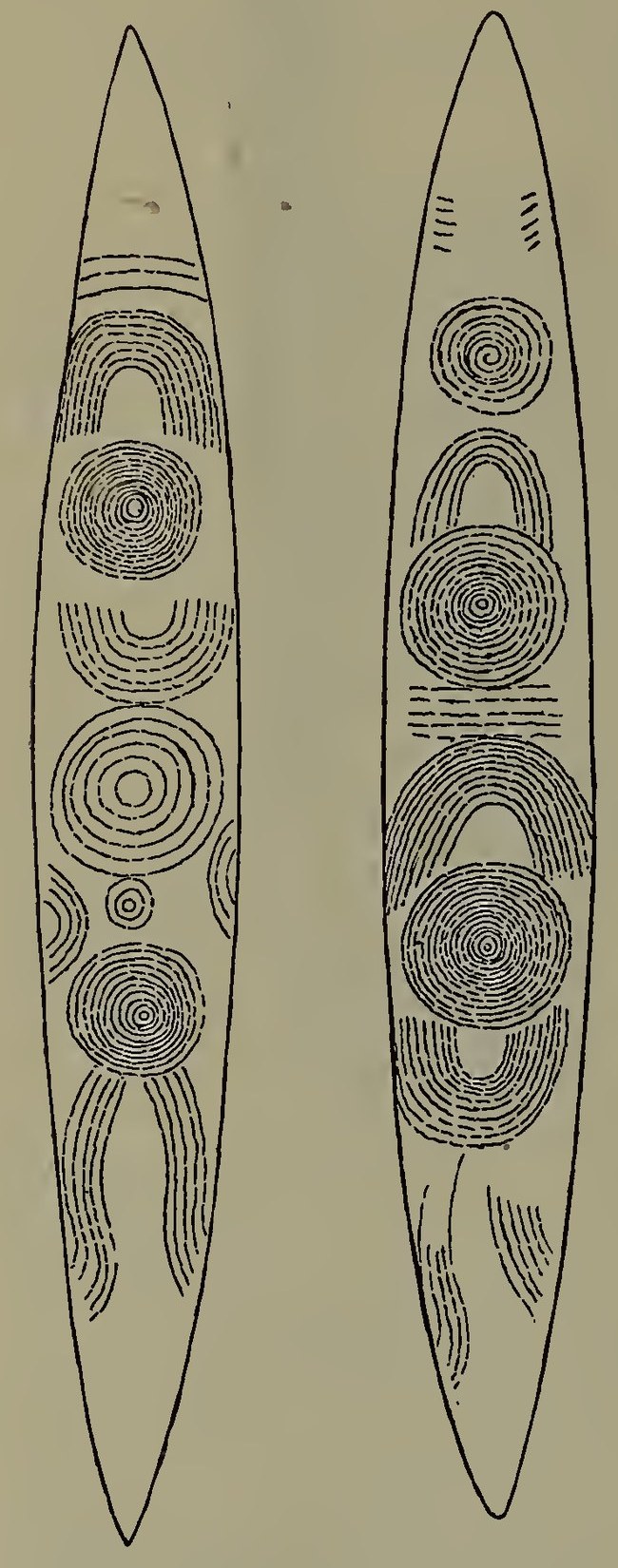
Their northern neighbours the Warumungu, around Tennant Creek, tell it of a single man. Murtu-murtu, whose name is the Warumungu word for the bullroarer, spent his days making the roar with his mouth. Two very big wild dogs “heard the noise made by the man all day long. They decided to follow it up.” They stalked him from two sides and tore him apart, and his flesh roared as it flew (Spencer and Gillen 1904, pp. 279, 434–435). A Warumungu boy hears this on the night he is first shown the instrument. His father puts it in his hands, and the men tell him “the legend of how the murtu-murtu was first made in the Wingara by a man whom the wild dogs killed and eat, but, though they did this, they could not destroy the sacred stick” (Spencer and Gillen 1904, p. 352).
Twice, then, among neighbours, the first roar made on earth draws dogs, and the dogs do what dogs do to a thing that runs: they chase it down a hole, or they pull it to pieces. Further north, among the Binbinga inland from the Gulf of Carpentaria, the dogs own the instrument outright: “the origin of the Churinga is attributed to two Dingo men of the Alcheringa, who also first introduced the use of a stone knife at circumcision” (Spencer and Gillen 1904, p. 280).
And on the Northern Territory coast, among the Murrinh-Patha of Port Keats, south-west of Darwin, the boys who wait to be swallowed by the Mother whose voice is the bullroarer are made into dogs before they hear her. W. E. H. Stanner: “From this time on their personal names are not used. Anyone who speaks to or about them calls them ku were (lit. ‘flesh’, ‘wild dog’). Any flesh which is ku cannot be that of persons or kadu. The youths are not only made nameless but are symbolically no longer human either” (Stanner 2014, p. 6). The word that calls a youth a wild dog also calls him flesh.
The quarry
A bullroarer in use is a voice with no body. It is swung in the dark or behind a screen of bush, it moves faster than a man seems able to move, and the people it is meant for are forbidden to look. Every people who keep it must say whose voice that is. Across northern Australia and New Guinea the usual answer is a monster that swallows the boys. The peoples in this essay gave a second answer, and they gave it far apart: the voice is a dog.
A dog is the hunter that is heard before it is seen. It gives tongue on a trail at night; it runs ahead and to the side, “barking here, barking there”; and its noise tells the quarry exactly what is happening to it. So where the roar is a dog, the hearers are game. The Yagwoia novices are marsupials. The dead man of Tatau is run through his own village and killed when the noise stops. The Yoruba women bolt their doors against the grandfather’s dog, and in the pagan districts of Hausaland the women hide from it “or they will die.” In Central Australia the hunt turns on the roarer’s own makers, who are caught at the mouths of their holes.
A dog also hunts for someone. Behind the Yoruba dog walks the dead grandfather, who once lost his way and was led home by it. Behind the little dog of the Komo comes the hungry mother; beside the Efik dog wails the cow with the ghost’s voice; beside the Dii little dog roars the panther; behind the invisible dog of the Yagwoia, the senior initiates. The dog is the part of the rite that goes out and fetches. A rite this particular, a voice that is a dog and hearers who are game, travelled. It runs from the Niger to the Papuan mountains and the islands off New Ireland because the bullroarer carried its meanings from people to people, and the dog went with the instrument.
The hunt has one more turn: the hunted boys take up the dog’s voice themselves. The Kippurs of the Brisbane River sat under their rugs with spears over them while their mothers believed the medicine-men were swallowing them. Then they came out with dogs’ tails tied round their heads, and for three months of nights they went into the bush with their own Wobblekums and made them bark. The boy is caught by the dog in the dark, and then he whirls the roarer and makes it bark.
Key sources
- Jadran Mimica, Imacoqwa’s Arrow: On the Biunity of the Sun and Moon in a Papuan Lifeworld (Chicago: HAU Books, 2025), pp. 3–4 (the Yagwoia and their country), p. 58 (Wuiy-Malyoqwa as prey and hunter, dog and harpy eagle), pp. 58–59 (the nose-piercer as harpy eagle), p. 59 n. 25 (the Iqwaye dogs; the bullroarer as the voice of an invisible dog; hunting magic and war; the tongue of the primal dog).
- Michael J. Gunn, Malagan Ritual Art on Tabar, New Ireland, Papua New Guinea (PhD thesis, University of Otago, 1992), p. 22 (the “chasing of the wild dog”), pp. 26–27 (the funeral of Pamas, Tatau, January 1984), p. 135 (Madas, incest and the wild dog).
- Leo Frobenius, The Voice of Africa, trans. Rudolf Blind (London: Hutchinson, 1913), vol. 1, pp. 168–170 (Oro; the legend of the boards; grandfather’s dog; the upper Niger ancestors “and their dogs”).
- Henri Labouret, Les Manding et leur langue, Bulletin du Comité d’études historiques et scientifiques de l’Afrique occidentale française 17(1) (1934), ch. V (the night voices of the Komo; the list of Komo instruments: komo-ba and komo-ulu-ni); translated from the French.
- M. D. W. Jeffreys, “Efik names of some musical instruments,” African Music 4(2) (1968): 70–71, p. 70 (ebua ekpri akata, enang ekpri akata).
- Jean-Claude Muller, Les rites initiatiques des Dìì de l’Adamaoua (Cameroun) (Nanterre: Société d’ethnologie, 2002), p. 87 (the circumcised as “dog”), p. 100 (the lucky wood called “little dog” or “little leopard”; the miniature bullroarer called “little dog”).
- Tomas Sundnes Drønen, Communication and Conversion in Northern Cameroon (Leiden: Brill, 2009), p. 127 (the Dii bullroarer as the panther’s voice).
- G. P. Bargery, A Hausa-English Dictionary and English-Hausa Vocabulary (London: Oxford University Press, 1934), s.v. kura 1(a), 5(a); s.v. fatauci II (p. 805 in Shuji Matsushita’s 1994 edition of the Zaria vocabulary).
- Pitt Rivers Museum, Annual Report 1933–34, donations of P. G. Harris (the Katsina kura, accession 1933.69.3).
- Baldwin Spencer and F. J. Gillen, The Northern Tribes of Central Australia (London: Macmillan, 1904), pp. 272–273 and 420–421 (the Tumana and the wild dogs), pp. 279 and 434–435 (Murtu-murtu and the wild dogs), p. 280 (the Binbinga Dingo men), p. 352 (the legend told to the Warumungu novice).
- A. W. Howitt, The Native Tribes of South-East Australia (London: Macmillan, 1904), pp. 596–599 (the Turrbal initiation; Bugerum and Wobblekum; the sentries; dogs’ tails and snakes’ skins; the man eaten; the Kippurs’ three months).
- Frances Morris, Catalogue of the Musical Instruments of Oceanica and America, Catalogue of the Crosby Brown Collection of Musical Instruments, vol. II (New York: Metropolitan Museum of Art, 1914), no. 738, pp. 45–46 (W. I. Weatherill on the Wilmurra).
- W. E. H. Stanner, On Aboriginal Religion (1963; Sydney: Sydney University Press, 2014), p. 6 (ku were).
- Frobenius set the Yoruba dog beside the upper Niger in 1913. As far as we know, setting the West African dogs beside those of New Guinea and Australia is original to this page.