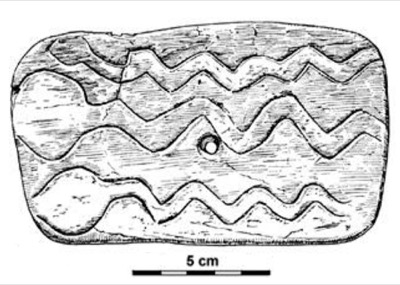
Khanty ethnographer T. A. Moldanov heard a wind board demonstrated at a scholarly meeting and expected the weather to turn windy and bad. Soldatova records that he wanted a fair-weather incantation to counter what the sound had called. A thin board could therefore arrive in a modern room carrying a much older consequence. Its Mansi name, the wind-calling flying board, joins movement, voice and weather in a few words. Across Siberia, sounding blades similarly make the surrounding world answerable: they call the wind, imitate a bird or teach a child whose voice is passing through the air. These uses form a broad family of listening and reply. 1
Asking the wind to come
At Shchekurya, a Mansi village on the eastern side of the Urals, a field photograph from September 1987 shows the slim sounding plank with its cord. Soldatova follows its weather-changing use through Mansi accounts and notes its appearance in the Bear Games. The wind-calling flying board could belong to an occasion with its own songs and performances as well as to the immediate wish to change the sky. Khanty ethnographer T. A. Moldanov’s response to the later demonstration makes the expectation especially vivid: the wind’s voice was powerful enough that sounding it could require another utterance in return. 1
Among neighbouring Khanty, the Kazym name vot vokhty means asking for wind. The scholarly instrument account groups a rotating whirrer with a propeller form under that name, amid children’s whistles, birch-bark sound toys and rattles. The naming supplies a close likeness to the Mansi board: a voiced request directed to wind. Toy-making and the memory of weather work can occupy the same sound vocabulary. The likeness is especially tangible in these neighbouring Ob-Ugric names, each treating wind as something people may address. 2, 1
A feather that speaks a snowstorm
Far northeast among Chukchi, the vyutkunen or vyulgyn was shaped like a bird’s feather. Notches along the wood reproduced its plumage. Its name relates to blizzard, and its sound imitated a snowstorm; the account transmitted by Sheikin and his colleagues says that voice could affect surrounding nature. The blade makes a suggestive meeting of two things the wind carries: a feather’s form and the storm’s roar. The authors distinguish it from the little propeller played with by children, reporting that this howler had retained its consequential role. 3
The Enets instrument account offers a remarkably close form farther west: a rotating howler made like a spindle or feather. It was posi among forest Enets and vyrvyr among tundra Enets, and it could call the wind. The two names keep a local distinction within a shared practice. Chukchi carved feather-barbs into their storm voice; Enets gave the wind caller the profile of a feather or spindle. Shape and sound brought the surrounding air into something a player could hold, move and address. 4, 3
The wind in a child’s hands
Among Nganasan, the biakhery had once established a magical connection with the wind. The instrument account describes it in later use as a children’s toy, alongside the separate sani khery buzzer. The change of occasion still leaves an audible resemblance: a howling sound can matter to a weather-worker and fascinate a child. Nganasan children’s sound tools also included whistles made from goose feather, willow and tubular grass, forms that could imitate birds for hunters. Play grew among the sounds through which people knew and approached the living country. 5
Learning whose voice it is
For Even families, a bullroarer could be an owl speaking. Marilyn Walker’s interview account describes people adding sounds to its basic voice, perhaps to produce a wood grouse. Children listened and guessed whose voice they heard. They also learned to make the instrument reproduce those voices themselves. The game demanded attention and skill: hear a creature, recognise it, then find the movement that lets it speak again. Singing, improvising and recreating nature’s sounds belonged to a child’s musical education. 6
The surrounding Even sound world joined music to practical attention. A reindeer herder’s staff whistled when thrown. Hooves hung on a hide pouch rattled, attracting a reindeer’s attention while making the sound of travel. Walker’s interlocutor described listeners so practised that a bell could tell them whether a reindeer was moving up or down. The owl-speaking blade belonged among these ways of noticing and producing a voice: a child’s game cultivated an ear that would serve in the herd and the wider living landscape. 6
Tools, toys and local names
Teleut herders and hunters used rotating gudelki among simple, one-use sound implements, alongside whistling rods and cracking whips. The scholarly account also places those implements in children’s play. The practical tool and the toy could share a repertoire. A person learned how to make a useful sound from a modest object, and the same knowledge offered pleasure. This working setting gives the broad Siberian family another ordinary route of transmission, through familiar occupations and the sounds children encountered around them. 7
Sakha children knew a droning tool named isiirer. Dyakonova lists it with their musical bow, birch-bark sound strip, wood and horn jaw harps and rattles. A museum toy from Zhilinda in the Olenek country gives that childhood sound world a physical particular: an elongated wooden blade, twelve and a half centimetres long, with cotton thread, collected through Gurvich’s 1944–1945 expedition. On Kamchatka, Itelmen accounts likewise name the rotating plate-on-cord instrument locally: khezvez at Kovran, kel-kel at Tigil. Small sounding objects travelled through particular hands, villages and vocabularies. 8, 9, 13
Sakha (Yakut) · Sakha (Yakut), Olenek · Itelmen / Kamchadal / Kovran-Tigil
The voice beside a human singer
The khirilee entered the Tuva Ensemble’s modern performances with Sergei Ondar, whose instruments included it alongside voice, fiddle and other sound tools. The group’s liner notes describe a chip of wood whirled on strings. Another recorded voice comes from the far northeast: Oumka sang Flight of a Seagull against the Wind with enietkoutchina accompaniment. The brief performance lasts a minute and sixteen seconds. Its title again places a bird against moving air, now in a song preserved on an anthology of Siberian and Far North music. 11, 12
Tuvan Ensemble / modern Tuvan performance context · Siberian Eskimo / Chukchi-Eskimo anthology track
A weather request, a feather-shaped howler, an owl that a child can recognise and a sounding companion to song all make the surrounding world audible through movement. The blade gives that voice a place in human activity: calling, learning, working and performing. Its circling sound lets a player address the living country, and lets a child learn to hear it. 1, 3, 6, 11, 12
Mansi / Ob-Ugric · Chukchi · Even · Tuvan Ensemble / modern Tuvan performance context · Siberian Eskimo / Chukchi-Eskimo anthology track
Names that carry the tradition
| People | Name | Meaning or use |
|---|---|---|
| Mansi | vōt vōvnē tovlyŋ pārt | Wind-calling flying board; spelling follows Soldatova’s account. 1 |
| Kazym Khanty | vot vokhty | Asking for wind; shared by rotating and propeller varieties in the source. 2 |
| Chukchi | vyutkunen / vyulgyn | Names related to blizzard for the feather-shaped storm howler. 3 |
| Forest and tundra Enets | posi / vyrvyr | Forest and tundra names for the rotating spindle- or feather-shaped wind caller. 4 |
| Nganasan | biakhery | The rotating howler formerly used to establish a connection with wind. 5 |
| Sakha | isiirer | The droning sound tool listed among children’s instruments. 8 |
| Tuva Ensemble | khirilee | A wooden chip whirled on strings, in the ensemble’s own glossary. 11 |