No. IGNATIEVA2012-002
Odul fishing-rod drone
Russia · Upper Kolyma (Verkhnekolymsky district), Sakha Republic (Yakutia) · East Siberia
Play / practical
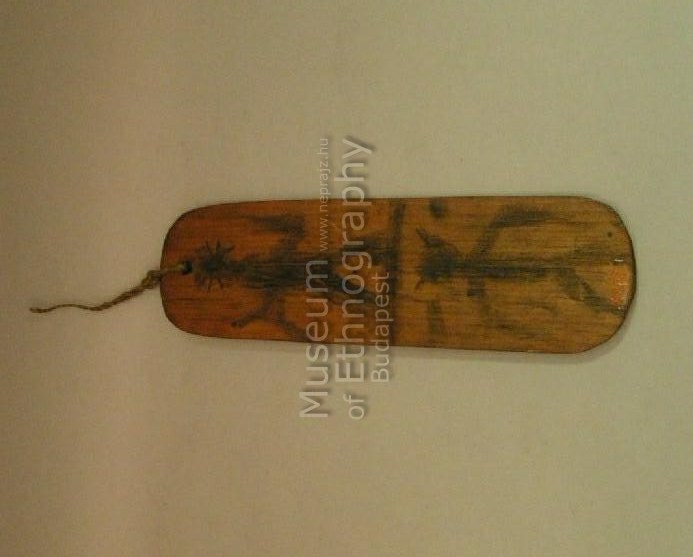
Source term: вращаемая пластина или щепка (rotating plate or splinter); free aerophone
A sliver of wood swung like a little fish on the end of a fishing rod, droning without a break as it spun. Among the Odul, the Yukaghir of the upper Kolyma, it was a children's sound toy, kept alongside a square, ribbed button-buzzer twirled on a cord. Downriver the Vadul made a longer blade on a cord, and their shamans used it to charm the weather. Both belonged to peoples who hunted and fished on foot through the taiga and tundra. Once ritual instruments, these whirlers had become children's things by the twentieth century, yet a child's toy still served as a protective charm.
напоминающая рыбку на удочке, которая при вращении создает непрерывный гудящий звук
resembling a little fish on a fishing rod, which makes a continuous droning sound as it turns
T. I. Ignatieva, «К вопросу о бытовании фоноинструментов у юкагиров», Традиционная культура (2012), p. 83.
Particulars
- Object
- A wooden plate or splinter whirled on a line like a little fish on a fishing rod, giving a continuous drone.
- Function
- A children's sound toy.
Source
T. I. Ignatieva, «К вопросу о бытовании фоноинструментов у юкагиров», Традиционная культура 1 (45) (2012), pp. 81–89