No. RUSIN-003Siberia
Itelmen k'el-k'el, the spirit-taming buzzer
Russia · Western Kamchatka · Kovran and Tigil · Siberia
Sacred / spirit
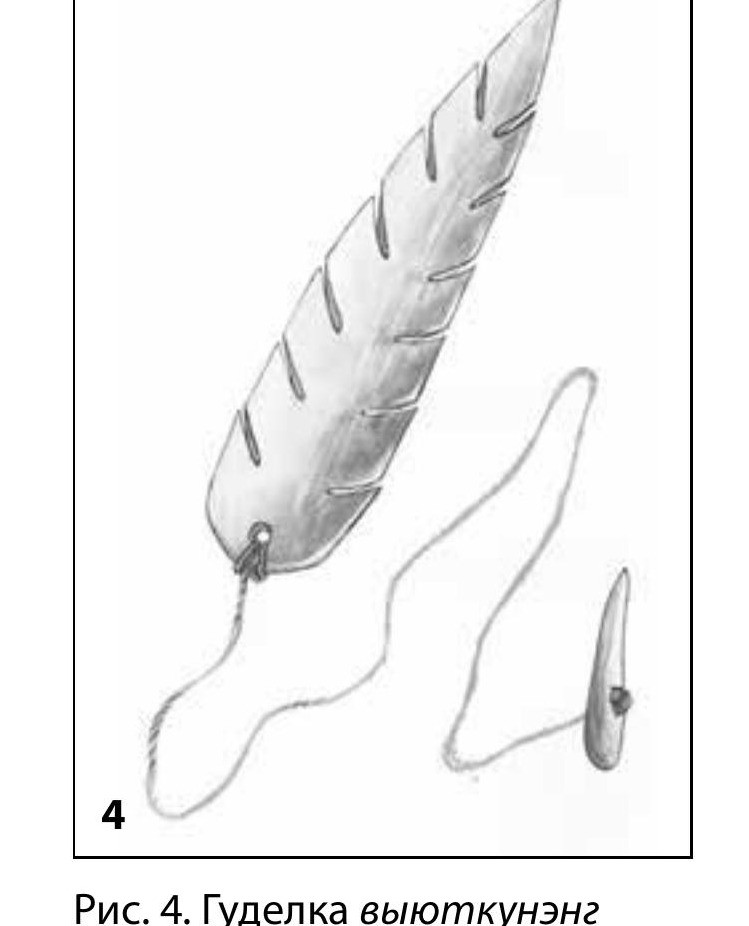
хэзвэз / к’эл-к’эл
Source term: rotating aerophone / plate on a string
хэзвэз (khezvez) = Kovran-dialect Itelmen for the whirled plate-on-string aerophone, glossed "жужжалка" (buzzer); к'эл-к'эл = Tigil-dialect term for the same, glossed "вертушка" (spinner), and close kin to the spinning wheel-ratchet that "заменяла бубен" (stood in for the drum). Distinct from the propeller-bladed vortex aerophone кыжиам (Kamchadal) / кэхэм (Kovran) / талитал (Tigil), which was whirled at the autumn "очищение грехов" festival (the Alkhalalalai), and from the reindeer-bone toy тэн-к'эл (Kovran) / гыр-гэр (Tigil).
Etymology. Source glosses к'эл-к'эл as Tigil Itelmen вертушка, spinner or whirligig.
Among the Itelmen of western Kamchatka, a plate whirled on a cord made a sound like the wind, and that sound was believed to tame an evil spirit. The same instrument now circles over children's heads as a toy. At Tigil it is the k'el-k'el, the 'spinner'; in Kovran it is хэзвэз, the 'buzzer'. It belonged to a whole family of Itelmen whirring things: a wooden propeller-bladed roarer turned at the autumn 'cleansing of sins' festival, a spinning toy of reindeer bone made for children, and a spinning wheel-ratchet that could stand in for the shaman's drum.
Вращаемый аэрофон (пластина на веревке) у ковранцев обозначается термином хэзвэз (жужжалка), у тигильцев – к'эл-к'эл (вертушка)…
The rotating aerophone — a plate on a cord — is called khezvez ('buzzer') among the Kovran people, and k'el-k'el ('whirligig') among the Tigil people…
Arctic Megapedia, 'Музыка ительменов' (2020)
Particulars
- Object
- A plate on a cord, rotated to sound; Kovran term хэзвэз, Tigil term к’эл-к’эл.
Sources
- Arctic Megapedia, “Музыка ительменов” (2020) View · archived
- Russian State Library, record 01008198274, Itelmen kель-келе performance
- Aleksey Nikolsky and Antonio Benítez-Burraco, “The evolution of human music in light of increased prosocial behavior: a new model,” Physics of Life Reviews 51 (2024): 114-228, p. 194, Audio-37 View