No. BRODSKY1974-001
Koryak vuvuchan: gulls, geese and wind
Russia · Kamchatka Krai, Koryak District (northern Kamchatka) · Siberia
Play / practical
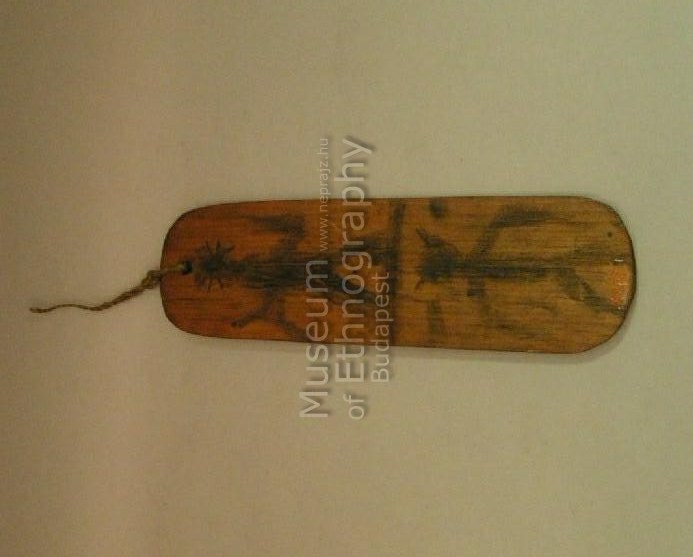
vuvuchan (вувучъан)
Source term: вращаемая завывалка (whirled howler); bull-roarer
vuvuchan (вувучъан): the Koryak whirled 'howler' (завывалка). geingevytkunen (гэйнэвыткунэн): a reed instrument cut from a bird's feather quill. gytkomnan (гыткомнан): a small cylindrical whistle. talytal (талытал): a spinning buzzer.
Koryak musicians painted pictures in sound. Pieces called 'Gulls', 'Wind' and 'Goose' were played for listening, sometimes solo but more often in ensembles, and the whirled vuvuchan, the 'howler', was one of their voices. In one trio it sounds beside a reed cut from the quill of a bird's feather and a small cylindrical whistle, and together the three make a seashore: birds crying over moving air. Koryak players also formed ensembles of howlers alone, several bullroarers whirling at once, something known elsewhere in the Russian Far East only among the Yukaghir.
Their combination is used to represent a natural landscape of a seashore with bird calls and wind.
Nikolsky and Benítez-Burraco, Physics of Life Reviews 51 (2024), p. 194 (Audio-40).
Particulars
- Object
- A whirled "howler" (завывалка), played alone, in ensembles of several howlers, or with buzzers, whistles and a feather-quill reed.
- Function
- Instrumental music for listening: sounded in Koryak ensembles that picture gulls, geese and wind on the seashore, and in ensembles of whirled howlers alone.
Sources
- I. Brodsky, «О народных музыкальных инструментах и инструментальной музыке Дальнего Востока РСФСР», in Теоретические проблемы народной инструментальной музыки (Moscow, 1974), pp. 158–159 View
- Aleksey Nikolsky and Antonio Benítez-Burraco, 'The evolution of human music in light of increased prosocial behavior: a new model', Physics of Life Reviews 51 (2024), p. 194 View