No. STEWART1941-002
Atsa (Fort McDermitt) wimo'to snow-melting bullroarer
United States · Quinn River drainage, northern Nevada · North America · Great Basin
Weather / fertility magic
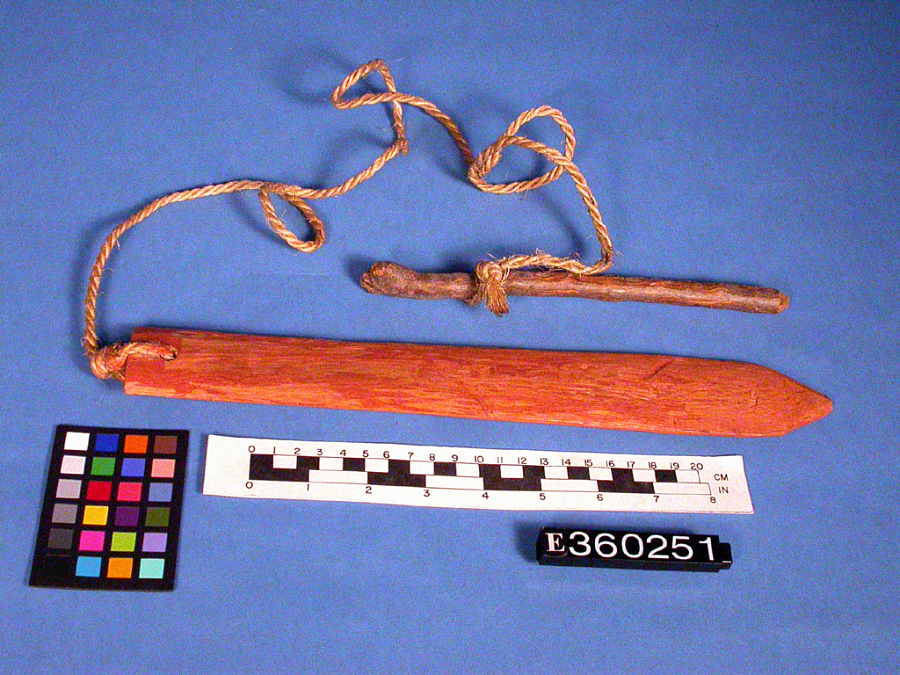
Wimo'to
Source term: wimo'to
Wimo'to: the Northern Paiute name for the bullroarer, cognate with the Surprise Valley kwi'mo and with the wimo- forms in Stewart's Ute and Southern Paiute vocabularies.
Pete Snap, born at McDermitt on the Quinn River, told Omer Stewart what the wimo'to was for, and the answer was narrow: only to melt snow. The whirrer was juniper, and it had to be painted red. It was swung to make the wind blow, and the wind did the melting; it was never a toy, and the Atsa kept it apart from the buzzers they also spun. Two details make this band's roarer unlike its neighbours': a required colour and a single seasonal job, working against the winter rather than for a crowd.
Particulars
- Object
- Whirrer of juniper, painted red.
- Function
- Whirled to raise a wind that melts the snow; not a toy.
Source
Omer C. Stewart, 'Culture Element Distributions: XIV, Northern Paiute,' Anthropological Records 4:3 (1941), pp. 364, 401, 403 and 438