No. OPLER1938-001North America
Thunder's groaning stick
United States · Jicarilla Apache Reservation, Dulce, New Mexico · North America
Restricted
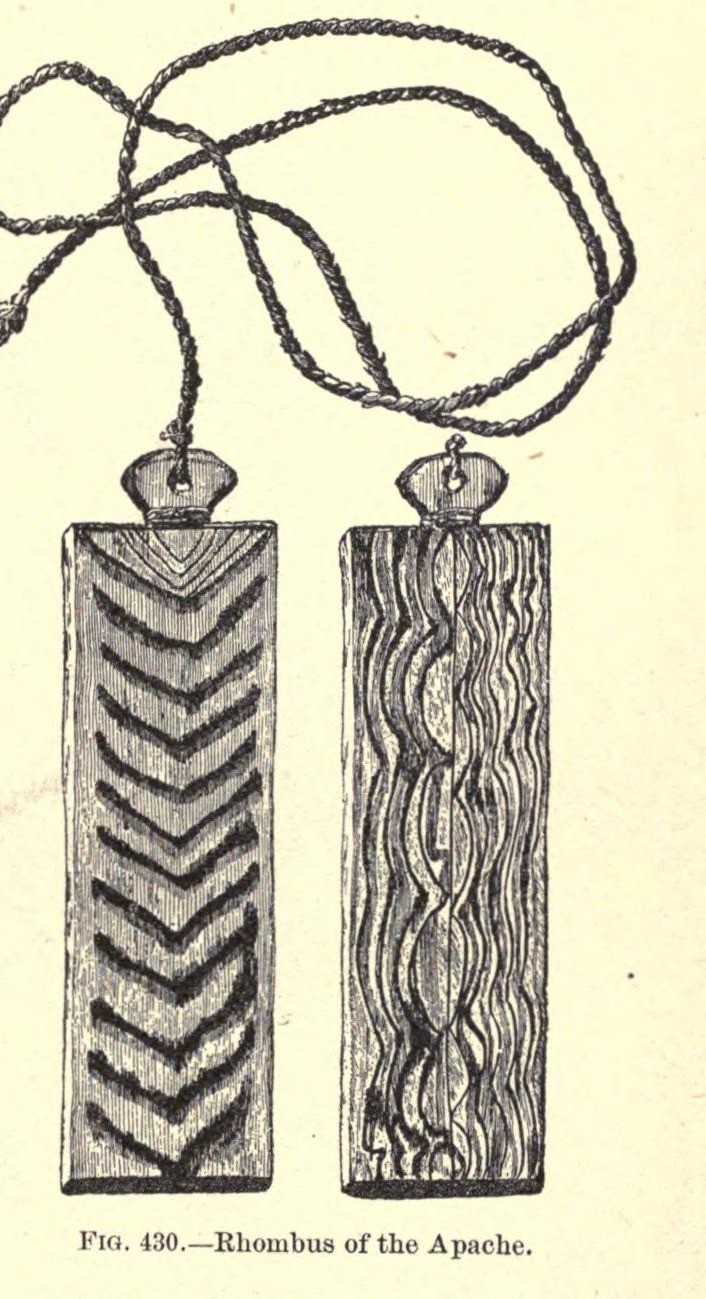
groaning stick
Source term: bull-roarer; groaning stick
Hactcin: the Jicarilla holy beings who made the world and gave the people their curing ceremony; the groaning stick is Opler's English for the bull-roarer.
Black Lightning made the first one. Asked to the first Hactcin ceremony, he stepped into a black cloud, sent his arrow, the black flint, into a spruce, picked up the splinter that fell to the east and cut it to the shape of the flint. At the ceremony Thunder Hactcin whirled it outside the corral at each of the four directions, and it was never to be twirled in the sight of the people. When the gods left, Talking Hactcin told Thunder, "You must leave your groaning stick here," and Old Man Thunder went up into a cloud with a clap: "They will say, 'Grandfather, we like to hear you every year.'" The people made their own copy, strung with mountain-sheep hide and patterned on the first. The original went home to Thunder by a messenger who turned himself into a flash of light, and Thunder sent back word that he would send a shower.
You must leave your groaning stick here. Whenever the people have this ceremony they will use this stick.
Talking Hactcin to Thunder, in Morris E. Opler, Myths and Tales of the Jicarilla Apache Indians (1938), p. 165
Particulars
- Object
- A blade of lightning-riven spruce cut to the shape of a black flint arrowhead, swung on a string of mountain-sheep hide.
- Function
- Thunder's voice in the Hactcin curing ceremony: sounded by the dancer who plays Thunder Hactcin outside the corral at each cardinal direction, never in the sight of the people.
Source
Morris Edward Opler, Myths and Tales of the Jicarilla Apache Indians, Memoirs of the American Folk-Lore Society 31 (1938), pp. 147, 151–152, 165, 183–184, 199–200