No. NA-S1952-007
Diegueño assembly bullroarer
United States · California · Baja borderlands · North America
Restricted
air
Source term: bullroarer
air: the Diegueño name for the bull-roarer (Waterman 1910, p. 308).
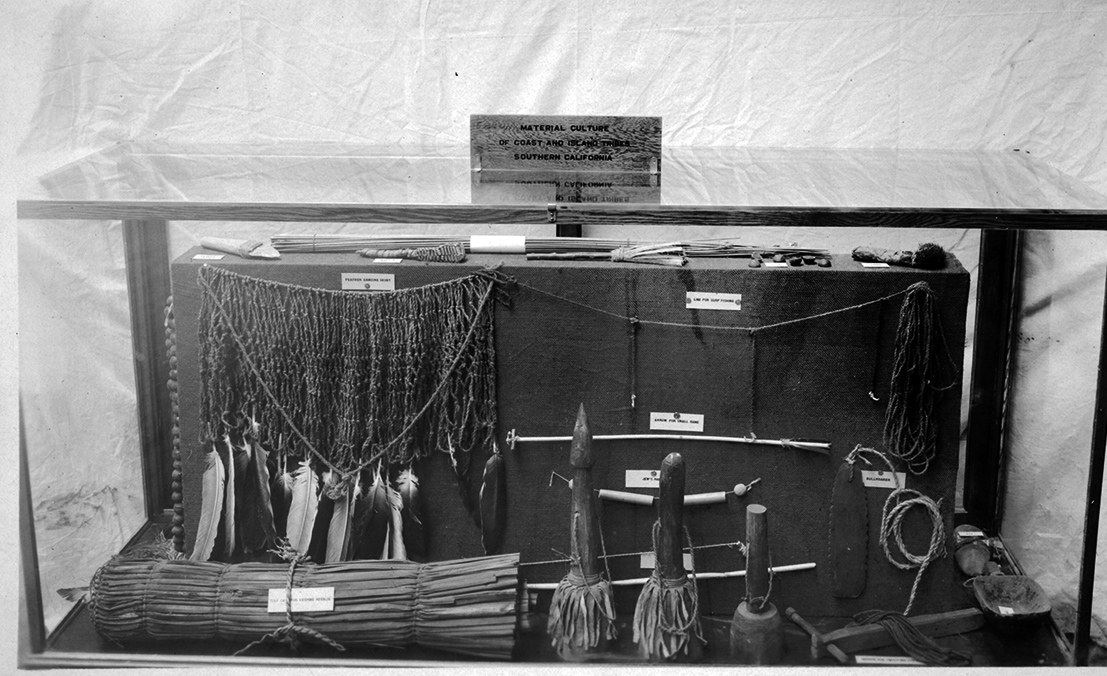
Among the Diegueño (Kumeyaay) of the San Diego backcountry the bull-roarer was, in T. T. Waterman's words, "a smooth, narrow piece of greasewood about three feet long, fastened end on to a short twisted rope of milkweed fibre"; swung rapidly around the head it gave out a deep booming or roaring sound. Its work was to gather people: down to recent years before Waterman wrote in 1910, it was sounded three times as the signal for an assembly for ceremonial purposes. It called them to the dead as well. After the death of anyone who had passed through the toloache, the jimsonweed initiation, the Diegueño held the Feather ceremony: in mid-afternoon an old man swung the bull-roarer, air, three times, and when the people had gathered a practiced dancer performed the Whirling dance, with so much spinning that a man unused to it grew dizzy and fell down. One Kumeyaay roarer left Capitan Grande, in the San Diego River canyon, in 1908 for the museum in San Diego, whose label gives it a second duty: hung over the entrance of the ceremonial enclosure, it stood guard over everything inside. The village itself went under the El Capitan reservoir in the 1930s.
Particulars
- Object
- A Kumeyaay bullroarer collected at Capitan Grande, on the San Diego River, in 1908 is held by the Museum of Us, San Diego. Waterman describes the type as a smooth, narrow greasewood blade about three feet long on a short twisted rope of milkweed fibre.
- Function
- A summons: sounded three times to call the people to ceremonies, mourning rites included. Hung over the entrance of the ceremonial enclosure, it guarded what lay inside.
Source
T. T. Waterman, The Religious Practices of the Diegueño Indians (UC-PAAE 8, 1910), pp. 282, 307-308; P. Drucker, Culture Element Distributions V: Southern California (Anthropological Records 1:1, 1937), p. 25; T. A. Seder, 'Old World Overtones in the New World,' University Museum Bulletin 16(4) (1952), pp. 51-54; San Diego Museum of Man (now Museum of Us), exhibit label for the Capitan Grande bull-roarer, 1908 (transcribed 2010); A. L. Kroeber, Handbook of the Indians of California (1925), p. 713, Table 7 (Diegueño 'air')