Thunder along the trail, at the spring and in the kiva
Hopi Snake–Antelope
Rain prayer made audible across the Hopi mesas
In specifically documented Hopi Snake–Antelope ceremonies, bullroarers join lightning frames, rain-cloud forms and journeys for water. Walpi, Mishongnovi, Oraibi and Shipaulovi accounts place the sound in warriors’ hands and along ceremonial routes, making thunder part of a prayer for corn, rain and the flourishing of living things.
At Oraibi, a water carrier stopped before a spring and sounded a bullroarer with an eagle-bone whistle. He was announcing himself to the water deities, Balölökongwuu and the Clouds. Back on the mesa, warriors made lightning flash from jointed frames and thunder sound from whirling wood. Across several Hopi villages, the Snake–Antelope ceremony gave the bullroarer a precise place in the work of bringing rain. 1, 2, 5
The instrument’s shape carries the weather before it sounds. On the Walpi Antelope altar, Jesse Walter Fewkes described two flat wooden whizzers with rain-cloud terraces cut into their ends. John G. Bourke described another Tusayan form as a narrow board ending in a triangle: a blue or yellow snake or lightning design ran down its length, and the triangle served as the snake’s head. The blade could carry the storm in its silhouette and paint as well as its sound. 3, 4
At Oraibi the bullroarers rested near the Snake altar with lightning frames, snake bags, rattles and whips. They belonged to a larger set of ceremonial tools. Their task was to add a moving, audible storm to the offerings and images already assembled around the altar. 1
An Oraibi Antelope water carrier described his journey to H. R. Voth. The two chief priests furnished him with offerings; the Snake chief gave him a bullroarer, meal and honey. He descended the mesa, stopping along the trail to sound the instrument and leave prayer offerings. Before reaching the spring he sounded it again with his whistle, addressing the water serpent Balölökongwuu and the personified Clouds. His prayer asked rain for the corn, herbs for the animals and good condition for all living things. Water collected for the following morning’s race carried that request back toward the village. 1
Before dawn at Oraibi, two warriors put on snake kilts, took bullroarers and lightning frames, and circled the Snake and Antelope kivas. In another sequence they entered the Antelope kiva, aimed the lightning frames toward the hatchway four times and sounded the bullroarers four times. They repeated the performance at the Snake kiva. Voth’s explanation is direct: the paired actions represent lightning and thunder. The storm moves around the buildings, between them and inside them. 1
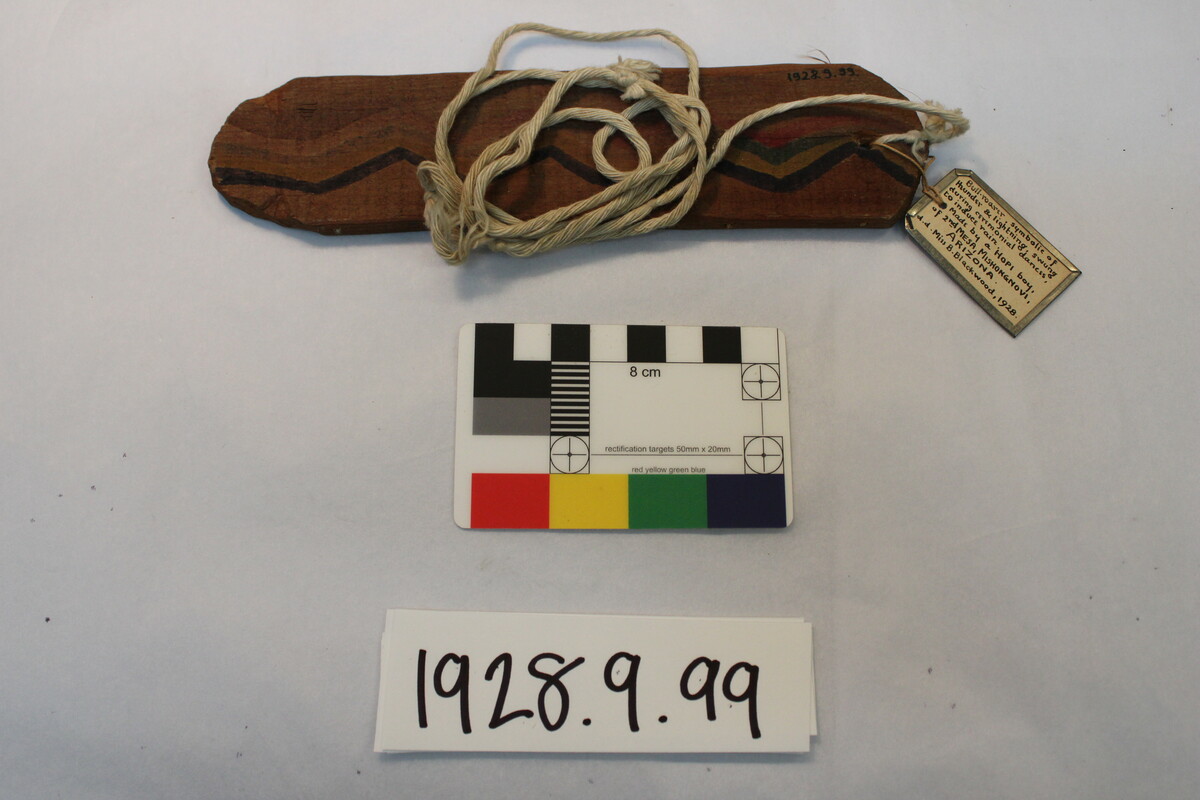
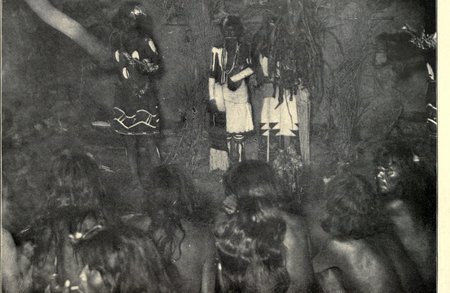
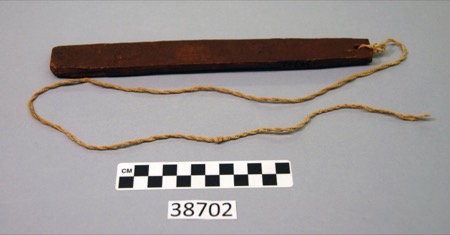
At Mishongnovi, George Dorsey and Voth pictured the same warrior office in the Antelope kiva. A Kalehtaka whirls a bullroarer beside the sand mosaic while the Antelope priests sit around it. A later blade from that village supplies a compact explanation in its own accompanying label: made by a Hopi boy, painted with a zigzag and swung in ceremonial dances to induce rain. The photograph places the office in the rite; the labelled blade preserves the thunder-and-lightning meaning in village craftsmanship. 5, 6
At Walpi, Fewkes watched the whizzer-bearing warrior enter at the rear of the Antelope procession, stand at its far left and leave last. He sounded the instrument at critical moments. Bourke, who had watched the ceremony in 1881, compared its sound to a gust of rain-laden wind and was told it compelled wind and rain to help the crops. Fewkes placed thunder in the same language of prayer: smoke makes clouds visible, sprinkled water acts out rain, and the whizzer supplies its thunder. 2, 4, 3
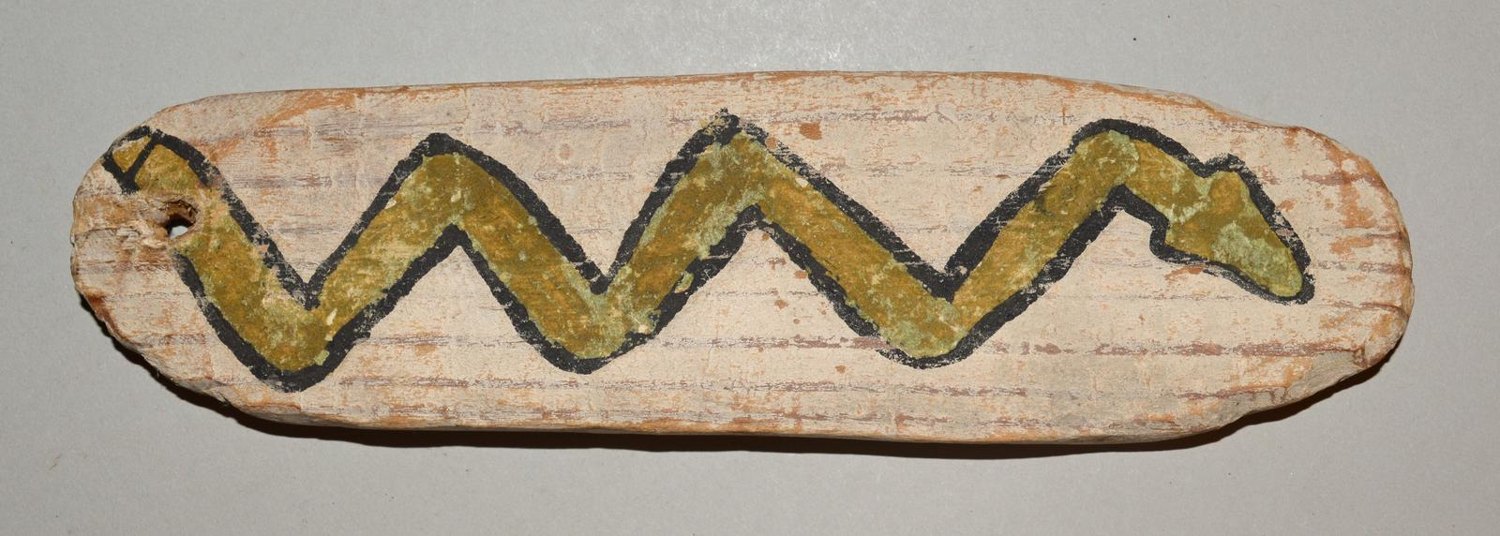
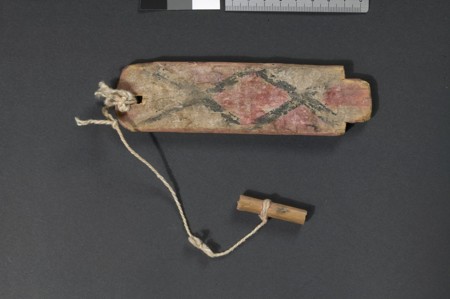
The moment could change between villages and stages of the ceremony. At Shipaulovi in 1896, a warrior in a white kilt and antelope skin twirled the bullroarer after the children in the Snake-race procession. The sunset dance that followed had no whizzer-bearing warrior. The Oslo blade from Shipaulovi was used in men’s dances and also as a children’s toy. A shared ceremonial institution allowed particular performances, and an instrument could have a life beyond the rite. 2, 7
The recurring pattern is an action carried through places: an altar equips it, a trail extends it, a spring receives it and a kiva gives it another setting. Sound joins painted cloud forms, snake designs, lightning gestures and offerings to call the weather that nourishes the community. These specifically attested Hopi practices make a regional family through their ceremonial work and the offices that perform it. 1, 3, 5
The Walpi Snake Dance re-enacts Tiyo’s journey to the underworld, where Spider Woman guided him into the kiva of the Snake people and he learned the songs and prayers that bring corn and rain. In 1901 a newly initiated boy no more than five stopped in the procession and sounded a flat wooden…
Dorsey and Voth, The Mishongnovi Ceremonies of the Snake and Antelope Fraternities (1902), pl. CI · Public domain
Thunder and lightning, swung to bring the rain: that is how the label on a Mishongnovi bullroarer explained it in 1928, on a blade a Hopi boy of the village had made and painted with a black zigzag. The Smithsonian's older Mishongnovi series goes under the same idea in English, "Thunder-Stick."…
Representative — not this record’s object · A Kalehtaka whirling a bullroarer inside the Antelope kiva at Mishongnovi.
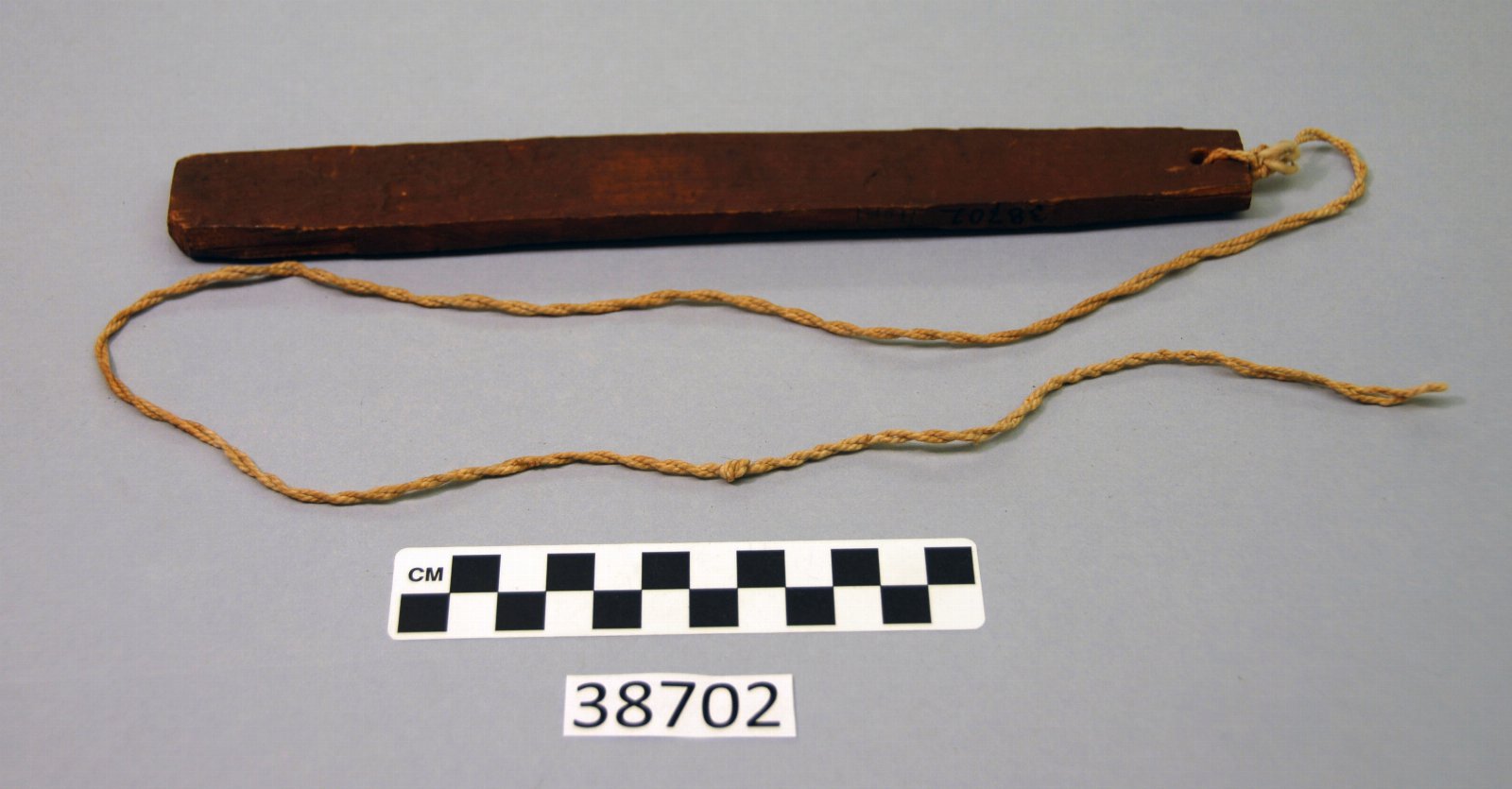
Two years after this blade left Oraibi, H. R. Voth published what a thing of that name does there in August. Coming down to the spring in the Summer Snake ceremony, the priest stopped short of the water, twirled the bullroarer and blew his eagle-bone whistle — announcing himself, he said, to the…
Kulturhistorisk museum, Universitetet i Oslo, UEM13727 (photo Marten Teigen); rotated 180° by The Bullroarer Atlas · CC BY-SA
Shipaulovi, smallest of the Second Mesa villages, kept its own form of the Hopi bullroarer's name: tovolpi. The decorated slat that carried the word to Norway crossed between two worlds at home — swung by men in the dances, and by children as a toy — the same humming wood serving the plaza ceremony…
pp. 288, 318–323, 327–328. The spring journey on pp. 319–321 is an Antelope water carrier’s account to Voth, not Voth’s personal observation; warriors and altar are separately described. Printed name on p.320 is Balölökongwuu.
Sixteenth Annual Report of the Bureau of Ethnology, pp. 282–284, 288, 298. Walpi warrior and Shipaulovi race; the Shipaulovi sunset dance omitted that role.
Nineteenth Annual Report of the Bureau of American Ethnology, pp. 983–985 and 1011: Walpi cloud-terraced whizzers, warrior office and thunder within dramatic rain prayer.
Ninth Annual Report of the Bureau of Ethnology, pp. 476–478. Walpi observation in 1881 and Tusayan snake/lightning blade. Apache rounded-head board and its dimensions are a separate example.
Exact object and attached label: made by a Hopi boy, symbolic of thunder and lightning, swung during ceremonial dances to induce rain. Folded support of NAMER-008.
Exact catalogue attests men’s dances and children’s toy use. Snake–Antelope village membership additionally rests on Fewkes’s separate 1896 race account.