A woman begins Oku’s war medicine. Nso’ warriors capture a roarer and learn how to prepare its medicine from Bamum. At Kom, a bullroarer society guarded royal authority; at Ndu, masked officers punished in the ancestors’ name.
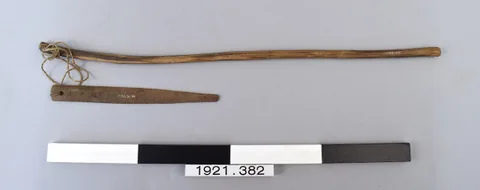
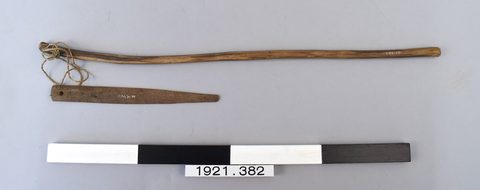
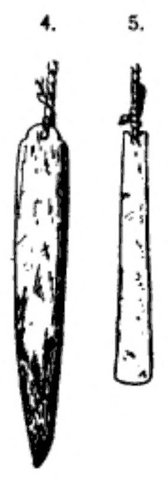
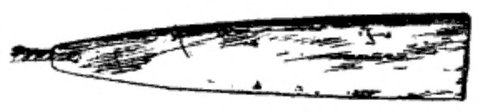
Eyap / Eghap / BagamThe complete N'kwi'i rig from Bagam — blade, string, and the long whirling stick it swung from, collected by L. W. G. Malcolm.
A woman closes her eyes and places the first plants in a clay vessel. In Oku, Samba’s war medicine begins with her. The plants are roasted to ash and left for seven weeks; when the medicine is ready, a woman receives some before the men. The society’s members keep their own secrets, but their power depends on someone outside their membership. Samba traces its founding to a woman in Bangolan. 1, 2
Nso’ remembered acquiring mfu’ from Bamum in war. Mfoome John Ngo told how warriors entered a lodge at Yar, beyond Mbokam, and carried off its bullroarer, medicine and secrets. Preparation of the medicine still had to be learned from Bamum. Mfu’ became the senior fraternity of the Nso’ military association under the king’s patronage. Its two palace-side houses survived the fire of 1959 and later assembled men for royal announcements and communal work. 3, 4
At Bamum the wooden roarer was called mwu or mfu, a name tied to thunder. It roared at the burials of the old, no woman or child might see it, and a titled officer, the Fomwu, ruled over it. The shared name acquires historical force from Nso’s own account of taking the instrument and its institution from Bamum. 5
Oku’s Samba owned three Njamse, animals in the form of bullroarers, beside seven membrane pipes called little animals. In the old wars its dangerous mask carried a roarer in each hand, and enemies who saw them were said to lose their wits. Its wearer took drugs that made the world look small, so that he felt no fear. The same society’s medicine served healing and fertility, and football teams later bought it to help win matches. 2
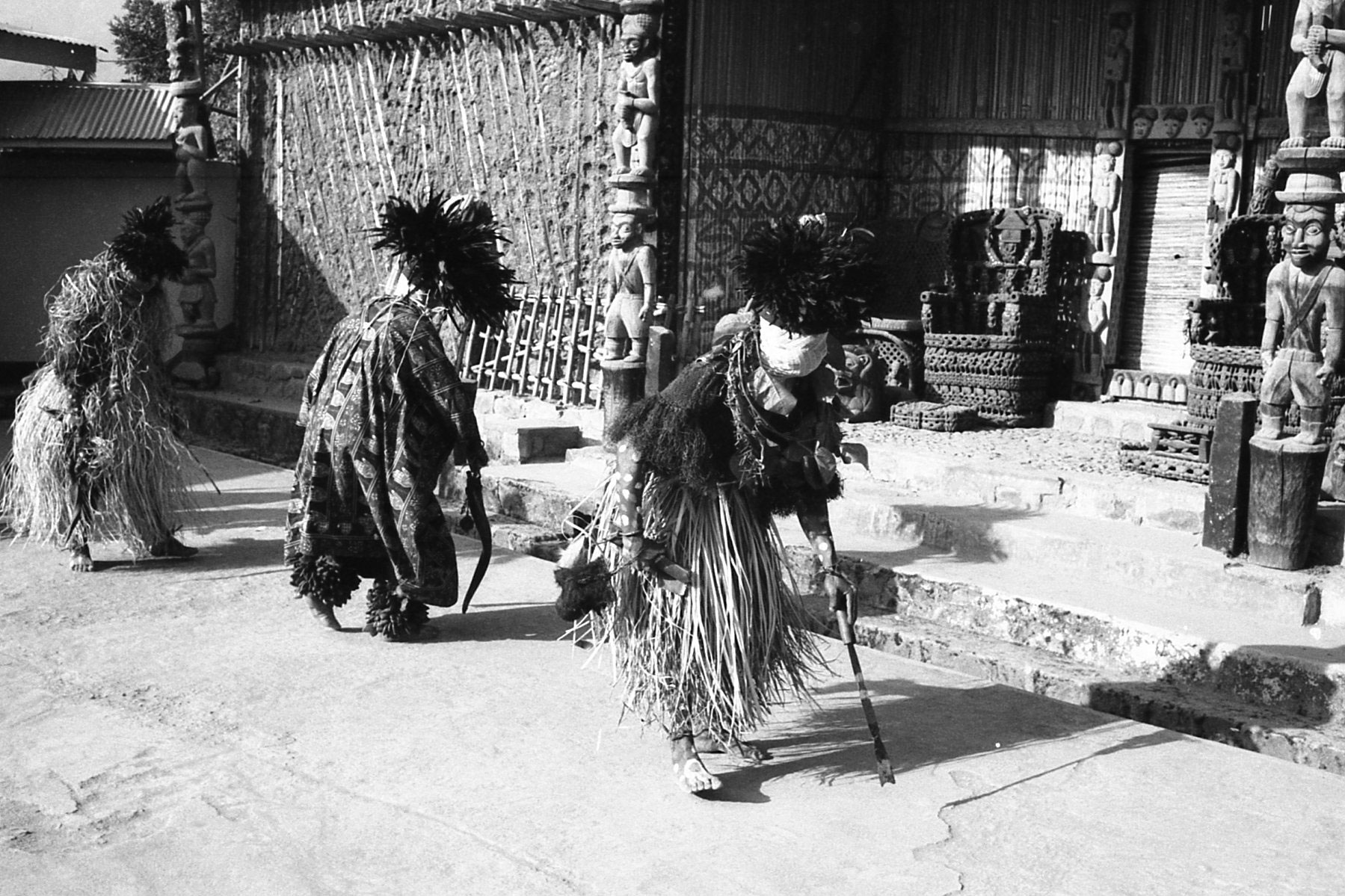
Military-society roarers sounded over Kan Ngvume’s grave at Ngashie on 21 December 1977. He had been a medicine man and an elder of several societies, and each acknowledged its bond with him. In Bagam, farther south, a procession to a relative’s grave was followed that night by men of one compound whirling their roarer through the streets. Women withdrew into the bush when it came near. 6, 7
Kom’s Nkvifon used the bullroarer, carried out the Fon’s decrees and accepted each new Fon. In its guarded chamber at Laikom, decisions were also taken to discipline a ruler who disregarded custom. Kom’s founding clans were led home by a python, and kingship retraced its road: before installation the heir walked the python’s trail through the forest to a spring and returned by another route. Then the kingmakers seized and slapped him one final time before seating him on the sacred stone. 8, 9, 10
At Ndu, among the Wiya, ngwarong belonged to the chief and formed his bodyguard. Its masked officers were held to embody the ancestral spirits, and as ancestors they punished offenders by confiscation, whipping and, formerly, execution. Because the dead had struck, no kinsman had a living executioner to pursue in blood feud. 11, 12
Every military society in the kingdom of Oku keeps three bullroarers in the medicine corner of its house, and Samba calls its three Njamse, "animals"; its seven bat-wing membrane pipes are the "little animals". In the old wars the Samba mask went into battle with a roarer in each hand. Its wearer…
Representative — not this record’s object · A weathered Bafia blade with a swallow-tail notch.
Nso' (Banso), mfu' lodge of the military association manjoŋ
Nso' remembers exactly where its war roarer came from. Nso' warriors broke into the mfu' house at Yar, beyond Mbokam, and carried off the lodge's bullroarer, nyam mfu', together with its medicine and secrets. The roarer alone was not enough: Nso' still had to learn from Bamum how to prepare the…
Representative — not this record’s object · A Bagam bullroarer from elsewhere in the Grassfields.
When old people of Bamum were buried, the mfu roared, and no woman or child might look at it. The wooden roarer carries the sky's name: among the peoples north of Bamum mwu means "lightning", and among the Bamum country people the same word names the noise of thunder. Roarers of bamboo, usischa,…
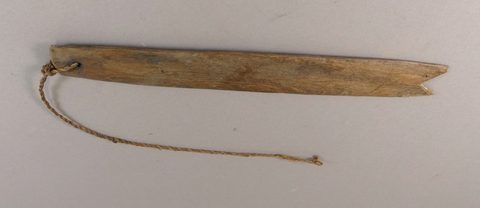
Representative — not this record’s object · A wooden N’kwi’i blade from Bagam, Cameroon (Cambridge MAA)
The men who made the king of Kom could also discipline him. The Fon's orders were carried out by Nkvifon, and Nkvifon used the bull-roarer; it danced masked at the funerals of the Fon and the great, and in its guarded chamber at Laikom it decided when a ruler who flouted custom must be brought to…
Representative — not this record’s object · Two Tschamba langa, wood and iron, drawn for Frobenius (1913).
Among the Wiya of Ndu, the punishments of the chief's bull-roarer society, ngwarong, were not the work of the living. Its masked officers were the ancestral spirits incarnate, and as the ancestors they seized offenders' property, whipped them or, in former times, put them to death. Because it was…
Representative — not this record’s object · A Bokko wonatona, 30 cm, wood, drawn for Frobenius's 1913 volume
No woman might see ñgū muñ mo. When its roar came near, women left the road for the bush, while a party of men from one Bagam compound, the only men allowed to play it, swung it through the streets. It came out on the night of a commemoration for the dead. Earlier that day a procession had wound…