Atlas Essay —
War Medicine
The bullroarer and the making of power in Cameroon’s Grassfields
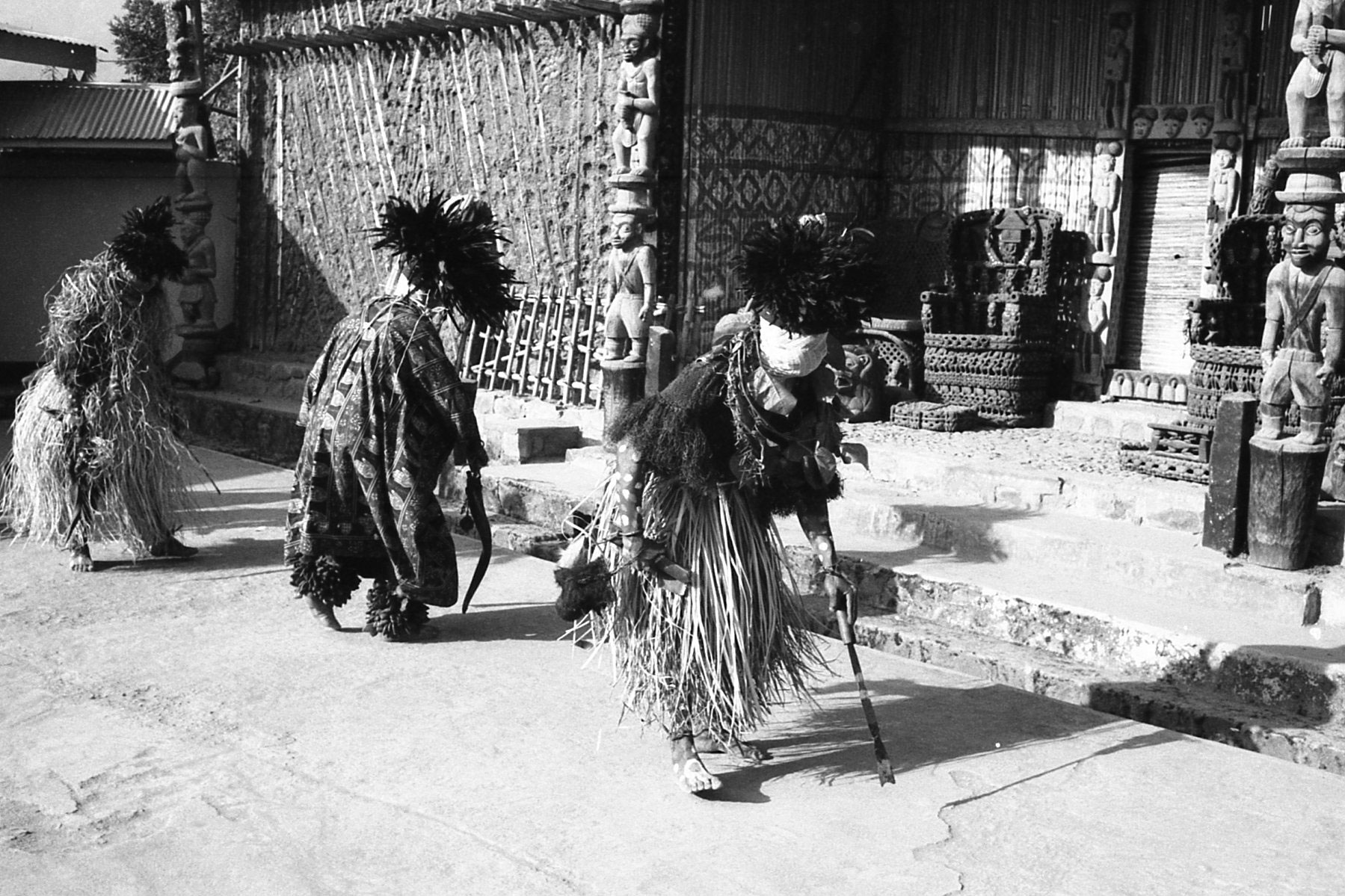
At the beginning of the dry season in Oku, a mountain kingdom of the Bamenda Grassfields in north-western Cameroon, the war medicine must begin with a woman. On a night without a moon she closes her eyes and puts the first plants into a clay vessel. They roast for days until they fall to ash, and the ash rests for seven weeks. When it is ready, a woman must take some before any man. This is Samba, a society whose war mask once went into battle with a bullroarer in each hand. The same medicine could protect a family from its dead, help a woman bear children, or carry a football team’s hopes onto the field.
In the Grassfields of Cameroon the bullroarer’s force belonged to the society that held it, and that society could redirect it, carrying it between kingdoms by raid and purchase and turning it from war to the grave and the court.
In brief
- Oku’s Samba medicine cannot be made without a woman, who places the first plants and takes the first share, yet she is never told the society’s secrets.
- Samba called its three bullroarers Njamse, “animals”, and its war mask carried one in each hand; enemies were said to lose their wits at the sight.
- Nso’ warriors carried off a bullroarer with its medicine and secrets from a Bamum war lodge, learned to brew the medicine, and with the king’s leave made mfu’ the senior lodge of their army.
- The Bamum roarer’s name, mfu, names war lodges at Nso’, in Wimbum country, where it “was got from Bamum through traders”, and at Oku, where the roarer’s voice belongs to Nyam Nfuh, the animal of the lodge.
- When the wars ended, Oku’s war roarers sounded over the graves of senior members, and the war lodges of Oku and Nso’ turned to royal farms, roads and the king’s announcements.
- At Kom the society that sounded the bullroarer accepted each new king, carried out his orders, and could discipline him for breaking custom.

The woman who starts the medicine
Samba’s masks, Hans-Joachim Koloss writes, are counted everywhere in the Grassfields “among the most feared masks of all”. Oku remembers who first owned the society:
In Oku, at any rate, it is said that Samba was once founded by a woman in Bangolan, but was brought to Oku in very early times. Here it was first kept in the palace for the protection and welfare of the royal clan Mbele, before it was sold on. Today there are four independent Samba societies in Oku.
Koloss, 1996, p.392 (translated from the German)
Bangolan is a chiefdom of the Ndop Plain, south of Oku. After its founder, men’s societies held the medicine, and still they could not make it alone. Medicines, masks and secret societies were otherwise “most strictly closed” to women, but Samba’s strength was traced to them:
For all the important acts in making and using the medicine must first be performed by a woman: the first plant for the medicine must be cut by a woman, and it is likewise a woman who lays the first medicine plant in the medicine pot. Before the finished medicine is eaten or drunk, a woman must first receive some of it.
Koloss, 1996, p.394 (translated)
The society needed her hands and kept its knowledge to itself. On the moonless night, Brian Bartelt writes, “the medicine men of Samba meet along with a woman and the juju masquerade.” She sets the plants roasting and takes the first portion seven weeks later, and still “as important as women are to Samba, they are not considered members, and are not entrusted with any secrets.” Bartelt, p.159 · archived.
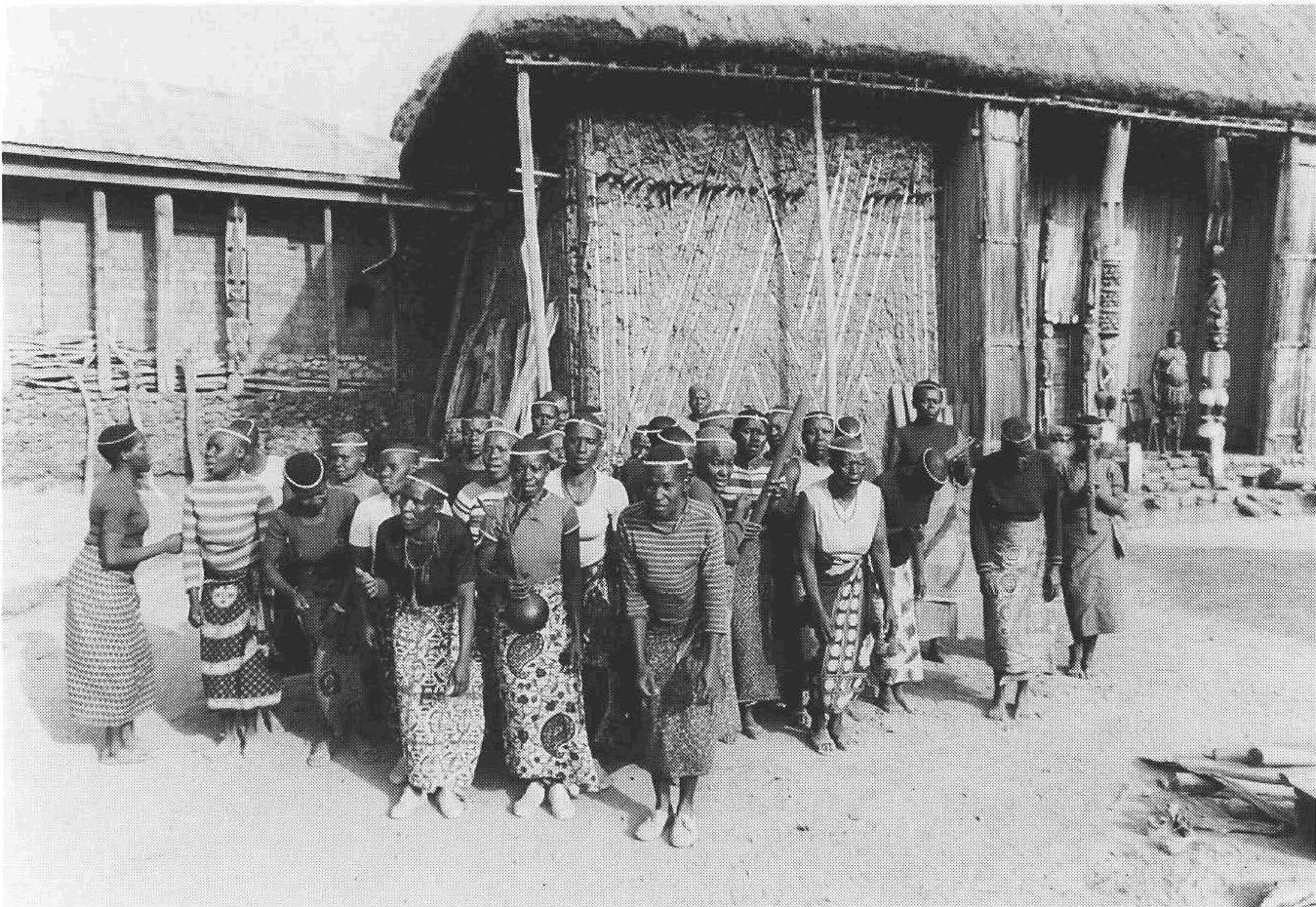
That power was meant first for war. Samba’s medicine, in Koloss’s words, “is intended predominantly for military purposes”, though it was famous too for healing, for women’s fertility, and for sending off the dead so that they would not come back to terrorize their families.
The mask with a roarer in each hand
The bullroarers were the most dangerous things Samba owned. “Like the other military societies,” Koloss writes, “Samba owns three Njamse (animals) in the form of bullroarers.” Its seven membrane pipes were the Woni Njamse, the little animals, and their membranes were cut from bats’ wings, where the ordinary mask societies used spiders’ nests. In war the animals went out in the mask’s hands:
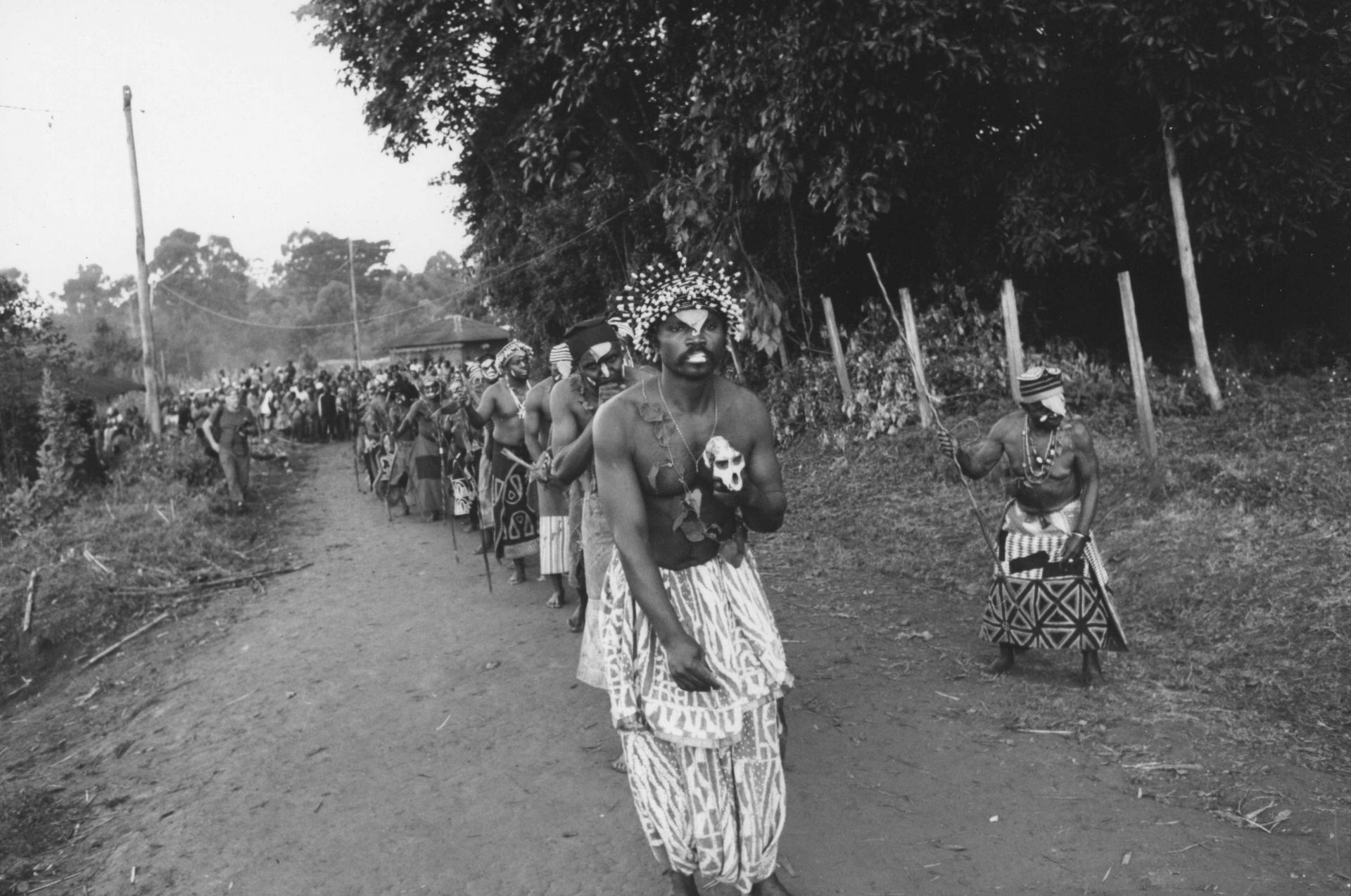
While Samba nowadays appears only at important ceremonies, it formerly served, as a special military society, in the defence of the land as well. On campaigns the mask had a special importance. In each hand it carried one of the sacred and dangerous bullroarers, at the sight of which the enemy were reportedly confused, indeed even lost their wits. Before going into action the wearer of the mask had taken certain drugs through which his surroundings appeared greatly shrunken; by them he was to lose every feeling of fear. The other members of Samba followed the mask; they too were equipped with all kinds of objects filled with medicine.
Koloss, 1996, pp.394–395 (translated)
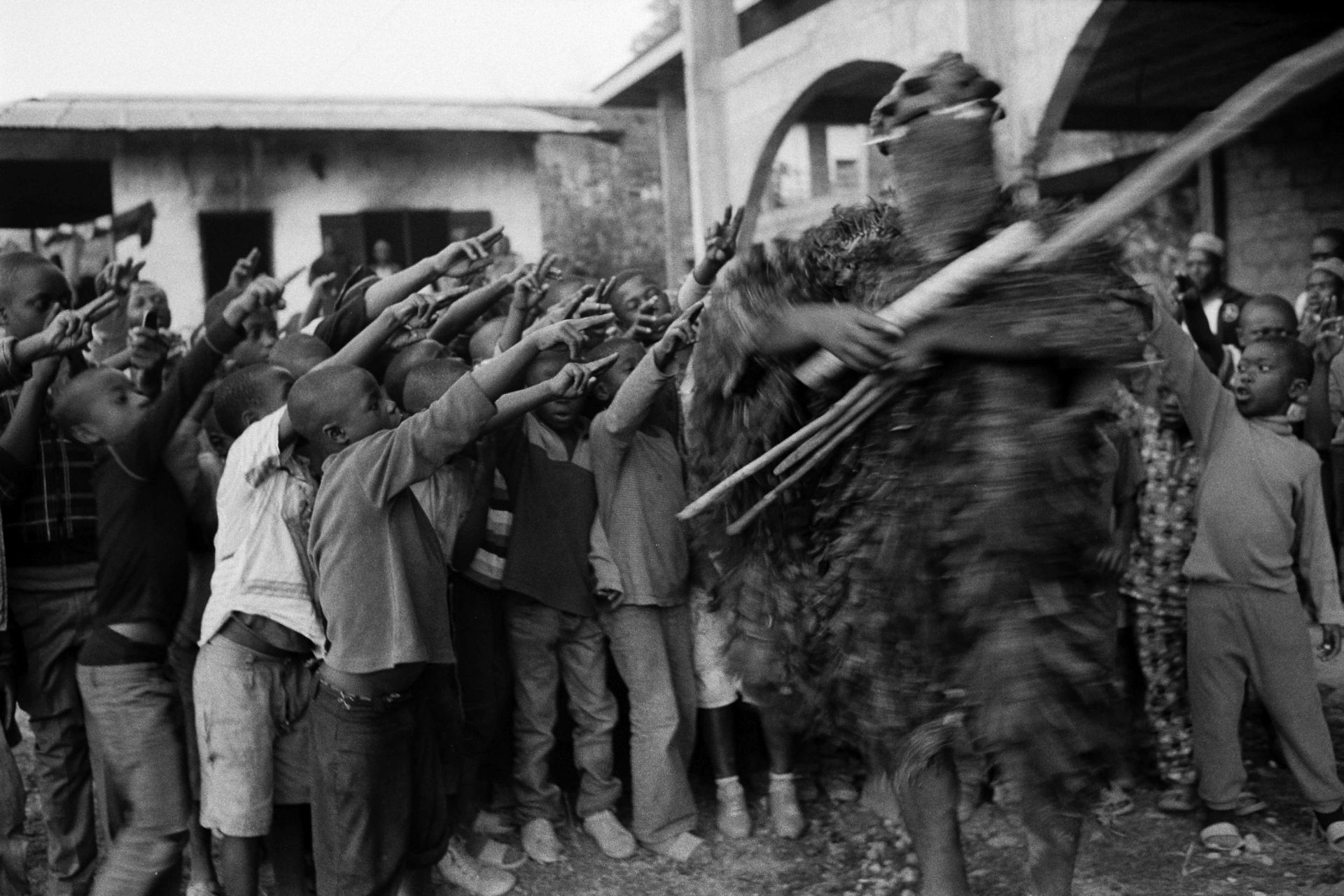
In December 1977 Samba-Feking, one of Oku’s four Samba societies, brought its war mask before the palace for the memorial festival of the dead queen mothers. When it grew too wild a medicine man splashed it from his calabash to calm it. Two days later the seven medicine men, who knew all its secrets and had once been its commanders in war, sat before the palace with black paste on their faces, drinking, licking and rubbing in their medicines while they sang to the dead leaders of Samba. The society that had defended the land was honouring the kingdom’s dead queens. Koloss, 1996, pp.392–396 · archived.
Nso’ takes the strong arm
East of Oku lies the kingdom of Nso’, whose palace stands at Kumbo. Its historians Verkijika Fanso and Bongfen Chem-Langhëë tell how its war lodge came from Bamum, the kingdom centred on Foumban to the south-east:
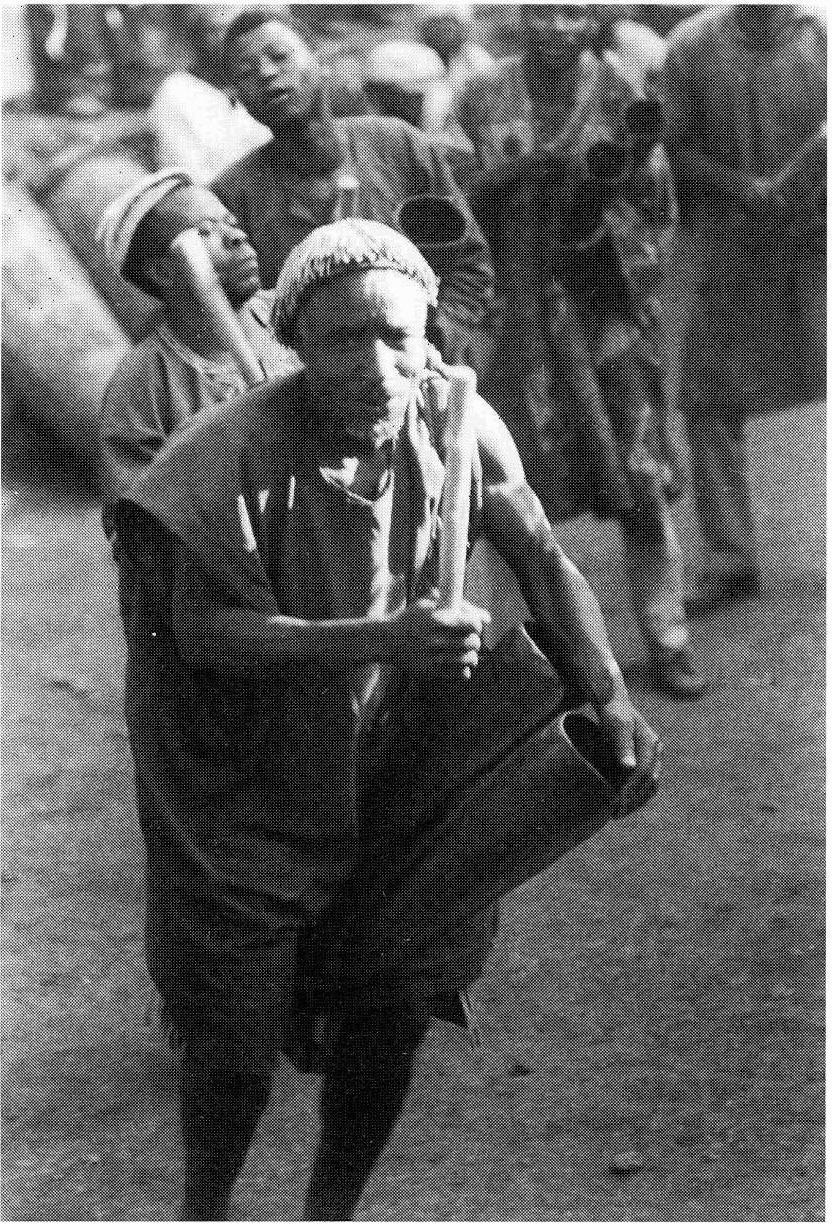
Mfu’ was the most senior of the fraternities, and the most important wing of manjoŋ. The esoteries of mfu’ are said to have been acquired from Bamum during one of the early Nso’-Bamum encounters. According to Mfoome John Ngo, Nso’ warriors entered the mfu’ house at Yar, beyond Mbokam, and found nyam mfu’ (bull-roarer) and kifu ke mfu’ (medicine and secrets) and took both. Those courageous enough to drink the medicine soon discovered its potency: it ‘made the heart strong’, and rendered men brave to go forth, fight and capture enemies. The concoction of the medicine was soon learned from the Bamum and the mfu’ institution was brought and introduced in Nso’ as the ‘strong arm’ of manjoŋ.
Fanso and Chem-Langhëë, 1996, p.104
The lodge was not theirs until Nso’ men could brew its medicine, and then it needed the king. “Permission to introduce such groups was granted by the Fon,” the same page continues, “as was the case for mfu’.” Fanso and Chem-Langhëë, p.104 · archived.
Its houses stood beside the palace. The most prestigious lodges of manjong, Chem-Langhëë, Fanso and E. M. Chilver write, “privileged to have human and animal supporters of their pedestal drums, elaborately carved doorframes and support posts, were those of mfu’ (bull-roarer), with headquarters adjacent to the palace; mfu’ was acquired from the Bamum borderlands, and came under royal patronage.” Two of them, one for each of manjong’s divisions, survived the palace fire of 1959. Chem-Langhëë, Fanso and Chilver, pp.153, 157 · archived.
The lodge on the move
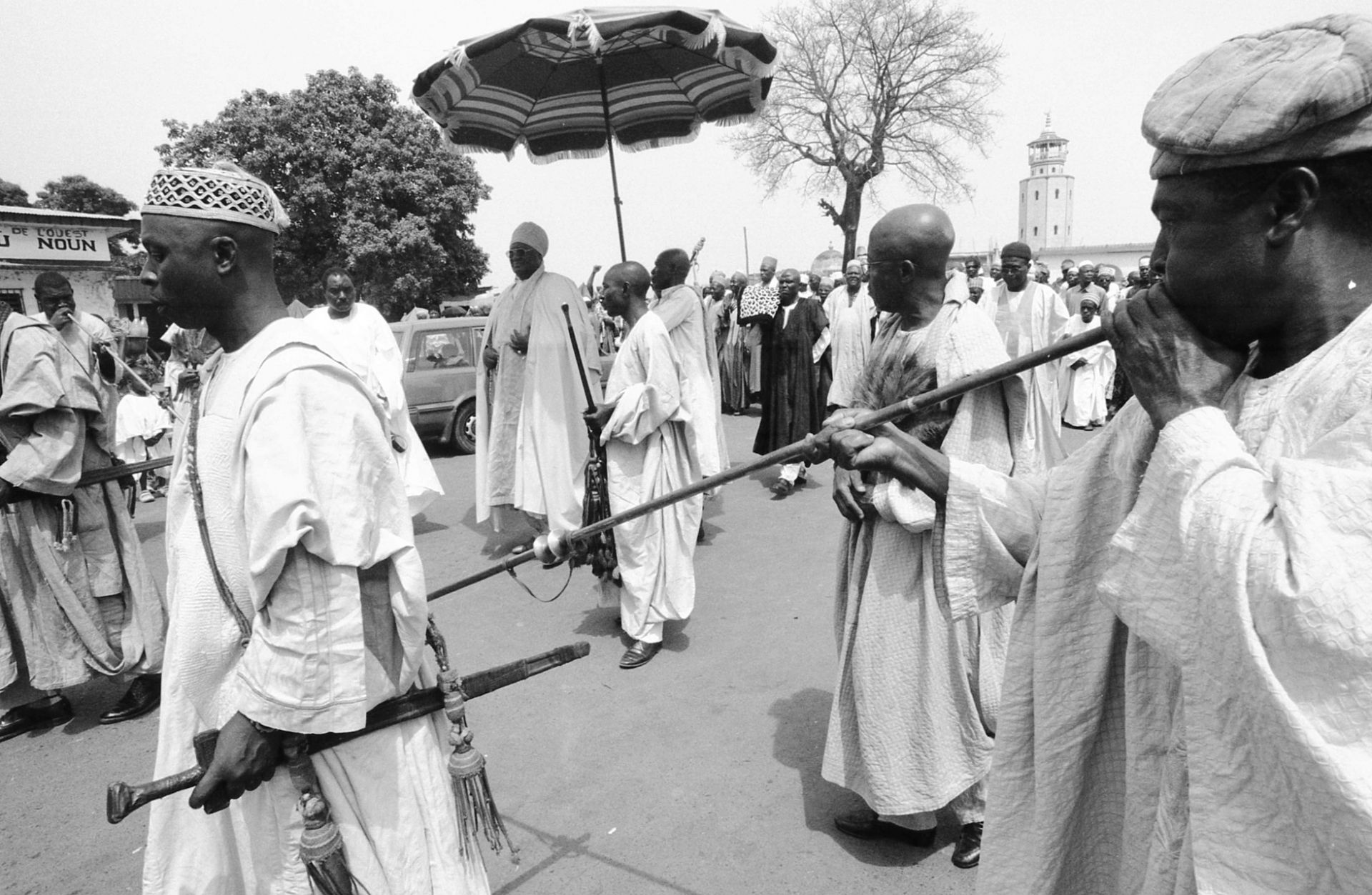
The Nso’ lodge kept the Bamum word. In Bamum, Otto Zerries reported from Leo Frobenius’s notes, “there are bullroarers of wood (Mwu or Mfu) and of bamboo (Usischa)”. No woman or child might see them, they were swung when old people were buried, and the office answered to a titled head, the Fomwu. Zerries, 1942, p.20 · archived. The Bamum mfu and the Nso’ mfu’ are one name for one instrument, and Nso’ says it took both from a Bamum house.
North of Nso’, in the Wimbum chiefdoms, the lodge arrived by trade. Notes from those chiefdoms, edited by Chilver, record that one chief “has the mfu war society, with four officers – mfomi, nggwaiyi, nggwang and tamfu. Mfu was got from Bamum.” The same chief also had “the widespread Samba society”.
“Mfu’ was got from Bamum through traders in the time of Mfo, before the Germans arrived.”
Wimbum notes, ed. E. M. Chilver, 1997, p.38
Oku names the same sources for its own war lodges. Manjong and then Nfuh, Koloss writes, reached Oku in the reign of King Ngeck Zuelam, who ruled from 1909 to 1940; “Bamum, Nso and Ndu are usually named in this connection.” Koloss, 1996, p.398 · archived. The roarer’s animal came with them. At the close of the 1977 festival two bare-chested Nfuh men danced with a long rope and wound it round the whole company, and the women were told that the rope held Nyam Nfuh, the animal of Nfuh, whose voice was the sound of the lodge’s secret instruments. Nso’ calls its roarer nyam mfu’. Nfuh was led that day by Tamfuh of Elak, commander of all Oku’s troops; in Wimbum country tamfu is an officer of mfu. Koloss, 1996, p.400 · archived.
Samba moved the same way. Oku traces it to Bangolan, and the Nso’ saamba, “a war-like dance society, was obtained in the early part of the twentieth century from a group on the Ndop Plain.” Raid and purchase carried these lodges across the Grassfields, and the roarer and its medicine travelled each time as the lodge’s property, held by whoever had taken or bought the right.
The war power at the grave
Every society in Oku keeps a special corner in its medicine house. Of Manjong’s, Koloss writes:
In this medicine corner, when the society was founded, an especially dangerous medicine was buried, which will always be effective and destroys anyone who breaks the laws of the society, that is, who betrays its secrets. The secret and dangerous musical instruments, which represent the voice of the society, are kept here as well. These instruments were used above all on campaigns. Today they are played only at the death of the highest members: they are above all three bullroarers.
Koloss, 1985, p.12 (translated)
On 21 December 1977 Kan Ngvume was buried at Ngashie in Oku. He was an elder of the royal Mbele clan and a senior member of several societies. When the earth was in, the war society danced and sang over the grave: “Now Manjong’s secret musical instruments were played as well, namely bullroarers.” Koloss, 1993, p.18 · archived.
“Originally used by military societies to terrorize and defeat the enemy, today they are used exclusively by the Mfuh society during burial ceremonies of its deceased members.”
Bartelt, 2006, p.202
A generation later the roar at the grave was still a charge. Bartelt, who spells Nfuh as Mfuh, describes its men “swinging their bullroarers and waving their machetes” as they “rush upon the burial site in a menacing manner, at which point all non-members must hide or look away, or risk immediate affliction” from the lodge’s medicine. Bartelt, p.202 · archived.
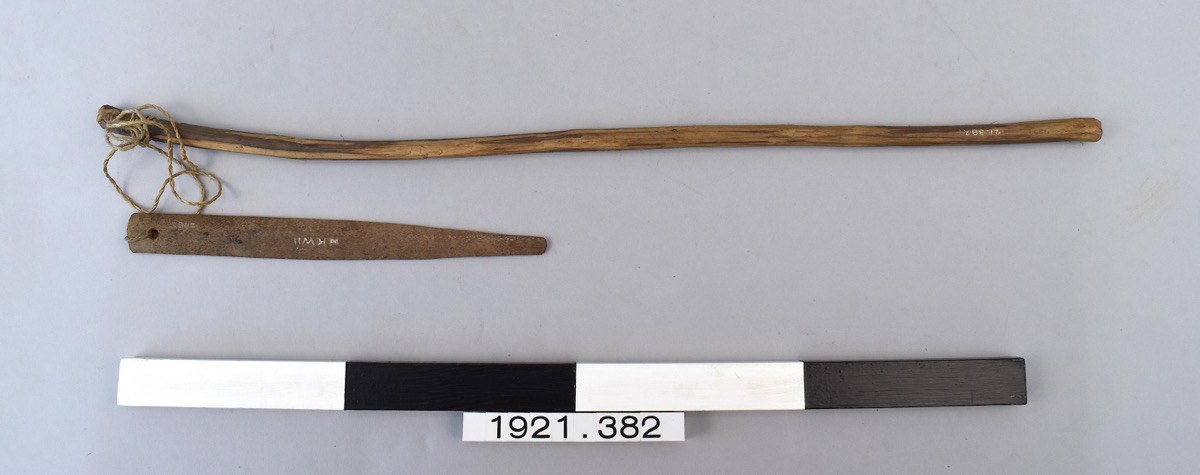
To the south, at Bagam in Cameroon’s West Region, the Eyap held a dance at a relative’s grave some time after the burial. A procession led by a man in a cowrie-covered garment wound through the main roads to the grave, sang and danced there, and went home. L. W. G. Malcolm set down what followed:
The same night a party of men go through the streets swinging a bull-roarer (Fig. 1 b). This is called ñgū muñ mo, and I was informed that no woman is allowed to see it. They must go into the bush if they hear it near at hand. It is played by certain men from one compound and no one else is supposed to use it.
Malcolm, 1923, pp.399–400
At Bagam, too, the roarer had owners: the men of a single compound. Malcolm, 1923, pp.399–400.
The society above the king
West of Oku, at Laikom, the capital of the Kom kingdom, the bullroarer belonged to the society that makes the king. Its name is Nkvifon, the Kom form of Kwifon, the society that enforces a Fon’s rule in Oku, Bum, Bafut and other Grassfields kingdoms. M. D. W. Jeffreys set down how it received a successor:
When a new chief is to be enthroned, the Ŋkvifon, a secret society, assemble. The eldest male of each of the other two families then lead the chief designate to the Ŋkvifon. An Atyaf holds the new chief’s right arm and a Tinela the left. After being accepted as the new chief by the Ŋkvifon the coronation ceremony is performed.
… The executive and police force of the Fon is the Ŋkvifon society. … The Ŋkvifon uses the bull-roarer and carries out decrees and orders of the chief. The execution of criminals was also in the hands of the Ŋkvifon. The society dances in masks at the funeral of the chief and other important tribal members.
Jeffreys, 1950–1951, pp.95–97
Nkvifon, the keeper of the Kom bullroarer, could also judge the king it had accepted. Paul Nchoji Nkwi describes its sacred house at Laikom, guarded day and night and closed to all but members, where it kept the musical instruments and the masks. In that room “major decisions concerning public affairs of disciplining the ruler for his disregard of tradition and custom were taken.” Nkwi, 1985, p.108 · archived.
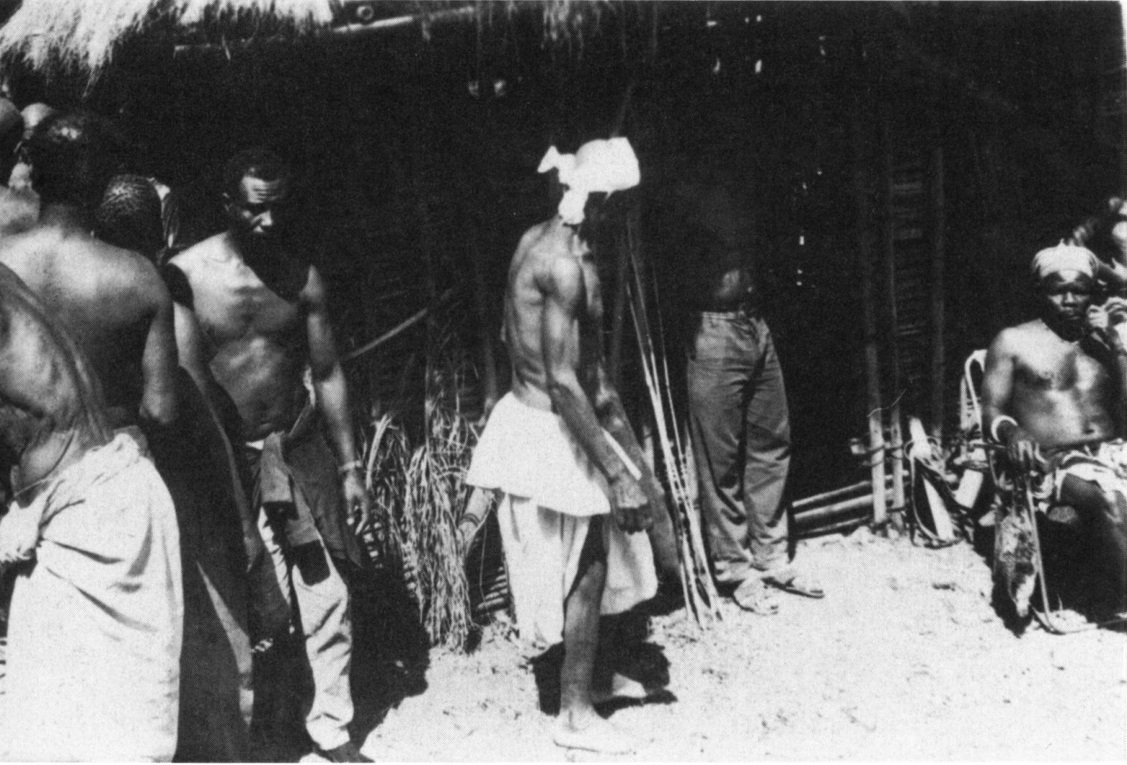
Kom says its founders followed a python’s track to Laikom. Before dawn, Nkwi writes, the heir walks that track to a spring to be bathed by priests. In the public square two kingmakers, one each from the Achaf and Itinalah matrilineages, Jeffreys’s Atyaf and Tinela families, seize the heir, slap and buffet him for the last time, and seat him on the sacred stone. Nkwi, 1990, pp.238–241 · archived.
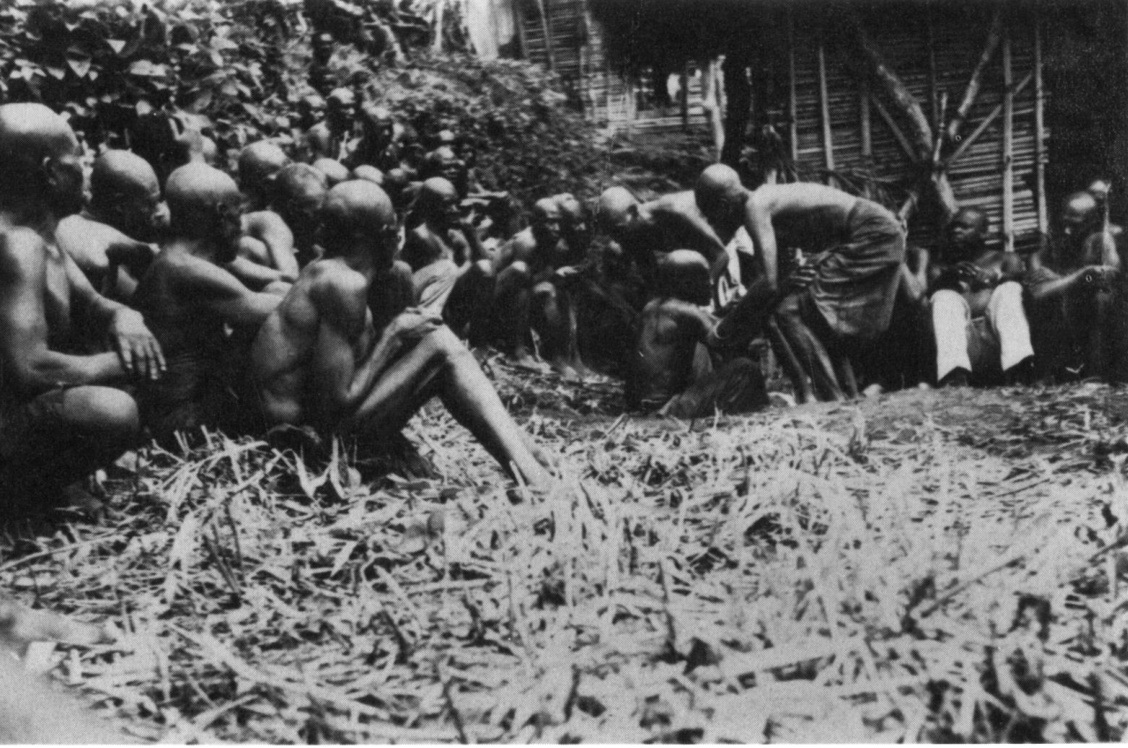
To the north-east, the Wiya of Ndu gave the same kind of society an ancestral face. Their ngwarong belonged to the chief and was counted among the things their forebears brought from their old home at Kimi. In a passage reproduced by Miller and Okon · archived, Jeffreys wrote that its masked officers
… are supposed to be ancestral spirits incarnate for special duties such as restoring the violated mores of the tribe by inflicting punishment upon the offenders. The punishments are either confiscation of property, whippings or execution of the malefactor. The theory is that the punishment is done by ancestral spirits. In this way the creation of a blood feud is avoided.
Jeffreys, 1962, p.91, quoted in Miller and Okon, 2020, p.103
Power finds another field
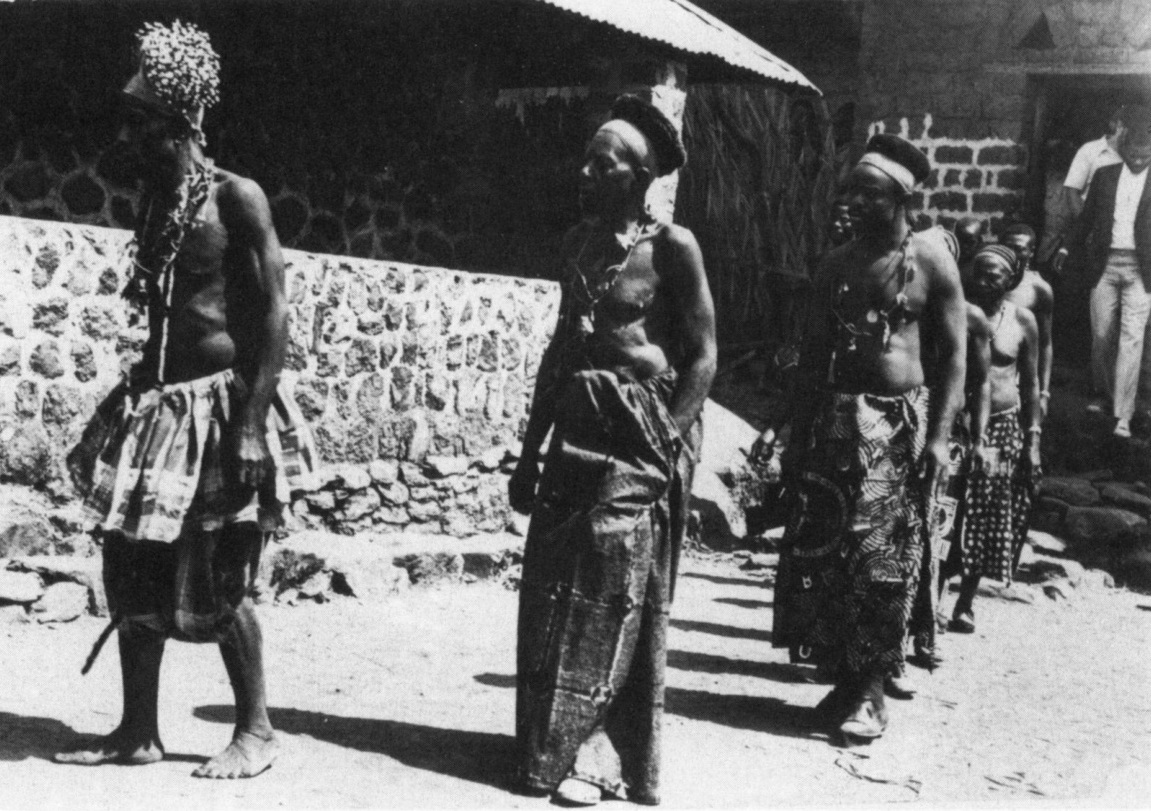
The wars ended and the lodges kept their men. Oku’s military societies, Koloss writes, “belong not to the individual extended families but to the whole people”, and every adult man had to join at least one. Their old tasks were campaigns and communal hunts:
Today they are above all entrusted with carrying out and supervising communal work. Such work has ‘always’ included the elaborate repairs to the buildings of the palace area and the cultivation of the royal farms, and more recently road and bridge building and the putting up of public buildings.
Koloss, 1996, p.398 (translated)
Through Nfuh’s leaders a royal decision could run through every village of Oku on a single market day. In Nso’ the two mfu’ houses became the places where the Fon gave out important news and set communal work.
Samba’s medicine went furthest of all. “Since wars have long ceased,” Koloss writes, “Samba medicine has in recent years become increasingly important for healing. But athletes too, and football teams above all, prize its strength, for they believe that with its help they can make sure of winning their matches.” Koloss, 1996, p.395 · archived.
Every one of these turns was made by the owners of the power. Nso’ took the roarer from Bamum and placed it under its king, and Wimbum chiefs had the lodge from Bamum traders. The same lodges carried the roar from the battle line to the graves of their senior men and sent their members to the king’s farms and roads. At Kom the society that sounded the bullroarer accepted each king and could bring him to account. The roarers that once confused Oku’s enemies went wherever their keepers took them, and in the Grassfields their keepers carried them from kingdom to kingdom.
Key sources
- Bartelt, Brian A. 2006. Healers and Witches in Oku: An Occult System of Knowledge in Northwest Cameroon. PhD dissertation, University of Southern California. Military societies and Mabuh, pp.149–151; Samba medicine-making and women’s role, pp.158–159; Fimbien, p.160; Mfuh funeral bullroarers, p.202. Institutional PDF · archived.
- Fanso, Verkijika G., and Bongfen Chem-Langhëë. 1996. “Nso’ Military Organisation and Warfare in the Nineteenth and Twentieth Centuries.” In Ian Fowler and David Zeitlyn, eds., African Crossroads: Intersections between History and Anthropology in Cameroon, pp.101–114. Mfoome John Ngo’s account of the raid at Yar, royal permission, and saamba from the Ndop Plain, p.104. Page preview · archived.
- Chem-Langhëë, B., V. G. Fanso and E. M. Chilver. 1985. “Nto’ Nso’ and its Occupants: Privileged Access and Internal Organisation in the Old and New Palaces.” Paideuma 31:151–181. Manjong membership, the mfu’ lodges and the Gham/Ba’ divisions, p.153 and n.1; two houses, 1959 fire and later civic uses, p.157. Original article · archived.
- Koloss, Hans-Joachim. 1996. Tikar (Äquatorialafrika, Kameruner Grasland) — Totengedenkfest für die Königsmütter in Oku. Publikationen zu Wissenschaftlichen Filmen, Ethnologie 19:329–402. Samba’s founding, Kvevli and the paired masks, pp.392–393; women, Njamse and war, pp.394–395; healing, football and the rite of 28 December 1977, pp.395–396; arrival and civic work of Manjong and Nfuh, pp.398–399; Nyam Nfuh and Tamfuh, p.400. Film companion · archived; Samba film · archived.
- Koloss, Hans-Joachim. 1995. “Kefuh Myin: A Therapeutic Medicine in Oku.” JASO 26(1):69–79. Ancestors, reconciliation and dangerous medicines, pp.69–72; protection of instruments, p.75. This therapeutic institution is distinct from Samba. Article PDF · archived.
- Koloss, Hans-Joachim. 1993. Tikar (Äquatorialafrika, Kameruner Grasland) — Begräbnis. Publikationen zu Wissenschaftlichen Filmen, Ethnologie 18:1–32. Kan Ngvume’s burial, pp.13–18; grave bullroarers, p.18. Film companion · archived; Film · archived.
- Koloss, Hans-Joachim. 1985. Tikar (Äquatorialafrika, Kameruner Grasland) — Vorbereitung und Durchführung einer rituellen Reinigung. Publikationen zu Wissenschaftlichen Filmen, Sektion Ethnologie 14/14. Manjong’s medicine corner and the bullroarers as the society’s voice, p.12. Film companion.
- Jeffreys, M. D. W. 1950–1951. “Some Notes on the Bikom.” The Eastern Anthropologist 4(2):88–97. Nkvifon’s acceptance of a new chief, p.95; its bullroarer and royal executive role, pp.96–97. Scanned issue.
- Nkwi, Paul Nchoji. 1985. “The Kom Palace: its Foundation, Growth and Significance.” Paideuma 31:105–110. Python foundation narrative, p.105; the society’s guarded inner house and discipline of the ruler, p.108. Article PDF · archived.
- Nkwi, Paul Nchoji. 1990. “‘Becoming Foyn’ among the Kom of the Cameroon Western Grassfield.” Paideuma 36:235–245. Bathing at the spring and installation, pp.238–239; founding python’s path, p.241. Article PDF · archived.
- Malcolm, L. W. G. 1923. “Notes on Birth, Marriage and Death Ceremonies of the Eyap Tribe of Central Cameroon.” Journal of the Royal Anthropological Institute 53:388–401. Membrane instrument, p.398; grave procession and the night bullroarer, pp.399–400. Scanned volume.
- Zerries, Otto. 1942. Das Schwirrholz: Untersuchung über die Verbreitung und Bedeutung der Schwirren im Kult. Stuttgart: Strecker & Schröder, p.20. Bamum instruments and office, reporting Frobenius manuscript material. Book record and snippets · archived.
- Chilver, E. M., ed. 1997. Some Materials for the Study of the Wimbum of the Western Grassfields of Cameroon: A Collection of Grassfields Working Notes, p.38. Mfu’ got from Bamum through traders; the things brought from Kimi; the widespread Samba society.
- Jeffreys, M. D. W. 1962. “The Wiya Tribe.” African Studies 21(2):83–104, p.91, quoted in Ivor Miller and Efiong Okon, “Ékpè ‘Leopard’ Association songs from the Cross River Region,” International Journal of Languages and Communication 7 (2020):91–117, p.103. Miller and Okon PDF · archived.