No. MINE2026-077
Northern Saulteaux hunting-wind bullroarer
Canada · Northern Saulteaux country, northwestern Ontario · North America · Subarctic
Weather / fertility magic
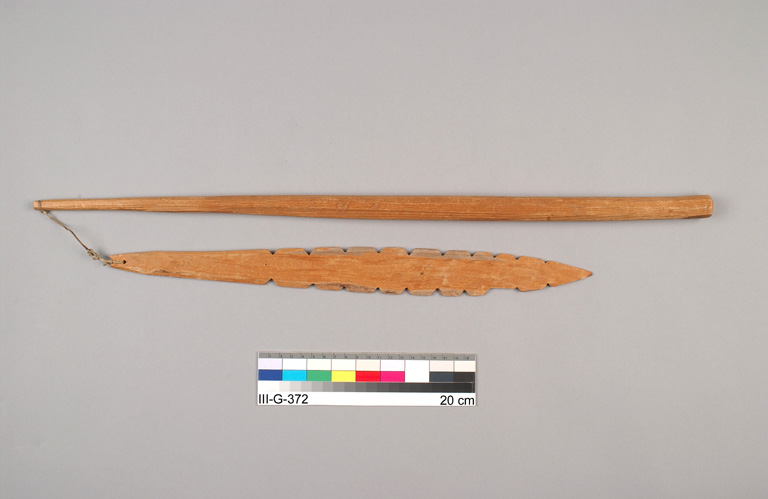
Source term: bull roarer
A Northern Saulteaux legend tells where the winds came from: a woman bore four sons at a single birth and died leaving them, and each grew into one of the four winds and travelled off to his own quarter — the eldest south to bring warm weather, the youngest north to send the bitter cold. Of the four it was that north wind the hunters wanted, the best hunting wind, and to raise it they carried a serrated wooden bullroarer on a yard of cord and sat up through the night swinging it overhead — its rushing hum, Skinner guessed, standing in for the rush of the wind. The same blade could also be sounded simply for amusement. These were Ojibwe communities of the lake-and-forest country north of Lake Superior, close kin to the Eastern Cree.
Bull roarers of several kinds not only serve as amusements but are carried by hunters, who use them to bring the wind.
Alanson Skinner, Notes on the Eastern Cree and Northern Saulteaux (1911), p. 141; north-wind context p. 148.
Particulars
- Object
- Edge-serrated wooden blade on roughly a yard of cord, swung around the head from a short hand grip.
Source
Alanson Skinner, Notes on the Eastern Cree and Northern Saulteaux (AMNH Anthropological Papers 9(1), 1911), pp. 117-118, 141 and 148