Atlas Guide —
Pūrerehua: The Māori Bullroarer, Its Sound and Meaning
The pūrerehua is the Māori bullroarer: a flat blade of wood, bone or stone tied to a long cord and whirled through the air until it roars. It is one of the taonga pūoro, the traditional instruments of the Māori, and its name is also the Māori word for a moth or butterfly. Among Ngāti Porou of the East Cape it called down the rain for the crops; on the Taranaki coast it roared beside a chief lying in state, to drive the evil spirits off; and the old people told Elsdon Best that the sound was made by the wairua, the soul, of the one who swung it.
The names of the pūrerehua
Māori names for the bullroarer evoke its whizzing and rumbling sound, or the insects it resembles in flight. Huhū is the ordinary verb for hissing, whizzing and humming; whēorooro is to rumble; pūrorohū is a whistling, whizzing noise, and the word is used for a noisy storm of rain as well. Two names catch insects. Pūrerehua, the name most people know, is the moth and the butterfly: the blade takes it from the moth, whose flight its own resembles, especially the lighter and fatter wooden ones (Flintoff). Rangorango is a blowfly, and the instrument is called that, the dictionary explains, “because it sounds like a blowfly”: its song is the whirring of the blowfly’s wings, rising and falling in pitch as it darts and hovers.
Elsdon Best listed six names together in 1925: huhu, purorohu, turorohu, rangorango, wheorooro and purerehua (spelled, as the period spelled, without macrons). Others belong to particular coasts.
| Name | What else it means, and where | Source |
|---|---|---|
| pūrerehua | Moth, butterfly; and the bullroarer, of wood, stone or bone on a long string, named for the moth’s flight. | Te Aka Māori Dictionary; Williams 1892; Flintoff, Taonga Pūoro |
| pūrorohū | A whizzing or whistling noise; the bullroarer; a noisy storm of rain. | Te Aka; Williams 1892 |
| huhū | To hiss, whiz, buzz, whirr, hum; the bullroarer. On the Whanganui River, the bullroarer’s own name. Not the same word as huhu with short vowels, the edible grub of rotting wood. | Te Aka; Best 1926 |
| rangorango | Buzz, hum, buzzing sound; a fly or blowfly; the bullroarer, “because it sounds like a blowfly.” | Te Aka, citing Te Wharekura 41 |
| whēorooro | To make a rumbling noise; the bullroarer. | Te Aka |
| tūrorohū | The name in the Ngāti Porou rain rite of the East Cape (printed turorohu in Best and Te Ara’s English text). | Best 1925; Flintoff 2017 |
| mamae | Pain, ache; and on the Taranaki coast, the bullroarer of mourning. | Hamilton 1901; Tregear 1904; Te Aka |
| gārara | The name Richard Nunns paired with pūrerehua for his RNZ demonstration. | RNZ He Ara Pūoro, 2012 |
Polynesians elsewhere named the instrument the same way, by its noise or by a buzzing insect. On Aitutaki in the Cook Islands the leaf bullroarer is patangitangi, built on tangi, to sound or cry; Samoan children called theirs lango mumu, after the fly whose hum it copies.
What the pūrerehua was for
Calling the rain among Ngāti Porou
The fullest account of the pūrerehua at work comes from the East Cape, from the Ngāti Porou leader Tuta Nihoniho, who described it to Elsdon Best. “When rain was needed, as for crops,” an adept went out in the evening or at night. He threw a handful of ashes toward the south, the rainy quarter, and swung the tūrorohū until it boomed. Then he bared his buttocks to the south and recited a karakia meant to insult the quarter and goad it into sending a storm. Best printed the karakia in full; it opens “Kaore koa te whenua nei ka ruia ka nekea.”
The instrument was too dangerous to play with. Children who sounded a bullroarer were scolded and told they would bring on a storm: “Kati te mahi; he taritari marangai tena mahi!” Best drew the conclusion himself: “This looks as though this implement was not used as a toy, but only in connection with ceremonial usages, which reminds one of its use in the ritual of Australian natives, and other peoples” (1925; 1976 reprint, p. 294). The rite has its own point on the map: Ngāti Porou rain rite.
A farewell to the dead on the Taranaki coast
On the west coast of the North Island the pūrerehua had another name and another task. Augustus Hamilton wrote in Maori Art (1901, p. 374): “On the Taranaki coast these purerehua are called mamae.” Mamae is pain. There it was sounded while a chief lay in state, and its roar drove away the evil spirits gathered about the body; Hamilton returns to the funeral use of the west coast at p. 430. Edward Tregear put it the same way three years later:
In some parts of the country bull-roarers were used when a deceased chief was lying in state, and the sound was supposed to drive off evil spirits.
Edward Tregear, The Maori Race (1904), p. 55
J. Macmillan Brown, writing in 1907, says it was used “to drive off spirits from a chief’s body at a tangi” (p. 206). The tangihanga, the days of mourning over the dead, is still the great gathering of Māori life, and the pūrerehua once sounded at its centre. Brian Flintoff, in Te Ara, gathers the stories told of the instrument into one line: they speak of it “calling rain, summoning tears and even enticing food from hiding places.”
The swinger’s own soul
What makes the roar? Best’s answer, written in 1900 from Ruatāhuna in Tūhoe country and drawn from “the elder generation of natives now living,” is a rare one among the world’s bullroarers:
The bull-roarers (purerehua) formerly used by the Maori produced a loud whirring or roaring sound when swung round. This noise is said to have been caused by the wairua of the operator.
Elsdon Best, “Spiritual Concepts of the Maori,” Journal of the Polynesian Society 9 (1900), p. 181
He repeated it in 1922 and again in 1925, and Tregear wrote in 1904 that “the spirit (of the operator) caused the noise.” The wairua is the Māori free-soul, the part of a person that leaves the body in dreams, sees at a distance and survives death. In Aboriginal Australia and New Guinea the bullroarer’s roar is the voice of an ancestor or a god; here it is the swinger’s own spirit, sent out on the cord. That thread runs across the world in This Is Your Body and Grandfather and Mother.
Wind, prayer and Tāwhirimātea
In the order of taonga pūoro, Flintoff places the pūrerehua in the family of Tāwhirimātea, the atua of the winds: its instruments carry the player’s hopes out on ngā hau e whā, the four winds. Te Papa’s curator Isaac Te Awa, writing for Matariki in 2022, sets the pūrerehua among the taonga of Ururangi, the Matariki star of the winds. Its sound, he writes, is likened to the voices and winds of Tāwhirimātea; it has been used to call rain, to speak with and draw lizards and birds, to tell stories, and to let grief be “released into the winds of Tāwhirimātea.” Te Papa’s own description of the instrument puts its purpose in a sentence: “The main purpose of this instrument is to offer messages of prayer to people and to the gods.”
A children’s toy on the Whanganui
Two hundred miles from the East Cape the same instrument had come down to a plaything. Best’s 1926 word list records it in a single line: “huhu, the bull-roarer, a toy. An example of onomatopeia [sic]. Whanganui.” On the Whanganui River the roarer that called the storm for Ngāti Porou was something children swung for the noise. The Whanganui huhū has its own record. Across the world, the bullroarer’s road runs from god to toy, and the toy is where it ends, not where it begins (The Original Spin).
How a pūrerehua is made
The classic pūrerehua is an elongated, flat oval of mataī heartwood, pointed at both ends. Best gives its length as twelve to eighteen inches (about 30 to 46 centimetres), hung on a cord about four feet long (some 1.2 metres), which in turn is tied to a rod handle about three feet long. Tregear’s “large bull-roarer (purerehua or mamae)” is the same: “hard wood (matai) eighteen inches long,” on a four-foot cord fastened to a three-foot stick “by which the bull-roarer was whirled round, making a booming or humming noise” (1904, pp. 54–55). The handle lets the player whirl the blade in a wide circle over the head; swing it faster and the whirr deepens into a boom. Best notes the Ngāti Porou instrument was swung with a handle like the Tūhoe one.
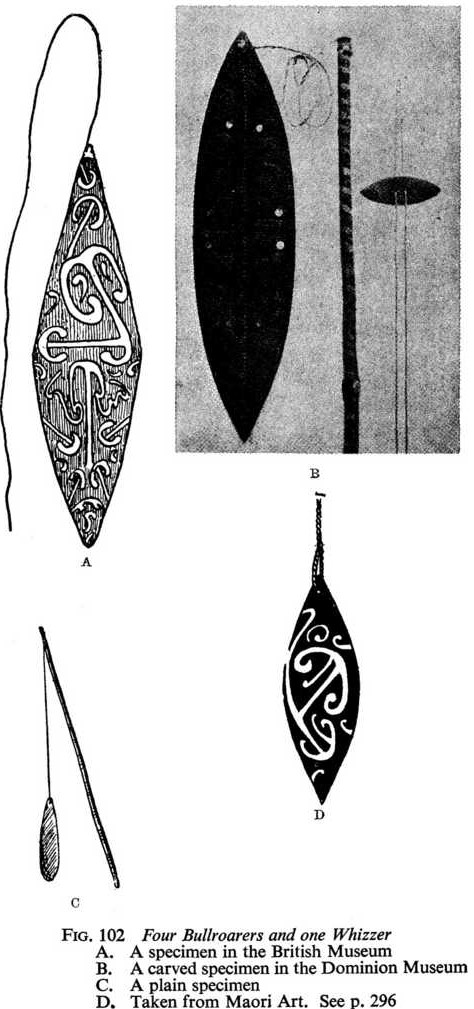
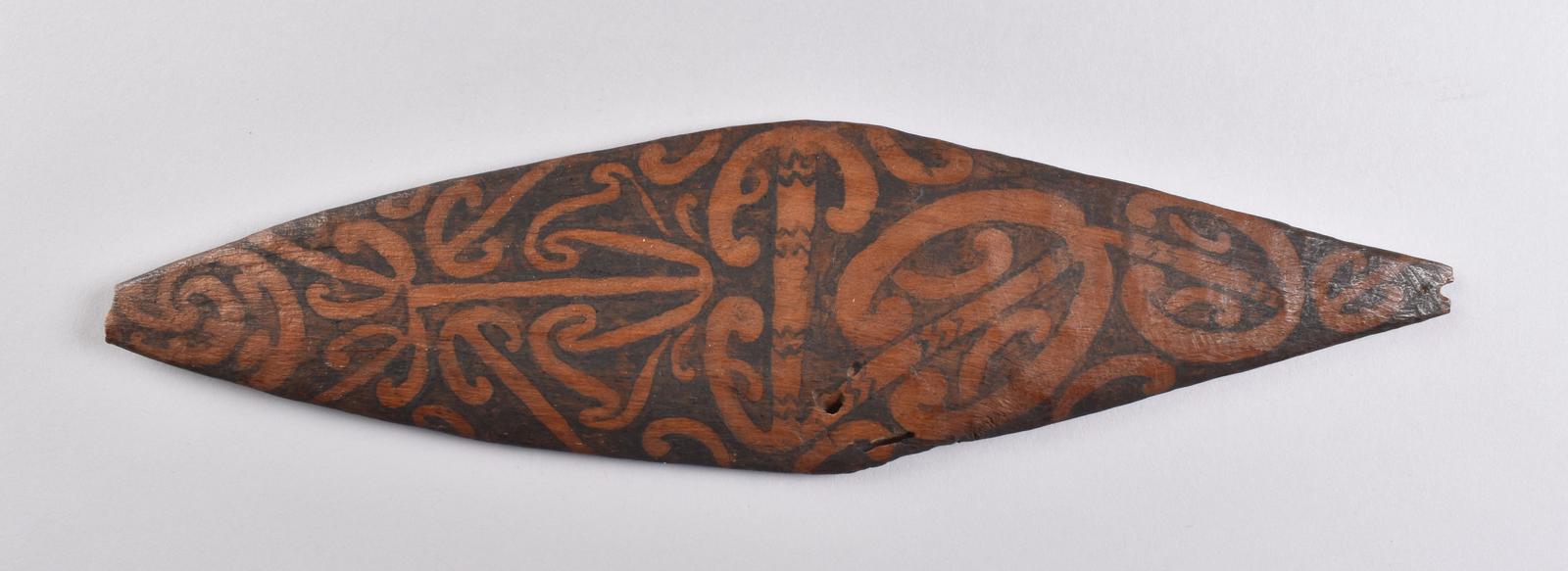
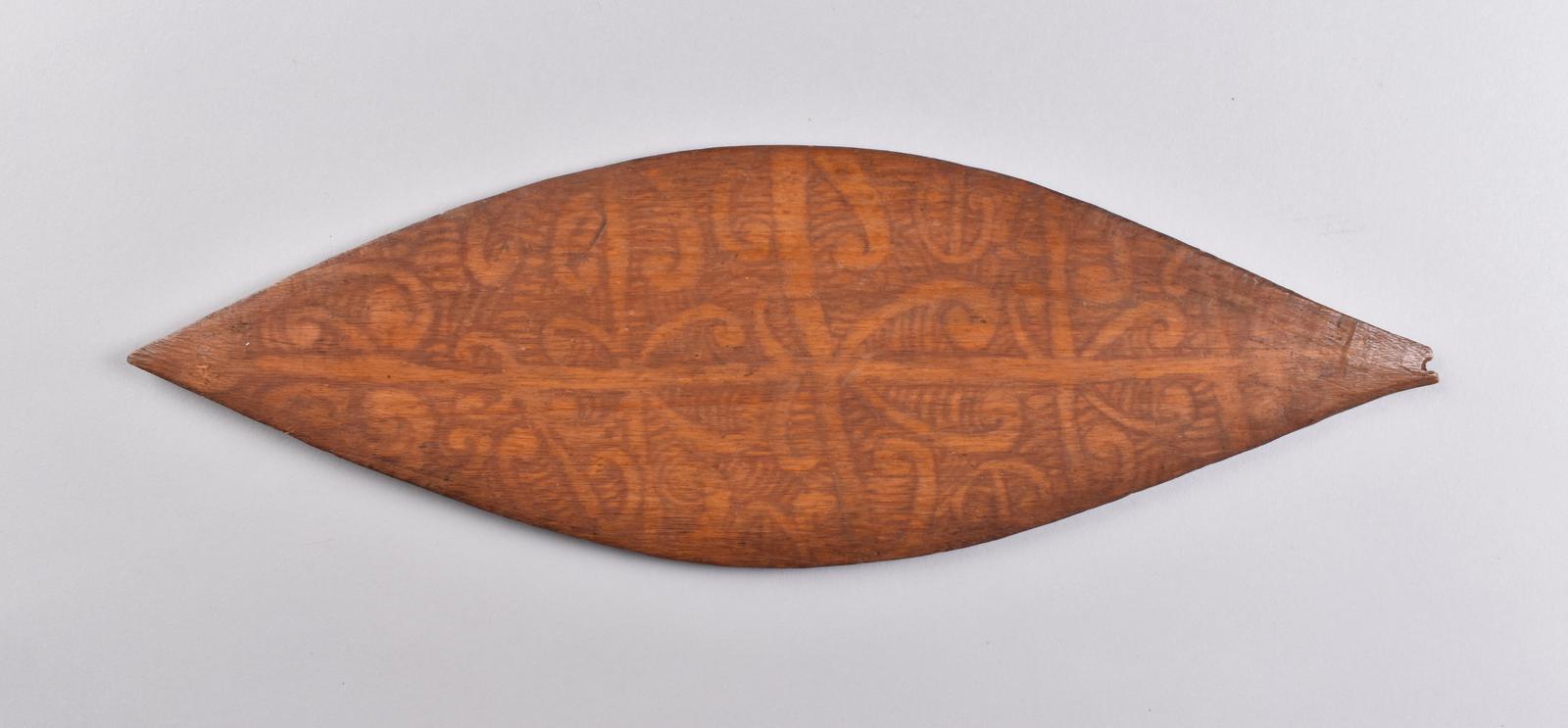
Mataī was the wood of the old accounts, but the dictionary’s definition is wider: a pūrerehua is made of wood, stone or bone, attached to a long string. Surviving blades show the whole range of finish. Some are plain. Others are carved, like Best’s Dominion Museum blade with its shell inlay, or painted: the two British Museum blades carry kōwhaiwhai, the flowing scrollwork of meeting-house rafters, and one of them has its pattern left in bare wood across a black ground. The cord is twisted plant fibre, passed through a hole at one tip and bound around it.
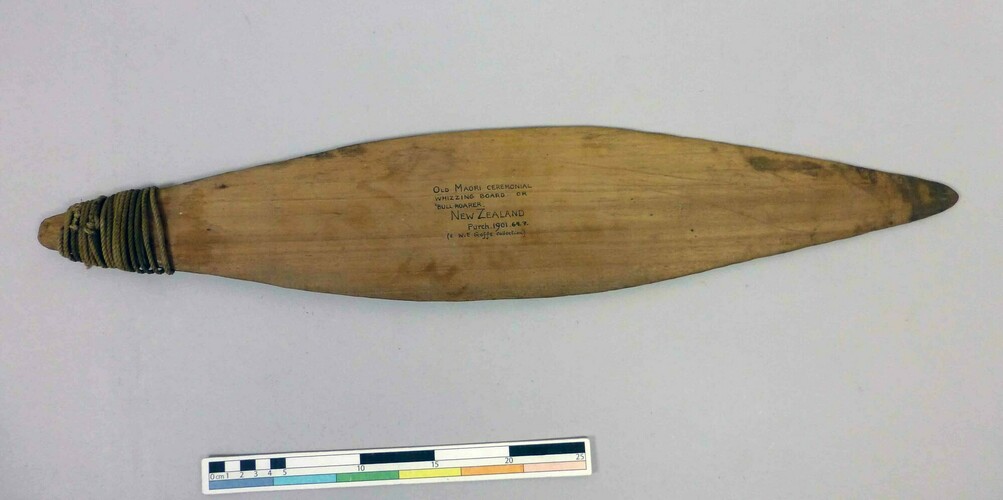
Museum blades vary far more than the old measurements suggest. Te Papa holds one from 1997 that is only 155 millimetres long; Bernard Makoare’s is 427 millimetres; and the carved blade in the Pitt Rivers Museum at Oxford is 625 millimetres, about a third longer than Tregear’s eighteen inches. For the general technique of shaping and tying a blade, see How to make a bullroarer.
Pūrerehua in museums
The pūrerehua reached European museums early. Andrew Lang knew carved New Zealand bullroarers in the Christy collection when he wrote his famous essay on the instrument in 1884, and A. C. Haddon figured a decorated British Museum specimen in The Study of Man (1898). These are the objects to look for today:
- British Museum Oc.4879 (Plate I): a pointed oval blade, 29 × 7.5 × 0.5 centimetres, painted on both faces with pitau-series kōwhaiwhai, its cord surviving. Bought from Bryce McMurdo Wright in 1868.
- British Museum Oc.4878 (Plate IV): a broader blade with kōwhaiwhai scrollwork across its face.
- Pitt Rivers Museum 1901.64.7 (Plate III): carved wood and twisted plant fibre, 625 × 115 millimetres, bought at Stevens Auction Rooms in 1901. The museum records its Māori names as puurorohuu and puurerehua.
- Te Papa ME016169: a wooden pūrerehua, 427 × 60 × 13 millimetres, made by Pena (Bernard) Makoare and given by him to the museum in 1997.
- Te Papa ME015914: a small blade of wood and cord, 155 × 50 × 5 millimetres, made in 1997 and given by the Haumanu collective of taonga pūoro players.
- Te Papa ME002939 and ME002621: two wooden pūrerehua, the first carved, both given by Alexander Turnbull in 1913. Both are pictured in Isaac Te Awa’s Ururangi article.
These objects and the written accounts share one point on the map, the Māori pūrerehua, with separate points for the Ngāti Porou rain rite and the Whanganui huhū. Among the Moriori, the people of Rēkohu, the Chatham Islands, a carved whalebone blade from an old burial ground is the Moriori entry, a candidate: Arthur Dendy recognised it as a bullroarer in 1901 and made a working replica of it.
Pūrerehua vs porotiti
The two are often confused, but they are different instruments. The pūrerehua is a blade tied by one end to a single long cord and whirled in a circle around the player, often from a handle. It roars. The porotiti is a small disc or flattened piece with a loop of cord passed through two holes near its middle. The player holds the loop at both ends and pulls it tight and lets it slacken in turn, so that the cord winds and unwinds and the disc spins back and forth between the hands. It whirrs.
Tregear gave the measurements in 1904. His small whizzer was “about four inches long,” its cord threaded through two holes “about a quarter of an inch apart,” and it was used “by twisting the string and letting it unwind itself”; the large purerehua was eighteen inches long on a four-foot cord and a three-foot handle (pp. 54–55). Porotiti are made of wood, pounamu and bone, and Flintoff records them used to ease infants’ blocked sinuses and the pain of arthritis. Best’s own Fig. 102 shows both kinds side by side: four blades and one small disc.

The revival of the pūrerehua
In the twentieth century the taonga pūoro all but fell silent. Their return was the work of three men above all: the composer and scholar Hirini Melbourne, the musician Richard Nunns, and the carver Brian Flintoff, who worked alongside elders and with other makers and players to bring the instruments back. A hui at Te Araroa on the East Cape in 1985 was an early gathering; another there in 1991 helped bring together Haumanu, the collective of players and makers that carried the work on.
In 1994 Melbourne and Nunns released Te Kū Te Whē on Rattle Records, an album played on the old instruments; its eighth track, “Purerehua,” is the bullroarer. Nunns’s spoken-and-played demonstration “Pūrerehua/Gārara” is in RNZ’s He Ara Pūoro. On the Voices New Zealand Chamber Choir album Voice of the Soul, Horomona Horo plays two tracks called “Purerehua.”
The instrument is made again by a new generation. Bernard Makoare’s pūrerehua went into Te Papa in 1997. At a taonga pūoro wānanga in 2009, Te Papa reported, James Webster helped participants make and play porotiti and pūrerehua alongside Horomona Horo, Nunns and Flintoff.
Questions about the pūrerehua
- What does pūrerehua mean?
- Pūrerehua has two meanings in Māori: a moth or butterfly, and the bullroarer, a flat blade of wood, stone or bone whirled on a long cord so that it roars. The instrument has other names too, among them pūrorohū, huhū and rangorango.
- How do you pronounce pūrerehua?
- Say it in five syllables, pū-re-re-hu-a, roughly poo-reh-reh-hoo-ah. The macron marks the first vowel as long; the r is a light tap, close to a soft d.
- What is the difference between pūrerehua and porotiti?
- A pūrerehua is a blade tied by one end to a single long cord and whirled in a circle around the player, often from a handle; it roars. A porotiti is a small disc or flattened piece threaded on a loop of cord through two holes near its centre and spun between the hands by tightening and slackening the loop; it whirrs. Both are taonga pūoro, and the old sources keep them apart.
- Is the pūrerehua sacred?
- In many places, yes. Among Ngāti Porou it called the rain and children were scolded for sounding it; on the Taranaki coast it was sounded while a chief lay in state, to drive away evil spirits; and its roar was said to be the wairua, the soul, of the person swinging it. On the Whanganui River the same instrument, called huhū, was a children’s toy.
- Where can I see a pūrerehua?
- Te Papa Tongarewa in Wellington holds several, including one made by Bernard Makoare (ME016169). The British Museum holds a painted kōwhaiwhai blade (Oc.4879), and the Pitt Rivers Museum in Oxford a large carved one (1901.64.7). All three have online catalogue entries.
Where to go next
- What is a bullroarer? The instrument and its history around the world.
- Bullroarer sound: listen and see how it works.
- How to make a bullroarer.
- The interactive map, with the Māori records in Aotearoa and their Polynesian neighbours, and every cultural region.
- This Is Your Body and Grandfather and Mother: the essays that set the pūrerehua’s wairua beside the soul-voices of other peoples.
- The Original Spin: where the bullroarer came from.
Key sources
- Best, Elsdon. 1900. “Spiritual Concepts of the Maori,” Part I. Journal of the Polynesian Society 9(4): 173–199, at p. 181 (the roar caused by the wairua of the operator).
- Best, Elsdon. 1922. Spiritual and Mental Concepts of the Maori. Dominion Museum Monograph 2, p. 11.
- Best, Elsdon. 1925. Games and Pastimes of the Maori. Dominion Museum Bulletin 8. 1976 reprint, pp. 293–296 and Fig. 102 (Tuta Nihoniho’s Ngāti Porou rain rite and karakia, p. 294; names, mataī blade, cord and handle). NZETC text.
- Best, Elsdon, comp. 1926. “Word list: containing words or meanings not included in published dictionaries of the Maori tongue.” Journal of the Polynesian Society 35(139): 242–247, at p. 244 (Whanganui huhū).
- Brown, J. Macmillan. 1907. Maori and Polynesian: Their Origin, History, and Culture, p. 206.
- Flintoff, Brian. Taonga Pūoro: Singing Treasures, digital edition, “Tāwhirimātea: Pūrerehua” (the moth’s flight; the rangorango’s wings). taongapuoro.nz.
- Flintoff, Brian. 2013. “Porotiti.” Te Ara, the Encyclopedia of New Zealand. teara.govt.nz.
- Flintoff, Brian. 2017. “Māori musical instruments – taonga pūoro,” pages 3 (“The family of Papa – rhythmic instruments”) and 4 (“Decline and revival”). Te Ara. Page 3, page 4.
- Hamilton, Augustus. 1901. Maori Art. Wellington: New Zealand Institute, pp. 374, 430 (mamae on the Taranaki coast; mourning). Scan.
- Moorfield, John C. Te Aka Māori Dictionary, s.vv. pūrerehua, pūrorohū, huhū, rangorango, whēorooro, mamae, huhu.
- RNZ. 2012. “Pūrerehua/Gārara,” Richard Nunns. He Ara Pūoro. rnz.co.nz.
- Voices New Zealand Chamber Choir, with Horomona Horo. Voice of the Soul. Atoll ACD213, tracks 10 and 20 “Purerehua.”
- Melbourne, Hirini, and Richard Nunns. 1994. Te Kū Te Whē. Rattle RAT-D004, track 8 “Purerehua.”
- Te Awa, Isaac. 2022. “Stars of the Matariki cluster: Ururangi.” Te Papa blog, 27 June. blog.tepapa.govt.nz.
- Te Papa Tongarewa. “Pūrerehua (taonga pūoro),” collection category; objects ME016169, ME015914, ME002939, ME002621. collections.tepapa.govt.nz.
- Te Papa Tongarewa. 2009. “Finding our voices.” Te Papa blog, 23 October. blog.tepapa.govt.nz.
- Tregear, Edward. 1904. The Maori Race. Whanganui: A. D. Willis, pp. 54–55 (large and small bull-roarers; mourning use). Scan.
- Williams, William. 1892. A Dictionary of the New Zealand Language, 4th ed., s.vv. purerehua, purorohu.
- British Museum, Oc.4879 and Oc.4878; Pitt Rivers Museum, University of Oxford, 1901.64.7 (collections online).