No. EXH2026-005
Moriori carved whalebone blade
New Zealand (Chatham Islands) · Okawa near Kaingaroa, Chatham Island · Oceania
Function not recorded Candidate only
Source term: bull-roarer (whale-bone)
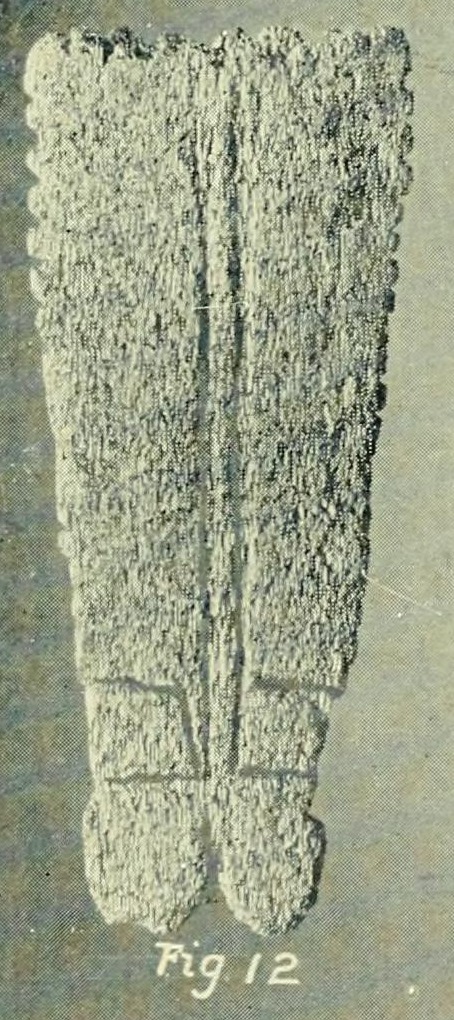
Among the things on a station hand’s table, a grooved piece of whalebone stopped Arthur Dendy short. It had come from an old Moriori burial ground near Okawa: six inches of carved bone, notched along the edges and honeycombed by age. Dendy recognised a bullroarer and made a working replica. Alexander Shand, who knew Moriori traditions, had never heard of the instrument; Dendy wondered whether it had been highly tapu. Its elaborate carving contrasted with the smooth Māori blades he knew, and he imagined a much older separation of the two peoples. Skinner later found no expected cord wear and favoured a pendant or toy; the decayed original was too fragile to test.
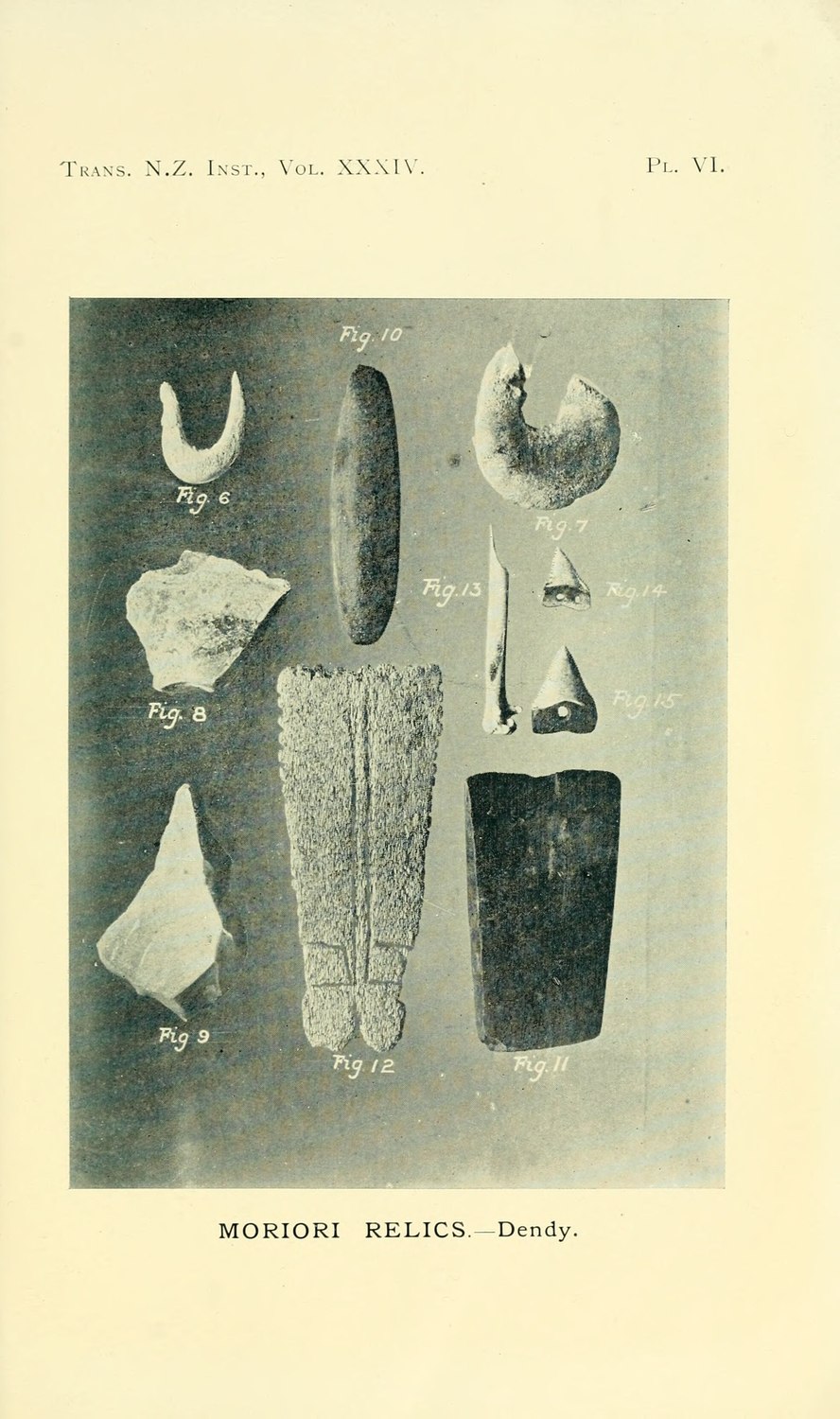
The bone, which is represented in Plate VI., fig. 12, had evidently been carefully shaped and carved, and I had no difficulty in recognising in it a very typical example of that extremely interesting instrument of primitive races known to ethnologists as the "bull-roarer."
Dendy 1901, "On some Relics of the Moriori Race," Trans. N.Z. Inst. 34:131
Particulars
- Object
- Whalebone blade, exactly 6 in. by 1.75-2.75 in., honeycombed with decay; paired longitudinal grooves down each face, edges set with small ornamental notches; deep end-notch (probable cord hole) and side fastening-notches 'evidently to allow of secure tying'; found in an old Moriori burial-ground; figured Plate VI fig. 12.
- Function
- Not recorded.
Source
Arthur Dendy, 'On some Relics of the Moriori Race,' Transactions of the New Zealand Institute 34 (1901), pp. 131-134 and pl. VI fig. 12; H. D. Skinner, The Morioris of Chatham Islands, Bishop Museum Memoirs 9(1) (1923), pl. VIII