Atlas Guide —
How to Make a Bullroarer
A strip of wood, a metre of cord, and an open space
To make a bullroarer, take a thin, flat strip of wood about 30 cm long, such as an old wooden ruler, make a hole near one end, tie on about a metre of thin cord, wind it up, and swing it round in a big circle. In a few seconds it roars. It is the same slat and string that has been sounded at initiations from Australia to Amazonia and whirled as a toy by Inuit children in the Arctic.
Why it works. Two motions make the sound: you swing the blade round in a big circle, and the moving air spins it fast about its own long axis, in line with the cord. That spin is what roars. The spinning blade also winds up the cord, so it periodically stops spinning, reverses and starts again, and the roar comes in waves.
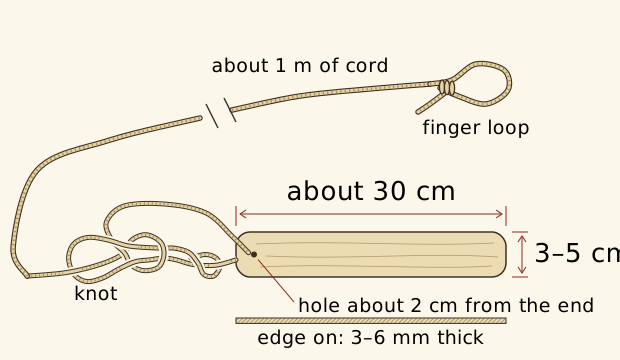
How to make a bullroarer
You’ll need:
- A flat wooden strip about 30 × 3–5 cm, 3–6 mm thick: an old wooden ruler, a wooden paint stirrer, or a piece of lath or craft wood
- About 1.5 m of thin, flexible cord (about 1 m between blade and hand once tied)
- If the strip has no hole: a drill with a 5 mm bit and a scrap of wood
- Sandpaper; a hand saw if the strip needs shortening
- Find a flat strip of wood. You need a thin, flat strip of wood about 30 cm long, 3–5 cm wide and 3–6 mm thick. An old wooden ruler is ideal, and many already have a hole at one end. A wooden paint stirrer, or a strip of lath or craft wood, works just as well; saw it to about 30 cm if it is longer.
- Make a hole near one end. If there is no hole, drill one about 5 mm across, on the centreline and about 2 cm from the end, with scrap wood underneath so it doesn’t splinter. Sand the edges and corners smooth, and round off the rim of the hole so it can’t fray the cord.
- Tie on the cord. Cut about 1.5 m of thin, flexible cord, such as braided nylon about 3 mm thick or strong garden twine. Tie it through the hole with any knot that won’t slip; a bowline is a good choice (see an animated bowline). After tying, leave about 1 m between blade and hand, and tie a small loop at the hand end for your finger.
- Wind it up. Hold the finger loop, let the blade hang, and turn the blade 20 to 30 times so the cord is twisted. This gives the blade its first spin.
- Swing it. Swing the blade in a big, steady circle over your head or beside you, about once or twice a second. Within a turn or two it starts to spin on its own and roars. Give it room: the blade travels fast, and if the knot lets go it flies a long way.
How to swing a bullroarer
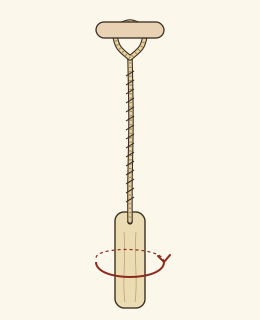
WindLet the blade hang from your finger and turn it 20–30 times.
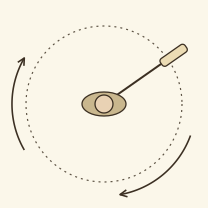
SwingSeen from above: a big, steady circle, about once or twice a second.
Keep the circle smooth and steady rather than whipping your wrist. Swinging faster raises the pitch. When the roar fades for a moment and comes back, the blade has reversed its spin; keep going. Between reversals the sound also pulses during each circle as the blade turns towards you and away.
Listen for it. An 18-second recording of a bullroarer: the swelling roar and the dips between.
For the physics of the sound, see Bullroarer sound: listen and see how it works.
Troubleshooting
If it only whooshes, flutters or goes dead, check three things:
- Start the spin. A blade that circles without spinning makes no roar. Stop, wind the cord 20–30 turns, and start again.
- Free the cord. Let the blade hang and unwind between goes. Thick or stiff cord binds; use thin, flexible cord. A very narrow strip, like a craft stick, may never get going.
- Adjust the speed. Swing steadily, about once or twice a second, a little faster if it won’t start. Calm air helps.
A swivel between cord and blade won’t stop the sound. It removes the build-up of twist and the slow pauses when the blade reverses; the faster pulses from each circle remain. For the full rise and fall, tie the cord straight to the blade.
Make a sturdier one from plywood
For a bullroarer that lasts, cut a 300 × 50 mm blade with rounded ends from 6 mm (¼-inch) plywood, using a coping saw or jigsaw, and drill a 5 mm hole centred 20 mm from one end. Those sizes sit in the middle of real instruments: the physicists Neville Fletcher, Alex Tarnopolsky and Joseph Lai give typical wooden slats as “typically 200–400 mm long, 30–60 mm wide and 5–10 mm thick,” and a nineteenth-century Hopi bullroarer in the Metropolitan Museum measures 33 × 5 × 0.5 cm on a 103 cm cord.
The template below prints at full size on one A4 or US Letter page, in two halves that overlap. Tape B over A so the shaded bands match and the ⊕ marks meet. Check the scale bar measures exactly 50 mm before you cut; if it doesn’t, print again at Actual size or 100%.
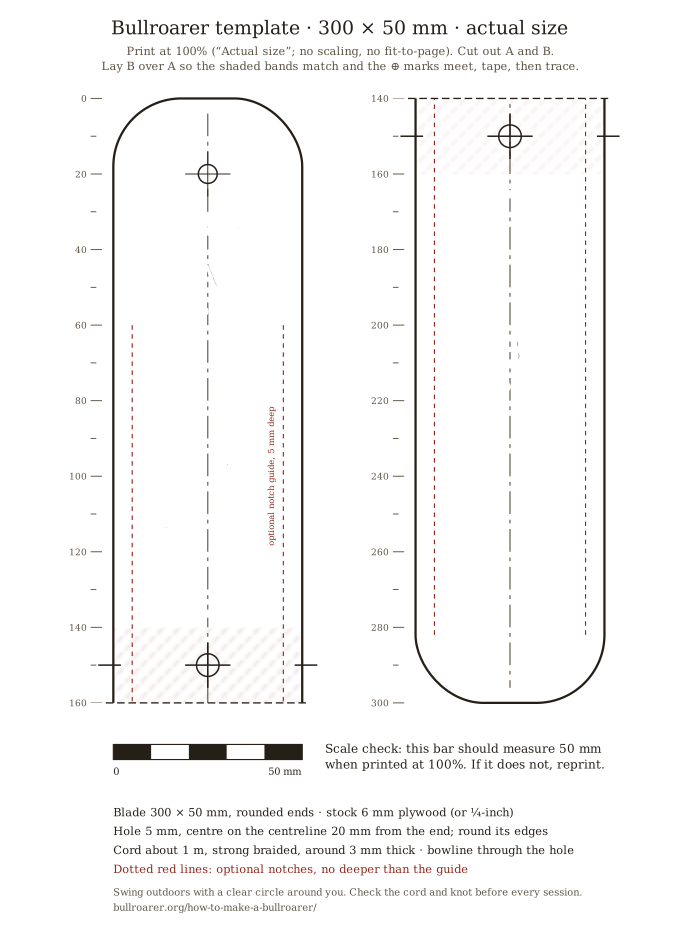
Many old blades have notched or serrated edges, and many makers add them; the template marks a guide if you want to. Whether notches change the sound hasn’t been settled by tests, and a plain blade roars perfectly well.
Bullroarers have been made far smaller and far larger than this, from finger-length toys to carved boards over a metre long, and many traditions hold them sacred. For their history and meaning, see What is a bullroarer?
Questions
What is the best wood for a bullroarer?
Any thin, flat, stiff wood that won’t split at the hole. A wooden ruler or paint stirrer is the easiest start; plywood about 6 mm thick makes a sturdier one, because its crossed layers resist splitting. No kind of wood has been shown to sound better than another.
How long should a bullroarer string be?
About 1 metre between blade and hand. Published builds use between 60 cm and 1.5 m. A longer cord swings a wider circle and needs more room; a shorter one is easier for children to control.
Why won’t my bullroarer make a noise?
The blade isn’t spinning on its own axis yet. Wind the cord 20 to 30 turns before you start, use thin, flexible cord, and swing steadily about once or twice a second. A very narrow strip, like a craft stick, may never get going; use something 3–5 cm wide.
Why does a bullroarer sometimes go quiet?
Its spin winds up the cord. The twisted cord brakes the blade until it stops and turns the other way, and for that moment the roar almost vanishes. Keep swinging and the roar returns as the blade picks up speed. Roger & Aubert (2006), p. 839.
Does a swivel stop a bullroarer working?
No. A blade on a swivel still sounds. The swivel removes the build-up of twist, and with it the slow pauses when the blade reverses its spin; the faster pulses from each circle remain.
Key sources
Fletcher, N. H., Tarnopolsky, A. Z. and Lai, J. C. S. 2002. “Rotational aerophones.” Journal of the Acoustical Society of America 111(3): 1189–1196 — typical wooden slats, cord about 1 m (p. 1189). PDF.
Fletcher, N. H., Tarnopolsky, A. Z. and Lai, J. C. S. 2002. “Australian Aboriginal Musical Instruments — The Bullroarer.” Innovation in Acoustics and Vibration (Australian Acoustical Society), pp. 186–189 — swinging at one to two revolutions a second; pitch rising with airspeed.
Roger, M. and Aubert, S. 2006. “Aeroacoustics of the Bullroarer.” Acta Acustica united with Acustica 92(5): 826–841 — spin about the long axis and reversal; the bearing-mounted blade still sounding (p. 838); “At reversal the sound pitch and level almost vanish” (p. 839); pulses during each circle (p. 840). PDF.
Science World. n.d. “Bullroarer.” Classroom activity — a ruler with an end hole, 1 m of string, 20–30 twists. Lyncean Education. n.d. “Humming sticks” — thin flexible string; narrow sticks working poorly.
Metropolitan Museum of Art, Hopi bullroarer, 89.4.3179 (33 × 5 × 0.5 cm; cord 103 cm). Jerram, L. and Nieman, A. 2009. School Workshop Toolkit, Part Two: Vibration and Sound. Sound Matters / University of Southampton, pp. 14–15 — blanks cut from ¼-inch plywood.