Atlas Essay —
The God Through the Bosom
Gurob, the Fayum, Egypt · third century BC
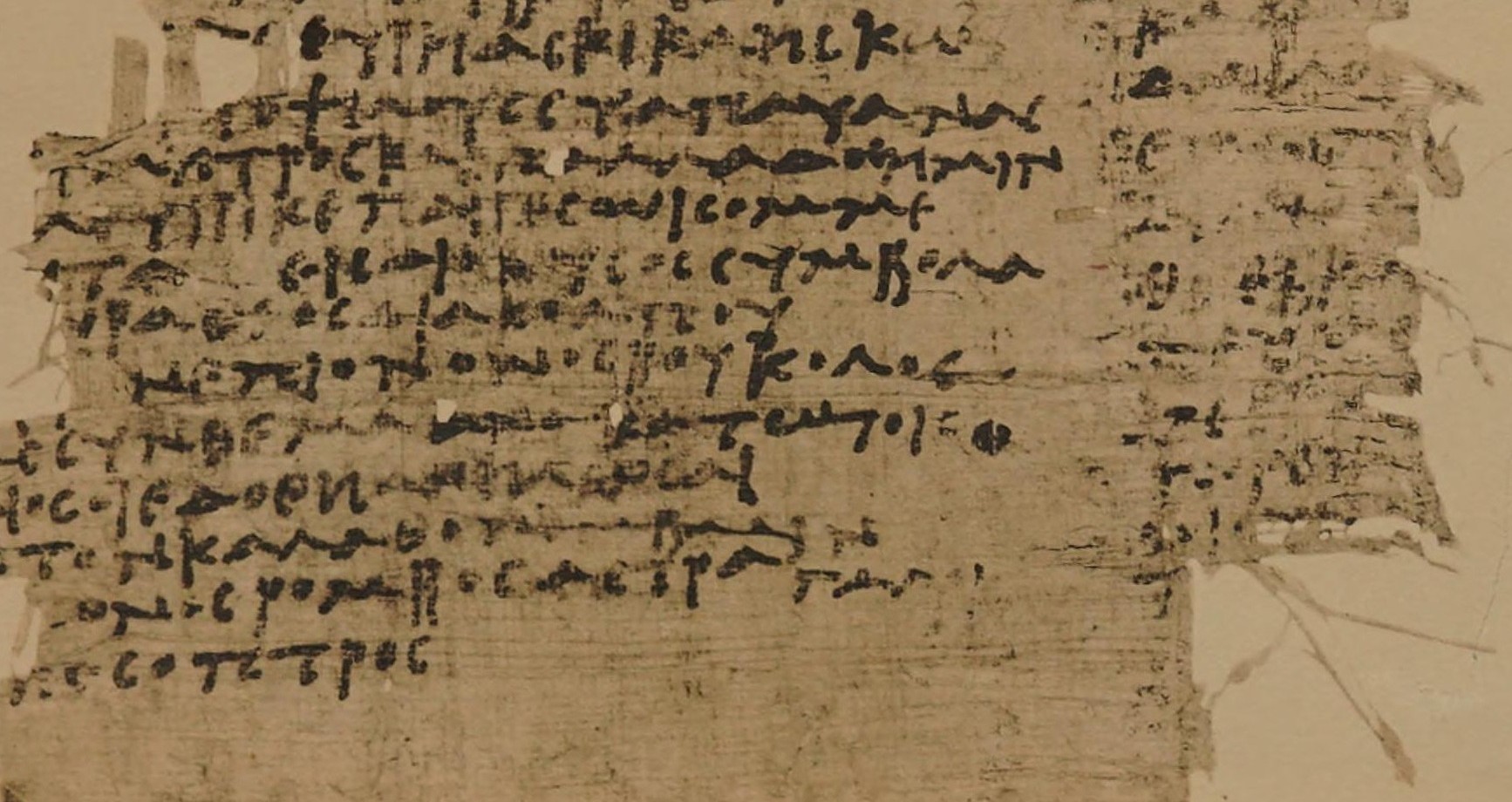
Someone in Ptolemaic Egypt owned a roll of instructions for a night with the god. Raw meat is gathered, Brimo and Demeter and Rhea are begged to save the worshipper, a ram and a goat are offered and the rest of the meat is eaten. Then the sheet turns from prayer to handling. A serpent is drawn through the initiate’s robe, wine is drunk, a password is given, and the last thing the scribe wrote before the papyrus tears away is a list of objects for the basket: a cone, a bullroarer, knucklebones, a mirror.
The Gurob papyrus is a working ritual script of the Dionysiac mysteries, written in the third century BC. At line 24 of its first column it calls for the god “through the bosom,” the Sabazian serpent drawn through the initiate’s clothes; at lines 29–30 it puts the rhombos and the mirror into the sacred basket. The serpent and the bullroarer belong to one rite, set down in one primary text, five lines apart.
In brief
- P. Gurob 1 is a torn sheet, 17 by 13 cm, recovered from mummy cartonnage at Gurob in the Fayum, south-west of Cairo. J. G. Smyly published it in 1921 and dated it by its hand to the first half of the third century BC; James Hordern re-edited it from the original in Dublin in 2000.
- Its first column mixes hexameter prayers with prose directions, the kind of book Plato says the wandering initiators of Orpheus carried from door to door.
- Line 24 reads theos dia kolpou. Clement of Alexandria names those words as the token of the Sabazian mysteries and explains them: “this is a serpent drawn over the breast of the votaries.”
- Lines 28–30 order things put into the basket: cone, rhombos, knucklebones, mirror. Both editors identify them as the toys the Titans used to lure the child Dionysus, the same set Clement lists some four and a half centuries later.
- Elsewhere in Greece the serpent and the roarer come from separate witnesses. Gurob gives both on one working sheet, in one rite, five lines apart.
The Greek records in this essay sit under the map’s Snake-linked lens, beside the serpent rites of Australia, New Guinea and the Americas.
A torn sheet from a mummy case
Gurob lies at the mouth of the Fayum, the great oasis basin west of the Nile, where Ptolemy II settled Greek soldiers on reclaimed land in the third century BC. When their dead were buried, the embalmers stiffened the mummy cases with layers of used papyrus, and the paper of the Greek settlers came out of the ground with them. This scrap is now in Trinity College Dublin, and in 1921 Smyly printed it first in his volume of the Gurob papyri, the oldest of them. On the hand alone, he wrote, it “probably belongs to the first half of the third century B.C.” Hordern, examining it again eighty years later, found “little objection to Smyly’s proposed dating of the papyrus to the third (probably mid-third) century B.C.”
What survives is the right-hand end of thirty lines and the first few letters of the next column. Smyly saw at once what kind of document it was. It contained, he wrote, “parts of two prayers, the description of a sacrifice of a ram and a goat, a number of mystic symbols, and a list of the contents of the basket.” Hordern calls it “a curious mixture of invocations and prayers and what appear to be instructions for a ritual based around the death (and rebirth?) of the infant Dionysus.” Some lines tell the celebrant what to do, in the third-person imperative: let him eat the rest of the meat; let the uninitiated not look on. Others are words to be spoken.
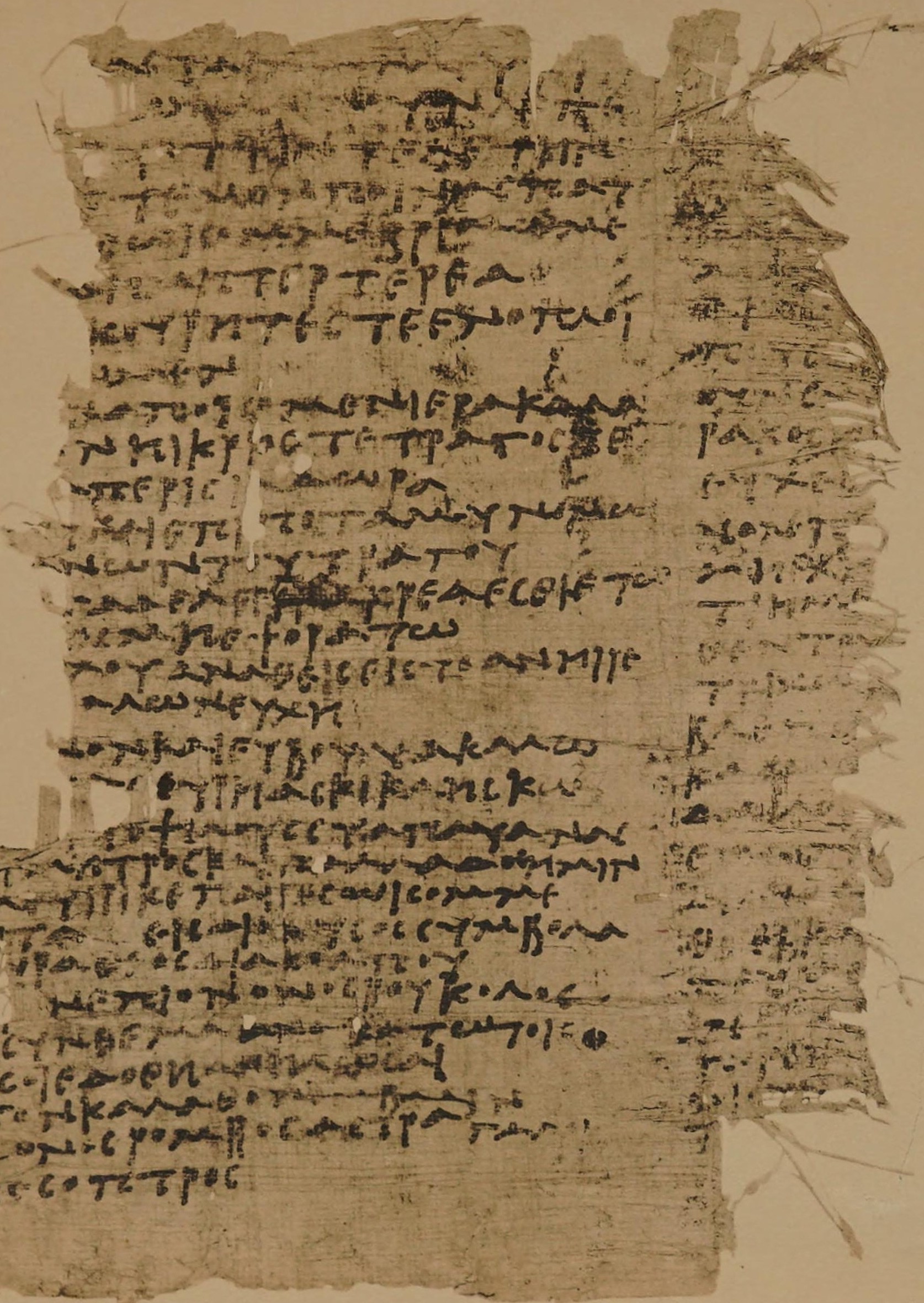
The writing is not a temple copy. Hordern calls it “a rather messy book-hand,” with irregular line lengths and spelling slips, and he places it among the books of the itinerant priests Plato describes in the Republic, who went from house to house offering initiation with “a hubbub of books” by Orpheus and Musaeus. Their rites borrowed freely from the great cults: the papyrus calls on Brimo from Eleusis, near Athens, Rhea and the Kouretes from Crete, Eubouleus and the Orphic Erikepaios. Within a generation or two the Ptolemaic state ordered everyone who performed the rites of Dionysus in the Egyptian countryside to come to Alexandria and register, and to hand in their sacred text sealed. The Gurob roll is the kind of book that order was written to collect: a practitioner’s script, carried and used.
The god through the bosom
Near the foot of the column the prayers stop and the script declares “One Dionysus,” then “Tokens.” The next line holds a phrase every reader of the mysteries knew. Here are the last eight lines of the column, as far as they survive:
| 23 | …ἑῖς Διόνυσος· σύμβολα | … One Dionysus. Tokens: |
| 24 | …θεὸς διὰ κόλπου | … the god through the bosom |
| 25 | …ἔπιον ὄνος βουκόλος | … I drank, an ass, a herdsman |
| 26 | …σύνθεμα· ἄνω κάτω τοῖς | … password: up, down, to the … |
| 27 | …καὶ ὃ σοι ἐδόθη ἀνηλῶσαι | … and what was given you, consume it |
| 28 | …εἰς τὸν κάλαθον ἐμβαλεῖν | … to throw into the basket: |
| 29 | …κῶνος ῥόμβος ἀστράγαλοι | … cone, bullroarer, knucklebones |
| 30 | …ἔσοπτρος | … mirror |
Smyly glossed line 24: “This was a golden snake drawn across the breast of the initiate under his clothing, as a symbolical representation of the intercourse of Zeus, in the form of a snake, with Persephone.” His authority, and Hordern’s, is Clement of Alexandria, who around AD 200 mocked the mysteries by listing their secret tokens. Of Zeus coming to Persephone as a serpent he writes:
At any rate, in the Sabazian mysteries the sign given to those who are initiated is “the god over the breast”; this is a serpent drawn over the breast of the votaries, a proof of the licentiousness of Zeus.
Clement of Alexandria, Exhortation to the Greeks 2.16, trans. G. W. Butterworth (1919), p. 35
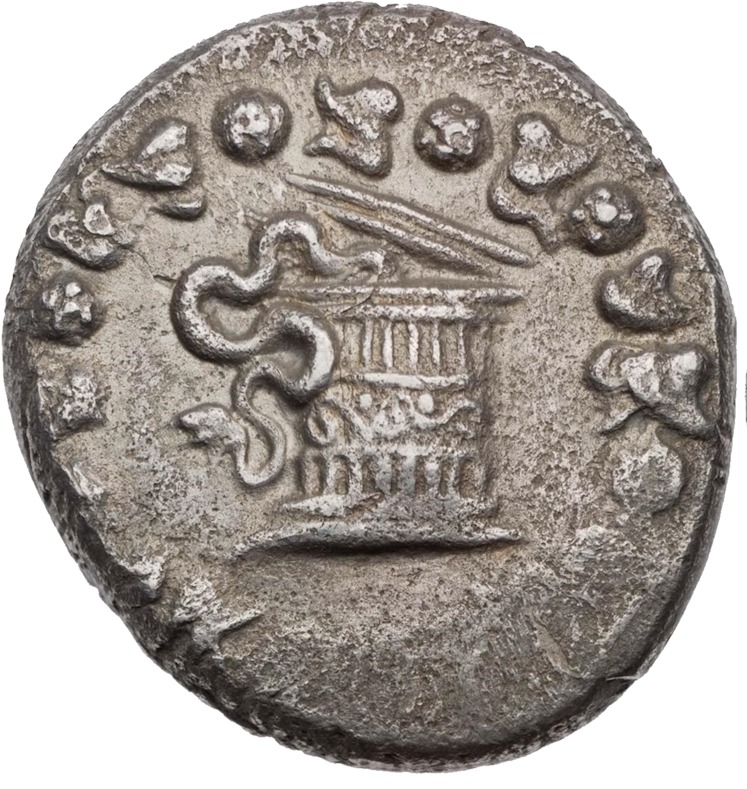
Clement’s Greek is the papyrus’s phrase word for word, ho dia kolpou theos, and he adds the gloss outright: drakōn de estin houtos, “this one is a serpent.” The kolpos is the fold of the garment over the breast, where a Greek carried things against the skin. Hordern quotes M. L. West for the act itself: “letting a golden snake – earlier, presumably, a live one – slip through the initiand’s clothing next to the skin, and then pulling it back again.” And he adds the practical point that matters most here: “The phrase was perhaps uttered while the action was performed.” On the Gurob sheet the god through the bosom stands among the tokens of the rite: the words that went with the serpent under the robe.
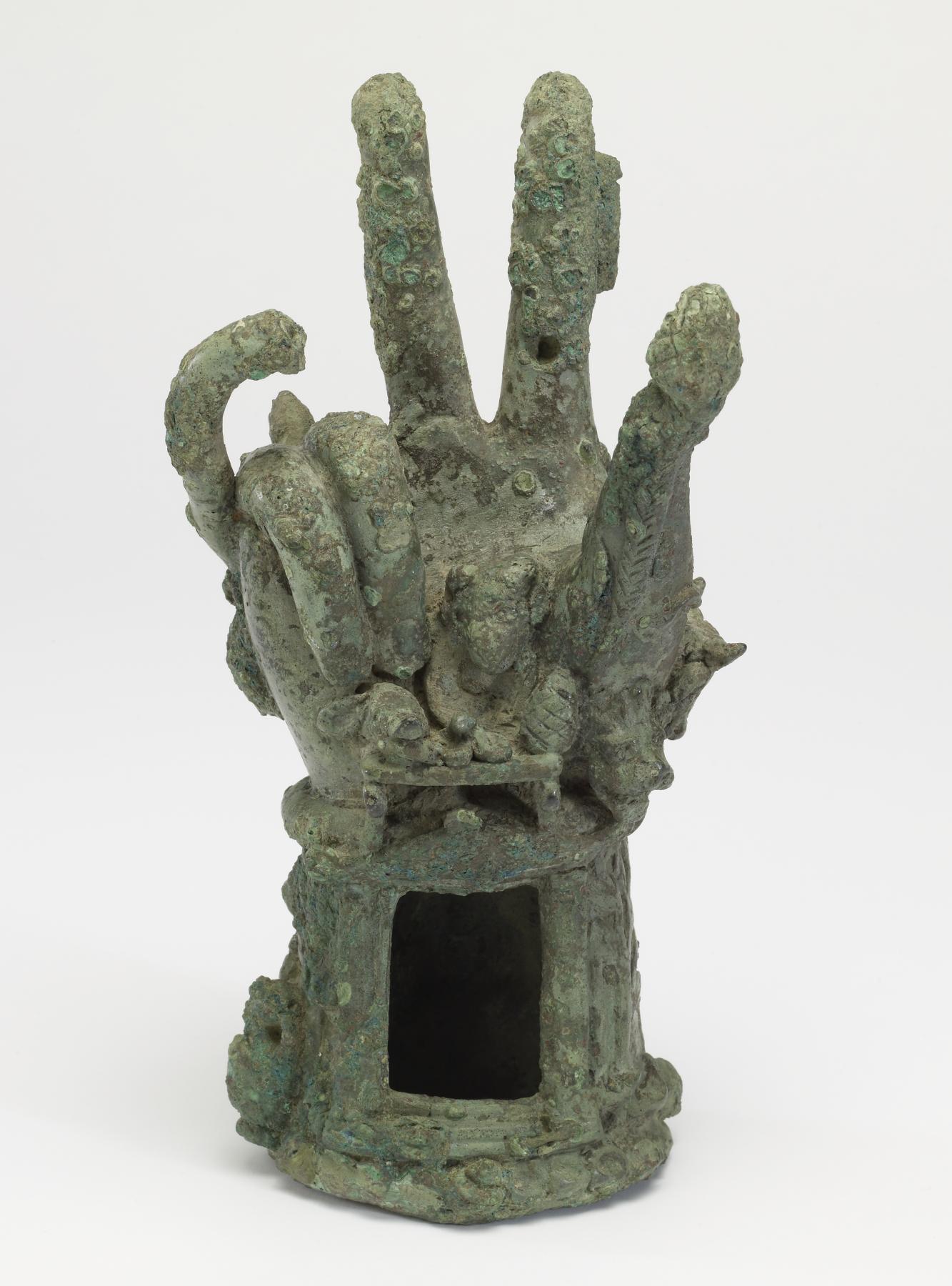
Athens knew the rite three generations before the papyrus was written. In 330 BC Demosthenes taunted his rival Aeschines with his boyhood as an acolyte in his mother Glaukothea’s initiations. By night, he says, the boy dressed the novices in fawn-skins and scoured them “with the loam and the bran”; by day he led the initiates through the streets:
…and, as you went, you squeezed the fat-cheeked snakes, or brandished them above your head, now shouting your Euoi Saboi! now footing it to the measure of Hyes Attes! Attes Hyes!
Demosthenes, On the Crown 260, trans. C. A. and J. H. Vince (1926)
The snakes were real, tame and handled, and Saboi is the god’s own cry. The daub recalls the Titans, who in the myth whitened themselves to fall on the child unknown; the initiates who re-enact his death wear it, the whitening traced through the swallowing rites in Burnt and Bald. Hordern notes the old equation that makes one rite of all this: “the conflation of Sabazius with Dionysus-Zagreus.” The god through the bosom on the Gurob sheet is the Sabazian serpent brought into the mysteries of the torn child.
Into the basket
Four lines later the script turns to the basket. Smyly’s note on line 28 reads the construction as “a list of things which must be put into the basket,” and names them at once:
These were the toys with which the Titans amused the infant Dionysus Zagreus before they tore him in pieces.
J. G. Smyly, Greek Papyri from Gurob (1921), p. 9, on col. i 28
The myth is the core story of the Orphic mysteries. The Kouretes dance round the infant Dionysus with clashing weapons to hide him; the Titans, their faces whitened, creep up and draw him away with playthings; they tear him apart, boil and roast him, and Zeus strikes them with lightning. The toys in the basket are the lures of that killing, and the initiate handles them because the rite re-enacts it. Clement gives the list as the mysteries’ own tokens: “the knuckle-bone, the ball, the spinning-top, apples, wheel, mirror, fleece!” Where Butterworth writes “wheel,” Clement’s Greek is rhombos.
On the papyrus the rhombos stands between the cone and the knucklebones, at line 29. Smyly in 1921 rendered it “a humming-top”; Hordern’s commentary names the four tokens “(pine-)cone, bull-roarer, knuckle-bones and mirror,” following A. S. F. Gow’s 1934 study of the instrument. The rhombos is the slat on a cord. An old scholiast gives the same roaring wood to the kōnos; on the papyrus, with the rhombos named beside it, the kōnos is the cone, and the roarer stands under its proper name. Hordern’s note gathers the Greek witnesses for “its explicit use in Bacchic rites”: Aeschylus’ lost Edonians, where “bull-voices roar thereto from somewhere out of the unseen”; Euripides’ Helen, where the rhombos whirls in the Mountain Mother’s rite; an epigram in the Greek Anthology, where a woman named Euanthe hangs up her Bacchic gear, the whirled rhombos with her fawnskin, cymbals and drum. The wheel-shaped buzzer, the iynx, is a different machine with its own name; Buzzer vs. Bullroarer separates the two.
The mirror follows on the next line. In the later Orphic writers the mirror is where the child is caught: Nonnus has the Titans fall on him while he gazes at his own face in it. Bullroarer and mirror end the column together, the sound in the dark and the image, the last two things the sheet tells the celebrant to lay in the basket. What the Titans used to lure the god to his death, the initiates put away with their own hands.
One sheet, one rite
Greece has other witnesses to the serpent and to the roarer, and all of them come in pieces. Demosthenes gives the snakes and the Sabazian cry and no roarer. Euripides and Aeschylus give the roar in the Mother’s and Dionysus’ rites and no serpent. A scholiast on Clement explains the kōnos as “a little piece of wood, to which a string is fastened,” whirled in the mysteries “to make a roaring noise,” and says nothing of snakes. Clement himself has both, the serpent in one paragraph and the toys in the next, but Clement is a Christian polemicist writing around AD 200, collecting scandals from every cult he could name. A reader could take him for a collector, stitching separate rites together.
Gurob answers that suspicion. Four and a half centuries before Clement, a practitioner’s script moves from the serpent under the robe, through the wine and the password, to the bullroarer in the basket. No polemicist joined these lines. They belong to one night’s rite, copied out for use. Smyly saw the agreement at once:
The list, as far as it goes, is identical with that given, some four and a half centuries later, by Clement of Alexandria.
J. G. Smyly, Greek Papyri from Gurob, 1921, p. 2So Clement reported the rite accurately, and Gurob shows its shape. The Dionysiac mysteries put a serpent against the initiate’s skin and a bullroarer into the initiate’s hands in a single sequence, under the sign of the god who was torn apart and came back. That is the pattern the atlas maps across the world, from the python whose voice is the roarer among the Yolngu of Arnhem Land in northern Australia to the roarer whirled at the Hopi Snake Dance at Walpi in Arizona, and traced in The Serpent’s Voice. The Greek mysteries are not an exception to it. On the Gurob sheet they carry the pattern in their own handwriting.
The Greek frame around this sheet, the star-nurses of Dionysus, the women’s rites and the roaring god, is laid out in Dionysus, the Seven Sisters and the Bullroarer, and the torn child set beside a story from the Wiradjuri of south-eastern Australia in Mutato Nomine. The rhombos of the mysteries has its own record, the Greek Dionysiac rhombos. But no other document from the Greek world puts the serpent and the bullroarer this close. Line 24 draws the god through the bosom; five lines on, the same hand lays the roarer in the basket.
Key sources
- Smyly, J. Gilbart. 1921. Greek Papyri from Gurob. Cunningham Memoirs 12. Dublin: Royal Irish Academy — no. 1, “Ritual of the Mysteries,” pp. 1ff. and Plate I: the contents and the agreement with Clement, pp. 1–2; the date, p. 2; note on line 24, p. 8; notes on lines 28 and 30, p. 9.
- Hordern, James. 2000. “Notes on the Orphic Papyrus from Gurôb (P. Gurob 1; Pack² 2464).” Zeitschrift für Papyrologie und Epigraphik 129: 131–140 — the sheet, hand and date, p. 131; the itinerant initiators, p. 132; theos dia kolpou and the Sabazian serpent, p. 134 and n. 13; text of col. i, p. 135; notes on lines 28–30 and the bull-roarer in Bacchic rites, p. 139.
- Clement of Alexandria. Exhortation to the Greeks (Protrepticus) 2.16–18. Trans. G. W. Butterworth, Loeb Classical Library. London: Heinemann, 1919 — the god over the breast, p. 35; the Titans’ toys and the tokens, pp. 37–39.
- Demosthenes. On the Crown 259–260. Trans. C. A. Vince and J. H. Vince, Loeb Classical Library. Cambridge, MA: Harvard University Press, 1926.
- West, M. L. 1983. The Orphic Poems. Oxford: Clarendon Press — the serpent through the clothing, pp. 96–97, as quoted by Hordern.
- Nonnus. Dionysiaca, book 6: the chalk-whitened Titans and the mirror, 6.172–173.
- Ptolemaic edict on the rites of Dionysus, Sammelbuch no. 7266 (late third century BC), cited by Hordern, p. 131 n. 2.
- Gow, A. S. F. 1934. “ΙΥΓΞ, ΡΟΜΒΟΣ, Rhombus, Turbo.” Journal of Hellenic Studies 54: 1–13.
- Harrison, Jane Ellen. 1912. Themis. Cambridge: Cambridge University Press — Aeschylus, Edonians fr. 57, in translation, pp. 61–62.
- Lang, Andrew. 1884. “The Bull-Roarer.” In Custom and Myth. London: Longmans — the scholiast on Clement and the kōnos.
- Plato. Republic 2.364e, on the books of Orpheus and Musaeus, as cited by Hordern, p. 132.