Atlas Essay —
The Bullroarers Gourlay Missed
A 1975 survey listed ninety New Guinea peoples without a bullroarer; sixteen turn out to have one
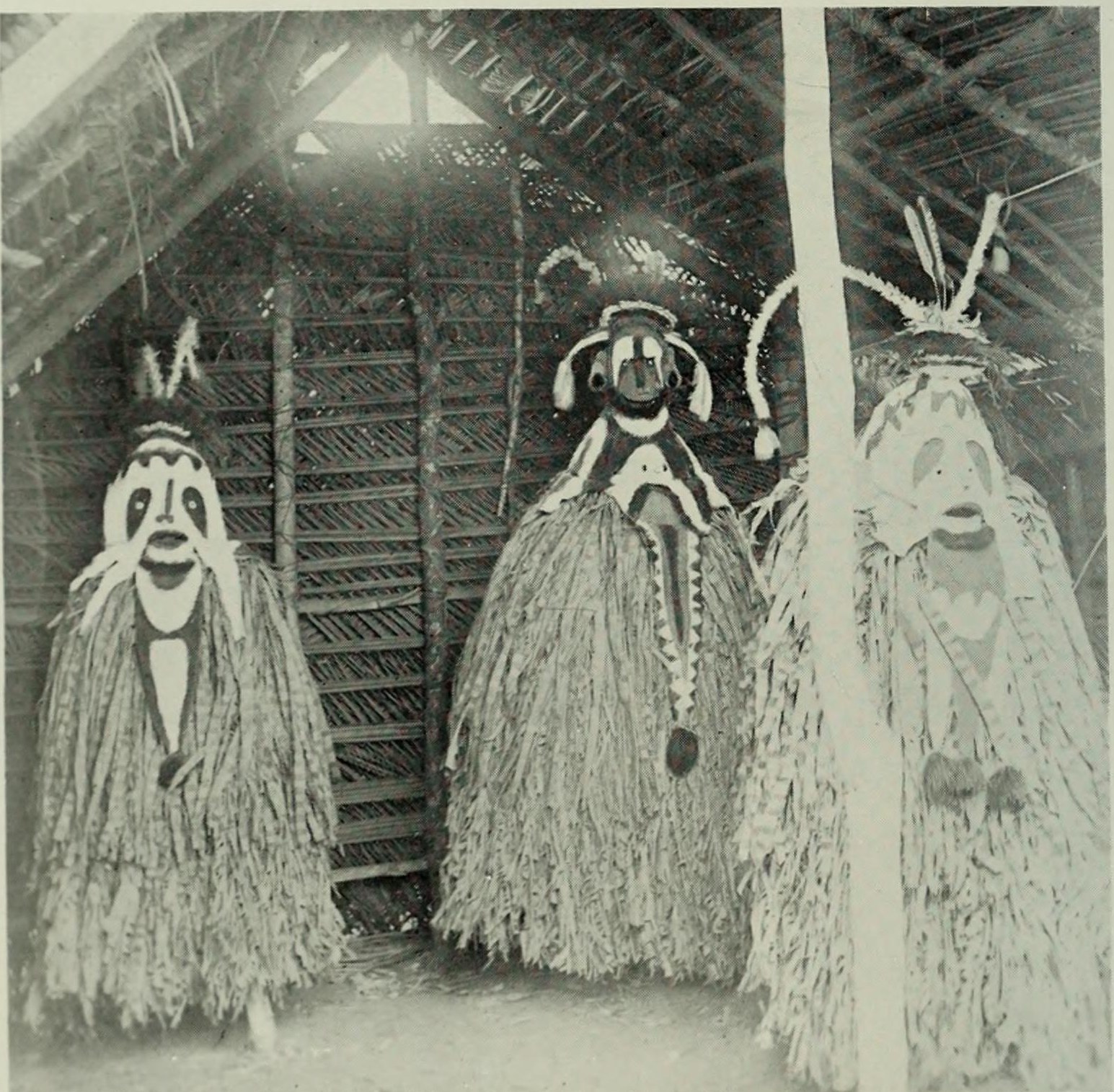
At Waima, on the coast of Papua New Guinea west of Port Moresby, the kaivakuku came out in the afternoon. They were the masters of the food taboo, hidden head to foot in masks of bark cloth and fringe, and they walked on the sides of their feet so that nobody could know them by their gait. “At night,” C. G. Seligman wrote in 1910, “they would swing bull-roarers.” Sixty-five years later the most careful survey of New Guinea’s sacred instruments listed the Roro, the people of Waima, among the societies with no bullroarer at all, and cited Seligman’s book as one of its sources.
A survey’s “no bullroarer” records what one scholar’s shelf held, not what the people did. Wherever anyone has looked harder, in a dictionary, a museum drawer or the next page of the same book, the blank has filled. That is why an atlas that puts every report in front of the reader at once matters.
In brief
- In 1975 Ken Gourlay coded ninety peoples of Papua New Guinea as having no bullroarer, and drew two great “areas of significant absence” in the highlands and in eastern Papua.
- Sixteen of those ninety are now answered by an atlas record. Six are museum objects, two are dictionary words, and eight are written accounts, two of them in the very books Gourlay cited.
- On Dobu Island, in Milne Bay, a missionary’s word list gathered in the 1920s gives the bullroarer as belubelulu, though Reo Fortune’s classic ethnography never mentions it.
- Gourlay cited Georg Friederici’s 1912 Barriai vocabulary for its slit-gong; six pages on, the same vocabulary gives tibura, the bullroarer, “from forest and breath.”
- In the highland zone where Gourlay found “no exceptions,” a carved bullroarer was collected at Wabag in 1961. A Bine blade collected in 1904 and a Bine dictionary of 2020 answer another of his negatives.
- The atlas’s own negatives, from Zerries’s Asia to Sachs’s Real-Lexikon, are searches aimed at the gap with a working control beside them. That is what makes them hold. In Wallacea five great ethnographies came back empty, yet museum blades from Ternate, Flores, Rote and Timor are on the map.

Ninety blanks
Ken Gourlay taught music at Goroka Teachers’ College in the Eastern Highlands of Papua New Guinea in the early 1970s, and he set out to map three instruments the men of New Guinea kept from women: the bullroarer, the paired side-blown flutes and the slit-gong. He gathered data for 233 societies. His sources, he wrote, were “all written anthropological and ethnomusicological works available in Papua New Guinea at the time of research,” and one more that nobody else had: the assignments his own students wrote on the instruments of their home districts, which he marked with an x in his source column and thanked in a footnote for being too valuable “to be allowed to languish in the inevitable academic wastepaper basket.”
He published the result in 1975 as Sound-Producing Instruments in Traditional Society. Table 1 lists 150 peoples and places with a column for each instrument. Table 2, “Significant negative evidence,” lists thirty more for which, he said, “a reasonably complete list of instruments was available” and none of the three appeared. Between the dashes in the first table and the whole of the second, ninety peoples come out without a bullroarer.
Gourlay knew what a blank could and could not mean. He threw out forty-two sets of data that named only one or two instruments, and eleven student reports “on the supposition that some educated informants might be unaware of esoteric instruments.” Then he turned the blanks into geography. In the highlands west of Mount Hagen lay his area F:
“F. The ‘highlands area of significant absence’, characterised by the absence of the instruments under discussion, stretches westward from Mt Hagen to cover those highland areas not included in D and may even extend into parts of Western District and the inland Gulf area. As given, there are no exceptions.”
Gourlay, 1975, p. 16
Across Central and Milne Bay provinces in the south-east lay area G, “the ‘Eastern Papua area of significant absence’,” which he allowed was “less negative than its highland counterpart.” A footnote answered the obvious objection, that his map might show where anthropologists had worked rather than where instruments were. Anthropological sources, he wrote, “provide evidence for absence as well as presence,” and his students’ reports drew the same pattern as the books. “It does not invalidate the overall position.”
A blank could also be a decision. The Azera of the upper Markham valley, in Morobe Province, stand at the head of Table 2, though Gourlay’s source, Karl Holzknecht’s 1956 paper on their instruments, reported a slit-gong. Gourlay said what he did with it: Holzknecht “refers to its recent introduction to the inland Azera (49 - classified here as ‘negative’ from a traditional viewpoint) by the missions” (p. 15). The instrument there is the slit-gong, not the bullroarer, but it shows what a mark in the tables was: a judgement about what to count, not a search that went looking and came back empty.
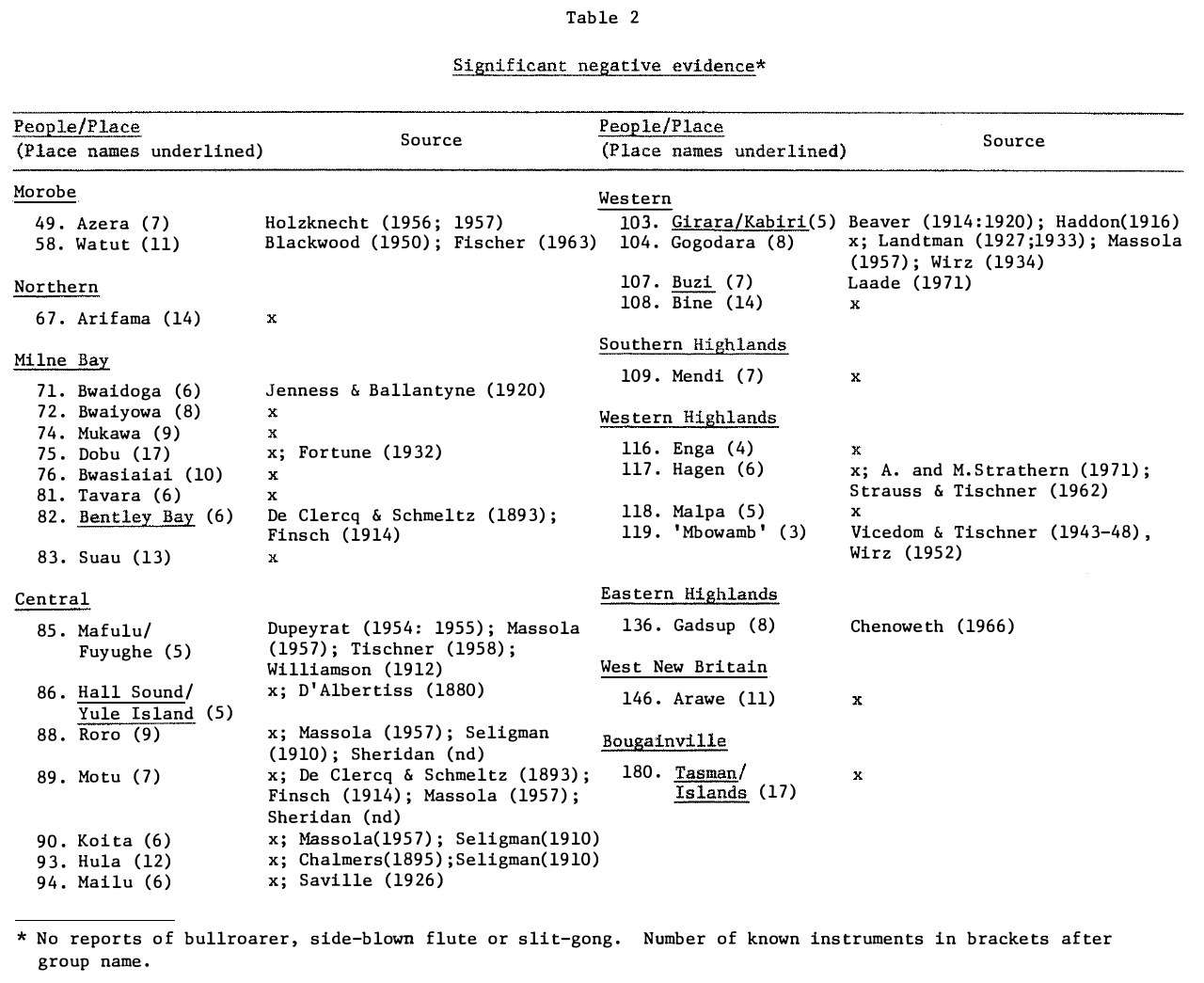
It was good work, done the only way it could be done in Goroka in 1974: one man, the books within reach, and a class of student teachers. Gourlay could not search a museum catalogue in Rotterdam from his desk, or read a mission dictionary printed in Milne Bay, or turn every page of a German colonial report for a word he was not looking for. Sixteen of his ninety blanks have since been answered: in museums half a world away, in dictionaries printed far from Goroka or long after him, and on pages of his own books that he had no reason to turn to. The map above sets them out.
The word Fortune never wrote down
Dobu is a small volcanic island in the D’Entrecasteaux group, off the eastern tip of New Guinea, and its people are among the most famous in anthropology. Reo Fortune lived with them in 1927–28 and wrote Sorcerers of Dobu, the book that made them a byword for suspicion: yam gardens grown by spells that named beings so secret their names were spoken only when there was work for them, and the kula ring carrying shell valuables from island to island. Gourlay had Fortune and a student report, and between them Dobu came out with seventeen known instruments and no bullroarer. It is one of the fullest instrument lists in Table 2. Fortune’s book never mentions a whirled blade.
J. W. Dixon, a Methodist missionary, gathered most of his Dobu words in his first term, 1923–26, in the village of Nemunemu beside the mission station. His widow Olive wrote that “no word was accepted as correct until it was checked by the old and middle-aged people of the village.” The United Church printed his English–Dobu Dictionary in 1970. Under B:
“bullroarer n. Belubelulu.”
Dixon, English–Dobu Dictionary, 1970, s.v. bullroarer
Under P, the same sound turns up as a gesture: lobelulu, “to make the sound of ‘pshaw’,” a scornful puff of breath at someone. The Dobu belubelulu was gathered before Fortune arrived, and it was in print five years before Gourlay’s survey. It simply was not on a shelf in Goroka. A dictionary has no reason to leave out a children’s toy or a men’s secret; it has only to be asked the English word.
The next page
Seligman’s The Melanesians of British New Guinea is a thick book, and Gourlay read it for bullroarers. He cites its page 592 for the blades of the Awalama and Taupota in Milne Bay, used “only at the stepping posts in the construction of a ceremonial house for feasting.” He cites it again as a source for the Roro, the people of the coast around Hall Sound and Yule Island, and the Roro go into Table 2 with nine instruments and no bullroarer. Three hundred pages before the Awalama, in the chapter on the Roro-speaking tribes, Seligman describes the kaivakuku of Waima and Hisiu:
“The kaivakuku men would promenade the village in the afternoon, taking care to disguise their gait, and walk on the side of their feet, so that they might not be recognized. At night they would swing bull-roarers.”
Seligman, 1910, p. 299
The custom had come along the coast. There is “not the slightest doubt,” Seligman wrote, “that the custom has been introduced from the Elema tribe of the Papuan Gulf,” to the west. The name of the instrument came from the other side. Beriwa meant the spirits of the dead and powers that had never been human, “while the same word is used for the bull-roarer,” and Seligman thought the Roro had it from the Nara district to their east, “for these folk who swing the bull-roarer to make their crops grow, also call it beriwa.”
Gourlay did mark Waima positive, in a separate entry, on a student report and Michael Allen’s survey of male cults, so his tables hold a Roro village with bullroarers beside the Roro people without them. His source for Hall Sound, Luigi D’Albertis’s 1880 travel book, gives a real instrument list, but for one inland village, Naiabui: “The only musical instruments they possess are the drum, a kind of bagpipes made of seven reeds, and a jews’-harp of bamboo.” The shore had the roarer all along. The Waima kaivakuku swung it in Seligman’s pages, and two incised blades from the Roro Islands and the Yule district reached the Musée du Quai Branly in Paris in 1933.
The Barriai of West New Britain, the big island east of the New Guinea mainland, have their bullroarer in Gourlay’s own source too. Gourlay’s only source for them was Georg Friederici, a former German army officer who travelled the coast on an official expedition in 1908 and published his findings in 1912. Gourlay cites two pages, 190 and 206, and codes the Barriai with a slit-gong and nothing else. Both are entries for the slit-gong: küre, “die Holzschlitztrommel,” the wooden slit-drum, in the Barriai vocabulary, and the same word again in a comparative word list. The bullroarer is on page 101, between Friederici’s pages on games and on dances:
“Among the Barriai and Kilenge it has kept its old purpose as an instrument of ceremony and of terror towards women and children. Every young man coming of age must pay a pig for leave to see it for the first time, that is, to learn the author of the terrible sounds he has feared until then; the pig is then eaten together.”
Friederici, 1912, p. 101 (“Bei den Barriai und Kilenge hat es noch seinen alten Zweck als Zeremonial- und Abschreckungs-Instrument Frauen und Kindern gegenüber bewahrt”)
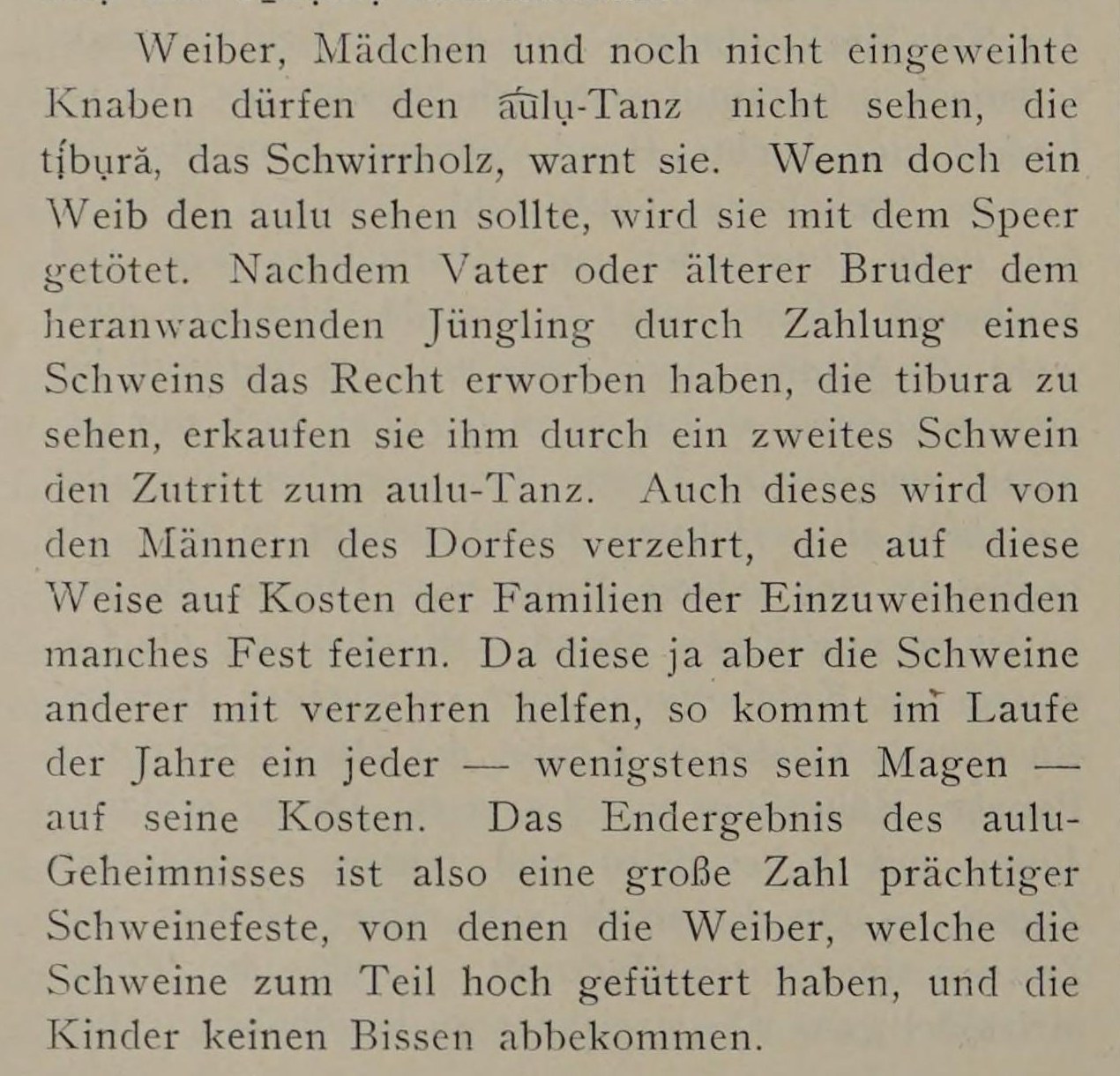
On the next page the tibura warns women and boys away from the aulu dance of the tall cylindrical mask, and a woman who sees the dance is killed with the spear. The vocabulary Gourlay used has the word too, on page 196, six pages from his own citation: “tibura, das Schwirrholz; aus tibur, Wald, und uru, Luft, Atem.” The bullroarer, from forest and breath. The jew’s harp on the same page is tañuri, from “to weep” and the same breath. The Barriai tell of the bullroarer that women found it first, in a chip of mangrove wood that whirred as it flew from the axe, before the men killed them for it.
A blade in the no-exceptions zone
Area F was Gourlay’s strongest claim. West of Mount Hagen, through the Enga country and the Southern Highlands, he found none of the three instruments anywhere. The Enga entry in Table 2 rests on one student report naming four instruments.
On 28 July 1961 a collecting journey through the highlands acquired a dark carved blade at Wabag, the seat of the Enga country. It is 49 centimetres long. Toward the hole for the cord it narrows into a forked, animal-like head, with a band of chevrons cut beneath it. The Wereldmuseum in Rotterdam catalogued it as a bullroarer and filed it under spirit and ancestor veneration.

“As given, there are no exceptions.”Gourlay, 1975, p. 16, of the highlands area F
The highlands answers come from Gourlay’s eastern edge too. Terence Hays, surveying the highland sacred flutes in 1986, found the Gadsup, where “women hearing the bullroarers and flutes would say that ‘the grandparents are returning’,” and the Gende and the Kuman, where the bullroarer had become “that of children’s toy.” All three were blanks in Gourlay’s tables. The Gende toy comes from Heinrich Aufenanger, the missionary who co-wrote the very Gende monograph Gourlay cited.
1904 and 2020
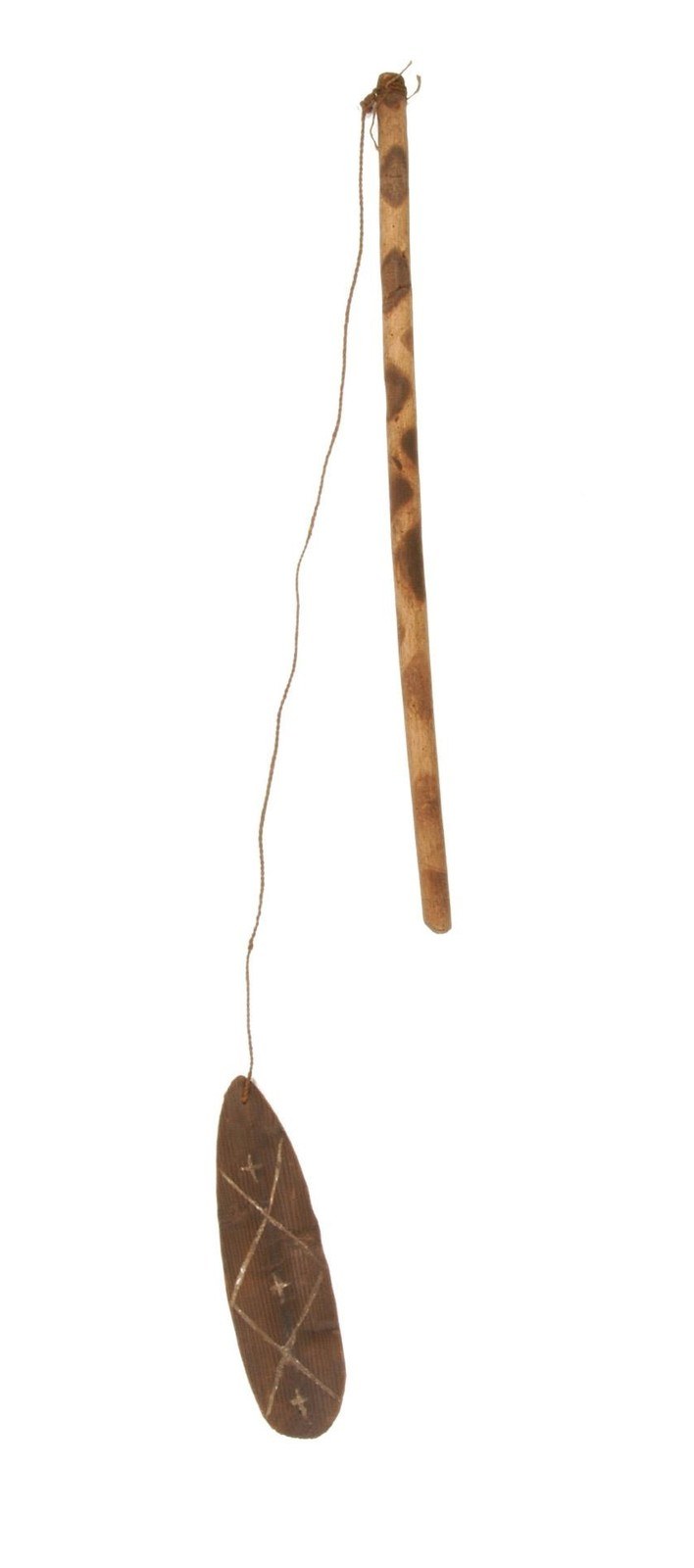
The Bine live in the Trans-Fly, the flat country of south-western Papua New Guinea between the Fly River and the border with Indonesia. Gourlay had a student report naming fourteen instruments for them, and none was a bullroarer. In 1904 the Cooke Daniels expedition passed through Masingara, a Bine village, and brought home to the British Museum a spatulate blade on a long twisted cord. It has been in London ever since, labelled with the village where it was collected.
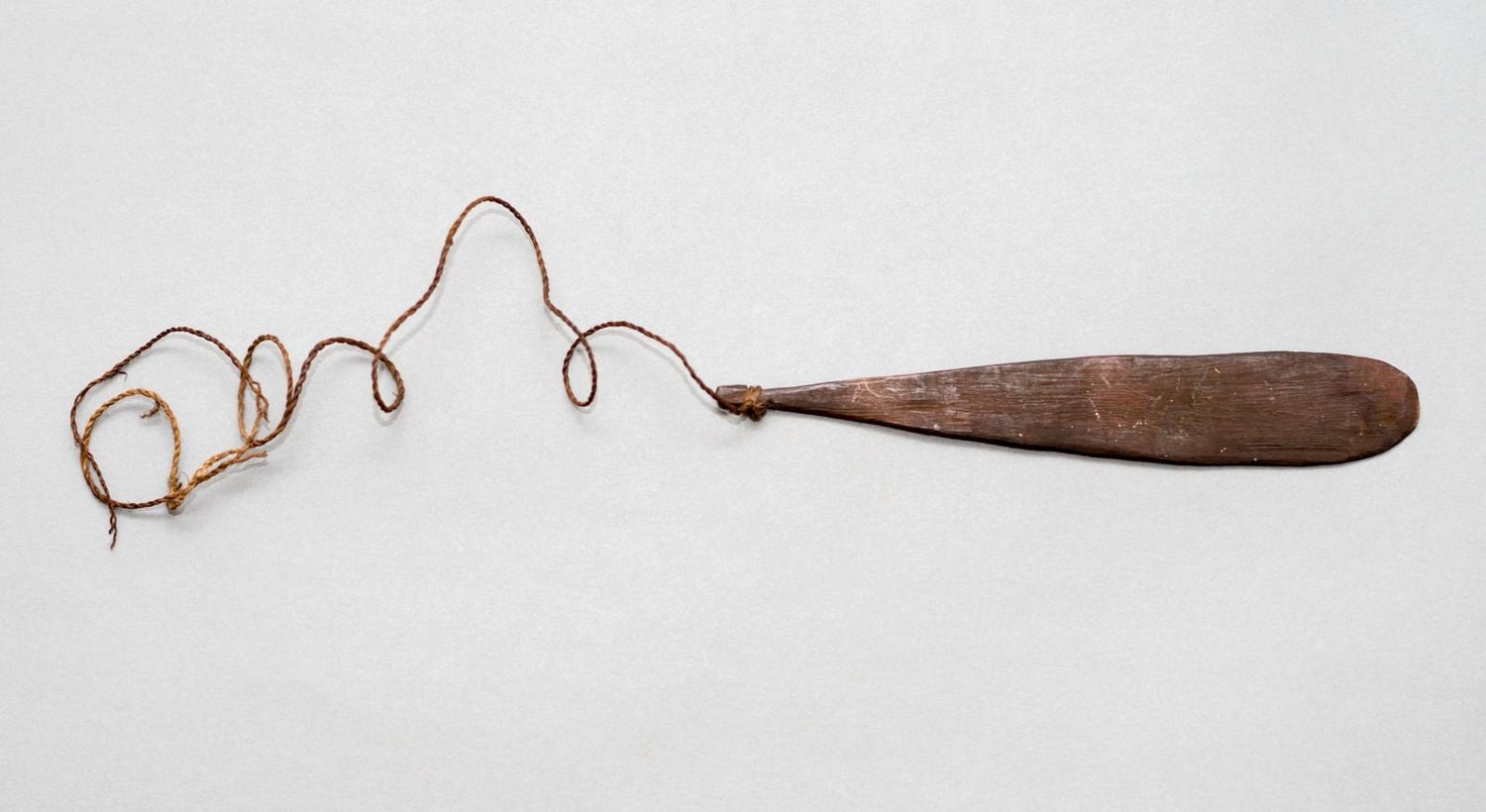
A century later the linguist Christian Döhler compiled a dictionary of Bine from Irukupi, another Bine village, and deposited it in an open archive in 2020. It names wagra, the bullroarer, and buebue, the one children make from a coconut leaf. The blade came seventy years before Gourlay and the word forty-five years after him, from two Bine villages, and they agree.
The collector’s own drawer
Beatrice Blackwood of the Pitt Rivers Museum in Oxford worked in New Guinea in 1936–37 and brought home more than two thousand objects. Gourlay cited her twice: for the Bosmun of the lower Ramu River, in Madang Province, whom he coded with flutes and slit-gongs, and, with Hans Fischer, for the Watut of inland Morobe, who in his words “have none of the instruments.”
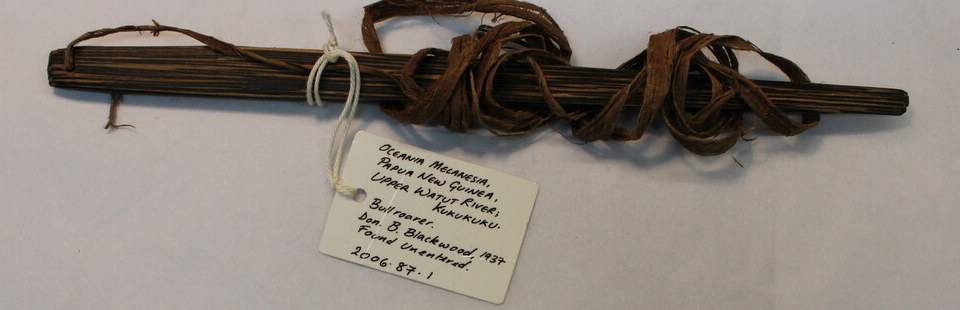
Blackwood’s Watut book was her technology of the Anga, then called Kukukuku, of the Upper Watut valley, where she lived near Otibanda patrol post. Gourlay has no other entry for those people anywhere in his tables. Among them she collected bullroarers. One plain blade, rigged with its bark-fibre cord, still carries its handwritten museum tag. Three more came in tied together and have stayed that way. She photographed a roarer swung from the high seat while a boy waited to have his nose pierced, and wrote: “It is supposed to result in death for a woman to see the bull-roarer.” Among the Kapau, she recorded, the women cried, not knowing what it was, and the boys feared it would eat them.
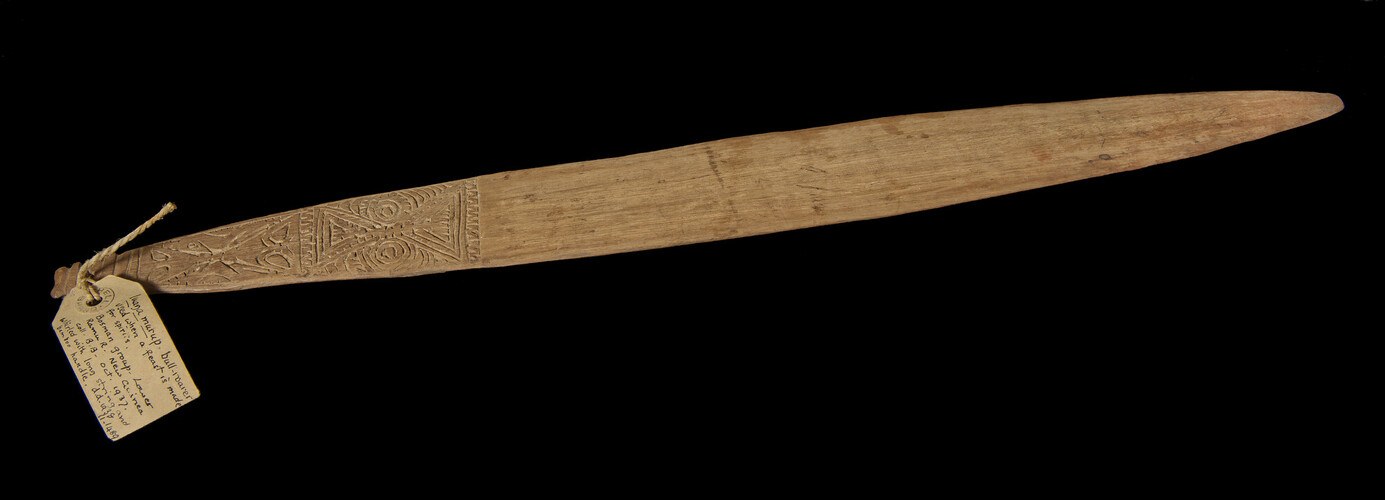
On the Ramu it was the same. Blackwood’s Bosmun instrument section runs from page 279 to 284, and Gourlay cites 279 and 282. Page 284 describes Bosmun bullroarers carved in relief, and in Oxford lies the one she collected, a blade more than half a metre long that the Bosmun called luana murup. Murup was also the name of their red carved masks and of a carved figure hung in the house.
Old wood in new rooms
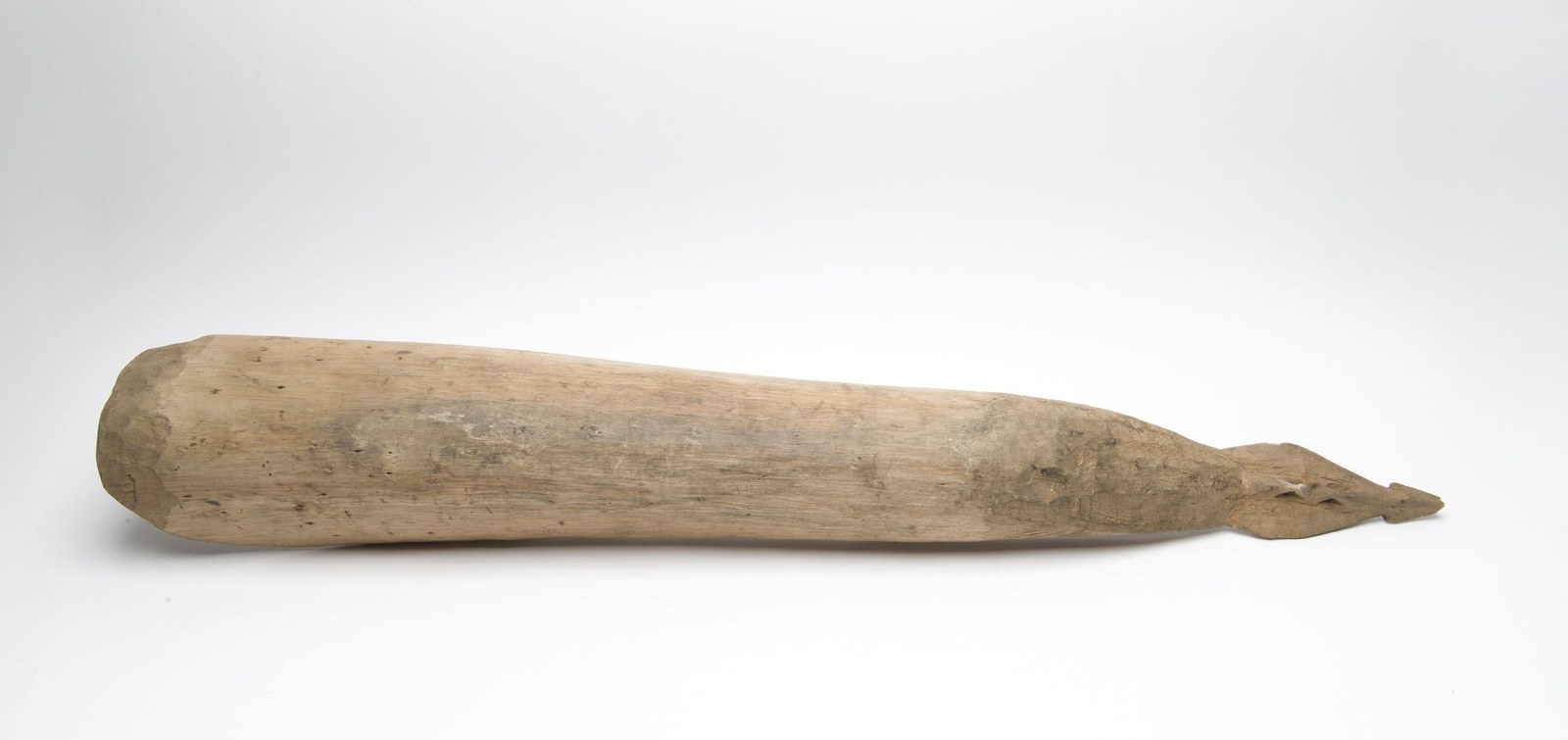
Most of the museum answers are older than the survey. The Übersee-Museum in Bremen holds a wooden blade 108.5 centimetres long, broad as a paddle and narrowing to a carved tip, which Ludwig Cohn collected before 1913 on the north coast near Sissano. Gourlay’s entry for that coast, Aitape and Sissano and the islands off it, drew on six sources and gave no bullroarer.
The Wereldmuseum holds a Gogodala roarer of bamboo from before 1957, its face scorched with spirals and figures, which the museum records as swung while yams, taro and bananas were planted, to make them grow. Gourlay had four sources for the Gogodala of the Aramia River, in south-western Papua New Guinea, and coded them with none of the three instruments.
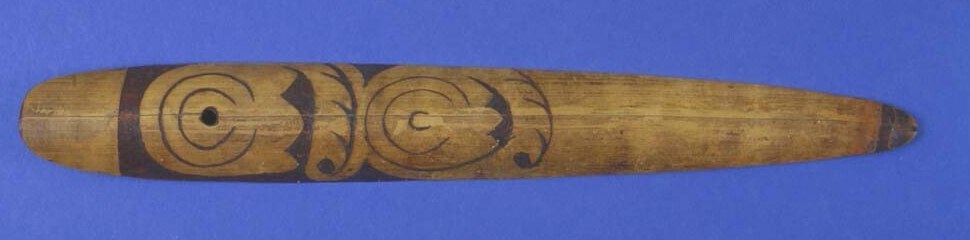
The written answers came by every road. On Tanga, off New Ireland, F. L. S. Bell’s fieldwork and his 1977 dictionary give four roarers of four sizes, each with its own name, the largest kept for the high men of the Sokapana society. Gourlay had a student’s report and no bullroarer. On the Sepik he listed the Chambri twice, once from Margaret Mead as Tchambuli without a bullroarer, once from his students as Chambri with one. His own table answered itself.
Where the blank holds
Some of Gourlay’s blanks stand. Marie Reay’s The Kuma, his source for the Kuma of the Wahgi valley east of Mount Hagen, has an index that lists “Flutes, 140, 141, 162, 170-1, 173, 174” and no bullroarer, and the whole book has twelve flutes and not one bullroarer in it. That is a blank someone tested: a full book, a search for the word, and a control term that came back where it should.
The atlas’s own great negatives are made the same way. When the bullroarer is missing from a whole region, the atlas does not take the silence of a summary. It goes to the sources most likely to carry the instrument and searches them for it, with a term known to be there as a check that the search works. Otto Zerries’s world survey of 1942, Das Schwirrholz, treats Asia in four pages, and every people it names is already on the atlas map; the belt from Anatolia to the Himalaya is empty in Zerries too. Curt Sachs’s polyglot Real-Lexikon of musical instruments (1913) has not one bullroarer between Greece and Indonesia, though it cites Persian more than a hundred times and Turkish and Tibetan nearly as often. George Robertson’s The Káfirs of the Hindu-Kush (1896) has no bullroarer, whirl or buzzer against more than a thousand mentions of the Kafirs themselves.
Those negatives hold because each was aimed at the gap and checked against a control. Gourlay’s had to be coded from whatever a source happened to say. A missionary noting Dobu words in the 1920s was not asked whether the Dobu had a bullroarer, so his silence would have meant nothing; when the word turned up it settled the question at once. The difference is the whole value of a negative.
Even a tested blank is exact only about the books it tested. In Wallacea, the island world between Borneo and New Guinea, five of the principal ethnographies were searched in Dutch and German for every word for the instrument, and every list of games and toys was read. Nothing was there. Yet the atlas maps bullroarers in Wallacea all the same: a bamboo blade from Ternate in the Batavia Museum, larger than its kin from Flores, Java and Nias; the jata of Ende on Flores, swung in the fields for rain; slats on cords collected on Rote and in the mountains of East Timor in 1935; a children’s game on Ambon. They came from museum registers, a musicologist’s footnotes and an encyclopedia’s list of games, shelves the ethnographies never reached. The region is thin, and most of what it holds is play; but it is not empty, and it took the whole shelf to show it.
Everything in front of the reader
A published “no” can fall to the people themselves. In 1934 Felix Speiser, in a comparative study of the cultures of the central New Hebrides, now Vanuatu, wrote in passing that the Mengen of New Britain’s south coast “know nothing of the bullroarer or of swallowing,” the rite in which a monster swallows the novices. Forty years later Gourlay’s own students reported that the Mengen had both the bullroarer and the sacred flutes, used in initiation or kept from women, and Gourlay’s table records it. A comparativist’s summary said no; a report from the ground said yes.
Every answer in this essay came the same way: someone held up the people’s own words, their own objects, or the next page of the book, against the summary. Gourlay could not do that at the scale it needed. He had one shelf, a few years and a classroom, and the objects were in Oxford, Bremen, Rotterdam, London and Paris, the dictionaries in mission presses and digital archives, the pages he did not cite inside books he did. He could not get all the data in front of him. Nobody could, until the museum catalogues went online, the old books were scanned, and a machine could read every page of them, in any language, for a word nobody had thought to look for.
The atlas exists to put it all in front of the reader at once, every report and every object for a people, a survey’s blank beside the museum blade that answers it. A survey can be read only against what its compiler was able to hold. An atlas can be read against everything. Gourlay’s ninety blanks mapped his shelf, and the people’s bullroarers were there the whole time, at Waima in the dark, at Wabag in a carved head, on Dobu in a word.
Key sources
- K. A. Gourlay, Sound-Producing Instruments in Traditional Society: A Study of Esoteric Instruments and their Role in Male-Female Relations, New Guinea Research Bulletin 60 (Canberra and Port Moresby: ANU New Guinea Research Unit, 1975): p. 3 and n. 1, sources and students; pp. 3–4, the negative evidence; p. 4 n. 1, the methodological objection; Tables 1–2, pp. 5–10; p. 15, Azera and Watut; p. 16, areas F and G.
- C. G. Seligman, The Melanesians of British New Guinea (Cambridge, 1910): p. 299, the Waima and Hisiu kaivakuku; p. 304 and n., beriwa; Plate XLI, the Hisiu masks; p. 592, Awalama and Taupota.
- J. W. Dixon, English–Dobu Dictionary (United Church in Papua, New Guinea and the Solomon Islands, 1970), s.v. bullroarer and pshaw; R. F. Fortune, Sorcerers of Dobu (London, 1932).
- G. Friederici, Wissenschaftliche Ergebnisse einer amtlichen Forschungsreise nach dem Bismarck-Archipel im Jahre 1908, II: Beiträge zur Völker- und Sprachenkunde von Deutsch-Neuguinea, Mitteilungen aus den deutschen Schutzgebieten, Ergänzungsheft 5 (Berlin, 1912): pp. 101–102, the Barriai bullroarer and the aulu dance; p. 190, küre; p. 196, tibura; p. 206, the slit-gong word list.
- T. E. Hays, “Sacred Flutes, Fertility, and Growth in the Papua New Guinea Highlands,” Anthropos 81 (1986): 435–453, at pp. 439–440 (Gende, Kuman, the Kapau, Gadsup).
- B. Blackwood, “Some Arts and Industries of the Bosmun, Ramu River, New Guinea,” in Südseestudien (Basel, 1951), pp. 266–288, the instruments at pp. 279–284; The Kukukuku of the Upper Watut, ed. C. R. Hallpike (Oxford: Pitt Rivers Museum, 1978); E. Haberland and S. Seyfarth, Die Yimar am oberen Korowori (Wiesbaden, 1974), §2.12.2, on the carved Bosmun blades of Blackwood 1951: 284.
- L. M. D’Albertis, New Guinea: What I Did and What I Saw, vol. I (London, 1880), p. 395.
- C. Döhler, A Dictionary of Bine (Endangered Languages Archive, 2020), s.v. wagra and buebue; British Museum Oc1906,1013.152.a; Wereldmuseum WM-54159 and TM-2670-418; Übersee-Museum Bremen D11950; Pitt Rivers Museum 1938.36.1562, 1938.36.785, 1938.36.787 and 2006.87.1; Musée du Quai Branly 71.1933.88.49.
- F. L. S. Bell, Tanga-English, English-Tanga Dictionary (Sydney, 1977), p. 198; M. Reay, The Kuma (Melbourne, 1959), index.
- O. Zerries, Das Schwirrholz (Stuttgart, 1942), pp. 41–44; C. Sachs, Real-Lexikon der Musikinstrumente (Berlin, 1913); G. S. Robertson, The Káfirs of the Hindu-Kush (London, 1896); F. Speiser, “Versuch einer Kulturanalyse der zentralen Neuen Hebriden,” Zeitschrift für Ethnologie 66 (1934), p. 167.