Atlas Essay —
The Right to Roar
Winter names, marriage gifts and serpent dancers on the Northwest Coast
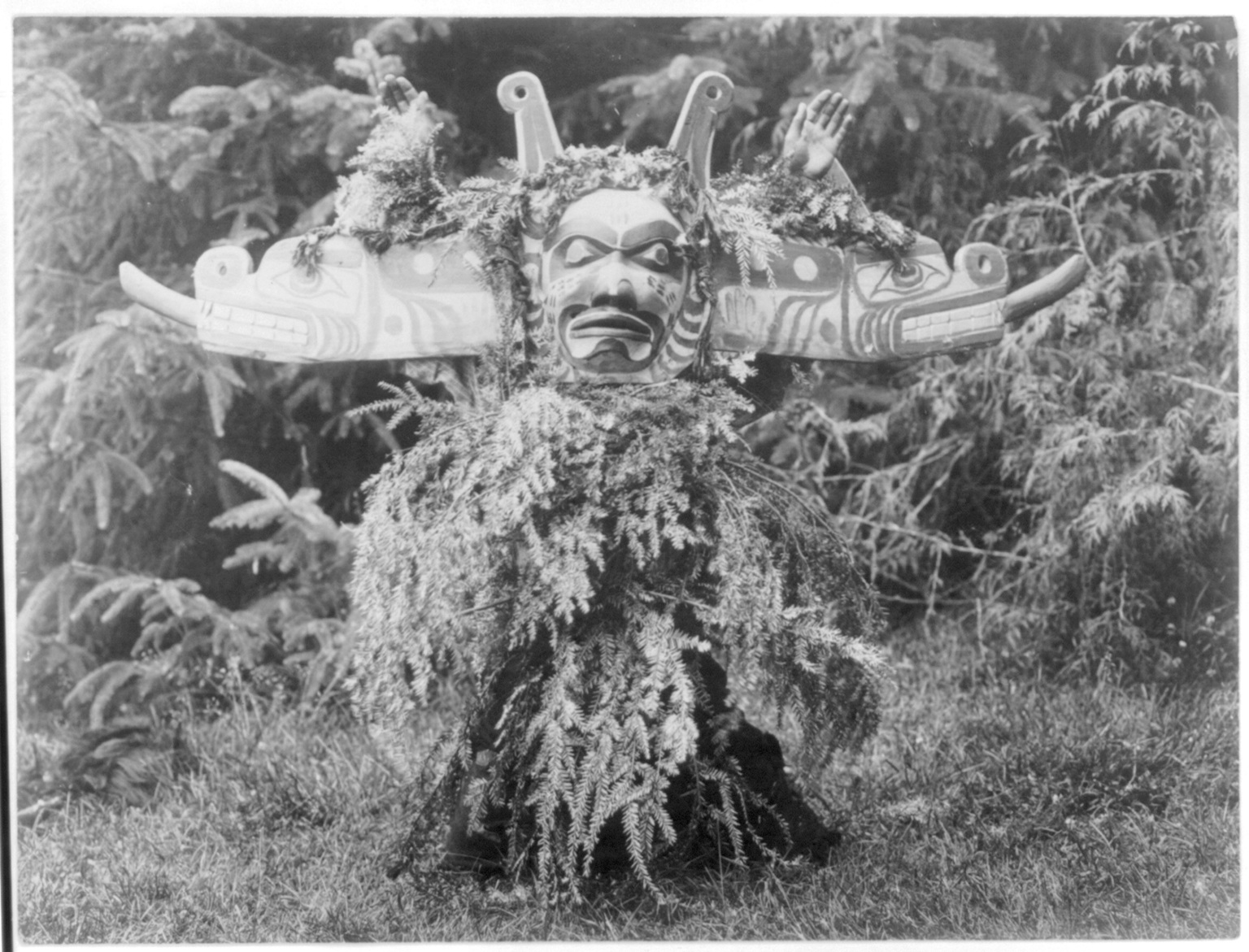
At midnight a party of men climbed onto the roofs of a Koskimo village on Quatsino Sound, at the north-western end of Vancouver Island in British Columbia, Canada, and whirled wooden blades on cords. The roar was the voice of Winalagilis, the warrior spirit of the far north, coming to carry off another novice. Four times it sounded. Then a young man shouted from the forest, and in the morning his blanket lay outside a house, where his father said the spirit had taken him.
On the Kwakwaka'wakw coast a spirit's voice was inherited property. The whistles packed in a marriage box and the whirring sticks on the Koskimo roofs sounded powers that passed by marriage and by capture, and whoever held a dance held the voice that called it into the house.
In brief
- At Koskimo, men whirled sticks on the roofs at midnight as the voice of Winalagilis come for a novice; Boas lists the five dances the sticks served.
- The general Kwakiutl winter ceremonial stages the same arrival with whistles, which "represent the voices of the spirits"; each dance had its own set, known by its tone.
- A dance came to a son-in-law in a box of badges and whistles, hidden as it changed hands, and the Koskimo Shamans' dances, the Cannibal dance among them, had come from the Wikeno through a marriage.
- A dance taken by killing its owner passed the same way: a Matilpe youth who found the dead man's whistles "had the right to use the dance."
- The painted room of the Hawinalal war dancer sets a bent-kneed squatter beside a double-headed serpent arched over the door, a pairing strikingly close to the ancestor figures Andreas Lommel traced around the Pacific.
- Where the dances lapsed, the roarer stayed in the village as a toy: at Fort Rupert, among the Wikeno and the Heiltsuk, at Massett and among the Quinault.

Winalagilis comes over the roofs
Franz Boas published the Koskimo night in 1897, in the great account of the Kwakiutl winter ceremonial he built with George Hunt of Fort Rupert, on the north-east coast of the same island:
“About midnight of this day a number of men secretly climb the roofs of the houses of the village and begin to whirl the ‘whirring sticks.’ The noise of these sticks is supposed to be the voice of Hai'alilaqas or Winalagilis, who comes to take away another novice. This noise is repeated four times, each time for about ten minutes. Then the people must sing their secret songs in the houses.
“When the noise stops, a hamatsa is heard to shout in the bush, and on the next morning a blanket is found in front of one of the houses. The people gather around it and try to discover whose blanket it is. After they have ascertained the owner of the blanket, they say, ‘It was certainly he whom we heard in the woods,’ and his father adds that Hai'alilaqas probably came and has taken his son to Baxbakualanuxsiwae. The people request him to clean his house and prepare for the return of the novice.”
Boas, 1897, p. 610
Winalagilis was a traveller. “He is a warrior and lives in the far north. He travels about constantly and never leaves his canoe.” He made war all over the earth, and he gave each of his chosen a different gift: to one the command of Sisiutl, the double-headed serpent that fights beside its master; to another the disease-spirit in the form of a worm, to be caught and thrown; to a third a body that wounds could not hurt and weapons could not kill. A footnote to the rooftop scene names the dances the whirring sticks served: “These are used for the hamatsa, mamaqa, hai'alikala, toXuit, and hawinalal. The kelp trumpets are used for the lololalal only.” Three of those five, the ToXuit, the Mamaqa and the Hawinalal, are the three gifts of Winalagilis. Boas, p. 394; p. 610, note 2.
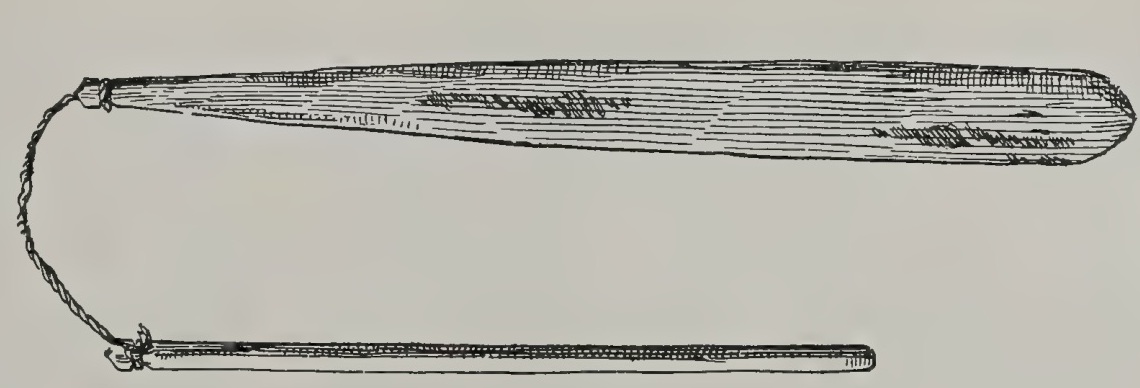
Elsewhere in the Kwakiutl winter ceremonial the same spirit arrives by the same road, and his voice is a whistle. The master of ceremonies has ordered everyone to bathe early each morning for four days, before the crows begin to cry, to prepare to meet Winalagilis:
“At this time the winter-dance whistles are heard for the first time. These whistles represent the voices of the spirits of the winter dance. When first heard, they appear to be far away from the house in a northerly direction. The second time they come nearer the house, and thus they are heard four times, nearer and nearer. This indicates that the spirit approaches the village from the north.
“Finally, the whistles of the spirit of the cannibal society are heard near the house. Then the sound is heard on the roof and moves around it four times. At this time the son of the man who gives the festival suddenly disappears, and a few minutes later he is heard to cry in the woods ‘hap, hap, hap,’ the sound which is ascribed to the cannibal spirit Baxbakualanuxsiwae.”
Boas, 1897, pp. 502–503
Four approaches, a sound on the roof, a young man gone into the woods crying the spirit's cry: the whistle night and the whirring-stick night are one event in two instruments. Boas says it again of the Hamatsa's own dances: “whistles are heard, which represent the voices of the spirits.” Those voices were never interchangeable. Philip Drucker's consultants on this coast, in 1936 and 1937, knew more kinds of whistle than they could list, “for each individual dance had its own set, distinguishable by tone or decoration.” Boas, p. 446; Drucker, 1950, p. 268. · archived
The people put on winter names
When the spirits came down for the winter, the village took itself apart and put itself back together around them. Boas describes the change as a complete rebuilding:
“The number of spirits is limited, and the same one appeared to ancestors of various clans of different tribes. But in these cases he gave each of his protégés his powers in a slightly different form. In fact each name of the nobility … has a separate tradition of the acquisition of supernatural powers, and these have descended upon the bearers of the name.… Therefore, from the moment when the spirits are supposed to be present, all the summer names are dropped, and the members of the nobility take their winter names.”
Boas, 1897, p. 418
Clans gave way to societies, each made of the people whom one spirit had initiated. The seats in a society were counted. “These ancestors have each only one representative at a time,” and so “a new member of a society can be admitted only when another one is dropped, whose place he then takes.” The old member handed his rights to a young man and stepped out of the ranks. A novice carried off by Winalagilis was going to sit in one of those numbered places, the seat of one ancestor who had met one spirit, and the whistle or the whirring stick that fetched him was that ancestor's spirit calling for his new representative. Boas, p. 419.
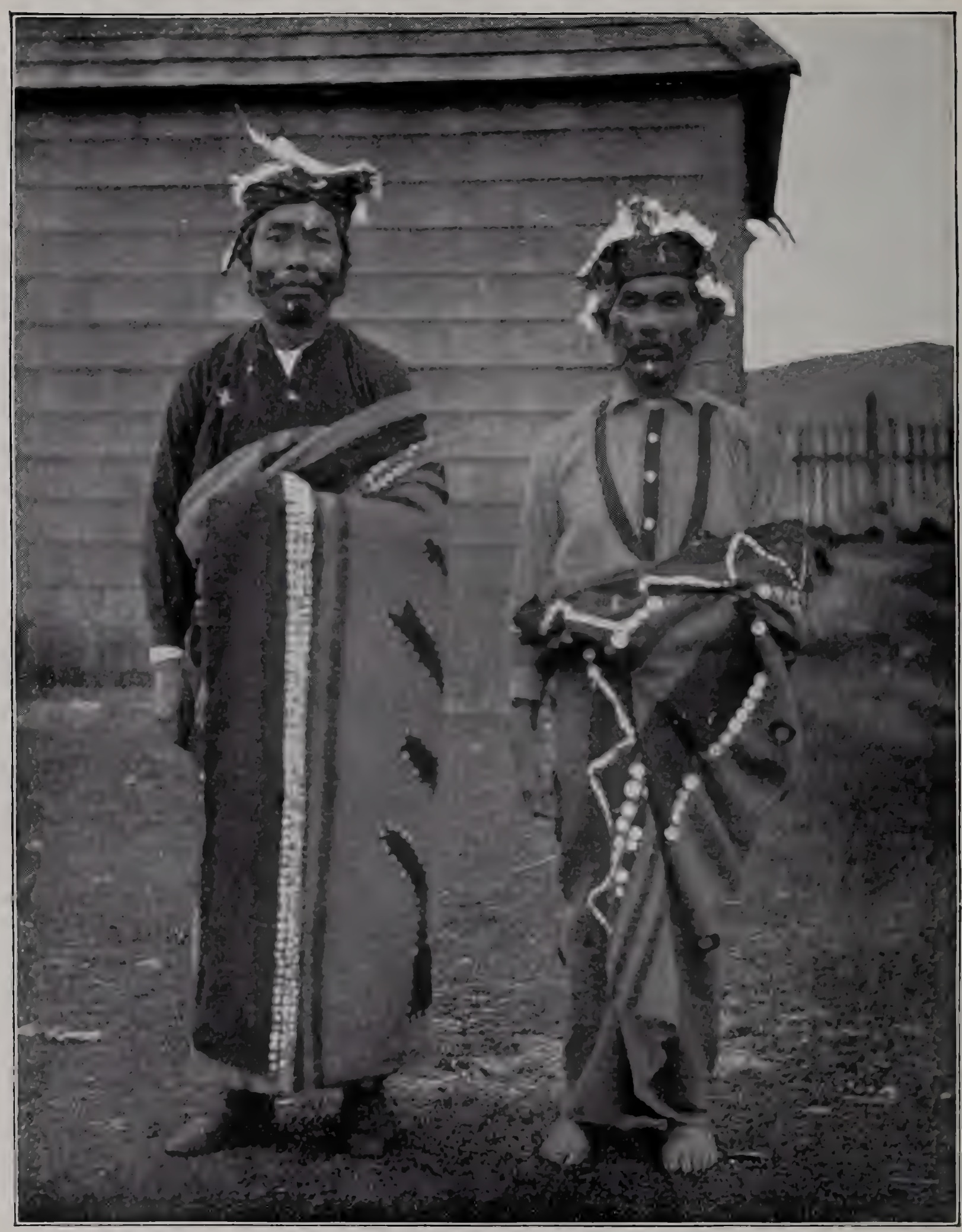
Around the dancers stood a second set of inherited offices. The master of ceremonies, the drummers, the men with the batons and the sprinkler of eagle down held their places in the male line, father to son. These were the people who called the company together, sent for the singing master, and stood on the beach when a son-in-law came down to receive his father-in-law's box. Boas, p. 431.
A bride brings a dance
The winter ceremonial was a wedding debt being paid. “Generally it is connected with the refund of the purchase money for a wife,” Boas writes, and the man who gives it tells his father-in-law that he “wants to have the box containing his father-in-law's dance” (pp. 500–501). A young man received his father-in-law's house, carvings and names through his wife, and with them a dance he would not perform himself:
“Together with the house, the carvings, and names of the father-in-law, the young man obtains his dance name and que'qutsa name, but not for his own use. They are given to his successor (Lawu'lqame), who is initiated in the prescribed way and then performs the ceremony. But the son-in-law of the former owner controls the dance. It can be shown only with his consent…”
Boas, 1897, p. 421
He could pass that control on again through his own daughter's marriage. The repayment itself filled a beach. The father-in-law's clan set old ceremonial box lids in a square about a hundred feet on a side:
“This is called the canoe (ma'wa), and all the property that is to be given to the son-in-law is placed in this inclosure. From one or two corners of this ‘canoe’ cedar bark ropes are stretched to the front corners of the young man's house. All the spoons and dishes which the father-in-law is going to give away are tied to them. They are called the anchor line of the canoe.… Then the wife of the son-in-law steps out of the canoe dressed in her best. She wears a blanket set with abalone shells. A large abalone shell is fastened to her nose by strings which pass over her ears, as the shell is too heavy to be worn suspended from the septum.… She performs a dance, after which her ornaments are given to her husband.”
Boas, 1897, p. 422
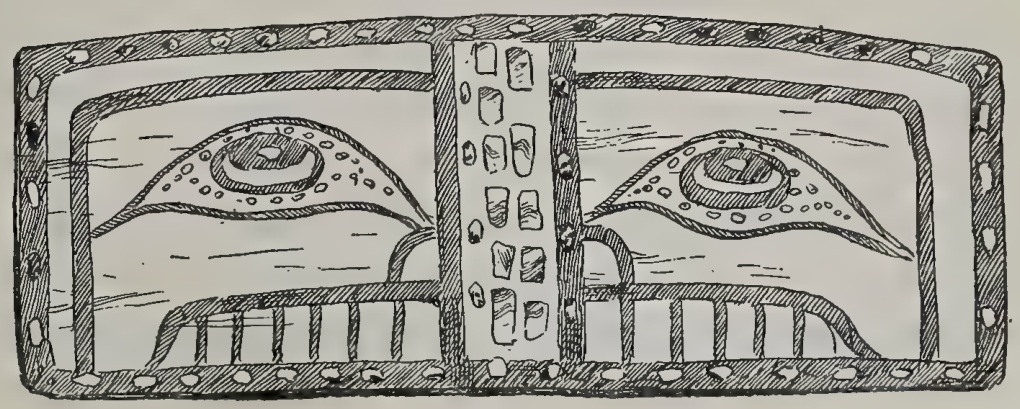
The speaker named each gift and held up sticks to stand for the blankets, the grease and the food. Then he came to the box with the voices in it:
“Then the speaker takes up a box in which the badges and whistles of the winter dance are tied up. The box must be hidden under the blanket, because it is baxus season and nobody must see it. He says: ‘Come, son-in-law, and take my box.’ The young man takes it and hides it at once under his blanket, saying: ‘I shall hide this. Thank you.’ He carries it to his house at once.”
Boas, 1897, p. 423
His friends slipped round behind the houses to the end of the village, rushed down on the canoe and split a corner lid with an axe, while the society members in the house cried out their winter cries in the profane season. This was “sinking the canoe,” and the next day the young man gave the whole cargo away to the tribe. A song of joy went up: “Wealth is rolling down to him from the great chiefs.” Boas, pp. 423–424.
In winter the same box changed hands again. The father-in-law pointed it out to the master of ceremonies: “I am afraid of this box here; you are the only one who is not afraid of it, because you went through the whole ceremonies of the winter dances.” The master lifted it under his blanket, singing “O friend, O supernatural friend,” gave the son-in-law the winter names that belonged to its contents, hung the neck ring on him, and handed over the box. Last came the words “I have seen what carried away our son,” and the voice itself: “With this he secretly puts a whistle into the hand of the son-in-law.” Boas, pp. 518–519.
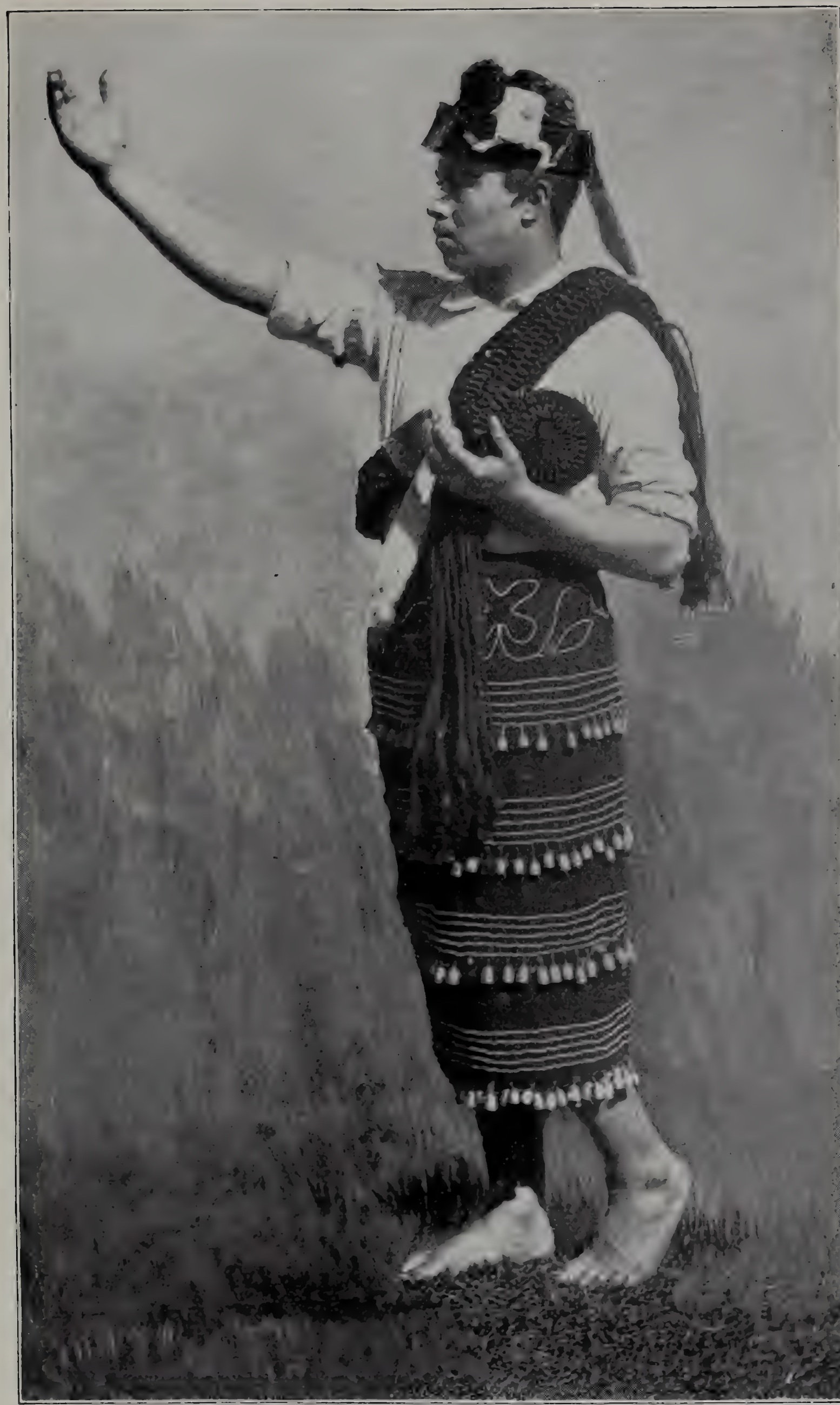
Marriages moved dances up and down the coast, and the voices went with them. Boas writes that marriages with the Wikeno of Rivers Inlet and the Heiltsuk, both on the central mainland coast of British Columbia, had increased the number of Kwakiutl dances. At Koskimo, Quatsino Sam told Drucker how his own people's Shamans' series had come: “The right to use the dances, masks, names, and so forth, came from the Wikeno in a marriage five or six generations before the informant's time.” The Cannibal dance was one of them, the dance the whirring sticks announced from the roofs. On the west side of Vancouver Island, among the Hupacasath at the head of Alberni Inlet, the roarer arrived the same way. Drucker's consultant counted the instrument a recent thing, because “the Wolf Dance (Loqwana) was fairly recent among his people, having been introduced since they became Nootkanized four or five generations ago.” Boas, p. 421; Drucker, 1940, p. 219 · archived; 1950, p. 268. · archived
Hex'hak'en opens his box
There was one other way to get a dance. “It is said that many dances were introduced among the Kwakiutl and related tribes in this manner,” Boas writes: by killing the owner. The Matilpe, another Kwakwaka'wakw people, had no Hamatsa, and their neighbours would not let them marry into one. Two Matilpe youths saw a northern canoe pass with four men and two women in it, one of the men wearing the Hamatsa's badges. They borrowed the strangers' guns on a pretext and shot all six.
“One of the youths took the cedar bark ornaments of the hamatsa. He found his whistles in a bag. At once he began to utter the hamatsa's cry ‘hap, hap,’ for now he had the right to use the dance owned by the man whom he had killed.”
Boas, 1897, p. 424
In the summer of 1895 George Hunt was walking down the street of the Nimkish village at Alert Bay, on the north-east coast of Vancouver Island, when old Hex'hak'en called to him from his summer seat. “Your days, young men, are good. But our past ways were evil when we were all at war against each other.” He had been pursued three times by northern raiders. Once, after outrunning their canoes, he had paddled back by night to the island where they had landed, crept up to their fire while they were eating, and fired buckshot into the line of them with his companion. They killed the men who did not run and took one man and four women as slaves.
“We took the property of the northern people. I looked into a large box, and when I opened it I saw much red cedar bark and abalone shells which were attached to it, and whistles of a hamatsa. I asked one of the women: ‘What is that in this box?’ She only replied: ‘Hom, hom, hom, hom, hom, ham, ham, ham, hu, hu,’ and she bit her own arm. Then I knew that one of these men whom we shot had been a hamatsa. I cried hap right away.”
Boas, 1897, p. 425
At home the chiefs heard the story and told him to show what he had brought in the coming winter, and to tell it whenever anyone asked where the Nimkish had got these dances. They sent every young man out of the house. Six chiefs stayed. Hex'hak'en bolted the door, put the cedar-bark ring around his neck and the other on his head, held up the whistles, and cried as the Hamatsa cries:
“Now look at me, Nimkish chiefs. This cedar bark ornament I obtained by killing its owner. Therefore you must not say anything against me. Examine it closely, else you will say later on when I give my winter dance that I invented it.”
“Then L'aqolas said: ‘Chief, what can we say against you since you killed these men? You have obtained this ornament from the man whom you have killed, therefore it is called obtained by killing. It is the same as though you had obtained your hamatsa through marriage. Now go on and give a winter dance. Why should we not do it in the right way?’ Then my brother's son disappeared right away, and when he came back in winter he was my hamatsa.”
Boas, 1897, p. 426
The box was the right. Killing and marriage were two roads to the same possession, and the chiefs who examined it ruled them equal. What they inspected behind the bolted door was cedar bark and the whistles, the spirit's voice, held up before them while Hex'hak'en cried the Hamatsa's cry. The Nimkish had the roarer too: in 1900 Boas collected from them a bullroarer with two blades, one half the size of the other. Boas, pp. 425–426; Keddie, 2023.
The warrior who could not stop
The last of the dances whose origin is ascribed to Winalagilis was the Hawinalal, the war dance, and its story belonged to the Maamtagila, whose country lies along Johnstone Strait between Vancouver Island and the British Columbia mainland:
“In the beginning of the world there was a man named Winaxwinagim, who was a great warrior. He wanted to go on war expeditions all the time. The people who desired to have peace tied him with strong ropes. He, however, broke them without difficulty. He held a knife in his hands, the handle of which represented the sisiutl, and ran out of the house, and killed everybody who set his foot on the street. The blood ran in streams down to the water.
“The people finally took hold of him again, cut holes through his thighs and through his back, and pulled ropes through them. Thus they hung him onto the beam of the house and began to sing songs which they hoped would appease him. While he was swinging from the beam he still held his knife, and as he could not cut anyone else, he cut his own head. His wounds did not hurt him; on the contrary, he enjoyed them. After a while he became quiet. Then they took him down. Later on, whenever he came back from war, he asked the people to pull ropes through his back and to haul him up to the roof.”
Boas, 1897, p. 495
They tied a Sisiutl carving to his back, ran a heavy rope from the beach to the roof of his house, hauled him up, carried him around the roof and let him down again. “The performance of the hawinalal is a repetition of the deeds of this man.” The novice fasted in the woods until he was thin and came back in hemlock, with small wooden slabs carved like paddles sewn along his arms and legs, across his chest and down his sides. A rope of red cedar bark ran from the roof of the dancing house to the beach. No one could walk under it, and a canoe that passed in front of it was seized, carried into the house and slung from the beams for four days. Boas, p. 496.
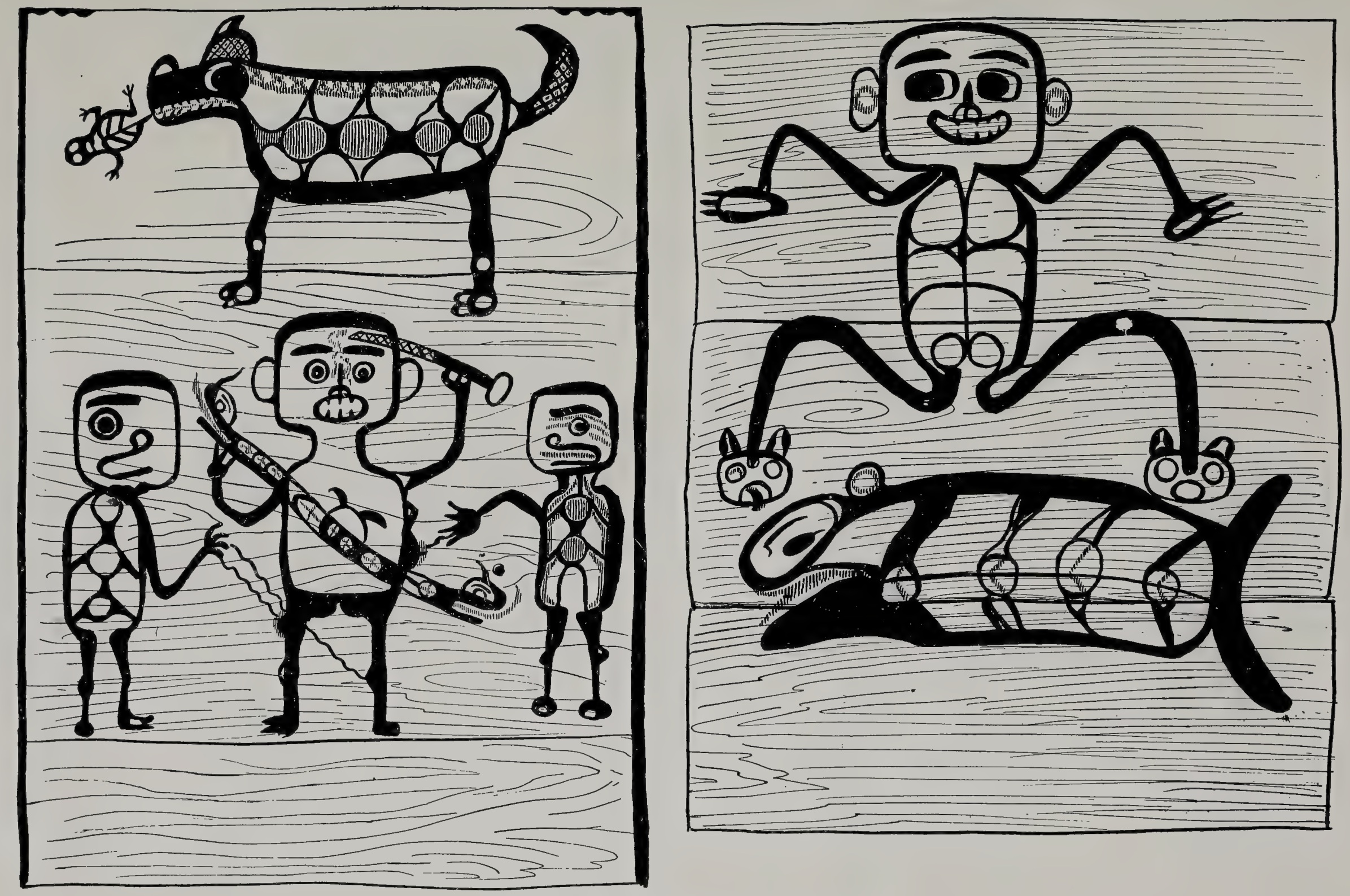
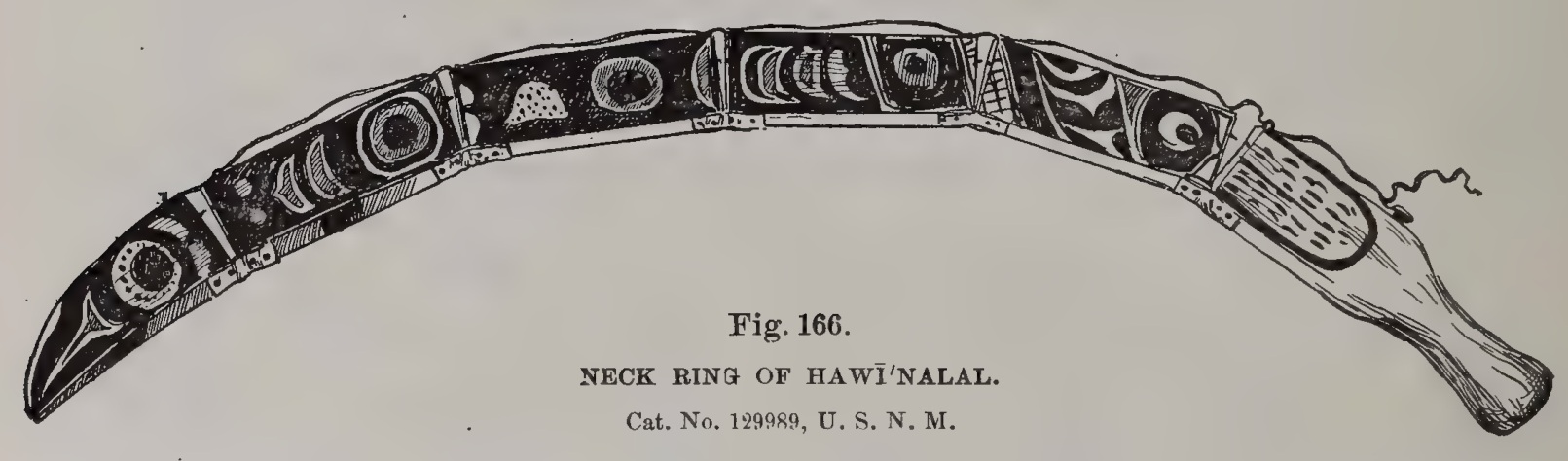
In the house his legs and back were cut and ropes drawn through the holes, held by two men. He pulled against them until his flesh stood far out from his body, stretched his arms backward crying “ai, ai!” for his leader to pull harder, then pointed upward with his first fingers and cried again: “Hang me to the beam!” He wore Sisiutl as a neck ring, jointed and hinged with leather, with a string along the joints; when the string was pulled the ring went straight and became the sword or lance he cut himself with. His belt carried the serpent's heads, and so did the knife in his hand. At last he tore his flesh with one jerk so that the ropes fell away, and vanished into his room at the back of the house. Boas, pp. 496–497.
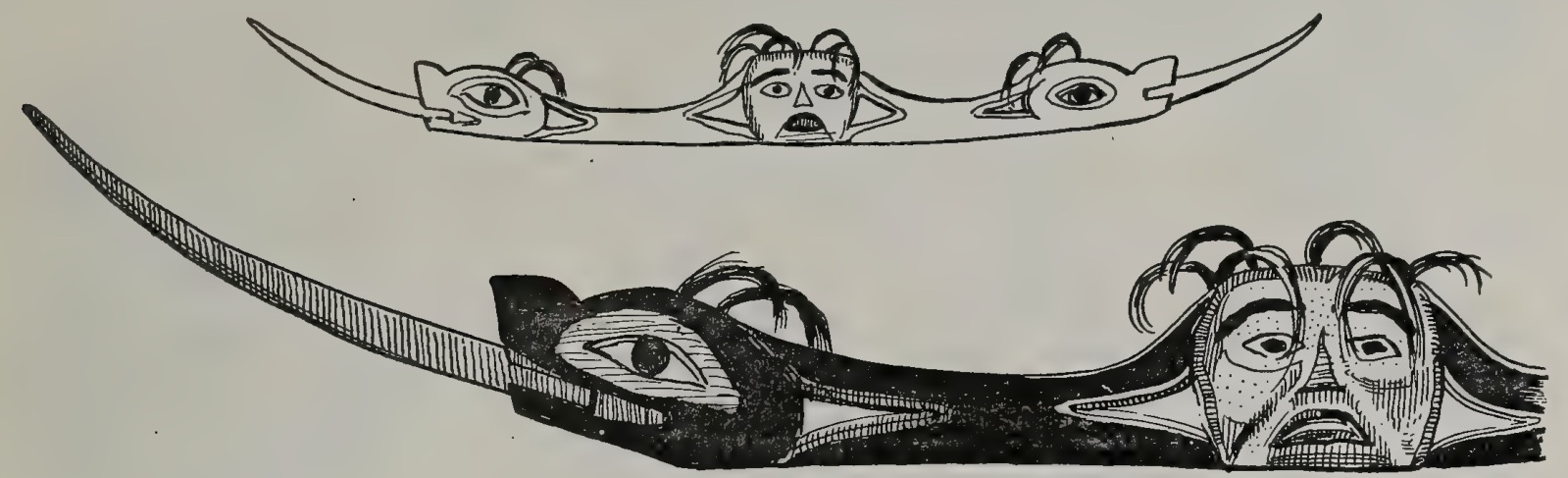
The man squatting over a whale
Boas printed the painted bedroom to show the Hawinalal's ropes. Its other wall carries a figure that turns up all around the Pacific. A man faces out of the plank with his arms bent at the elbows and his knees thrown wide, hands and feet splayed, and inside the outline of his body the painter has drawn a spine and a cage of ribs. Under him lies a whale patterned inside its own outline, and a small animal head sits at each of the man's feet. On the front of the same room, over the door, Sisiutl arches from one head to the other.
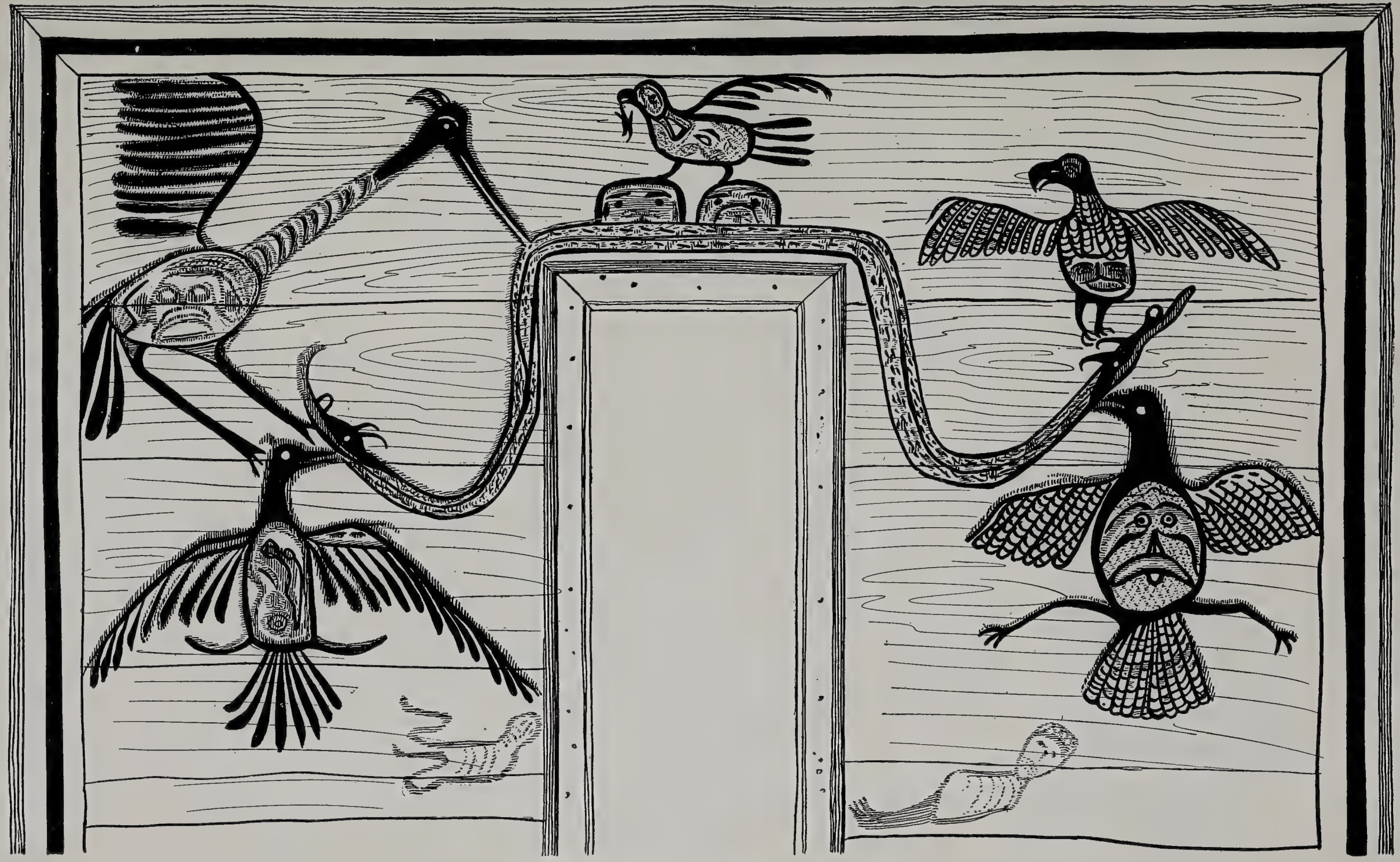
The posture has a name in the art-historical literature: the Hocker, the squatting figure. Andreas Lommel followed it in 1966 from Bronze Age China through Taiwan, Melanesia and Polynesia to New Guinea and northern Australia, and on around the rim of the ocean to the Americas. His case was that the posture travels with its meaning: as Vectors of Mind sums it up, “the figure functions similarly as a spirit ancestor across cultures.” Two of his plates could be captions for this room. A carved door panel from Taiwan shows “the ‘snake of heaven’ descending over the man's head and in the form of an arched snake with a head at both ends … and, above all, the ‘bent-knees’ ancestor figure of Polynesian type in the centre.” A painted board from Gaua in the Banks Islands of Vanuatu is “a classic squatting figure”: “The stylised ribs, which have merged with the vertebrae all the way down the spine, indicate that the picture represents the spirit of a dead ancestor.”
The Kwakwaka'wakw room holds both of Lommel's marks together: the double-headed serpent arched over the doorway and the bent-kneed man with his spine showing through. The comparison is strikingly close, and it sits where Lommel's reading says it should, among ancestors. Every power danced in this house was an ancestor's encounter with a spirit, held by the one living person who occupied his seat. The squatter keeps company with the bullroarer elsewhere on Lommel's map. In the Gulf of Papua, in Papua New Guinea, squatting figures are engraved on the roarers themselves, and near Broome in north-western Australia a long Yawuru board carries bent arms and spread knees among its spirals. In the Kwakwaka'wakw room the squatter is painted beside the Hawinalal, the swallowing wolf and the arched Sisiutl, in the dance world the whirring sticks announced. Boas, plates 40–41.
The serpent rises through the floor
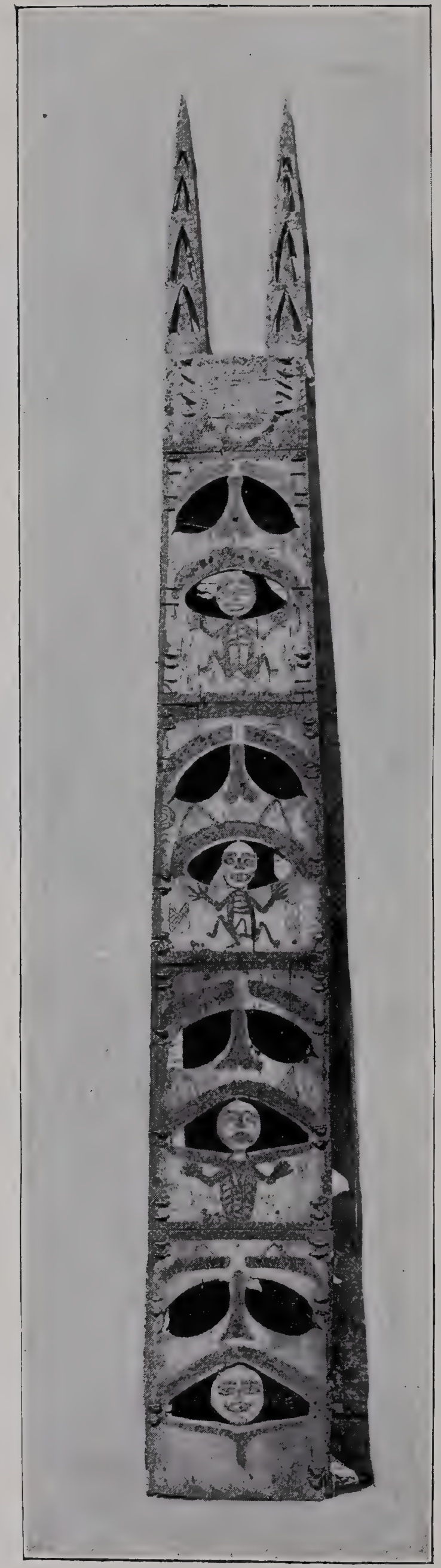
The other two gifts of Winalagilis on the whirring-stick list were serpent shows too. The Mamaqa caught the disease-spirit and threw it. His worm, which grew and shrank in his hands, “is either a small carved sisiutl, or snake, or it is a stick which is covered with bark,” made to telescope; a second worm flew along a line worked by men out of sight. He seemed to swallow the sickness, collapsed, and brought the worm up again with blood. Revived, he threw it into the people, who ran to the fire and fell lifeless until he or a shaman restored them. At the end of the season he paid each of them in blankets. Boas, pp. 485–486.
“The toXuit is almost always danced by women,” Boas writes. “Her spirit is in most cases the sisiutl, and him she is conjuring.” She circled the house four times and a huge serpent came up out of the floor at the back, horns and tongues moving, worked by lines or by men under the boards. Other ToXuit dancers called up birds, or a small jointed human figure, through the same floor. Boas, pp. 487–492.
The Koskimo return from the Wolves
The Koskimo kept a second winter series alongside the Shamans' dances, the nulam, and its roarer is the one Drucker's table records as ceremonial. Its first dancer had been carried off to the home of the Wolves, “to return after four years with the ritual and all the paraphernalia.” The nulam could be held in any season. The beating of a wooden drum and a whirring noise told the village that supernatural beings had come. Everyone put on a headband of undyed cedar bark and gathered in the chief's house. The future novices danced from house to house through the village while the rest marched chanting, out to a place in the woods, where four cries of “wia” went up and the novices vanished, “going to the house of the Wolves.”
The village sang the first Wolf dancer's songs to bring them back. On the fourth morning they came out of the bush singing, dressed in branches, and each showed by a gesture or an object the dance the Wolves had given him. One carried a Feathered Serpent; one a spear carved as a serpent with a hundred small heads hanging from it; one was carried from the woods on the back of a huge Wolf, borne by four men. A potlatch announced their new names, and their branch clothing was burned. Drucker, 1940, pp. 219–220 · archived; 1950, p. 268. · archived
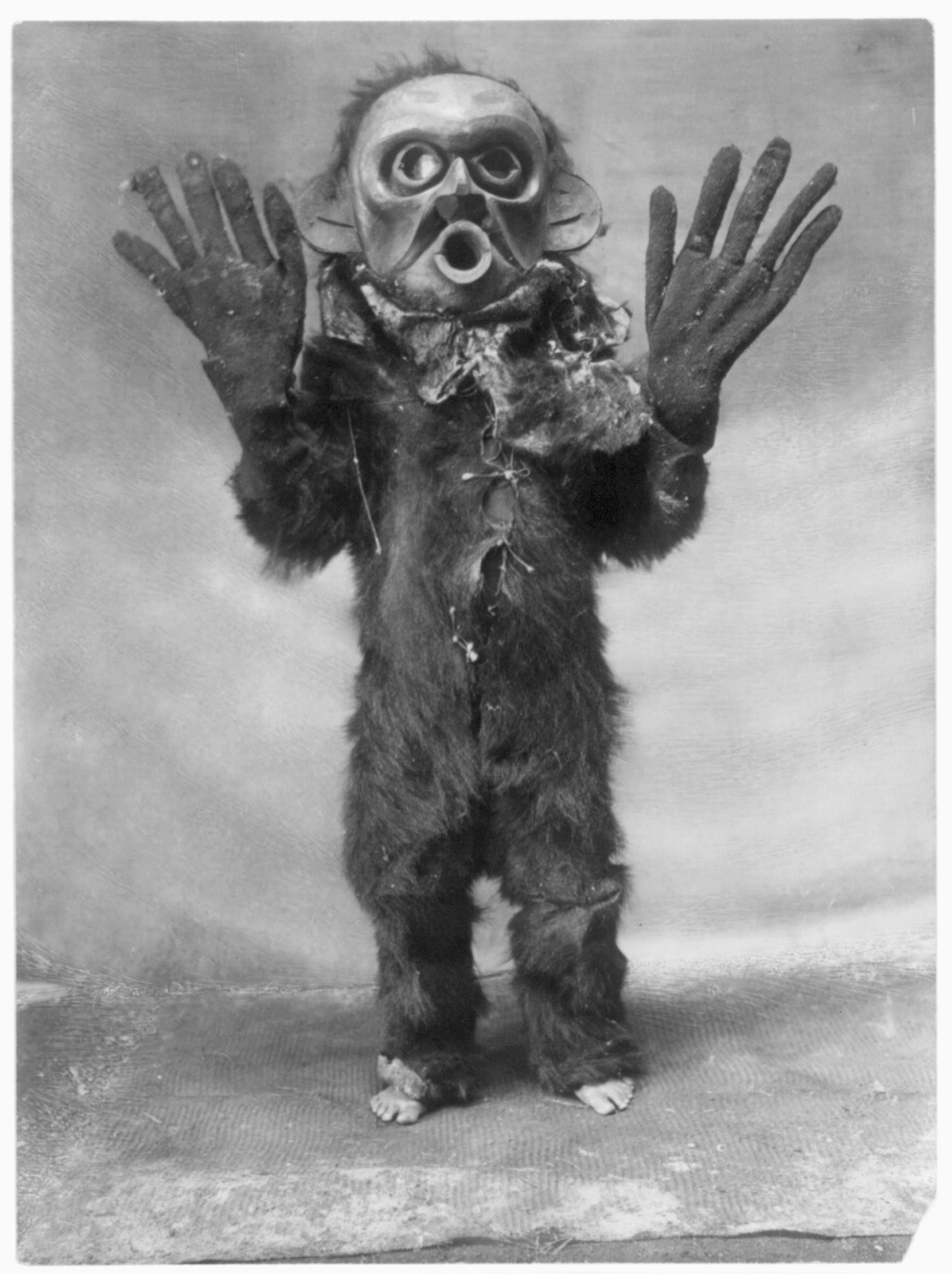
Some of the Wolves' gifts went straight into the audience. Four of the dancers were the Laughing Spirit, the Sleep Spirit, the Mosquito that scratches, and the Spirit of scuffling play:
“In these last four performances … the ‘spirit’ (i.e., dancer) pantomimes the action he is supposed to control. Then he makes a supernatural sound, and ‘throws it’ (the action) to four hereditary dance officials seated by the fire. These four immediately fall to performing the act (laughing, sleeping, scratching, or scuffling), then repeat the dancer's cry, and throw it to the spectators, all of whom begin to do it. The act is returned to the spirit via the four intermediaries.”
Drucker, 1940, p. 220 · archived
A whole house falls to laughing because one man owns the Laughing Spirit, and the laughter travels out from him along a fixed road through four men who hold their seats by inheritance, and comes home to him the same way.
Where the roarer became a toy
Drucker found the Quatsino people, the Koskimo among them, “culturally the best preserved of any of the groups worked in the present survey.” Their roarer was still the voice of the nulam. Across the island at Fort Rupert, Charley Nowell, a man who had collected the ceremonial history of his own people for his own interest, told Drucker that the Kweeha bullroarer was a toy. Fort Rupert had folded all its dances into a single Shamans' series, and Drucker found nothing there that differed markedly from Boas's account, in which the arriving spirit circles the roof as a whistle. The whistles kept the voice. The roarer went to play. Drucker, 1950, pp. 161, 199 · archived; 1940, p. 220. · archived
Up the mainland the pattern holds wherever the old life had thinned. The Wikeno, who had given the Koskimo their Shamans' dances, were a dwindling people by the 1930s, and their roarer was a toy. The Heiltsuk at Bella Bella had lived under missionaries for sixty years and had danced no dance for well over fifty; the bullroarer was still in the village, as a plaything. At Klemtu, farther up the coast, the old culture had been only a memory for many years, and the roarer was a plaything there too. On Haida Gwaii, Canada, the roarer at Skedans still sounded behind the painted screen at potlatches, while at Massett it had gone to play. Down the west coast of Vancouver Island the Clayoquot kept theirs in the Wolf Dance. South of the border, on the Washington coast of the United States, “the Quinault also have the instrument, but only as a toy”; their spirits spoke through rattles. Drucker, 1950, pp. 161, 199, 268 · archived; Loeb, 1929, p. 274. · archived
The instrument was the same handled slat from Haida Gwaii to Vancouver Island. What changed was whether a dance still stood behind it. Where an owner still held the dance, the roar was a spirit taking a novice; where the dance had lapsed, or a whistle or a rattle had taken over its voice, the blade stayed on in the village as a toy. That is the gradient Grandfather and Mother follows from Gippsland in south-eastern Australia to the Bandiagara escarpment in Mali, from the named forebear in a working cult to the plaything in the child's fist. The Koskimo blade itself made the journey. The stick Boas printed in 1897 as the Koskimo whirring stick is catalogued today in Berlin as a children's toy.
The cedar rings pass on
The Koskimo winter ended the way it had begun, with something bursting in from outside. On the last night the host asked who would keep the red cedar bark until the next year. No one answered.
“All of a sudden the door is opened and about twenty men rush into the house. They are covered with balsam pine branches, and blood is dripping from their bodies. They are called the Winalagilis or qumqumxde (land otters). They run around the fire and suddenly take the cedar bark rings from the heads of several men. They then leave the house again as suddenly as they entered. The men whose cedar bark rings they have taken will give a winter dance the following year. After this, the rest of the people take off their cedar bark ornaments, tie handkerchiefs around their heads, and begin to sing summer songs.”
Boas, 1897, p. 611
The men with bare heads owed the village a winter, and a winter meant a father-in-law's box, a son to be carried off, and the voice of Winalagilis on the roofs again. U'mista Cultural Centre, at Alert Bay, puts the obligation in a single line: “We must dance to show our history.” The guests at a potlatch are witnesses, paid for the work of witnessing. U'mista, “The History of the Potlatch Collection.” · archived
The right to roar was the right to a dance. It reached a son-in-law in a hidden box or a killer in a dead man's bag, and either way the proof of possession was the spirit's voice. Six chiefs behind a bolted door accepted Hex'hak'en's Hamatsa because he could show them its whistles and cry its cry. A Koskimo father could tell the village his son had been taken because the whirring sticks had sounded over the roofs that night, four times, for ten minutes each, while every house sang its secret songs.
Key sources
- Franz Boas, drawing extensively on George Hunt, The Social Organization and the Secret Societies of the Kwakiutl Indians, Report of the U.S. National Museum for 1895 (1897): p. 315, Hunt's contribution; p. 394, Winalagilis and his gifts; pp. 418–424, winter names, marriage transfers and acquisition by killing; pp. 425–426, Hex'hak'en's account to Hunt; p. 431, hereditary officers; p. 446, whistles as the voices of the spirits; pp. 485–497, serpent and war dances; pp. 500–503, the winter ceremonial and the approaching whistles; pp. 518–519, the winter transfer of the box; pp. 610–611 and p. 610 note 2, Koskimo whirring sticks and the season's end. Illustrations: plates 28, 39–42; figures 41, 166, 168, 189.
- Philip Drucker, Kwakiutl Dancing Societies · archived, Anthropological Records 2(6) (1940), pp. 201, 219–220: the Koskimo Shamans' series from the Wikeno, the nulam and its Wolves, the four spirits thrown through the hereditary officials, and Fort Rupert.
- Philip Drucker, Culture Element Distributions: XXVI, Northwest Coast · archived, Anthropological Records 9(3) (1950), pp. 157–165 (communities and consultants), 199 (elements 852–857) and 268 (notes on whistles and the bullroarer). Drucker's 1940 and 1950 accounts come from the same 1936–1937 survey.
- Edwin M. Loeb, Tribal Initiations and Secret Societies · archived (1929), p. 274: the Quinault toy.
- Andreas Lommel, Prehistoric and Primitive Man (1966), plate captions for the Taiwan door panel and the Gaua painting, quoted in Andrew Cutler, “Andreas Lommel and the squatters”, Vectors of Mind (14 May 2024); and “Archeologists vs Ancient Aliens”, Vectors of Mind, on the engraved roarers of the Gulf of Papua.
- Grant Keddie, “Bullroarers in the Indigenous Collections of the Royal B.C. Museum” (2023): the Nimkish two-bladed roarer collected by Boas in 1900.
- Ethnologisches Museum, Staatliche Museen zu Berlin, IV A 1488: the blade Boas printed as fig. 189.
- U'mista Cultural Centre, “The History of the Potlatch Collection” · archived: dance as history and guests as witnesses.
- Edward S. Curtis, “Sisiutl—Qagyuhl” · archived and “Hami—Koskimo” · archived (1914), Library of Congress.
- Ma'amtagila Nation, “Our Territory” · archived; British Columbia Assembly of First Nations, “Quatsino” · archived.